The steps my SEO pipeline runs before it publishes

I keep seeing posts saying Google bans AI content, but if you look into it more, that’s not really what it says.
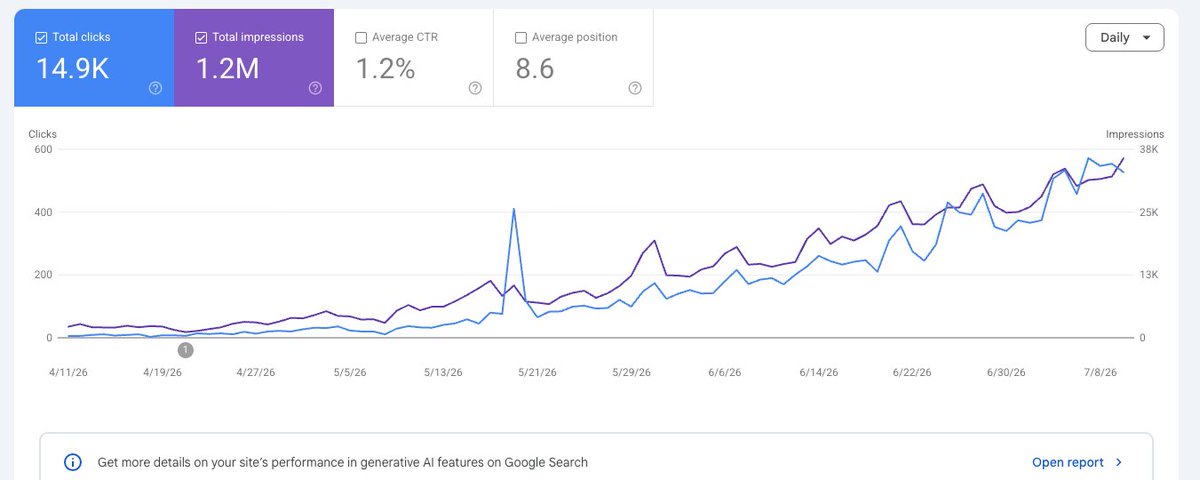
Google doesn’t care whether your content is written by AI. It cares whether the content is helpful, original, and written for people, not bots, crawlers, or other parts of Google’s algorithm.
The tool that writes the article was never the problem. The problem is that nobody checks what comes out of it.
I run an automated pipeline that writes and publishes blog posts for my apps. It’s not just a simple prompt that spits out an article and ships it.
It’s a multi-step pipeline with quality gates at every stage to make sure each blog post meets Google’s requirements: helpful, original, and written for people.
Here are the steps:
Step 1: Keyword research
Every article has to come from a keyword backlog, and the backlog is built in a separate research run. If the backlog is empty, the pipeline stops and tells me. It's not allowed to pick a nearby topic on its own just to keep publishing.
Step 2. Search intent
Once a keyword is picked, then before writing anything, the pipeline decides what the user actually wants.
Just so the article answers the user's intent instead of producing AI slop and stuffing the main keyword into the text several times.
Step 3. Product validation
Every statement about my app gets checked against a product definition file.
It contains:
The 2nd bit is important as LLMs needs a strict direction to limit their hallucination.
Step 4. Article structure
Then Claude writes a new article following this structure:
I’ve accumulated this structure by reading and distilling ideas from articles, posts, and comments here on X to come up with the best possible structure for both search engines and LLMs to index, rank, and cite.
Step 5. Two anti-slop passes
The first pass removes obvious AI patterns:
The second pass looks for subtler signals:
Again, AI can't make it 100% perfect and I can still hallucinate a bit but the result is still much better than without this step.
Step 6: Quality score and Revisions
Every article gets scored before publishing.
The biggest weights are:
It's pretty easy to get the title and meta description right, but that's not the most important part. The whole article has to read like it was written by a real person, or at least be as close to that as possible.
Once the content is scored and the score is high enough, the article is ready for publishing. Otherwise, it gets kicked back to Step 4.
Step 7. Publishing
After approval the pipeline:
That's it, the article is published.
For new websites I request a manual indexing via Google Search Console but for older websites new pages get indexed mostly within a day.
The ultimate goal isn't just to hide that the content is written by AI. It's to reduce as much AI-generated slop as possible and make the content genuinely higher quality.
I've been running this pipeline across a few websites. Not all of them have shown strong growth yet, either because they're too new (SEO is a long-term game) or because they're targeting niches with low search volume.
But I also have a few very promising candidates, which only proves that the pipeline is doing what it's supposed to do
So once again
and sooner or later you'll start seeing the results. 🚀
