Why Every Quant Edge That Prints Money Is Already Dying The Day You Find It

Every edge that has ever made money started dying the moment it was found, and the ones you can read about in papers or courses are already mostly spent

What kills an edge is not that it was fake, it is that it worked
Let's get right into it
But before reading
Bookmark this article and follow me @L1vsun for more Info
I am Erel, Quant Finance Researcher and Developer. Sharing information that I have learned in all my experience and found myself from various sources. Open for collabs and promo, Dm me
Every strategy anyone has ever sold you is the same thing underneath the branding, and it is not a machine and not a secret. It is a single fact: somewhere a price is predictably wrong, and you have a way to tell which way
That is the whole of it
The trouble is that the fact does not stay true, and the reason it stops being true is the most counterintuitive thing in this entire field. It stops being true because you traded on it
Chapter 1: An Edge Is Just A Price That Is Wrong, And You Are Not The Only One Who Can See It
The last article was about the leftover in a stock, the residual you are left holding after you hedge the market and the sector away, and how a whole style of fund trades it because it drifts from fair value and then gets pulled back
Real edge, real mechanism, and it ended on one uncomfortable line: that the edge decays, that it has been arbitraged away for two decades. This article is that line, opened up. Because the residual is not special here. Every edge that has ever existed behaves the same way, and the residual is just a clean example of it.
Here is the thing nobody tells you when they hand you a strategy. The moment you trade an edge, you begin destroying it. A mispricing is a gap between the price and where the price should be. When you buy the thing that is too cheap, your buying pushes it up toward fair
When you short the thing that is too rich, your selling pushes it down toward fair. Closing that gap is how you get paid, and closing that gap is the exact same motion as deleting the edge
You are not standing outside the mispricing collecting a toll
You are inside it, paying it down with every fill, and so is everyone else who found it.
And there is always everyone else. The data you used was sitting in front of a few hundred thousand other people. The method was in a paper, or a repo, or a thread someone screenshotted. Whatever you noticed, some slice of a very large crowd noticed too, and each of them is leaning on the same price in the same direction you are
An edge is not a thing you own and defend behind a wall. It is a shared resource being drained by everyone who can see it, and the more of them there are, the faster it runs dry

So the honest way to look at any strategy is never "does it work." It is "how much of it is left." A brand new edge that nobody is trading is a wide open gap and easy money
That same edge with a thousand funds stacked on it is a hairline that barely clears the cost of trading it. Nothing about the underlying idea changed between those two states. The only thing that changed is how many people are standing in the same spot, paying it down at the same time
Chapter 2: The Clock Starts When You Find It, And It Speeds Up When You Publish It
Every edge has a half-life, in the same way the residual from the last article had a half-life. There, the half-life measured how fast a stretched spread snapped back toward zero
Here it measures how fast the profit itself bleeds out as capital piles in
The mechanism is crowding
More money chasing the same signal corrects the mispricing faster and more completely, so the deviations get smaller, the snap-backs get quicker, and the money left on the table shrinks year over year until what remains is not worth the risk of reaching for it.
Someone actually measured this, and the numbers are brutal. In one of the cleanest studies in the field, two researchers took 97 published stock-market anomalies, essentially every documented edge in the academic record, and tracked what happened to each one after its paper came out
Two things showed up. The average edge was already about a quarter weaker just when tested on later data the original authors never touched, which is the overfitting shaking loose
And once the paper was actually published, once the edge was out in the open, the returns fell by more than half, around 58%
Publishing an edge is close to signing its death certificate
The same document that proves a strategy works is the document that teaches the whole world how to kill it.
There is a second, uglier reason so many edges die, which is that a lot of them were never alive. More than 300 market factors have been published, each with a clean backtest and a confident story, and when you account for how many thousands of combinations get tested in the hunt for them, most cannot clear the basic bar for a real discovery
A result that looks impressive at the usual threshold is often just the single luckiest pattern out of hundreds that somebody went digging through. So two different things are happening at once and they look identical from the outside
Real edges fade because the crowd arrives and competes them away
Fake edges "fade" because they were noise wearing the costume of a signal, and there was never anything there to begin with. Either way the backtest is gorgeous and the future is a letdown
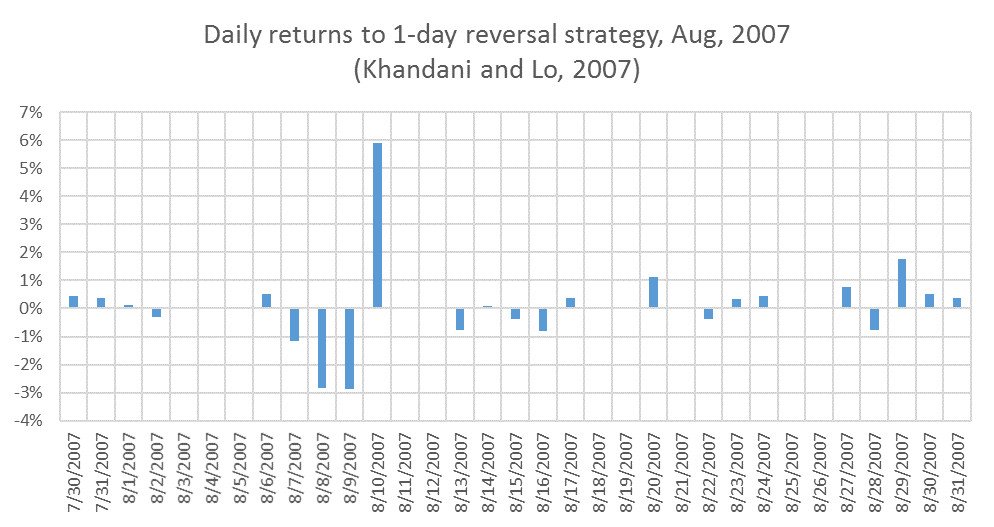
Crowding does not always erode an edge gently. Sometimes it snaps. Over a few days in August 2007, dozens of quant funds discovered they were all holding the same residual-reversion book, the precise trade from the last article, run at scale by nearly everyone at once
One large fund began unwinding its positions, and its selling shoved the crowded trade the wrong way, which slammed everyone else who was on it, who then had to unwind too, which shoved it further still
A strategy that had quietly printed for years lost money for several days in a row, violently, and then snapped back almost as fast once the forced selling burned out. Nothing was wrong with the signal itself. The problem was that everyone was standing on it, so the second one person jumped, the floor dropped out for all of them. A crowded edge is not merely a smaller edge. It is a far more fragile one
Chapter 3: How To Actually Use This As A Trader
You are not going to out-crowd a top quant fund from your kitchen, and that is not the point
The point is that once you accept that edges are born dying, the entire way you shop for strategies changes, and three things fall straight out of it.
First, stop hunting for the one permanent strategy, because it does not exist and the search itself is the trap
Every backtest you find in a paper, a course, a thread, or a video is by definition already public, which means the clock has been running on it since long before you read it
The published strategy is not a treasure map. It is a headstone with the dates already carved in. That does not mean ignore it. It means read it for the mechanism and assume the returns are mostly spent, because the returns are the part the crowd already took.
Second, the only durable edge is the rate at which you find new ones
The desks that survive for decades are not the ones that stumbled onto a magic signal and rode it forever, because no such signal exists. They are the ones that built a pipeline, a way to keep producing fresh edges as fast as the old ones die, so the basket of small fading edges never empties even though every single edge inside it is on its way out
The real skill is renewal, not discovery
Finding one edge is luck. Finding the next one, reliably, after this one dies, is the actual job.
Third, and this is the part almost nobody selling you a system will say out loud, capacity is the ceiling and it turns against size
An edge only absorbs so much money before your own buying moves the price and erases the very gap you were trading, and you become the crowd you were trying to beat
This is why the most successful fund in history caps its own size at around ten billion dollars and hands the profits back to its people every year instead of growing, because past a certain point the edge would simply eat itself. And here is the one piece of good news in the whole article, the flip side of that ceiling
You are small
You can trade edges that are far too tiny for a real fund to bother with, edges that stay alive precisely because no large pool of capital can fit inside them without destroying them. The thing that feels like your disadvantage, your size, is the one genuine moat you actually have

And here is the reframe to sit with
The strategy you are about to copy from somewhere did not stop working because someone lied to you. It stopped working because it worked, because working is the exact thing that summons the crowd that competes it away
The edges still printing money right now are, almost by definition, the ones nobody has written down yet, the ones too small or too strange or too new to have earned a paper
By the time an edge is clean enough and proven enough to reach you as a confident claim, its best years are the ones sitting in the backtest, behind it. The map is always drawn of the ground the treasure has already left.
None of this is a reason to quit, and none of the machinery is locked away either
You can watch the decay yourself
Take any published anomaly, run it on the years since its paper came out, and watch the edge shrink in your own spreadsheet this afternoon. You can see crowding in how tightly a trade has started moving with everyone else's. You can respect capacity by staying deliberately, almost stubbornly small
The barrier was never access to the strategies, because the strategies are everywhere and always have been. The barrier was understanding that a strategy everyone can see is a strategy already on its way out, and building for that truth instead of pretending it away.
If you want to go deeper, start with three sources:
Does Academic Research Destroy Stock Return Predictability? by McLean and Pontiff, the study that put hard numbers on all of this, 97 anomalies tracked before and after publication, with the average edge roughly halving once the paper was out.
...and the Cross-Section of Expected Returns by Harvey, Liu and Zhu, the audit of the whole "factor zoo," walking through why hundreds of published edges were mostly the byproduct of testing far too many things, and why an ordinary significant result is nowhere near good enough to trust.
Adaptive Markets by Andrew Lo, the frame that ties it all together: markets as an ecology where strategies are species, where competition drives the successful ones toward extinction, and where efficiency is not a fixed state but a moving one that punishes anything that stops adapting.
Read those and you will stop asking whether a strategy works, and start asking the only question that ever mattered, which is how long until it does not
Summary
An edge is just a price that is predictably wrong plus a way to see it, and the instant you trade it you start closing the gap that pays you, which is the same act as destroying the edge. You are never the only one who found it, so the whole crowd pays it down together, and the more crowded it becomes the smaller and the more fragile it gets.
Every edge has a half-life, measured in how fast the profit bleeds out as capital arrives
The research is blunt about it: published anomalies lose more than half their return once the paper is public, and many supposed edges were never real to begin with, just noise pulled out of testing thousands of patterns
Crowding can also snap instead of fade, the way it did in August 2007 when everyone on the same residual trade tried to leave through the same door at once.
So the play is never the one permanent strategy, because there is no such thing. The durable edge is the rate at which you find new ones as the old ones die, capacity is the ceiling that punishes size, and your smallness is the one real advantage you own
The strategy that reached you as a clean, confident, ten-year-backtested claim is exactly the one whose best years are already spent.
So here is the question to sit with. The next time someone hands you a strategy with a beautiful ten-year backtest, do not ask whether it worked, because the backtest already told you it did
Ask who else is holding it now, and how much of that decade is still in front of you rather than behind it
Because the honest answer is usually almost none, and the only edge worth having is the one you have not found yet.