I Reverse Engineered 1000s of AI Overviews: Here's Exactly How To Get Google To Cite YOU

Anyone telling you optimizing for AI Overviews is impossible or requires some sort of mysterious new marketing approach to "train the new Google" doesn't know what they are talking about.

And most SEOs are still following the old playbook, then hoping their sites (or worse, their clients sites) get visibility.
I don't do hope.
Over the last 12 months I've spent hours everyday tearing apart AI Overviews across the most competitive niches in our industry.
Using special anti-detect browsers with custom profiles setup and custom agentic workflows powering it all for me - Refreshing them, logged in/logged out, tracking every cited source, mapping what got pulled and what got ignored, how the outputs were structured, if they had elements like tables or even a code block, what entities or sentences were bolded etc etc... and cross-referencing it all against the underlying SERPs.
And here's the uncomfortable truth for everyone selling "GEO Services": AI Overviews are not that complicated.
They're a reading exercise with rules - And once you can see the rules, you stop guessing which pages get cited and start engineering it.
Yes, there's randomness built in by default.
Query fan-out sprays your one query into a ~dozen sub-queries. Token sampling means the same prompt cites slightly differently every time.
But randomness in the generation doesn't mean randomness in the selection. The pool of sources the machine is willing to cite for a given query is remarkably stable.
It's chosen by a logic you can reverse engineer the exact same way I've reverse engineered SERPs for 18 years.. Because underneath the AI wrapper, it IS a SERP - Same grounding index, same authority bias and an all too familiar consensus mechanic.
So let me show you exactly how I read an AI Overview, and then force it to cite whatever page I need it to...
Step One - Capturing, Tracking & Collecting
AI Overviews are inherently dynamic, and that means you need to collect as much sample data as possible.
That means the very first job is volume.
Load your target query in a clean profile (antidetect browser or at minimum incognito + geo-specific VPN, logged out), and refresh it 10-20+ times.
Then do it again logged in, then again on mobile using data.
You want AT LEAST ~30 different outputs across an array of testing.
You're not looking at any single output.
You're looking for what shows up every single time - Because that's the machine telling you what it considers non-negotiable for this query.
There is some caching happening, especially for larger queries -
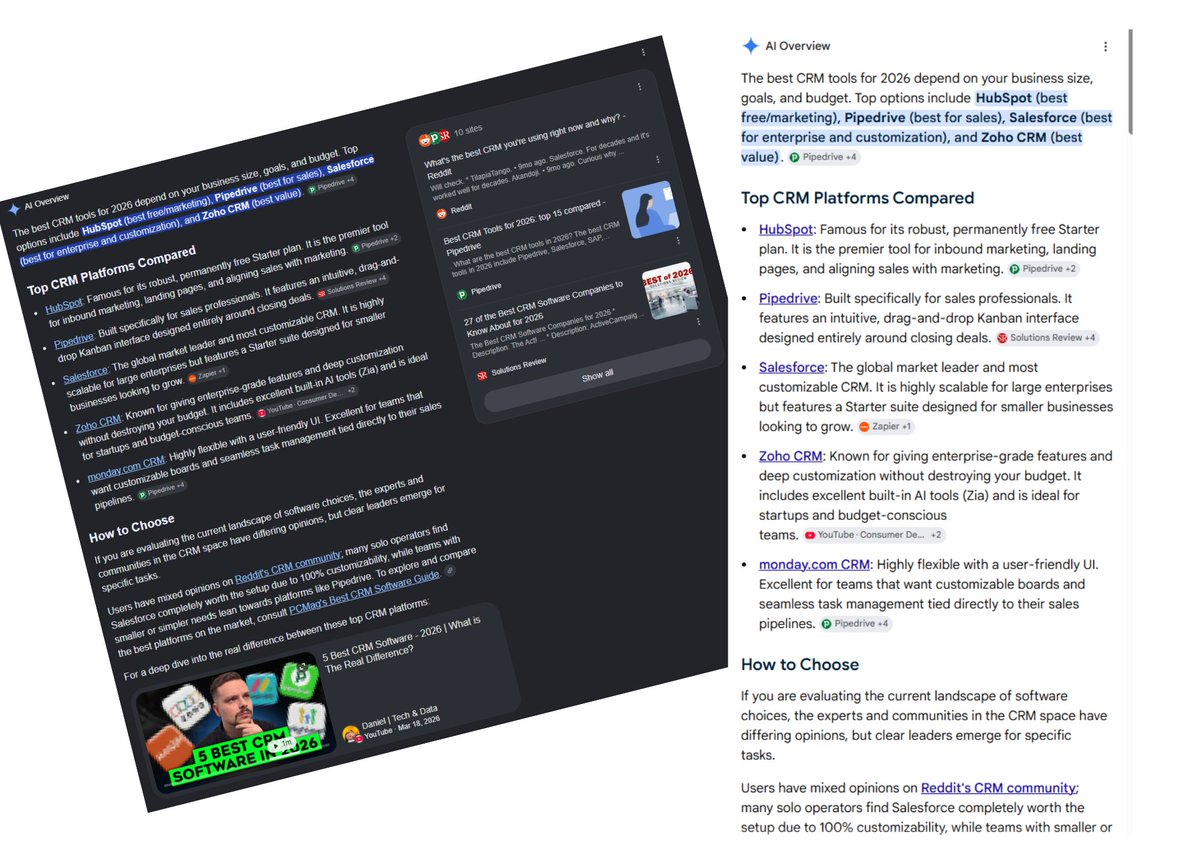
BUT, this is also where tracking over time works best.
If you can collect the above data over the course of several days or even weeks, you'll have a much better picture of how all the intertwined systems are building the final output.
Step Two - Building The Brief
Every single output you captured in Step One goes into one master document - There are levels to this, which is where time vs. ROI starts coming into account.
Do you have the time to just copy/paste or screenshot all of those outputs into the document? Or do you/a VA/agent have the time/setup to log every attribute necessary to get the most optimal end brief?
If it's the latter, then you're logging every attribute, every time:
But REMEMBER:
Being in the pool is not the same as being cited.
A source can be eligible every single time (Sitting in the candidate set the machine is drawing from) - But only actually appear in the output on half your captures, because that final selection has randomness baked in or the page has enough authority in retrieval + the traditional algo but not the right entities on page.
So you're sorting everything into two tiers:
Tier One: The Stable Core - Sources, claims, entities and formats that appear on EVERY capture.
This is the machine telling you what is structurally non-negotiable for this query. You do not get cited without satisfying this.
Tier Two: The Volatile Layer - Elements that appear on some captures but not others. Useful, lower priority, and often the difference between a source that's eligible and one that gets picked on any given roll.
By the time you've logged 30+ outputs, you should have a well formed shape of the current AIO - The same handful of sources keep surfacing, and the same phrasings, the same entities, the same structure repeat.
That repetition is the consensus.
And when an AIO bolds an entity or a phrase, it's showing you the tokens it weighted most heavily when it built the output for the end user.
That's a free salience map - The machine literally highlighting what it thinks the answer is about.
The internal AI system that I've built for this exact workflow gives me the end word cloud I'd need for the query "Best SEO Expert" -
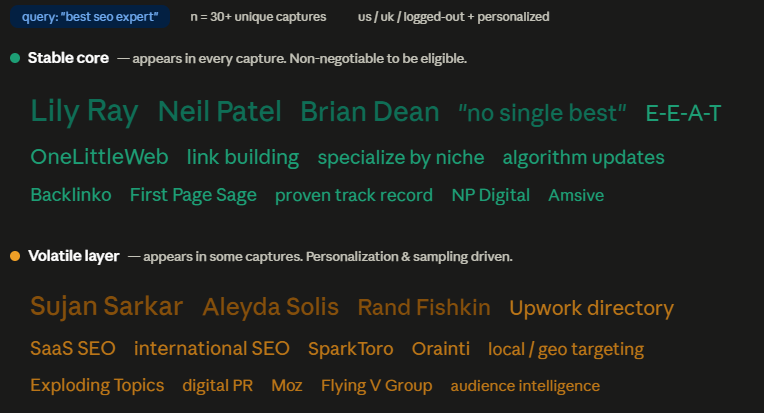
All of this is very similar to the mechanic for a traditional SERP and featured snippet, just surfaced directly inside the answer box instead of ten blue links below it.
Step Three - Tracing
Take every source in your Stable Core, open the actual page, and hunt down the exact passage the AIO lifted from - Or have an agent do it for you.
Just remember though, it's rarely one clean sentence.
The synthesis stitches spans together - You'll often find the cited claim is a fusion of two or three passages pulled from different parts of the same page, though often very close together, and sometimes across different sources entirely.
Don't go looking for one perfect matching paragraph and give up when it isn't there. You're tracing the raw material, not a copy-paste.
The AIO output side by side with the source page, highlighting the extracted span -

My page is the cited source almost all the time, and occasionally Google will even recommend to just go read my testing fully.
This is because I built the entities Google already wanted to see but forced my pick to the top, and added value that wasn't already there - I was the only written article to talk about using SpeedyIndex Telegram bot, reinforcing two video transcripts from James Dooley and Jacky Chou that were being cited.
Once you've found the extracts for EVERY source, the only question that matters is: what made THIS chunk so easy to pull? -
The machine is not rewarding the "best" content in any way a white hat would recognise the word. It's not grading expertise, effort or how beautifully written the page is.
It's reaching for the chunk that is easiest to extract and safest to attribute.
Credit where credit is due, @suganthan found the actual attribute in network traffic from Gemini, granted it's called snippets, but same/same -

And a grounded AI answer is built to minimise the risk of saying something it can't back up...
Every design choice - The corroboration weighting, the passage extraction, the citation itself, all exists so the model can say things it can defensibly attribute to a source. So it reaches for the most quotable, most corroborated, most self-contained chunk it can find.
Extractability plus corroboration.
That safeguards Google from liability too.
Step Four - Analyzing AIOs
Unless you have 15+ years in SEO, you aren't going to be able to do this analysis well enough anyway - So just let the AI do it for you...
You can use my exact prompt I developed this year, just make sure you prepare the variables and fill out the placeholders either with copy/paste text or ideally file names of the attached research.
Feed it your captures and the full text of every cited page. The more captures you give it, the sharper the stable/volatile split gets - I don't run this on anything under 10 extractions for anything.
If your page has a ton of variants, then you need to do the same research across all of those too before using this prompt -
<role>
You are a senior Google AI Overview citation analyst specializing in SERP pattern decomposition, source-attribution analysis, and citation-ready content brief creation for SEO publishers.
</role>

<context>
Your job is to analyze multiple captures of the same Google AI Overview for the query [QUERY], plus the full pasted text of the pages it cited, and produce an evidence-grounded brief for creating a page most likely to earn citation.

Primary objective: produce an accurate brief to be able to be cited #1.

Inputs:
- Query: [QUERY]
- AI Overview captures: [AIO_CAPTURES]
- Full text of cited sources: [SOURCE_TEXTS]
</context>

<task>
Analyze the captures and cited source texts, then return six sections in this exact order:
1. STABLE CORE
2. VOLATILE LAYER
3. STRUCTURE MAP
4. EXTRACT ANALYSIS
5. CONSENSUS ANSWER
6. CITATION BRIEF
</task>

<instructions>
Use only the pasted captures and source texts.

First, compare the AI Overview captures line-by-line and identify:
- claims, entities, and phrasings that appear in every capture
- claims, entities, phrasings, examples, or formatting elements that appear in some captures but not others
- the dominant answer structure across captures, including paragraph/list/steps/table usage, heading pattern, bolded terms, and repeated information order

Then, for each cited source, identify the most likely passage or passages the AI Overview used. Only reference text actually present in the pasted source material. For each passage, assess whether the match is:
- exact
- near-verbatim
- paraphrased
- inferred

Also explain why that passage was extractable using concrete factors such as:
- answer-first wording
- self-contained completeness
- heading alignment
- entity match
- list or table formatting
- definitional clarity
- corroboration value

Then synthesize a consensus answer in 2–3 sentences using only claims corroborated across the captures and sources.

Finally, create a prioritized citation brief for a page designed to earn citation for [QUERY]. Include:
- required entities
- required corroborated claims
- ideal page structure
- ideal chunk structure
- formatting patterns that align with the observed AI Overview
- the single best information-gain opportunity missing from the current AI Overview
</instructions>

<output_format>
Return the output in markdown.

Use markdown tables for Sections 1, 2, 3, 4, and 6.

Section 1: STABLE CORE
Use a table with columns:
| Item Type | Stable Element | Evidence Across Captures | Why It Is Non-Negotiable |

Section 2: VOLATILE LAYER
Use a table with columns:
| Item Type | Volatile Element | Appears In | Missing From | Priority |

Section 3: STRUCTURE MAP
Use a table with columns:
| Pattern Area | Observed Dominant Pattern | Evidence | Execution Implication |

Section 4: EXTRACT ANALYSIS
Use a table with columns:
| Source | Likely Extracted Passage | AIO Match Summary | Match Type | Confidence | Why Extractable |

Section 5: CONSENSUS ANSWER
Write 2–3 sentences only.

Section 6: CITATION BRIEF
Use a table with columns:
| Priority | Requirement Type | Specification | Why It Matters For Citation |
</output_format>

<constraints>
Treat stable core as a strict threshold: include an item only if it appears in every capture.
Treat volatile layer as a partial threshold: include an item only if it appears in some captures but not all.
Do not invent sources, facts, passages, or missing context.
Do not present thematic similarity as exact extraction.
When evidence is partial or ambiguous, label it clearly as inferred, likely, or low-confidence.
Reference actual pasted content directly whenever possible.
Prioritize accuracy over completeness.
Keep the analysis focused on citation likelihood and page-brief usefulness for the query.
</constraints>

<examples>
</examples>

Before finalizing, internally verify that:
- every Stable Core item appears in every capture
- every Volatile Layer item is missing from at least one capture
- every claimed extract is traceable to pasted source text
- the Consensus Answer contains only corroborated claims
- the Citation Brief is prioritized and directly derived from the observed evidence
Just remember, the model will confidently guess which passage got extracted in the EXTRACT ANALYSIS section.
Sometimes it's dead on, sometimes it's inferring - So spot-check the highest priority ones against the real pages before you build off them, especially for clients and competitive niches.
This output becomes the backbone of your content brief - Or, if the only goal is ranking in the AIO, then it can pretty much be the brief itself.
Step Five* - Do It Across Every Model
The only optional step, and the reason it's optional is simple: Not everyone, every niche and every brand needs visibility everywhere.
But if you do, the exact same process works on ChatGPT, Claude, Gemini, Grok and Perplexity. Run your query, log the cited and grounded sources, trace the extracts, and add it all into the same master brief.
Each model grounds a little differently:
The sources shift between them - But the mechanic never does.
Every one of them is reaching for extractable chunks that corroborate a consensus, for the exact same liability reason we already covered.
So you're not really optimizing for five different platforms. You're building one page that satisfies the one mechanic all the models you are trying to target share, then making sure your entities and extracts are present in the specific sources each model happens to trust.
With a priority on whichever models you want to target first/most.
Do this properly and a single well-built asset earns you visibility across the entire AI world at once, not just Google's slice of it.
Pro Tip: Build the cross-model brief in the SAME document, just colour-coded by platform. When you see the same source cited by three different models, that's not a coincidence - That's a priority target that'll pay you back five times over.
Step Six - Scale Up
Pretty much everything up to this point has just been one query.
A real campaign is hundreds, sometimes thousands of them...
This entire process is a rules-based loop: Capture, log, tier, trace, brief. That's not creative work - That's a system, and systems get automated.
This is where it stops being an SEO task and becomes an operations one:
Everyone's going to have access to the same LLMs, the same general theories, the same recycled Twitter threads.
Speed and volume of iteration IS the moat now.
Step Seven - Now We Optimize
You've got the brief. You know the stable core, the structure, the extractable formats, the consensus answer, and the gaps nobody has filled.
Now you build the page.
But this is where the discipline matters, and having the time over resources is an advantage, because there are two ways to get this wrong.
So the formula is the same one I've preached for traditional SEO for years, just pointed at the answer box:
Match the consensus, then beat it on optimization.
Then - and only then - you add your information gain.
The updated stat, the entity nobody else covered, the table the answer wanted but didn't have, the sub-question everyone left unanswered.
That single differentiator is what makes YOUR chunk the more useful one to pull for maximum visibility beyond matching consensus.
Keep your own branding, voice and tone on top of all of it - Because a page engineered purely for the machine still has to earn the human click once it's cited.
Getting pulled into the AIO is visibility, getting the click is the business.
Your Unfair Advantage
I won't pretend this is all effortless.
Done properly, this is real work - Capturing, logging, tracing, briefing, then building.
For a single competitive query it's hours until you have a page ready.
And for a campaign it's a system, VAs, and tooling - Which at the minimum is weeks and thousands of dollars.
Good. That cost is the entire opportunity...
Because we're sitting in the exact window traditional SEO had around 2010, but with more corporate investment than ever before.
The mechanic is understood by almost nobody, the tooling barely exists, and most of the people selling "GEO services" can't explain what you just read.
The barrier isn't budget or domain age or fifteen years of authority.. It's effort and understanding - Which means a DR30 page with the right entities, the right structure and one piece of real information gain can sit in an AI Overview next to brands spending millions.
That window does not stay open, it never has.
As the models mature, as the tooling commoditises, as every agency eventually works out what a handful of us already have - The advantage compresses.
The people winning AI visibility in 2028 will be the ones who built the systems, the data and the muscle memory in 2026, while it was still cheap to learn, test and build.
None of it needs a mysterious new discipline with a three-letter acronym invented last week...
It's all just reverse engineering.
The same thing the best SEOs have done since the very first search box - Look at what's winning, figure out why, then do it better and more deliberately than anyone else.
The black box was never a black box...
It's a mirror, that gives you an unfair advantage.
It shows you exactly what to build, if you're willing to look deep enough.
Charles Floate 🎩