GameStop's (not-so) Big Secret

On June 23, 2026, Ryan Cohen sat down with David Friedberg on the All-In podcast.


Six months earlier, GameStop's board had approved a compensation package for him worth up to $35 billion if he hit a $100B market cap and $10B EBITDA.
The morning of the podcast, GameStop announced Cohen had asked the board to withdraw the package before the July 7 shareholder vote and committed to releasing a detailed strategic and operational presentation of the combined GameStop-eBay entity that same week.
The deck never dropped.
The podcast did.
Friedberg asked him a specific question:
"How do you kind of think about presenting how you're going to be more successful in operating this business than existing management? Do you have execution on that vision over the next several years, or are you much more of a responsive manager — a tactician, iterating almost in an agile way to the business's success?"
Cohen answered with three areas. Not two. Three.
Pillar one - pull $2 billion of cost out of the business.
Pillar two - live commerce, built on the store network. The live-commerce TAM is ~$400B and eBay has the users, the brand, and critically, GameStop's ~1,600 US stores, which he'd convert into studios, fulfillment nodes, logistics hubs, and authentication centers for creators and sellers. So not just cards, but eBay's entire catalog. Sneakers, watches, electronics, cars, everything.
Neither pillar was new. Both had been in the eBay pitch since day one.
Then he kept going.
"And then the third thing is, and this is something that I have not spoken about before publicly…"
Pillar three — a marketplace for digital in-game items.
Skins. Weapons. The things hundreds of millions of players accumulate inside AAA titles with no legitimate place to sell them.
"Taking eBay and building a marketplace where you can provide liquidity for in-game digital items. It's what NFTs could have been - it's people thought they were, but ultimately they had no real utility. In-game items actually do."
And he continued:
"The addressable market is significantly larger than eBay's marketplace on physical items. And no one's doing it. And this should already exist. It's kind of like, it's crazy that it doesn't exist."
$GME shareholders get lambasted daily for believing Cohen has a plan he isn't telling anyone about.
He made a bid for eBay in May with a two-pillar synergy thesis.
He spent the money, filed the paperwork, did the interviews, took the rejection and then two months into the bid, weeks after being rejected, he unveiled a third pillar of the combined company he had never once mentioned publicly.
GameStop filed the full transcript with the SEC as a Form 425.
It is on the federal record.
Remember this interview.
Because everything that follows proves Ryan Cohen has been showing us this exact playbook for years in the open.
Launching Something New
July 11th, 2022
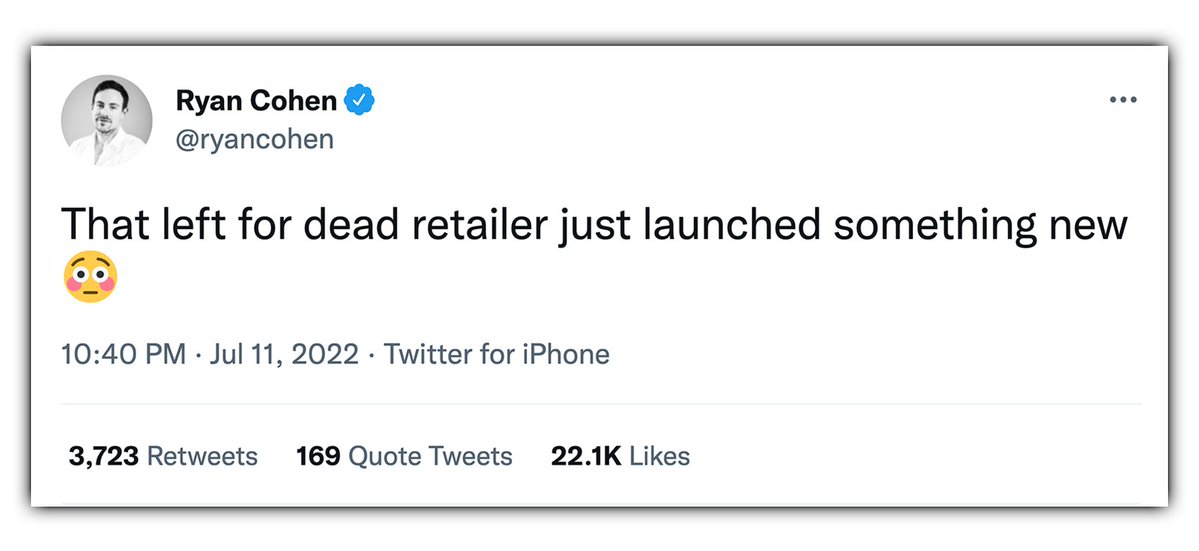
A year after taking over as chairman, GameStop launched a non-custodial, Ethereum Layer-2 marketplace for digital collectibles under Ryan Cohen.
On October 31, 2022, it fully integrated ImmutableX to bring the in-game item catalog onto it.
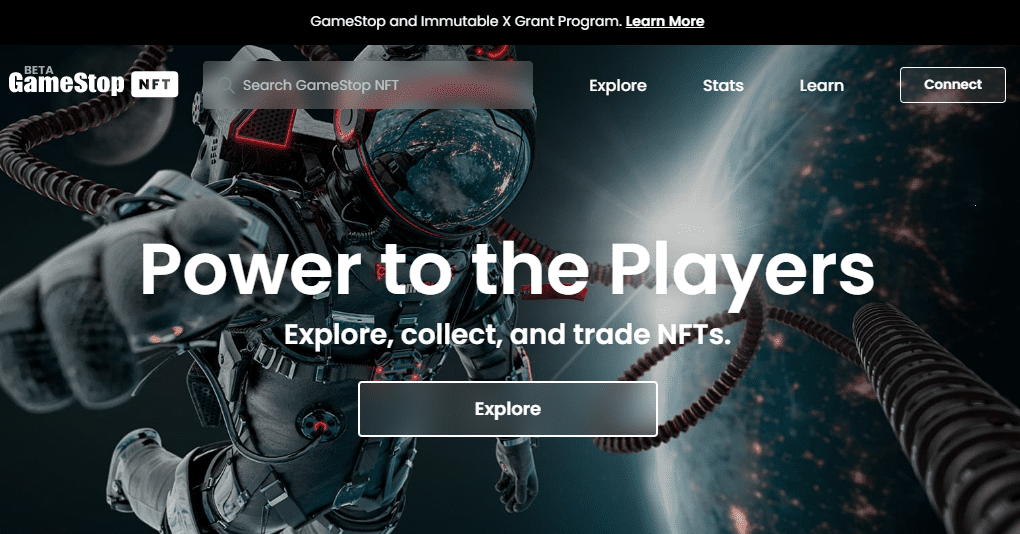
These were the features of the NFT marketplace:
Non-custodial. Users held their own assets in the GameStop Wallet. GameStop was not the counterparty holding keys.
Ethereum L2 via ImmutableX. GameStop picked the option that was cheap, fast, and defensible.
Real in-game items, not JPEGs. Using Immutable's shared order book: Gods Unchained (a top-three blockchain game by player count at the time), Illuvium, Guild of Guardians, Ember Sword, Planet Quest. Player-owned assets, on-chain, tradeable without publisher permission.
If the above sounds familiar, it should. This is the exact thing Cohen described.
A liquidity venue for in-game digital items, purpose-built, funded, and running. Four years before he said the words on a podcast.
And it worked. Roughly $6M in volume in the first two months. Top-ten NFT marketplace by summer 2022.
Where it fell short is worth naming, because what Ryan Cohen has presented so far addresses all three.
Which is why he turned it off.
February 2024. He benched it.

The stated reason was one thing, and only one thing: the continuing regulatory uncertainty of the crypto space.
The Trump Tweets?
Ryan Cohen doesn't do politics.

Then, on July 13, 2024, he broke character.
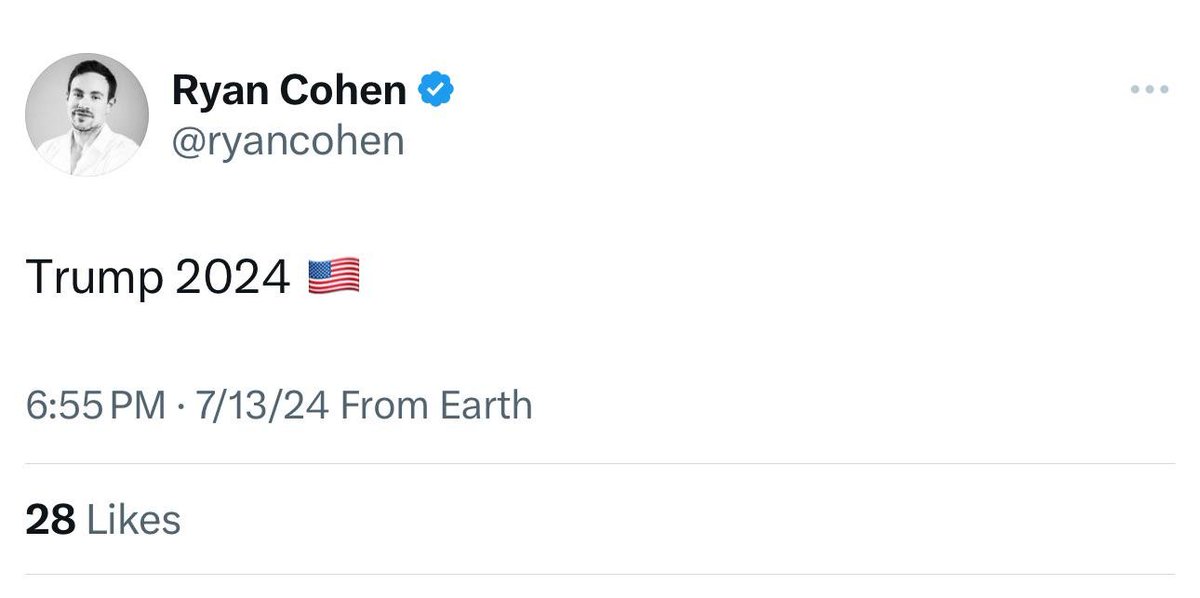
For a man whose entire brand is silence and ambiguity, that was the loudest thing he has ever said.
Funny enough, that adminstration just broke down the reason why the first thing he ever did at GameStop was shut down.
The payment layer. On July 18, 2025, the GENIUS Act was signed into law. It defined payment stablecoins, explicitly carved them out of both securities and commodities law, and put them on a federally licensed rail with 1:1 reserves. Translation: a marketplace can now take USDC at checkout and it is a regulated payment, not a legal grey zone.
Tokenized securities. Paul Atkins took the SEC in early 2025 and moved fast:
StapleGate was Suspicious
Do you remember StapleGate? A GameStop employee accidentally stapled a Nintendo Switch 2 on launch day. Cohen leaned into the meme and listed the stapler on $EBAY.

He went on CNBC on July 15, 2025, to talk about it. During that interview, Andrew Ross Sorkin walked him toward the biggest securities story of that summer: tokenizing shares in private companies, opening high-value markets to unaccredited investors, people with less than a million dollars.
Democratizing investing.
Cohen played dumb:
"I don't have much of an opinion on it. I haven't looked into it. Nothing intelligent to say on the topic."
Minutes later, the interview shifted to crypto and trading cards. And Cohen suddenly opened up.
Sorkin: Do you think that crypto and trading cards ever go together in some kind of digital way that we don't know about?
Cohen: It could. There's ways.
Sorkin: Give me a little more.
Cohen: We'll see. We'll see what happens, but… there's opportunities.
Sorkin: Can you tell us about those opportunities in terms of how to think about it for investors or customers of GameStop right now?
Cohen: [...] The ability to actually use crypto within transactions is something that is an opportunity, and it's something that we're looking at.
Nothing to say about democratizing securities. Plenty to say about buying collectibles with crypto.
Now why would Sorkin ask those two questions?
He walked Cohen right to the door of the whole thesis: tokenizing high-value assets, distributing them to small investors, using crypto rails to do it.
The man currently making a bid for eBay famously sold a stapler and his underwear for charity, and in the same sitting, was asked about integrating collectibles with crypto and democratizing securities of private companies.
One question he answered in detail. The other he refused to touch.
11 months later, how well did that interview age?
Gotta Catch 'em All

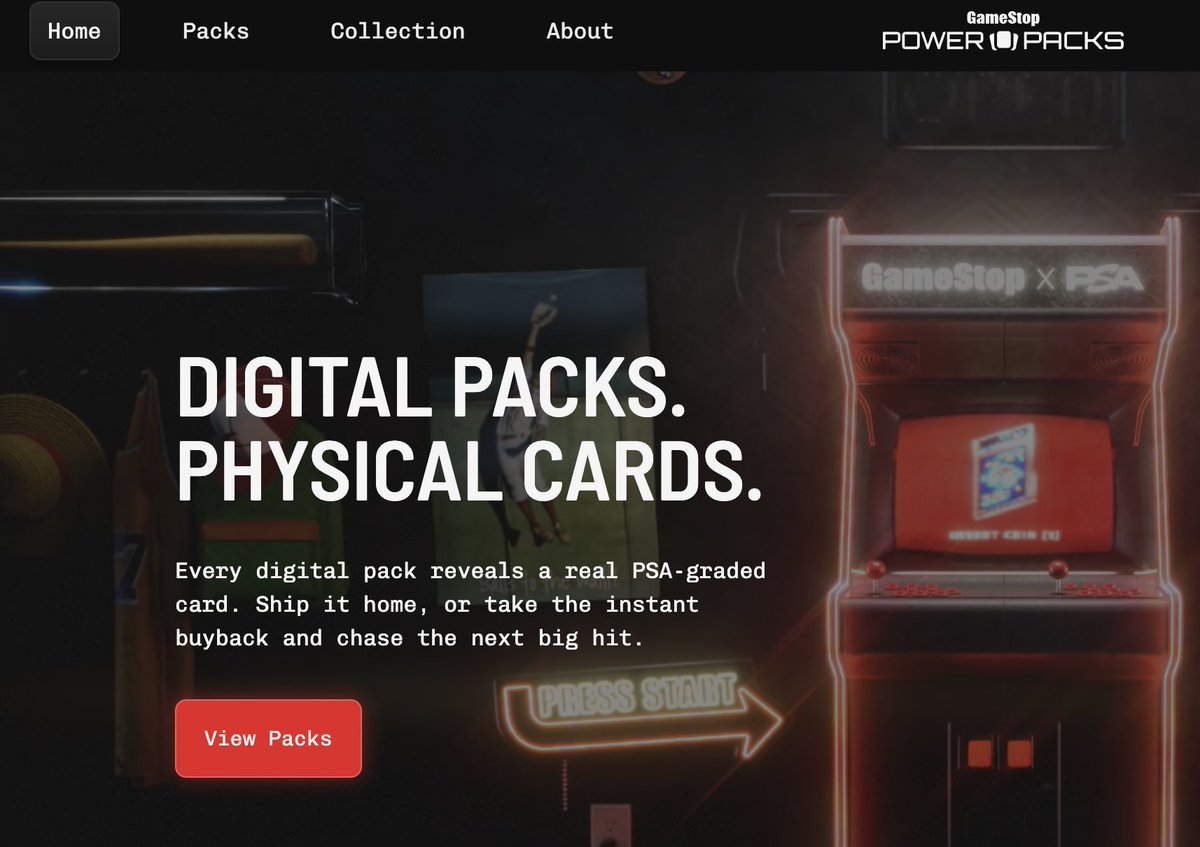
April 14, 2026. GameStop launched Power Packs. Users buy digital packs that unlock real, PSA-graded physical cards held in the PSA Vault.
Power Packs solved the supply-side custody requirement that the NFT marketplace never had.
In 2022, the marketplace ran on assets that were natively digital because the on-chain items were the assets. For a fractional exchange of physical goods, you need custody.
The trust layer is hardwired at the top: Nat Turner, the CEO of Collectors sits on GameStop's board for 0 shares and time limit to buy.
Power Packs had been in beta for a year.GameStop picked the month before the eBay bid to take it live.
Read the picture forming.
The two builds fit together.
The NFT marketplace was the digital-goods version of a liquidity exchange.
Power Packs is the physical-goods version of the same supply chain.
Now put them next to what Cohen just told Friedberg:
He isn't describing anything new.
He's describing what he already built, times two, at full scale, with the rails now legal.
The Bid for eBay
One month after Power Packs, Cohen moved on $EBAY.

May 4, 2026: GameStop bid $125 per share, $55.5 billion, half cash, half stock.
Note what he said the combined company would be.
eBay's entire catalog: collectibles, sneakers, watches, electronics with GameStop's ~1,600 stores as the authentication, fulfillment, and live-commerce network underneath it.
He told Barron's the categories where GameStop is having the most success are the same ones eBay leads in, and that "what eBay is doing online, we're doing offline."
eBay's board rejected it on May 12 as "neither credible nor attractive."
The accumulation continued. GameStop directly owns 4,343,725 eBay shares plus put/call option exposure to another 39,046,658 shares expiring February 23, 2028.
On June 3, the Hart-Scott-Rodino antitrust waiting period was satisfied, unlocking physical settlement.
The bid wasn't a headline event. It was step three in a sequence.
Step one: shut the digital marketplace and wait for legal rails.
Step two: ship physical-goods custody.
Step three: acquire the world's largest catalog of physical + digital goods to run through both.
The board said no. Cohen kept buying shares.
The Biggest Leak

Seven months ago, a post went up on r/Superstonk and disappeared almost as fast. What survived is a trail of screenshots, an archived landing page, and a paper trail pointing to a capstone project out of a California university — a student engineer building something under a GameStop-sponsored brief.
Fair caveat: most capstone projects are throwaway. They exist so seniors can graduate.
But sponsored capstones are a different animal.
Companies sponsor capstones for two reasons. Either they want cheap prototyping on something they don't want on the internal roadmap yet or they're running an extended interview, using the project as a live audition for a hire who will continue the work in-house.
At my university, GM sponsored self-driving vehicle capstones.
A government contractor sponsored remote-controlled tank capstones.
No projects were really hypothetical.
When a GameStop-sponsored capstone shows up, the correct question is not "what did this student build?" It's "what was the brief GameStop wrote?"
The student doesn't invent the spec. GameStop does.
Now look at what this student built.
On the surface it looks like a collectibles marketplace. It is not.
Read it off its own screens:

Fractional Ownership. Secure Storage. Real-time trading.
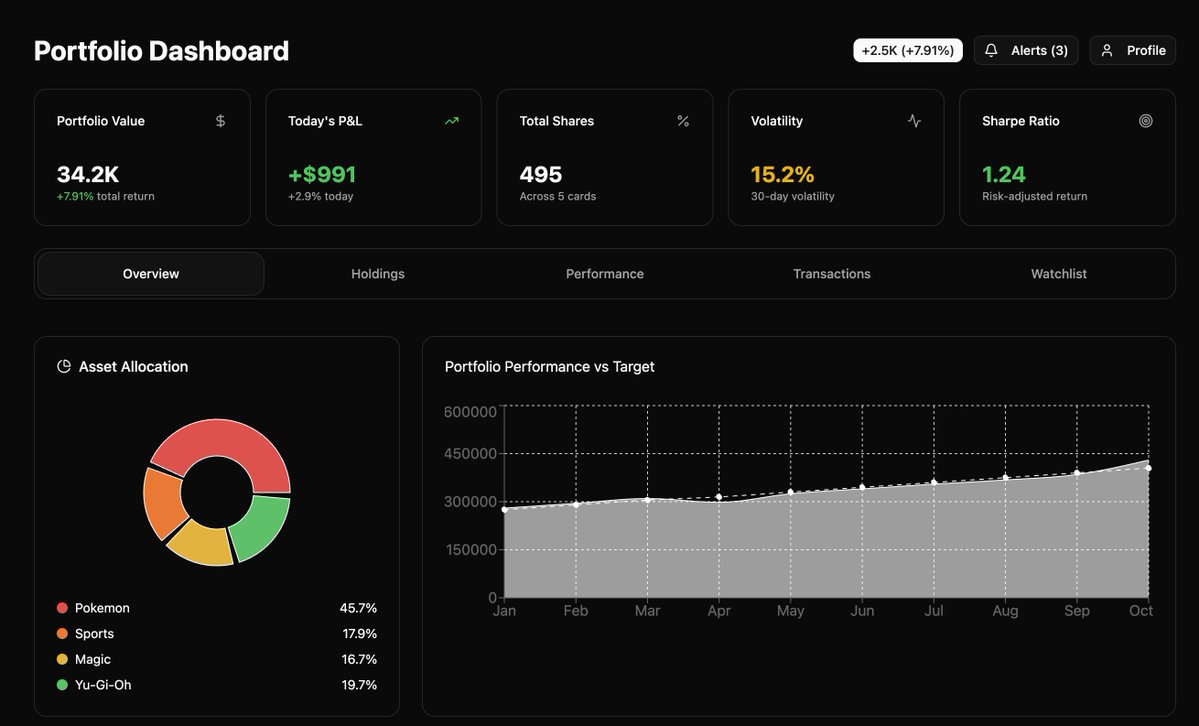
A brokerage, not a checkout. The Portfolio tab does not track "cards you own." It tracks portfolio value, P&L, asset allocation, volatility, and Sharpe ratio. Sharpe ratio is a risk-adjusted return metric. Nobody applies Sharpe to a Charizard binder. They apply it to a securities portfolio.
Stock-market hours. Collectibles marketplaces don't have market hours. Exchanges do.
Custody assumed."All cards professionally graded, authenticated, and stored in climate-controlled facilities."
And the language nobody puts on a school project.

That is not throwaway design.
SIPC is Securities Investor Protection Corporation coverage, you cannot randomly claim it.
FINRA is the self-regulatory body for US broker-dealers, you cannot radomly claim that either.
A student writes those lines only if the spec they were handed already assumed a broker-dealer entity was going to stand behind the product.
And the tagline: "The exchange of fandom. Democratizing access to collectibles."
"Democratizing."
The exact word Sorkin used.
The exact idea Cohen said he had nothing intelligent to say about.
A capstone student did not invent this from scratch. A student does not draft SIPC and FINRA footers. A student does not model a portfolio dashboard with Sharpe ratios and asset allocation. A student does not pick market hours.
Those come from a product spec. The spec came from GameStop.
What GCX is, plainly: a fractional securities exchange (a regulated broker-dealer product wearing a collectibles skin)
Every high-value physical asset with an authentication problem sits on the same technology stack.
Every piece of GCX's framing now has a regulatory path that did not exist when GameStop shut its NFT marketplace in February 2024 and now does.
The rails were built. The product was drafted. The person who ordered the draft was not the student.
What does the strategy look like now?
Look at the three artifacts side by side.
NFT Marketplace (2022–2024). A liquidity venue for digital in-game items. Shipped, ran, shelved for regulatory reasons.
Power Packs (April 2026). A vault-backed supply chain for physical collectibles. Shipped, live, PSA CEO on the board.
GCX (leaked 2025–2026). A fractional securities exchange with broker-dealer language pre-written. Drafted under a GameStop capstone spec.
Line them up with the pillars Cohen unveiled on All-In:
The three artifacts are not three separate products.
They are three surfaces of the same exchange.
Physical supply. Digital supply.
The trading layer that sits on top of both.
Teddy
One more piece.The wrapper isn't GameStop.

Teddy Holdings. Class 35 marketplace trademark, refiled March 2, 2026, two months before the eBay bid.
Trademark scope: "the provision of an online marketplace for buyers and sellers of goods and services."
Not collectibles. Goods and services. Everything.
teddy.com came online as a working store in November 2022 around the same window GameStop's NFT marketplace went live.
It was a live storefront, on a URL named after his father, selling the ideas his father gave him.
It ran for about three and a half years.
Then, at the beginning of June 2026, days before the podcast, days before the comp package withdrawal, days before the promised strategy deck, teddy.com went dark for the first time.
Then it came back password-gated. Then the password gate came down and the domain was rerouted entirely.
Today, if you type teddy.com into a browser, it hands you to gamestop.com.
The inventory
Line it up.
This is not only a collectibles exchange.
This is a fractional, tokenized liquidity layer for physical and digital commerce, where GameStop's stores are the authentication node, eBay's catalog is the inventory, PSA is the vault, stablecoins are the settlement rail, Atkins' SEC is the regulatory scaffold, and Teddy is the wrapper.
That is the size of what he's building.
The Endgame
The endgame isn't cards. Cards are the demo. It isn't collectibles. Collectibles are one vertical. It isn't even eBay's catalog. That's the beachhead audience.
The wrapper is Teddy. And the asset that ultimately gets democratized isn't a Charizard, or a sneaker, or a watch.

It's DK-Butterfly-1: the entity holding the Net Operating Losses from the former Bed Bath & Beyond, owned today by a dispersed base of former creditors sitting on frozen, illiquid claims with no secondary market.
The two-year disposition freeze under §382(l)(5) from the September 2023 plan effective date has now lapsed, which means a new ownership change no longer triggers the kill switch.
So the creditors receive tokenized Teddy equity issued once at the moment Teddy absorbs the shell.
An illiquid bankruptcy claim becomes a liquid, tradeable digital security and issued on the same tokenized-securities rails the SEC just built the framework for, settled through the same stablecoin infrastructure GENIUS just legalized, listed on the same broker-dealer exchange that started life as a card marketplace.
Distributed to exactly the small holders Sorkin was describing.
Sorkin asked him about tokenizing high-value assets and distributing access to small investors. Democratizing investing.
Cohen said nothing.
But his company had a fractional securities exchange drafted under its own name, with a tagline that repeated Sorkin's exact word.
Wall Street is always the first to know.
The question is:
Will you be the last?