a thread on how most jjk fans are actively being criticized by the...

solar ✮@SolarDTM
188 views
Jun 02, 2026
~15 min read
Advertisement
1
a thread on how most jjk fans are actively being criticized by the narrative🧵

2
contents:
0. info
i. intro
ii. grade system
iii. yuta
iv. maki
v. momo
vi. megumi
vii. gojo
viii. mai
ix. conclusion
0. info
i. intro
ii. grade system
iii. yuta
iv. maki
v. momo
vi. megumi
vii. gojo
viii. mai
ix. conclusion
3
0. info
before we discuss this, clear something up: power-scaling is completely fine. i have no personal issues with it whatsoever.
but this thread is about how the culture around scaling specifically using belittling terms to dismiss characters unconsciously mirrors the exact themes jjk is trying to challenge.
this is going to be one of my less formal threads. i don't want to trap this in a rigid academic framework, because it doesn't need one. it's just a overall look at how our vocabulary as a fandom reflects the toxic hierarchy of the story.
i'll do deeper individual character analyses later, but for now, let's look at the patterns.
before we discuss this, clear something up: power-scaling is completely fine. i have no personal issues with it whatsoever.
but this thread is about how the culture around scaling specifically using belittling terms to dismiss characters unconsciously mirrors the exact themes jjk is trying to challenge.
this is going to be one of my less formal threads. i don't want to trap this in a rigid academic framework, because it doesn't need one. it's just a overall look at how our vocabulary as a fandom reflects the toxic hierarchy of the story.
i'll do deeper individual character analyses later, but for now, let's look at the patterns.
4
i. intro
jjk is often dismissed as a pure battle shonen and as a series that values power above narrative, but its surface-level focus on power is intentionally deceptive and deceives the average viewer.
gege akutami uses typical genre tropes to hide his social critique, and when fans value characters strictly by their strength, they recreate the exact hierarchy the narrative condemns.
the series repeatedly depicts a world where people are assigned value according to strength, and parts of the fandom end up doing exactly the same thing.
this dilemma and incoherence leads to several fans not realizing the fact that they are unconsciously recreating the same value system the narrative critiques, today i will be talking about how many fans directly parallels jujutsu society and how it neglects a lot of character arcs.
jjk is often dismissed as a pure battle shonen and as a series that values power above narrative, but its surface-level focus on power is intentionally deceptive and deceives the average viewer.
gege akutami uses typical genre tropes to hide his social critique, and when fans value characters strictly by their strength, they recreate the exact hierarchy the narrative condemns.
the series repeatedly depicts a world where people are assigned value according to strength, and parts of the fandom end up doing exactly the same thing.
this dilemma and incoherence leads to several fans not realizing the fact that they are unconsciously recreating the same value system the narrative critiques, today i will be talking about how many fans directly parallels jujutsu society and how it neglects a lot of character arcs.
5
ii. grade system: the political trap
let’s start with the grading system. this should be common knowledge by now, but we need to stop using grades as an objective definition/categorization of strength.
this system is effectively defunct after the shibuya incident, its extremely unreliable and actually was used for political gain in some cases.
let’s start with the grading system. this should be common knowledge by now, but we need to stop using grades as an objective definition/categorization of strength.
this system is effectively defunct after the shibuya incident, its extremely unreliable and actually was used for political gain in some cases.
6
the special grade rank is heavily political, characters like yuta and gojo were given it to closely monitor them rather than a determiner for strength (primarily due to gojo's radical mindset), we see grades get loosely given to other people and how the higher-ups won't give characters like maki higher grades due to anti-conservative mindsets
(im sure people dont actually think maki is equal to grade 4 but you get my point)
x.com/sasukesugu/sta…
(im sure people dont actually think maki is equal to grade 4 but you get my point)
x.com/sasukesugu/sta…
7
so actively using this metric to measure strength is effectively misaligned (esp after shibuya), since, most characters actually fit outside this metric and cannot be defined to a singular grade (takaba, higuruma, hakari, toji/maki, etc)
using this to genuinely grade people is outside the point of the power system, sure sometimes it is used to rank strength, but a lot of the times it is politically motivated/driven and isn't actually fair to the characters
when you use the grading systems to classify characters as an absolute truth, you are effectively reflecting jujutsu society's rigid view of sorcerers and the higher-ups who built it.
using this to genuinely grade people is outside the point of the power system, sure sometimes it is used to rank strength, but a lot of the times it is politically motivated/driven and isn't actually fair to the characters
when you use the grading systems to classify characters as an absolute truth, you are effectively reflecting jujutsu society's rigid view of sorcerers and the higher-ups who built it.
8
iii. yuta: the masculinity trap
when the fandom talks about yuta, the word "fraud" is thrown around a lot.
but a core distinction most people fail to realize is that the story wants you to view him as a "fraud" to traditional shonen standards, but for a positive reason.
when the fandom talks about yuta, the word "fraud" is thrown around a lot.
but a core distinction most people fail to realize is that the story wants you to view him as a "fraud" to traditional shonen standards, but for a positive reason.
9
yuta okkotsu serves as a formal critique on toxic masculinity and gender conformity, he is a direct parallel to naoya in every way and shows you what healthy masculinity looks like and what it is supposed to represent:
- hes isn't afraid to ask for help when needed
- hes meant to be vulnerable when he needs to be
and its directly criticizing masculinity
- he is caring and loving
- he is emotional and himself without performing
this quote by bell hooks is a great aphorism on what yuta is a criticism of:
- hes isn't afraid to ask for help when needed
- hes meant to be vulnerable when he needs to be
and its directly criticizing masculinity
- he is caring and loving
- he is emotional and himself without performing
this quote by bell hooks is a great aphorism on what yuta is a criticism of:
10
in a way, calling yuta a fraud isn't neccessarily a bad thing, sure hes a "fraud" in the traditional hypermasculine sense, but is that necessarily a bad thing? is it a bad thing to be outside of toxic masculinity? is he a fraud because he dismantles stigma behind manhood?
it feels like people only call him a fraud because hes fine with asking for help as a man and is shown as vulnerable
when the fandom calls yuta a "fraud" because he is extremely open as a man, they are enacting the exact "ritual of power" bell hooks is talking about. he is a "fraud" to the toxic standards of manhood.
the fandom calls him a fraud because he refuses to emotionally cripple himself to satisfy their desire for a unfeeling, hypermasculine protagonist
it feels like people only call him a fraud because hes fine with asking for help as a man and is shown as vulnerable
when the fandom calls yuta a "fraud" because he is extremely open as a man, they are enacting the exact "ritual of power" bell hooks is talking about. he is a "fraud" to the toxic standards of manhood.
the fandom calls him a fraud because he refuses to emotionally cripple himself to satisfy their desire for a unfeeling, hypermasculine protagonist
11
iv. maki: the erasure of the marginalized
when the perfect preparation arc was animated, i saw a lot of fans saying, "i felt nothing during this" or "she just felt like a background character until now." at first, this viewpoint was perplexing, but then the structural brilliance of gege's writing clicked.
when the perfect preparation arc was animated, i saw a lot of fans saying, "i felt nothing during this" or "she just felt like a background character until now." at first, this viewpoint was perplexing, but then the structural brilliance of gege's writing clicked.
12
i explained this a bit in my reply to this tweet, but to generally simplify, maki is perceived as "less-important" or a "background character" early on because that is exactly how her society sees her.
gege structurally places maki on the margins of the story to make the reader experience the same systemic neglect she experiences in the jujutsu world.
a lot of this thread will talk about how gege writes his characters in a way that society perceives them (because of the common power-above-narrative viewpoint), and maki's arc is a good case study of that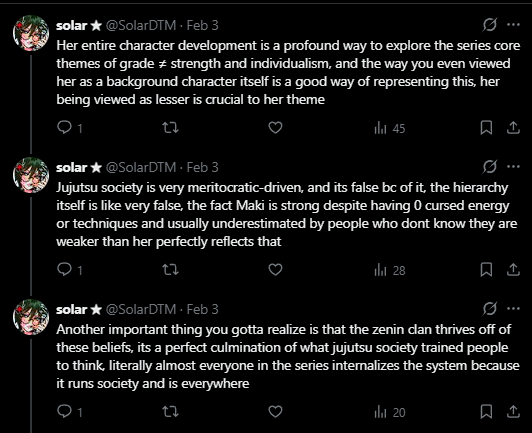
gege structurally places maki on the margins of the story to make the reader experience the same systemic neglect she experiences in the jujutsu world.
a lot of this thread will talk about how gege writes his characters in a way that society perceives them (because of the common power-above-narrative viewpoint), and maki's arc is a good case study of that
13
the fandom often mirrors this, before perfect prep, a lot of discussion about maki was basically:
"she's cool, but she's not really important."
"she's just another side character."
"she's basically weaker toji."
and this is directly what a lot of society thinks of her.
her entire struggle is being treated as someone who exists in a system that refuses to acknowledge her worth, and the fandom of jjk was viewing her in the same light of something she actively denies
"she's cool, but she's not really important."
"she's just another side character."
"she's basically weaker toji."
and this is directly what a lot of society thinks of her.
her entire struggle is being treated as someone who exists in a system that refuses to acknowledge her worth, and the fandom of jjk was viewing her in the same light of something she actively denies
14
and on top of this, makis lack of narrative focus early on isn't merely setup for a power-up. it's structurally placing her in the same position she occupies socially. the story itself makes her occupy the margins before violently forcing the community to re-evaluate her and recognize her true strength.
perfect prep arrives and suddenly everyone is forced to recognize her strength and how everyone was underestimating her similar to the society she is ostracized and belittled in
perfect prep arrives and suddenly everyone is forced to recognize her strength and how everyone was underestimating her similar to the society she is ostracized and belittled in
15
so thats why i think that tweeter had that reaction, in a way, they were like the zenin clan finally having to recognize makis strength and how shes not as weak as society portrays her as, they just probably saw her come out of "nowhere" and be like
"oh shes strong now, cool"
when she always had value regardless of power
"oh shes strong now, cool"
when she always had value regardless of power
16
v. momo: the silence of the weak
i think this is worth weaving into momo, who is also judged by usefulness
i believe momo is one of the biggest victims of this dilemma overall, even narrative readers belittle her as a "useless character" when thats not her main focus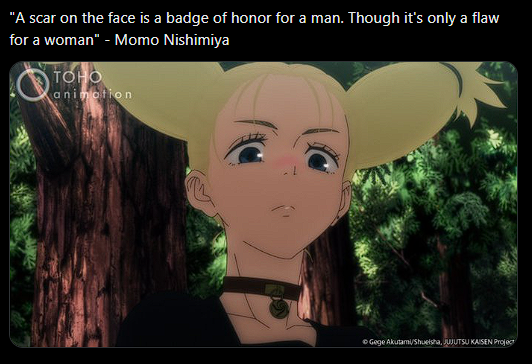
i think this is worth weaving into momo, who is also judged by usefulness
i believe momo is one of the biggest victims of this dilemma overall, even narrative readers belittle her as a "useless character" when thats not her main focus
17
momos main focus is not her strength, of course the fandom is going to zoom in on that however, because they put power over narrative first.
to have a voice in jjk, you have to be powerful.
and for momo she is not engaged with as a character because of her lack of strength
to have a voice in jjk, you have to be powerful.
and for momo she is not engaged with as a character because of her lack of strength
18
in my opinion, momo's speech is one of the clearest moments in jjk where someone openly criticizes the expectations placed on women within jujutsu society.
yet despite this, discussions surrounding her character are rarely about her ideas. instead, they focus on her strength, relevance, or lack of major accomplishments.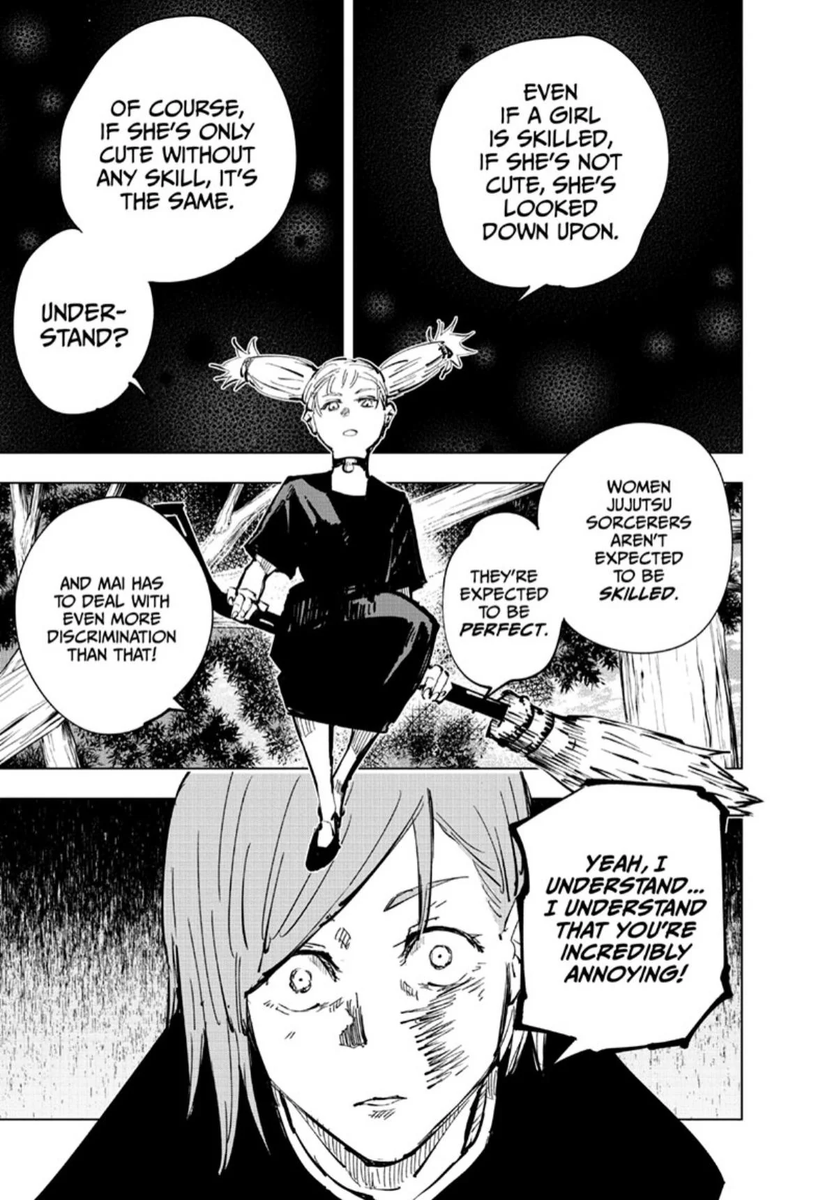
yet despite this, discussions surrounding her character are rarely about her ideas. instead, they focus on her strength, relevance, or lack of major accomplishments.
19
this is reflective of jujutsu society, since, momo argues that people are judged according to standards that are often impossible to meet.
the audience frequently dismisses her perspective because she is not among the strongest sorcerers in the story.
the audience frequently dismisses her perspective because she is not among the strongest sorcerers in the story.
20
if a character like gojo delivered the exact same speech, it would likely be remembered far more often. not necessarily because the argument itself or bc hes male, but because it would come from someone whose strength grants him authority within both the narrative and the fandom.
21
to many readers, a character's ideas seem to gain value in proportion to their power.
characters who are the greatest in fights are granted a voice, while characters who lose are often treated as though they have nothing worth saying. momo's treatment reflects this perfectly. her speech is not ignored because it lacks substance; it is ignored because it comes from someone the audience has already decided is unimportant.
characters who are the greatest in fights are granted a voice, while characters who lose are often treated as though they have nothing worth saying. momo's treatment reflects this perfectly. her speech is not ignored because it lacks substance; it is ignored because it comes from someone the audience has already decided is unimportant.
22
a lot of fans remember speeches from gojo, sukuna, etc not just because they're narratively important, but because they're attached to characters whose strength already commands attention. most of the memorable speeches itself ARE about strength (honored one speech), yet when its a weaker character talking about the state of society, it gets overlooked.
the irony is that if momo had the exact same dialogue, exact same personality, and exact same thematic role but possessed a fucking crazy "special grade" cursed technique people would probably quote her speech constantly.
it's not the quality of your ideas, its the quality of your strength that matters.
and i think even if someone like yuki said that speech instead of her it would be more recognized
the irony is that if momo had the exact same dialogue, exact same personality, and exact same thematic role but possessed a fucking crazy "special grade" cursed technique people would probably quote her speech constantly.
it's not the quality of your ideas, its the quality of your strength that matters.
and i think even if someone like yuki said that speech instead of her it would be more recognized
23
conclusion + ab her role later within the story:
one thing i noticed is that shes basically underutilized later on, but tbh i think this is reflective of her speech as a whole.
momo talks about the burdens placed on women, about how you have to be strong and "perfect" to truly get recognition, then she gets completely forgotten by the narrative, society, and community as a whole.
not even discussed, debated, hated, or scrutinized.
literally just forgotten about
and i really do think this is reflective of her speech
btw one small thing here: but i genuinely do believe the way the fandom objectified/sexualized her later on (the comments ab her butt and stuff) i honestly do believe its kinda ironic, because its kinda just showing how her only "redeeming quality" to the fandom is her body (and she looks very young so i find that extremely strange)
one thing i noticed is that shes basically underutilized later on, but tbh i think this is reflective of her speech as a whole.
momo talks about the burdens placed on women, about how you have to be strong and "perfect" to truly get recognition, then she gets completely forgotten by the narrative, society, and community as a whole.
not even discussed, debated, hated, or scrutinized.
literally just forgotten about
and i really do think this is reflective of her speech
btw one small thing here: but i genuinely do believe the way the fandom objectified/sexualized her later on (the comments ab her butt and stuff) i honestly do believe its kinda ironic, because its kinda just showing how her only "redeeming quality" to the fandom is her body (and she looks very young so i find that extremely strange)
24
vi. megumi: the burden of "potential"
i really do pray for the day most of the fandom doesnt view megumi as primarily strength over narrative or generally through the lens of power-scaling, because i dont think many people understand megumi is tired of being seen as a power source or "potential man" because his entire life was strained by that, megumi is affected by it mentally and his "power" has been an extreme obligation to him that he doesnt want.
megumi isn't just a character with potential. he's a character who is burdened by other people's perception of his potential, he was commodified and made an object source of power to be sold and relied on, hes okay with helping others (especially the ones he loves) yet hes always belittled to this role, and it taxed him mentally and made him very detached
very few people are interested in megumi simply being megumi, rather, they're interested in what he can provide and his potential. the fandom reflects that thought, and i think the fandom needs to stop looking at him as underperformative.
i really do pray for the day most of the fandom doesnt view megumi as primarily strength over narrative or generally through the lens of power-scaling, because i dont think many people understand megumi is tired of being seen as a power source or "potential man" because his entire life was strained by that, megumi is affected by it mentally and his "power" has been an extreme obligation to him that he doesnt want.
megumi isn't just a character with potential. he's a character who is burdened by other people's perception of his potential, he was commodified and made an object source of power to be sold and relied on, hes okay with helping others (especially the ones he loves) yet hes always belittled to this role, and it taxed him mentally and made him very detached
very few people are interested in megumi simply being megumi, rather, they're interested in what he can provide and his potential. the fandom reflects that thought, and i think the fandom needs to stop looking at him as underperformative.
25
this objectification and overreliance is exactly why megumi’s mental state collapses later in the story.
when sukuna takes over his body, megumi completely gives up. the fandom called him a "fraud" and yelled at him to "just wake up," entirely missing the psychological reality that megumi has spent his entire life being used as a vessel for other people's expectations and power.
whether it’s his clan, sukuna, or even the audience, everyone just wants to pilot his potential. no one actually cares about who he is as a person.
this brings us to the tragedy of his relationship with gojo, gojo didn't just intervene with megumi's situation out of charity; gojo looked at him and saw a mirror of his own upbringing. he saw that megumi was robbed of a normal childhood because he inherited a great technique, similar to himself.
they were both trapped in a system that valued their genetic value and worth over their humanity, gojo stepped in because he desperately wanted to shield megumi from the exact same institutional objectification that ruined his own life.
which leads us directly to the ultimate symbol of this dynamic and objectification: gojo himself..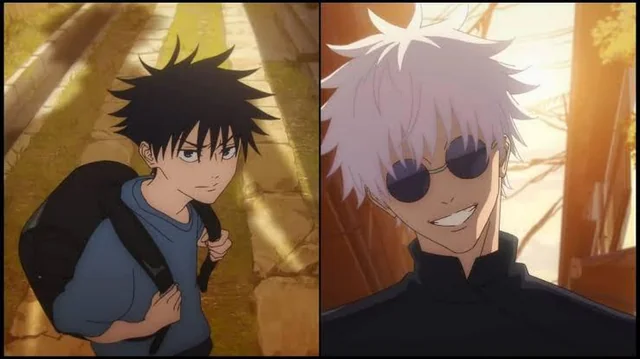
when sukuna takes over his body, megumi completely gives up. the fandom called him a "fraud" and yelled at him to "just wake up," entirely missing the psychological reality that megumi has spent his entire life being used as a vessel for other people's expectations and power.
whether it’s his clan, sukuna, or even the audience, everyone just wants to pilot his potential. no one actually cares about who he is as a person.
this brings us to the tragedy of his relationship with gojo, gojo didn't just intervene with megumi's situation out of charity; gojo looked at him and saw a mirror of his own upbringing. he saw that megumi was robbed of a normal childhood because he inherited a great technique, similar to himself.
they were both trapped in a system that valued their genetic value and worth over their humanity, gojo stepped in because he desperately wanted to shield megumi from the exact same institutional objectification that ruined his own life.
which leads us directly to the ultimate symbol of this dynamic and objectification: gojo himself..
26
vii. gojo: the societal power
if megumi is the tragic victim of unfulfilled potential, gojo is the ultimate victim of absolute power.
the fandom treats gojo as an untouchable anime god. he is hyped up for his aura, edits, and his strength.
but just like the characters in the story, the fandom completely isolates him because of that strength. we fell into the exact same trap as jujutsu society: we reduce gojo to a weapon without recognizing who he is as a person
even getos question comes to mind when i think of this dilemma, "are you the strongest because you're satoru gojo, or are you satoru gojo because you're the strongest?"
that question wasn't just asked for fun, its a genuine statement that asks if people see him as a person and not just his strength.
if megumi is the tragic victim of unfulfilled potential, gojo is the ultimate victim of absolute power.
the fandom treats gojo as an untouchable anime god. he is hyped up for his aura, edits, and his strength.
but just like the characters in the story, the fandom completely isolates him because of that strength. we fell into the exact same trap as jujutsu society: we reduce gojo to a weapon without recognizing who he is as a person
even getos question comes to mind when i think of this dilemma, "are you the strongest because you're satoru gojo, or are you satoru gojo because you're the strongest?"
that question wasn't just asked for fun, its a genuine statement that asks if people see him as a person and not just his strength.
27
to the higher-ups, gojo wasn't a human being; he was a natural disaster they had to manage. to his students and allies, he was an insurance policy,. he was a safety net that allowed them to survive. no one ever asked how he felt, because "he's the strongest, he'll be fine."
he started to internalize this overreliance himself
he started to internalize this overreliance himself
28
when Gojo was sealed in shibuya, the entire jujutsu society collapsed because they had entirely relied on one man to carry the weight of their society. in comparison, the fandom reacted the exact same way. when gojo lost to sukuna, the community threw tantrums. they accused gege of "ruining the story", calling gojo a "fraud" for losing, saying gege doesn't know how to write his own story, etc

29
this reaction perfectly proves gege's point. the fandom didn't miss gojo as a person, they were angry that their favorite weapon broke. they treated his death not as the tragic end of a lonely man who just wanted to raise a generation of equals, but as a statistical flaw of an overpowered weapon in a game.
by reducing gojo's entire existence to whether he won or lost the "strongest" title, the fandom replicated the exact curse that kept gojo isolated his entire life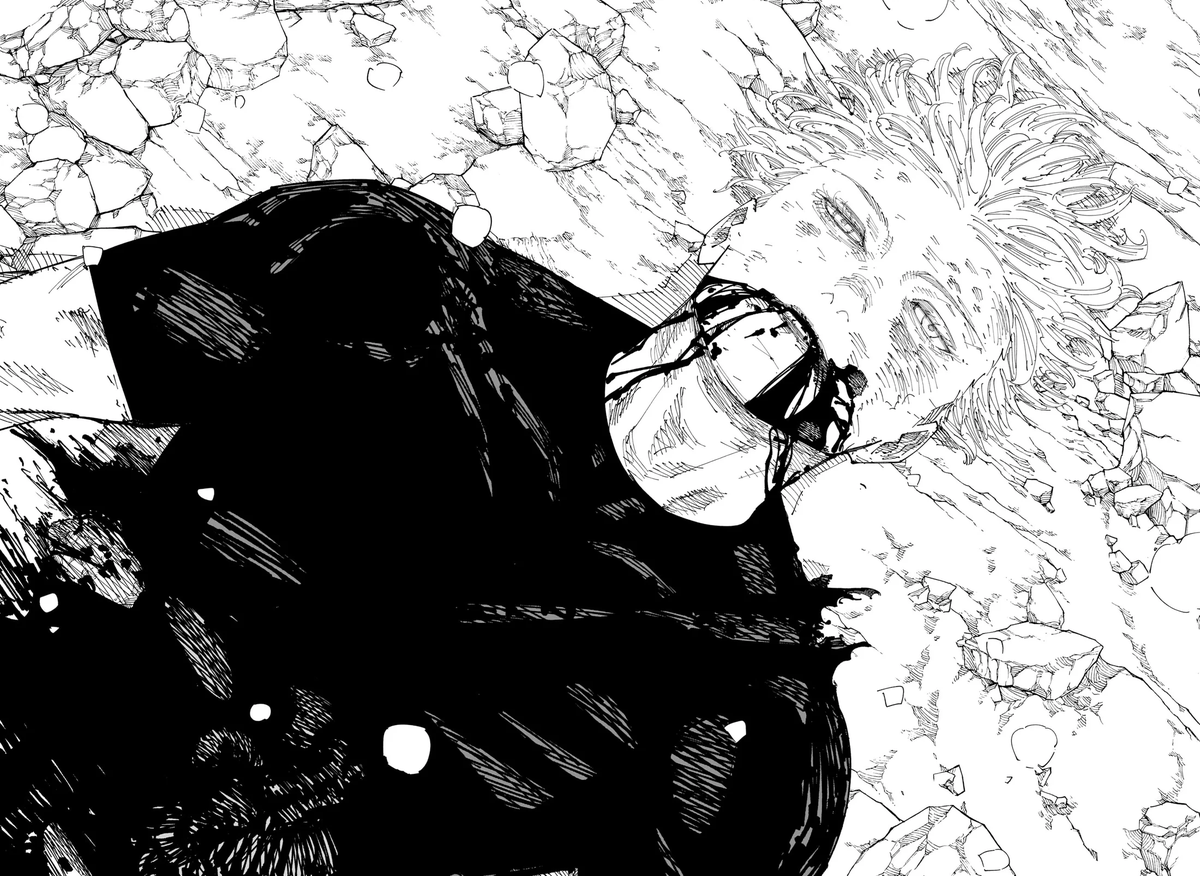
by reducing gojo's entire existence to whether he won or lost the "strongest" title, the fandom replicated the exact curse that kept gojo isolated his entire life
30
viii. mai: the proof of momo's speech
momo's speech is the ultimate nod to mai as a whole, you can tell that speech is primarily a response to how she is treated within jujutsu society.
within the fandom, mai is overwhelmingly dismissed. she is usually written off as a "bitch," a "weak sorcerer," or a minor character who only existed to die for maki’s gain.
once again, this surface-level reading completely blindfolds the audience to one of the most heartbreaking arcs in the series.
momo's speech is the ultimate nod to mai as a whole, you can tell that speech is primarily a response to how she is treated within jujutsu society.
within the fandom, mai is overwhelmingly dismissed. she is usually written off as a "bitch," a "weak sorcerer," or a minor character who only existed to die for maki’s gain.
once again, this surface-level reading completely blindfolds the audience to one of the most heartbreaking arcs in the series.
31
mai is a direct parallel to characters like sasuke from naruto. when a male character lashes out, acts cold, and becomes toxic due to severe systemic abuse and family trauma, the fandom praises them as complex, edgy, and deeply written.
but when mai exhibits those exact same trauma responses defensiveness, spite, and anger she is flattened into just being an annoying "bitch."
the reality is that mai’s behavior is a desperate survival mechanism. unlike maki, mai never wanted to be a strong sorcerer, or even had the fighting chance to if she wanted to be.
she never wanted to fight, mai always desired a normal and peaceful life, but the zenin clan’s abusive patriarchy dragged her into the meat grinder anyway. she was forced to mutilate her own desires just to survive a system she hated.
but when mai exhibits those exact same trauma responses defensiveness, spite, and anger she is flattened into just being an annoying "bitch."
the reality is that mai’s behavior is a desperate survival mechanism. unlike maki, mai never wanted to be a strong sorcerer, or even had the fighting chance to if she wanted to be.
she never wanted to fight, mai always desired a normal and peaceful life, but the zenin clan’s abusive patriarchy dragged her into the meat grinder anyway. she was forced to mutilate her own desires just to survive a system she hated.
32
when fans look at mai and only care about her "weakness" or her low output construction technique, they are siding with the zenin clan.
the zenins hated and essentially denounced her because her lack of ambition and power made her "useless" to them. the fandom dismisses her for the exact same reason.
mai's ultimate sacrifice wasn't just a plot device to give maki an overpowered weapon. it was a tragic, final rejection of the jujutsu world. she gave up her life to take the burden of the curse away from her sister, choosing love over a system built entirely on power.
yet, by reducing her entire existence to how she boosted maki’s stats, the community repeats the exact crimes of the society that killed her: valuing a person only for what they can provide to the illusionary "strong."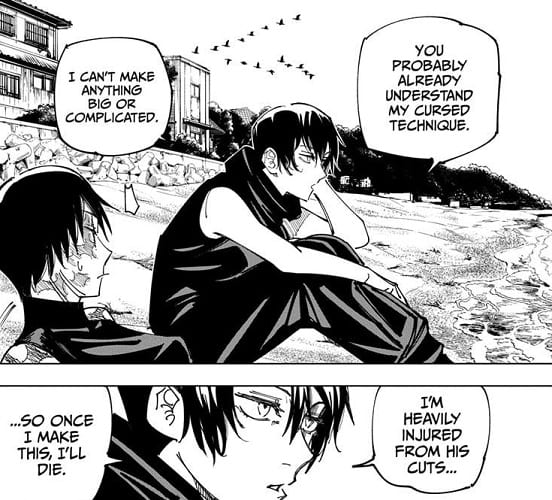
the zenins hated and essentially denounced her because her lack of ambition and power made her "useless" to them. the fandom dismisses her for the exact same reason.
mai's ultimate sacrifice wasn't just a plot device to give maki an overpowered weapon. it was a tragic, final rejection of the jujutsu world. she gave up her life to take the burden of the curse away from her sister, choosing love over a system built entirely on power.
yet, by reducing her entire existence to how she boosted maki’s stats, the community repeats the exact crimes of the society that killed her: valuing a person only for what they can provide to the illusionary "strong."
33
ix. conclusion: the mirror
ultimately, jujutsu kaisen's society is a tragic mirror to a major part of the fandom and community.
gege did not write a brainless battle shonen celebrating absolute power, instead, he wrote a critique of a world that treats human beings like expendable tools based entirely on their output.
the irony is that a massive portion of the fandom looked into that mirror, saw the corrupt higher-ups, and decided to act exactly like them.
we reduce complex psychological trauma to "fraud" memes, we silence weak characters with important messages, and we objectify the strongest until they break.
by prioritizing power-scaling over narrative depth, the community has recreated the exact Jujutsu society the story condemns.
jujutsu kaisen isn't just criticizing its own fictional world, it is actively criticizing us too.
ultimately, jujutsu kaisen's society is a tragic mirror to a major part of the fandom and community.
gege did not write a brainless battle shonen celebrating absolute power, instead, he wrote a critique of a world that treats human beings like expendable tools based entirely on their output.
the irony is that a massive portion of the fandom looked into that mirror, saw the corrupt higher-ups, and decided to act exactly like them.
we reduce complex psychological trauma to "fraud" memes, we silence weak characters with important messages, and we objectify the strongest until they break.
by prioritizing power-scaling over narrative depth, the community has recreated the exact Jujutsu society the story condemns.
jujutsu kaisen isn't just criticizing its own fictional world, it is actively criticizing us too.
34
extra:
i do wanna say this is not EVERYONE in the fandom who interacts with jjk this way, though, its a very loud and pervasive chunk. it is especially present within the power-scaling and "who would win" spaces, mai and momo definitely catch the highest amount of this too, since gege uses them to highlight systemic issues rather than giving them flashy combat. (which many people think is the focus)
i do wanna say this is not EVERYONE in the fandom who interacts with jjk this way, though, its a very loud and pervasive chunk. it is especially present within the power-scaling and "who would win" spaces, mai and momo definitely catch the highest amount of this too, since gege uses them to highlight systemic issues rather than giving them flashy combat. (which many people think is the focus)
