Jesus' first miracle wasn't really about running out of wine. It...

Adam | Faithful Messenger@Adam_FaithfulM
60 views
May 18, 2026
~2 min read
Advertisement
1
Jesus' first miracle wasn't really about running out of wine.
It was about something theologians have argued over for 2,000 years.
The wedding at Cana contains one of the most layered symbols in all of Scripture.
Most people read right past it.
A thread on what it actually means.🧵
It was about something theologians have argued over for 2,000 years.
The wedding at Cana contains one of the most layered symbols in all of Scripture.
Most people read right past it.
A thread on what it actually means.🧵
2
The story: John 2:1–11. A wedding in Cana of Galilee. The wine runs out.
Mary tells Jesus. He responds:
"Woman, what does this have to do with me? My hour has not yet come." (v.4)
That phrase — "My hour" — appears 7 times in John. Every single time, it refers to the cross.
He knew exactly what He was doing.
Mary tells Jesus. He responds:
"Woman, what does this have to do with me? My hour has not yet come." (v.4)
That phrase — "My hour" — appears 7 times in John. Every single time, it refers to the cross.
He knew exactly what He was doing.
3
The jars matter enormously.
"Now there were six stone water jars there for the Jewish rites of purification, each holding 20 to 30 gallons." (v.6)
Six jars. Not seven; the number of completion in Hebrew culture.
Six is the number of man. Of incompleteness. Of a covenant that hadn't yet been fulfilled.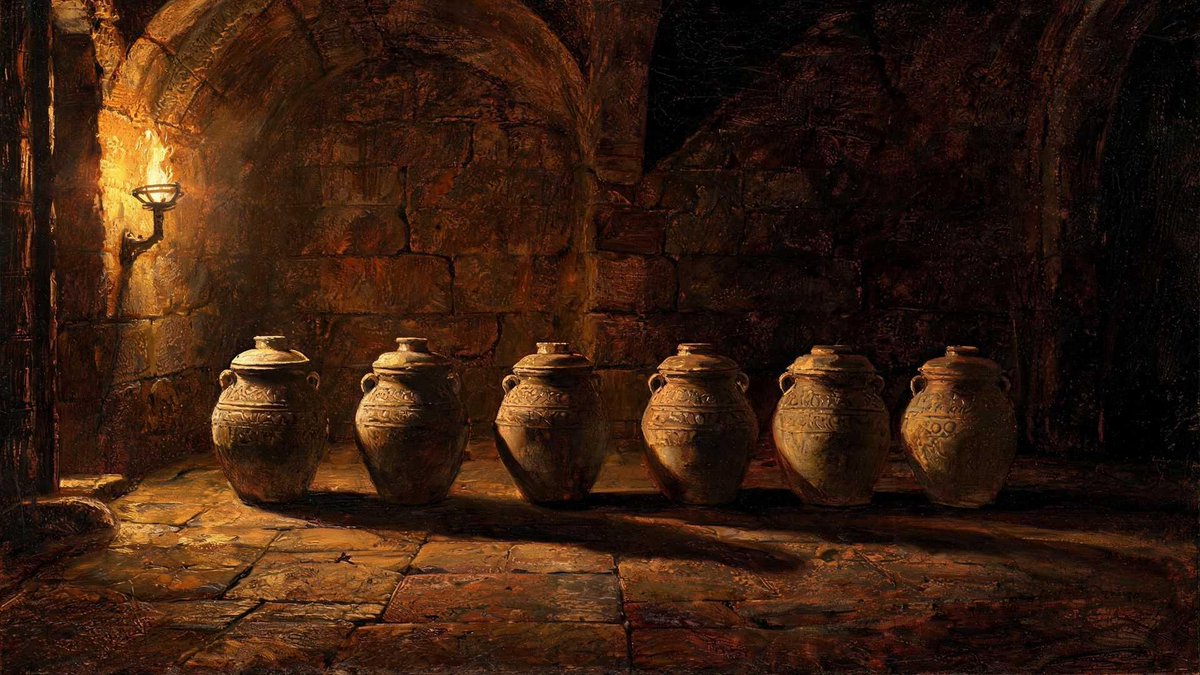
"Now there were six stone water jars there for the Jewish rites of purification, each holding 20 to 30 gallons." (v.6)
Six jars. Not seven; the number of completion in Hebrew culture.
Six is the number of man. Of incompleteness. Of a covenant that hadn't yet been fulfilled.
4
These jars were used for ritual washing, purification under the Mosaic Law.
Jesus doesn't create new jars.
He transforms what was already there for the old covenant into something new.
This is the entire gospel in one image:
The Law doesn't disappear; it is fulfilled. Transformed. Transcended.
Jesus doesn't create new jars.
He transforms what was already there for the old covenant into something new.
This is the entire gospel in one image:
The Law doesn't disappear; it is fulfilled. Transformed. Transcended.
5
The wine itself carries deep covenantal meaning.
In the OT, wine is a symbol of joy, abundance, and the messianic age (Isaiah 25:6, Amos 9:13–14).
The rabbis said: "The world was created only for the sake of the Messiah."
Running out of wine at a wedding wasn't just awkward. In that culture, it was a sign of judgment, of something broken.
In the OT, wine is a symbol of joy, abundance, and the messianic age (Isaiah 25:6, Amos 9:13–14).
The rabbis said: "The world was created only for the sake of the Messiah."
Running out of wine at a wedding wasn't just awkward. In that culture, it was a sign of judgment, of something broken.
6
Then this detail: the master of the feast doesn't know where the wine came from.
Only the servants who drew the water know.
This is John's recurring theme: the world does not recognize who Jesus is. But those who serve Him closest see the miracle firsthand.
Proximity to Jesus determines revelation.
Only the servants who drew the water know.
This is John's recurring theme: the world does not recognize who Jesus is. But those who serve Him closest see the miracle firsthand.
Proximity to Jesus determines revelation.
7
And why a wedding?
Because throughout Scripture from Genesis to Revelation, God frames His relationship with His people as a marriage covenant.
This miracle happens at a wedding because Jesus is the Bridegroom (John 3:29).
Cana isn't the beginning. It's a preview of the Marriage Supper of the Lamb.
Because throughout Scripture from Genesis to Revelation, God frames His relationship with His people as a marriage covenant.
This miracle happens at a wedding because Jesus is the Bridegroom (John 3:29).
Cana isn't the beginning. It's a preview of the Marriage Supper of the Lamb.
8
What the miracle at Cana actually declares:
1. The old covenant's purification system is now fulfilled in Christ
2. The Messianic age, long promised, has officially begun
3. Jesus is the Bridegroom of a new covenant
4. Those closest to Him see what the world cannot
5. His "hour", the cross, is always the horizon behind every miracle
1. The old covenant's purification system is now fulfilled in Christ
2. The Messianic age, long promised, has officially begun
3. Jesus is the Bridegroom of a new covenant
4. Those closest to Him see what the world cannot
5. His "hour", the cross, is always the horizon behind every miracle
9
John tells us this miracle "manifested His glory, and His disciples believed in Him." (v.11)
It wasn't the wine that changed them.
It was seeing who He was behind the miracle.
That's still the question every reader of John must answer.
Follow for regular threads like this.
What detail in this story surprised you the most?
It wasn't the wine that changed them.
It was seeing who He was behind the miracle.
That's still the question every reader of John must answer.
Follow for regular threads like this.
What detail in this story surprised you the most?
