Energy demand is skyrocketing Superintelligence will require the...

Daniel Romero@HyperTechInvest
20 views
Nov 03, 2025
~11 min read
Advertisement
1
Energy demand is skyrocketing
Superintelligence will require the equivalent of thousands of nuclear plants to power it
That’s why energy stocks are surging
Here are 14 energy companies benefiting from the AI data center boom that you should consider
A thread 🧵
1. Bloom Energy Corporation
Market cap: $31B
Bloom Energy develops solid-oxide fuel cells that generate electricity on-site using natural gas, biogas, or hydrogen. The company also builds high-temperature electrolyzers that produce hydrogen more efficiently than conventional systems, making it a strong candidate to supply clean, reliable power for the AI infrastructure boom.
Recent agreements reinforce its momentum: a $5B partnership with Brookfield to supply power for AI data centers, over 100 MW with Equinix across U.S. sites, and a 500 MW commitment from SK ecoplant linked to hydrogen projects. CoreWeave is also deploying Bloom units at its Illinois AI facility, showing growing adoption across major hyperscale and industrial clients.
2
2. Hyliion Holdings Corp
Market cap: $420M
Hyliion develops the KARNO linear generator, a sealed unit that uses high-temperature oxidation to produce electricity and can run on a wide range of fuels including natural gas, hydrogen and raw well-head gas. The company acquired the technology from GE Additive in 2022 and a customer unit has logged 100 days of continuous operation.
Compared with Bloom Energy, which relies on a mature solid-oxide fuel-cell platform scaled across data centres, Hyliion emphasises fuel flexibility and use of field-gas. Bloom is actively signing large AI-power deals and has a long record with colocation operators.
Hyliion secured a $6 M grant from the U.S. Department of Energy to deploy up to 2 MW of KARNO units on Permian well-head gas and achieved the 100-day runtime milestone. Bloom signed an “up to $5 B” partnership with Brookfield Asset Management for AI data centres and surpassed 100 MW with Equinix, Inc. across U.S. sites.
3
3. Fluence Energy Inc
Market cap: $4B
Fluence Energy designs and sells utility-scale battery storage systems built from modular units with integrated controls, supported by cloud-based software that optimizes how those batteries and renewable assets operate in power markets. Its ecosystem combines Gridstack hardware for physical storage, Fluence OS for system management, and Mosaic software for AI-driven market bidding and dispatch.
The company emerged as a Siemens–AES spin-out and has become one of the largest pure-play energy storage providers globally, with multi-year deployments across major utilities and independent power producers. Recent wins include a 160 MW / 640 MWh project with Torch Clean Energy in Arizona and 200 MW of systems for Ukraine’s DTEK to strengthen grid reliability during outages.
Financially, Fluence has scaled into the multi-billion-dollar annual revenue range, though results have fluctuated due to manufacturing cycles and project timing. Management continues to highlight a large backlog and expects growth to stabilize as new U.S. production capacity comes online.
4
4. First Solar Inc
Market cap: $29B
First Solar manufactures cadmium telluride (CdTe) thin film solar modules, specifically its Series 6 and Series 7 lines, built primarily in the United States. These modules perform better than traditional polysilicon panels in hot climates and are produced at scale in Ohio and a new Alabama facility, with another 3.7 GW U.S. factory planned for 2026–2027.
The company benefits from IRA 45X manufacturing credits, worth around $0.07 per watt at the module level. These credits support strong margins and continued domestic capacity expansion, reinforcing First Solar’s position in the U.S. energy transition.
Commercially, First Solar is one of the most heavily booked suppliers in the solar industry, with a 53.7 GW contracted backlog valued at $16.4 billion. Despite reducing some volumes tied to a bp dispute, the company continues adding capacity to meet demand and maintain leadership in American-made solar manufacturing.
5
5. Canadian Solar Inc
Market cap: $1.4B
Canadian Solar is one of the largest solar manufacturers and project developers in the world. It sells solar panels and large-scale battery systems to utilities and commercial clients, while its subsidiary Recurrent Energy develops, finances, and operates renewable energy projects. This gives the company a mix of hardware sales and recurring revenue from owned assets.
The company is expanding its production footprint beyond Asia, with a major solar module factory in Texas and plans for a cell plant in Indiana to strengthen its U.S. supply chain. Its e-STORAGE division delivers containerized battery systems for utility-scale projects, with shipments already surpassing 10 GWh.
By combining global manufacturing scale with project ownership, Canadian Solar has positioned itself as a vertically integrated player across both the solar and battery storage markets, offering flexibility and long-term growth potential as clean energy demand accelerates.
6
6. GE Vernova Inc
Market cap: $159B
GE Vernova designs and manufactures critical energy infrastructure, including gas turbines, wind turbines, grid systems, and electrification hardware. Its focus is clear: electrify to thrive and decarbonize.
The company is integrating artificial intelligence throughout its portfolio. Its Electrification and Digital Decarbonization division uses AI to provide real-time insights, improve grid orchestration, and optimize complex energy systems that mix renewables, storage, and traditional generation assets.
GE Vernova is also becoming a direct supplier to the AI infrastructure boom. It recently signed a deal to deliver 29 LM2500XPRESS gas turbine packages to Crusoe Energy Systems for powering AI data centers, showing how rising compute demand is driving parallel growth in electricity generation.
On the software side, GE Vernova acquired Alteia SAS, a company specialized in AI computer vision and machine learning, to enhance its grid software suite with visual-intelligence capabilities.
In essence, GE Vernova is building both the hardware that powers the AI era and the AI-driven software that manages the increasingly complex grids sustaining it.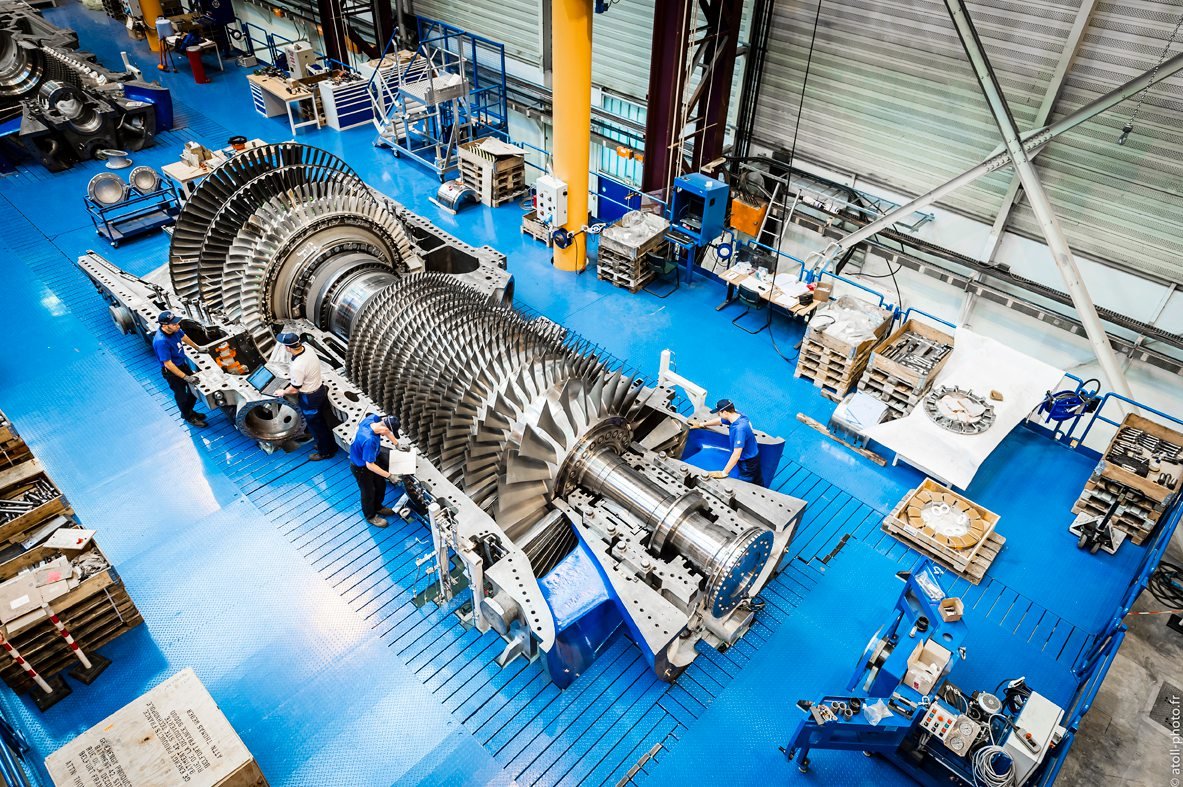
Market cap: $159B
GE Vernova designs and manufactures critical energy infrastructure, including gas turbines, wind turbines, grid systems, and electrification hardware. Its focus is clear: electrify to thrive and decarbonize.
The company is integrating artificial intelligence throughout its portfolio. Its Electrification and Digital Decarbonization division uses AI to provide real-time insights, improve grid orchestration, and optimize complex energy systems that mix renewables, storage, and traditional generation assets.
GE Vernova is also becoming a direct supplier to the AI infrastructure boom. It recently signed a deal to deliver 29 LM2500XPRESS gas turbine packages to Crusoe Energy Systems for powering AI data centers, showing how rising compute demand is driving parallel growth in electricity generation.
On the software side, GE Vernova acquired Alteia SAS, a company specialized in AI computer vision and machine learning, to enhance its grid software suite with visual-intelligence capabilities.
In essence, GE Vernova is building both the hardware that powers the AI era and the AI-driven software that manages the increasingly complex grids sustaining it.
7
7. Terrestrial Energy
Market cap: $1.8B
Terrestrial Energy is developing the IMSR (Integral Molten Salt Reactor), a molten-salt fission plant designed to deliver high-temperature heat and electricity for industrial facilities and grid applications. The design has passed Canada’s Phase 2 Vendor Design Review with no fundamental barriers to licensing and is currently in pre-application review with the U.S. NRC.
The company is positioning the IMSR to serve the AI power boom, pursuing memorandums of understanding to site reactors on EnergySolutions-owned properties and collaborating with Schneider Electric and Viaro/Ameresco on projects that specifically target data center power demand.
Though still pre-commercial, Terrestrial Energy’s strategy is clear: develop near-site, firm nuclear power to meet the massive, continuous loads of data centers and heavy industry.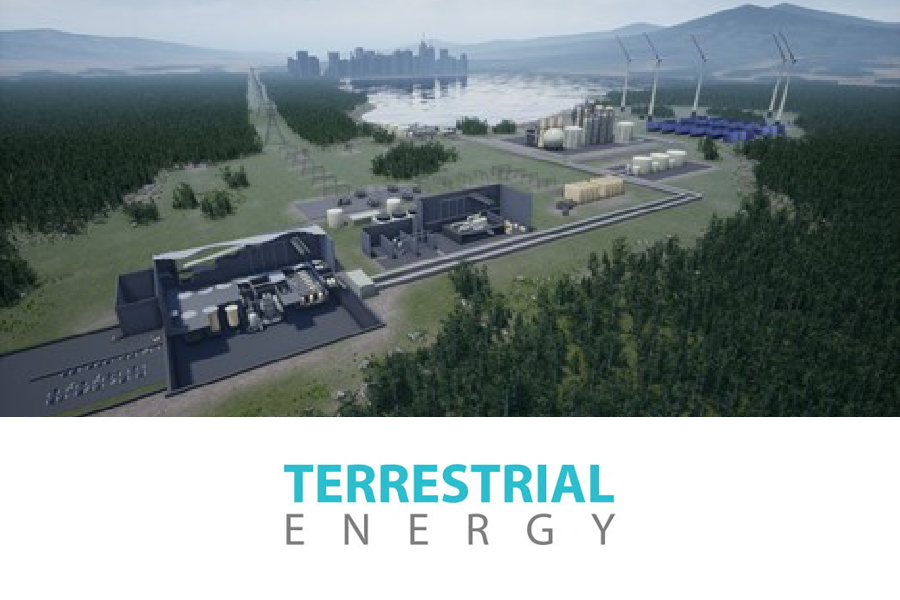
Market cap: $1.8B
Terrestrial Energy is developing the IMSR (Integral Molten Salt Reactor), a molten-salt fission plant designed to deliver high-temperature heat and electricity for industrial facilities and grid applications. The design has passed Canada’s Phase 2 Vendor Design Review with no fundamental barriers to licensing and is currently in pre-application review with the U.S. NRC.
The company is positioning the IMSR to serve the AI power boom, pursuing memorandums of understanding to site reactors on EnergySolutions-owned properties and collaborating with Schneider Electric and Viaro/Ameresco on projects that specifically target data center power demand.
Though still pre-commercial, Terrestrial Energy’s strategy is clear: develop near-site, firm nuclear power to meet the massive, continuous loads of data centers and heavy industry.
8
8. Constellation Energy Corporation
Market cap: $118B
Constellation Energy operates the largest U.S. fleet of carbon-free power generation, primarily through nuclear energy. The company has embraced the surge in AI-driven electricity demand, developing 24/7 hourly matching software with Microsoft to track and source clean megawatt-hours in real time.
Microsoft also signed Constellation’s largest-ever power purchase agreement, enabling the restart of Three Mile Island Unit 1 (now the Crane Clean Energy Center) and adding approximately 835 MW of zero-carbon capacity to the PJM grid. The project is positioned specifically to serve the rapidly expanding AI and data-center sector.
Constellation is prioritizing grid-connected nuclear models for hyperscale clients and has secured long-duration contracts, including a 20-year deal with Meta tied to the Clinton plant in Illinois. With nuclear capacity factors in the mid-90s, Constellation maintains some of the most reliable operations in the industry. Management views AI electricity demand as a long-term structural tailwind, supporting both its generation assets and its growing suite of digital energy products.
9
9. NuScale Power Corporation
Market cap: $13B
NuScale designs factory-built small modular reactors (SMRs) under the VOYGR brand, each using 77 MWe modules. The company is the first SMR developer to receive U.S. Nuclear Regulatory Commission approval for its uprated design. While still pre-deployment, its flagship Utah UAMPS project was canceled in 2023, and the Romania Doicești project remains in the FEED phase with a final investment decision expected after 2026.
The AI connection is direct. Standard Power selected NuScale to supply nuclear energy for two data center campuses in Ohio and Pennsylvania, targeting around 2 GW of dedicated capacity. NuScale’s partner ENTRA1 Energy is also advancing large-scale U.S. programs and project financing. Management has confirmed ongoing talks with major data center operators, indicating a growing commercial pipeline, though construction has yet to begin.
NuScale’s strategy centers on modular, scalable nuclear power as a clean, continuous energy source for AI infrastructure and high-load industrial demand.
10
10. Oklo Inc
Market cap: $20B
Oklo is developing compact fast-fission reactors known as Aurora powerhouses, designed to deliver dedicated, always-on power for high-demand customers such as AI data centers and industrial facilities. The company remains pre-deployment, but its commercial pipeline reflects strong momentum, including letters of intent covering up to 750 MW for U.S. data centers, a 20-year framework with Switch referencing up to 12 GW by 2044, and a 50 MW LOI with Diamondback Energy in the Permian Basin. Oklo is also collaborating with Vertiv to integrate nuclear power and advanced cooling for data centers, underscoring its tight focus on the AI energy ecosystem.
Fuel supply remains a key challenge for advanced reactors. Oklo’s roadmap depends on HALEU (high-assay low-enriched uranium) sourced from Centrus Energy and other U.S. initiatives. While licensing and initial construction are still ahead, the company’s partnerships and alignment with AI-driven demand position it as one of the most AI-focused next-generation nuclear developers in the U.S.
11
11. Ormat Technologies Inc
Market cap: $6.5B
Ormat Technologies operates geothermal and energy storage assets, providing baseload, carbon-free electricity under long-term power purchase agreements. Alongside its geothermal fleet, the company is expanding into utility-scale battery storage, including new projects such as the 60 MW / 120 MWh Lower Rio installation in Texas. Management has emphasized that the 24/7 electricity demand from AI data centers is creating strong tailwinds for firm, clean power, supported by long-term deals like the 25-year SCPPA extension for the Heber 1 plant.
The AI narrative is now central to Ormat’s strategy. The company’s guidance references accelerating AI-related load growth, and its energy storage pipeline is on track to reach 600–670 MW of operating capacity by the end of 2025. Ormat has also partnered with SLB to advance integrated geothermal and next-generation enhanced geothermal systems (EGS), framing these as scalable solutions for the rising energy needs of AI infrastructure.
In short, Ormat’s combination of round-the-clock geothermal output, battery flexibility, and long-term contracts positions it to benefit directly from the global shift toward continuous, high-demand AI workloads.
12
12. Hut 8 Corp
Market cap: $5.5B
Hut 8 is transitioning from a pure Bitcoin miner into a power-focused AI infrastructure operator. The company owns and manages power generation and data center assets, operates Tier III colocation and HPC sites across Canada, and is building a U.S. development pipeline aimed at serving AI compute demand. As of mid-2025, management reports approximately 1,020 MW under management across 15 sites and a 10.8 GW development pipeline, with 3.1 GW under exclusivity.
To strengthen cash flow visibility and secure long-term energy access for future AI campuses, Hut 8 and Macquarie’s joint venture, Far North Power, secured five-year IESO capacity contracts covering 310 MW of Ontario gas plants starting May 2026. The company is also expanding key locations such as River Bend in Louisiana, which is being developed to support AI and HPC workloads.
In essence, Hut 8 is evolving from a crypto miner into a vertically integrated, energy-backed compute provider, positioning itself to capture the next wave of AI infrastructure demand if it successfully executes its power build-outs and data center expansions.
13
13. Generac Holdings Inc
Market cap: $10B
Generac designs and sells backup power systems, microgrid equipment, and grid software at large scale, and it is increasingly positioning itself for the AI data center build-out. On the hardware side, the company is launching 2.25–3.25 MW generator sets for hyperscale and colocation sites, complementing its multi-megawatt generator packages already deployed across data centers.
On the software front, Generac’s Grid Services division operates Concerto, a distributed energy resource management system (DERMS) and virtual power plant (VPP) platform acquired through Enbala. Concerto coordinates batteries, solar arrays, and generators to enhance resilience and grid stability, positioning Generac not only as a hardware supplier but also as a grid orchestration provider.
As AI compute demand accelerates, data centers are under pressure to secure firm backup capacity and islanding capability. Generac is capitalizing on this need, offering purpose-built data center generators and microgrid controllers that integrate with battery storage to ensure uptime as campuses scale.
While its residential segment remains tied to PWRcell batteries and home energy management, the near-term growth story revolves around critical power infrastructure and grid software supporting the AI energy surge.
14
14. BWX Technologies Inc
Market cap: $20B
BWX Technologies is a major nuclear engineering and manufacturing company supplying reactors and fuel to the U.S. Navy, producing advanced fuels like TRISO, and developing a factory-built microreactor known as BANR. The company recently secured multi-billion-dollar contracts for Navy reactor components and fuel production, alongside the commissioning of new TRISO fuel manufacturing capacity.
The link to AI infrastructure lies in BWXT’s BANR microreactor, a transportable, high-temperature system designed for behind-the-meter and remote power applications. It is being promoted for industrial sites and data centers, with BWXT conducting feasibility studies in Wyoming and publicly emphasizing data center use cases.
If AI compute demand continues to strain existing power grids, BWXT’s approach offers an alternative: dedicated, always-on nuclear power delivered directly to energy-intensive campuses. Though BANR remains pre-commercial, the project benefits from BWXT’s decades of experience in naval nuclear systems and fuel manufacturing, giving it credibility as a future supplier of distributed nuclear energy for AI workloads.
15
If you want to know what my latest microcap energy play is, check out my latest article:
open.substack.com/pub/hypertechi…
open.substack.com/pub/hypertechi…
