NEO just proved every major AI lab built their vision models wrong...

Robert Youssef@rryssf
149 views
Oct 27, 2025
~3 min read
Advertisement
1
NEO just proved every major AI lab built their vision models wrong 💀
OpenAI, Google, Anthropic...
they all use the same approach: train a vision encoder, bolt it onto an LLM, pray the alignment works.
NEO said "what if we just... didn't do that?"
and built a native vision-language model from first principles instead.
here's why this is actually insane:
traditional VLMs are Frankenstein architectures. you take a pretrained vision encoder (CLIP, whatever). add a projection layer. attach it to a frozen language model. hope they learn to talk to each other.
it works. but it's fundamentally fragmented.
vision and language compete for model capacity. alignment is expensive. training happens in stages. you're forcing two systems designed for different things to cooperate.
NEO throws this out completely.
it processes images and text through the same autoregressive architecture — a unified vision-language primitive that learns both modalities natively from scratch.
no separate vision encoder. no projection gymnastics. no alignment tax.
the technical breakthroughs that make this possible:
• Native Multi-Modal Attention with mixed masking - text tokens use causal attention (normal LLM behavior), image tokens use full bidirectional attention (exhaustive visual interactions). each modality processes information its natural way, in the same model, at the same time.
• Native-RoPE assigns distinct base frequencies to temporal, height, and width dimensions — solving the critical mismatch between text sequences (temporal) and visual data (spatial). no more forcing spatial information through temporal-only positional embeddings.
• Adaptive architecture that uses pre-Buffer layers during pre-training, then merges everything into a monolithic backbone during fine-tuning — automatically allocating capacity for encoding, alignment, and reasoning.
the efficiency? 390 million image-text examples. not billions. 390 million.
and it rivals GPT-4V and LLaVA.
every major lab uses modular architectures because that's what worked first. NEO suggests we've been doing it the expensive, complicated way this whole time.
OpenAI, Google, Anthropic...
they all use the same approach: train a vision encoder, bolt it onto an LLM, pray the alignment works.
NEO said "what if we just... didn't do that?"
and built a native vision-language model from first principles instead.
here's why this is actually insane:
traditional VLMs are Frankenstein architectures. you take a pretrained vision encoder (CLIP, whatever). add a projection layer. attach it to a frozen language model. hope they learn to talk to each other.
it works. but it's fundamentally fragmented.
vision and language compete for model capacity. alignment is expensive. training happens in stages. you're forcing two systems designed for different things to cooperate.
NEO throws this out completely.
it processes images and text through the same autoregressive architecture — a unified vision-language primitive that learns both modalities natively from scratch.
no separate vision encoder. no projection gymnastics. no alignment tax.
the technical breakthroughs that make this possible:
• Native Multi-Modal Attention with mixed masking - text tokens use causal attention (normal LLM behavior), image tokens use full bidirectional attention (exhaustive visual interactions). each modality processes information its natural way, in the same model, at the same time.
• Native-RoPE assigns distinct base frequencies to temporal, height, and width dimensions — solving the critical mismatch between text sequences (temporal) and visual data (spatial). no more forcing spatial information through temporal-only positional embeddings.
• Adaptive architecture that uses pre-Buffer layers during pre-training, then merges everything into a monolithic backbone during fine-tuning — automatically allocating capacity for encoding, alignment, and reasoning.
the efficiency? 390 million image-text examples. not billions. 390 million.
and it rivals GPT-4V and LLaVA.
every major lab uses modular architectures because that's what worked first. NEO suggests we've been doing it the expensive, complicated way this whole time.
2
the attention mechanism is where it gets wild.
text tokens can't see future tokens (causal masking). image tokens can see all other image tokens (bidirectional).
both happening in the same model simultaneously.
why does this work?
because vision and language process information fundamentally differently.
text is sequential → you can't read word 10 before word 5 images are spatial → every pixel relates to every other pixel at once
forcing both through the same attention pattern breaks one or the other.
NEO respects how each modality actually works.
then there's Native-RoPE — the positional embedding innovation nobody saw coming.
standard RoPE tells the model "this is position 1, 2, 3" (temporal sequence). works for text. breaks for images.
images aren't just sequences. they're height × width × channels.
Native-RoPE assigns distinct frequencies to temporal, height, and width dimensions in separate channels.
now the model natively understands: "this token is in the top-left corner" AND "this token comes after that one in the sequence."
no hacks. just architecture that respects reality.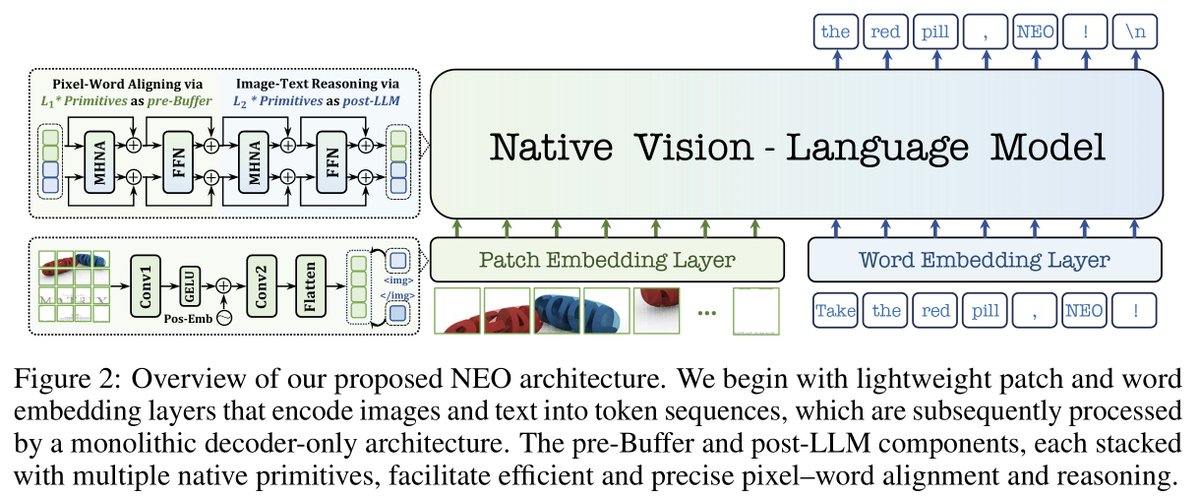
text tokens can't see future tokens (causal masking). image tokens can see all other image tokens (bidirectional).
both happening in the same model simultaneously.
why does this work?
because vision and language process information fundamentally differently.
text is sequential → you can't read word 10 before word 5 images are spatial → every pixel relates to every other pixel at once
forcing both through the same attention pattern breaks one or the other.
NEO respects how each modality actually works.
then there's Native-RoPE — the positional embedding innovation nobody saw coming.
standard RoPE tells the model "this is position 1, 2, 3" (temporal sequence). works for text. breaks for images.
images aren't just sequences. they're height × width × channels.
Native-RoPE assigns distinct frequencies to temporal, height, and width dimensions in separate channels.
now the model natively understands: "this token is in the top-left corner" AND "this token comes after that one in the sequence."
no hacks. just architecture that respects reality.
3
here's what changes:
training data: 390M examples vs billions others need architecture: unified from day one vs modular bolt-ons efficiency: competitive with GPT-4V using a fraction of resources accessibility: fully open-source — code, models, components, everything
every major lab took the same path: build best vision encoder + build best language model + figure out how to connect them.
practical. modular. expensive.
NEO asked a different question: what if we designed for both from the beginning?
turns out: you need less data, less complexity, less alignment headache.
and you get a model that doesn't treat vision as an add-on. it treats vision and language as equal primitives in the same system.
maybe modular architectures aren't the future.
maybe they're just the path we took because we built vision and language separately first.
the blueprint is public now.
training data: 390M examples vs billions others need architecture: unified from day one vs modular bolt-ons efficiency: competitive with GPT-4V using a fraction of resources accessibility: fully open-source — code, models, components, everything
every major lab took the same path: build best vision encoder + build best language model + figure out how to connect them.
practical. modular. expensive.
NEO asked a different question: what if we designed for both from the beginning?
turns out: you need less data, less complexity, less alignment headache.
and you get a model that doesn't treat vision as an add-on. it treats vision and language as equal primitives in the same system.
maybe modular architectures aren't the future.
maybe they're just the path we took because we built vision and language separately first.
the blueprint is public now.
4
5
The AI prompt library your competitors don't want you to find
→ Biggest collection of text & image prompts
→ Unlimited custom prompts
→ Lifetime access & updates
Use GOD30 at checkout for 30% off (24 hours left) 👇
godofprompt.ai/complete-ai-bu…
→ Biggest collection of text & image prompts
→ Unlimited custom prompts
→ Lifetime access & updates
Use GOD30 at checkout for 30% off (24 hours left) 👇
godofprompt.ai/complete-ai-bu…