BoJ Flags Growing Hedge Fund Leverage and the Collateral Risk That...

Blue Horseshoe@BlueHorse88
34 views
Oct 24, 2025
~2 min read
Advertisement
1
BoJ Flags Growing Hedge Fund Leverage and the Collateral Risk That Comes With It
The Bank of Japan’s latest Financial System Report (Oct 23, 2025) adds an important new dimension to Japan’s normalization story: global hedge fund leverage built on Japanese collateral.
1. Hedge funds have ramped up bond leverage
(Chart B2-1) shows how hedge funds have built large long and short positions in government bonds across the U.S., Europe, and Japan.
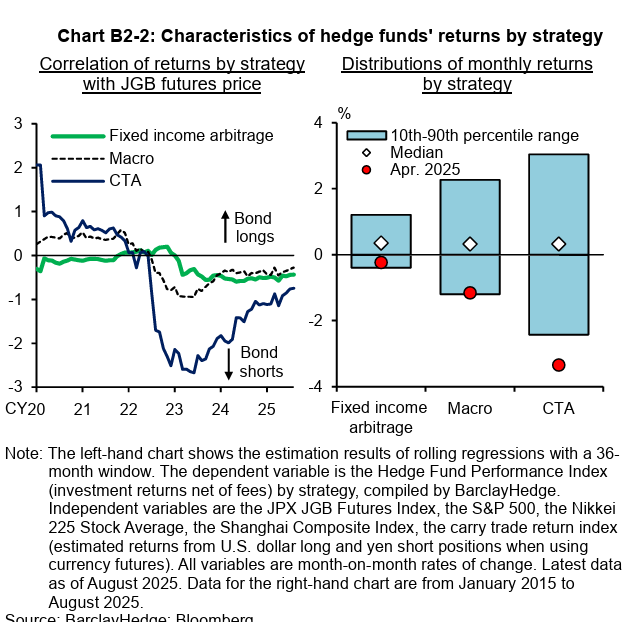
Most of this is driven by fixed-income arbitrage funds (traders betting on small yield spreads using heavy repo borrowing) (Chart B2-2).
When yields move sharply (as they have this year), these leveraged positions can unwind fast, creating waves of volatility across funding markets.
2. Repo financing is now the backbone of this trade
(Chart B2-3, left and middle panels) shows hedge funds’ share of U.S. repo transactions climbing to nearly 50% (!), the highest on record.
They borrow trillions of dollars through major global banks (G-SIBs), especially in the U.S. and Europe using Treasuries and JGBs as collateral.
The BoJ warns that this setup is fragile: if collateral values fall (e.g. when JGB yields rise), repo funding tightens and leveraged trades start to unwind, a feedback loop that can ripple through global markets.
3. Japan’s link in the chain runs through offshore hubs
(Chart B2-4) shows that funds based in the Cayman Islands (many managed from the U.S.) are now major traders of JGBs.
They borrow or source these bonds through Japanese and European bank affiliates, then reuse them as collateral in overseas repo markets.
Basically JGBs are increasingly being used as global leverage fuel.
Why it matters
The BoJ notes that while Japanese banks’ direct exposure to hedge funds is limited, their indirect exposure through repo and collateral chains is growing fast.
If hedge fund leverage unwinds, Japan could feel the shock via rising funding costs and tighter liquidity even without a domestic crisis.
Bottom line:
Japan’s long-term yields are rising, hedge fund leverage is expanding, and collateral is tightening.
That combination turns JGBs (once seen as a passive safe asset) into an active transmission channel for global volatility.
Source: Bank of Japan, Financial System Report (Oct 23, 2025), Box 2, Charts B2-1 to B2-4.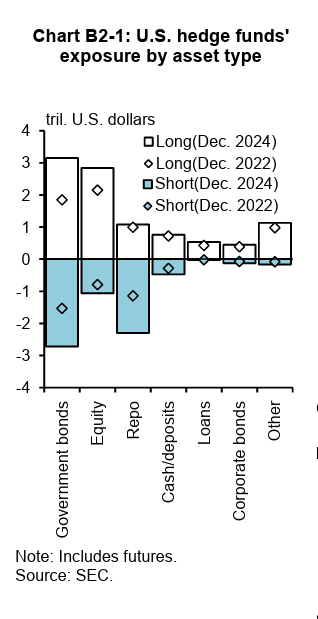


The Bank of Japan’s latest Financial System Report (Oct 23, 2025) adds an important new dimension to Japan’s normalization story: global hedge fund leverage built on Japanese collateral.
1. Hedge funds have ramped up bond leverage
(Chart B2-1) shows how hedge funds have built large long and short positions in government bonds across the U.S., Europe, and Japan.
Most of this is driven by fixed-income arbitrage funds (traders betting on small yield spreads using heavy repo borrowing) (Chart B2-2).
When yields move sharply (as they have this year), these leveraged positions can unwind fast, creating waves of volatility across funding markets.
2. Repo financing is now the backbone of this trade
(Chart B2-3, left and middle panels) shows hedge funds’ share of U.S. repo transactions climbing to nearly 50% (!), the highest on record.
They borrow trillions of dollars through major global banks (G-SIBs), especially in the U.S. and Europe using Treasuries and JGBs as collateral.
The BoJ warns that this setup is fragile: if collateral values fall (e.g. when JGB yields rise), repo funding tightens and leveraged trades start to unwind, a feedback loop that can ripple through global markets.
3. Japan’s link in the chain runs through offshore hubs
(Chart B2-4) shows that funds based in the Cayman Islands (many managed from the U.S.) are now major traders of JGBs.
They borrow or source these bonds through Japanese and European bank affiliates, then reuse them as collateral in overseas repo markets.
Basically JGBs are increasingly being used as global leverage fuel.
Why it matters
The BoJ notes that while Japanese banks’ direct exposure to hedge funds is limited, their indirect exposure through repo and collateral chains is growing fast.
If hedge fund leverage unwinds, Japan could feel the shock via rising funding costs and tighter liquidity even without a domestic crisis.
Bottom line:
Japan’s long-term yields are rising, hedge fund leverage is expanding, and collateral is tightening.
That combination turns JGBs (once seen as a passive safe asset) into an active transmission channel for global volatility.
Source: Bank of Japan, Financial System Report (Oct 23, 2025), Box 2, Charts B2-1 to B2-4.


