This is a story about a micro-cap tech company at a major...

Gaetano@crux_capital_
40 views
Jan 08, 2026
~11 min read
Advertisement
1
This is a story about a micro-cap tech company at a major inflection point.
After years of flying under the radar, One Stop Systems $OSS just brought in a top defense exec as CEO to execute on a newly-built $1B+ sales pipeline.
His first major task: landing a $200M+ sole-source Army contract that could fundamentally reshape the company.
Here's why $OSS is one to watch now 🧵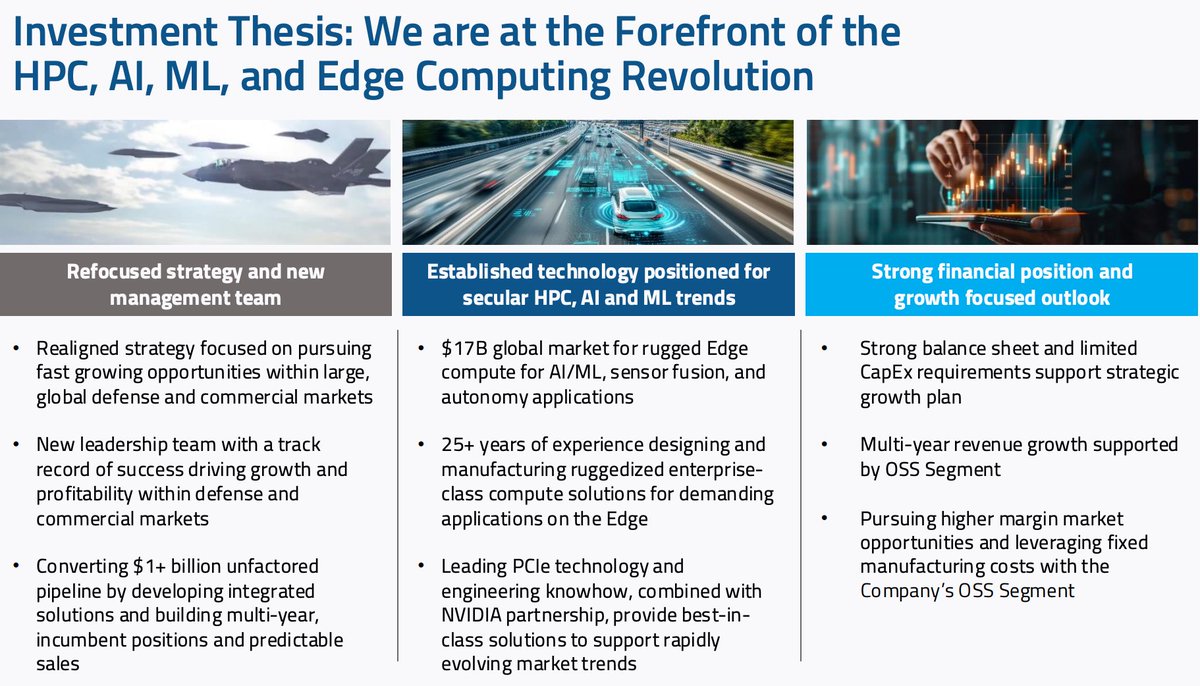
After years of flying under the radar, One Stop Systems $OSS just brought in a top defense exec as CEO to execute on a newly-built $1B+ sales pipeline.
His first major task: landing a $200M+ sole-source Army contract that could fundamentally reshape the company.
Here's why $OSS is one to watch now 🧵
2
What is One Stop Systems? $OSS
At its core, One Stop Systems designs and manufactures high-performance computing and storage solutions for rugged "edge" applications.
The company focuses on what it calls "AI Transportables," which are systems that deliver artificial intelligence and machine learning capabilities to harsh, mobile, and disconnected environments.
Their products include ruggedized servers, compute accelerators, and flash storage arrays engineered for demanding situations where standard computers would fail.
This technology is critical for real-time data processing in fields like defense, aerospace, autonomous vehicles, and heavy industry.
They build the specialized hardware that allows complex AI to function on the move, far from a traditional data center, enabling a new generation of intelligent systems in the field.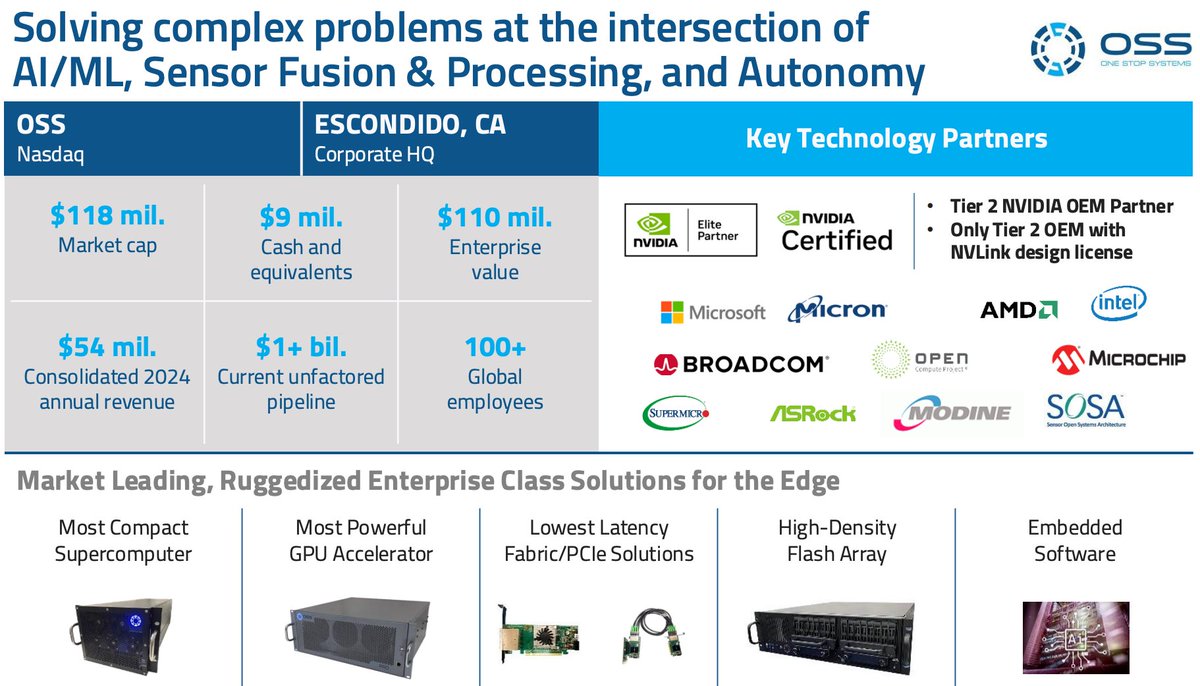
At its core, One Stop Systems designs and manufactures high-performance computing and storage solutions for rugged "edge" applications.
The company focuses on what it calls "AI Transportables," which are systems that deliver artificial intelligence and machine learning capabilities to harsh, mobile, and disconnected environments.
Their products include ruggedized servers, compute accelerators, and flash storage arrays engineered for demanding situations where standard computers would fail.
This technology is critical for real-time data processing in fields like defense, aerospace, autonomous vehicles, and heavy industry.
They build the specialized hardware that allows complex AI to function on the move, far from a traditional data center, enabling a new generation of intelligent systems in the field.
3
Core Market: Defense Dominance $OSS
One Stop Systems is strategically centered on the defense and aerospace market, which represents its largest and most immediate opportunity.
Their technology is a mission-critical component for the most demanding military applications.
This includes C5ISR (Command, Control, Computers, Communications, Cyber, Intelligence, Surveillance, and Reconnaissance), autonomous systems for ground combat vehicles like the Stryker and Abrams, and advanced data processing for reconnaissance aircraft such as the P-8A Poseidon.
In a world moving toward fully networked warfare, the ability to process massive amounts of sensor data in real-time without relying on a remote cloud is a non-negotiable requirement.
OSS's rugged, high-performance computers provide this exact capability, enabling zero-latency decision-making on the battlefield.
This positions them as a key enabler of a generational upgrade in military technology, where performance and reliability are valued far more than price, creating a significant barrier to entry for competitors.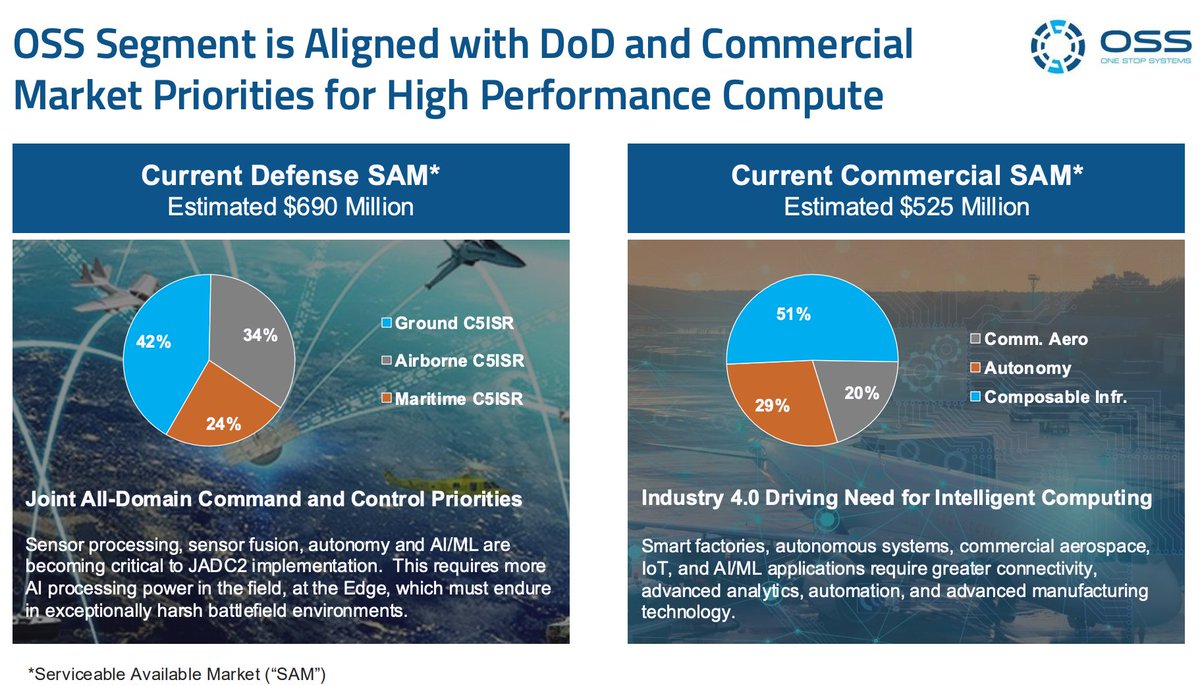
One Stop Systems is strategically centered on the defense and aerospace market, which represents its largest and most immediate opportunity.
Their technology is a mission-critical component for the most demanding military applications.
This includes C5ISR (Command, Control, Computers, Communications, Cyber, Intelligence, Surveillance, and Reconnaissance), autonomous systems for ground combat vehicles like the Stryker and Abrams, and advanced data processing for reconnaissance aircraft such as the P-8A Poseidon.
In a world moving toward fully networked warfare, the ability to process massive amounts of sensor data in real-time without relying on a remote cloud is a non-negotiable requirement.
OSS's rugged, high-performance computers provide this exact capability, enabling zero-latency decision-making on the battlefield.
This positions them as a key enabler of a generational upgrade in military technology, where performance and reliability are valued far more than price, creating a significant barrier to entry for competitors.
4
Growth Vector: Commercial Aerospace $OSS
Beyond defense, OSS is making calculated moves into high-value commercial markets.
A perfect example is their recent expansion into commercial aerospace.
The company announced a $1.5 million initial order from a Canadian integrator for passenger cabin systems, a deal expected to generate approximately $6.0 million in revenue over the next three years.
This is a strategic foothold in a new vertical. The systems, which include lighting and integration control units, are DO-160 qualified. A rigorous environmental testing standard for airborne equipment that demonstrates their hardware's reliability.
CEO Mike Knowles stated that expanding into this industry is a key part of their long-term growth strategy.
This win validates their technology's transferability from military to commercial applications and proves their ability to build long-standing partnerships with leading aerospace prime contractors, opening the door for recurring, multi-year production orders that strengthen the company's revenue backlog.
Beyond defense, OSS is making calculated moves into high-value commercial markets.
A perfect example is their recent expansion into commercial aerospace.
The company announced a $1.5 million initial order from a Canadian integrator for passenger cabin systems, a deal expected to generate approximately $6.0 million in revenue over the next three years.
This is a strategic foothold in a new vertical. The systems, which include lighting and integration control units, are DO-160 qualified. A rigorous environmental testing standard for airborne equipment that demonstrates their hardware's reliability.
CEO Mike Knowles stated that expanding into this industry is a key part of their long-term growth strategy.
This win validates their technology's transferability from military to commercial applications and proves their ability to build long-standing partnerships with leading aerospace prime contractors, opening the door for recurring, multi-year production orders that strengthen the company's revenue backlog.
5
Growth Vector: Medical & Industrial AI $OSS
OSS is also leveraging its expertise in rugged computing to penetrate other demanding commercial sectors.
A significant new vertical is medical imaging, highlighted by a recent $2 million follow-on order from a major medical OEM.
This single program has a potential value of over $25 million over five years, showcasing a substantial and growing revenue stream. These systems provide the intense computational power needed for advanced imaging technologies like MRI or CT scanners, where performance and reliability are paramount.
Additionally, the company provides critical solutions for autonomous trucking and agricultural equipment, where onboard AI processing is essential for navigation and operation in harsh outdoor environments.
These wins in diverse markets like healthcare and industrial automation demonstrate that the company's core competency is not limited to defense but is applicable to any field that requires data-center-level AI performance at the edge.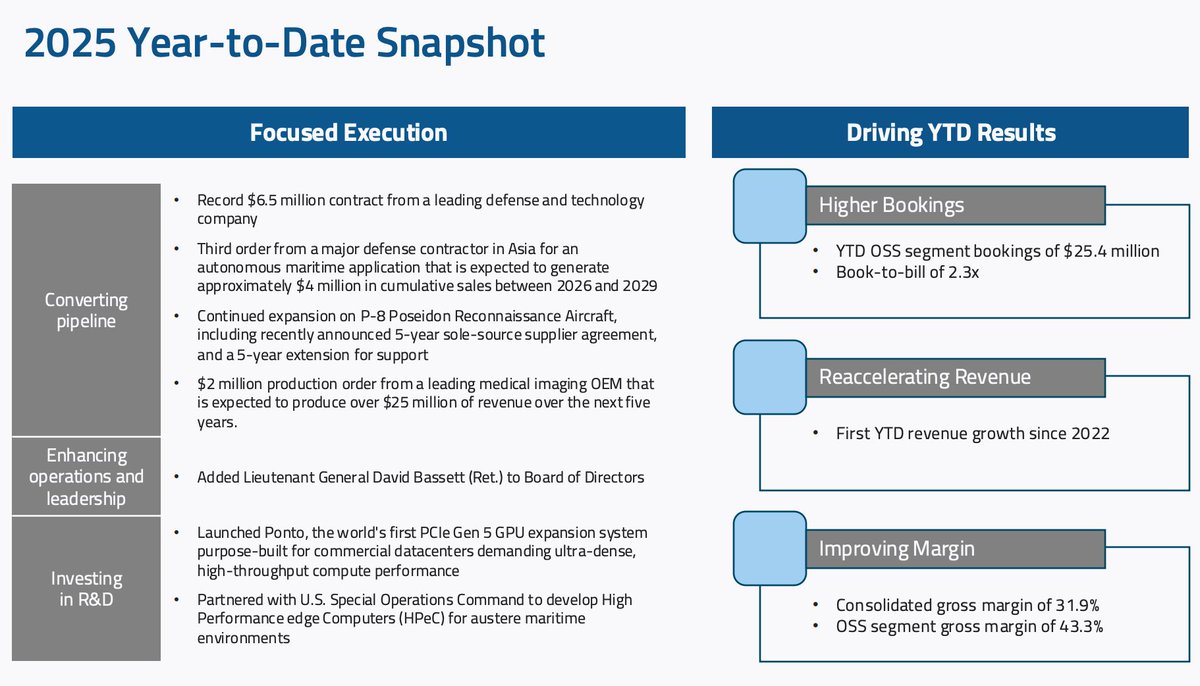
OSS is also leveraging its expertise in rugged computing to penetrate other demanding commercial sectors.
A significant new vertical is medical imaging, highlighted by a recent $2 million follow-on order from a major medical OEM.
This single program has a potential value of over $25 million over five years, showcasing a substantial and growing revenue stream. These systems provide the intense computational power needed for advanced imaging technologies like MRI or CT scanners, where performance and reliability are paramount.
Additionally, the company provides critical solutions for autonomous trucking and agricultural equipment, where onboard AI processing is essential for navigation and operation in harsh outdoor environments.
These wins in diverse markets like healthcare and industrial automation demonstrate that the company's core competency is not limited to defense but is applicable to any field that requires data-center-level AI performance at the edge.
6
The Secret Weapon: Customer-Funded Development $OSS
One of the most powerful and overlooked aspects of OSS's business model is its rapidly growing "customer-funded development revenue."
This revenue stream, which surged an incredible 118% to $3.7 million in 2024, is a critical leading indicator for future large-scale production contracts.
Here’s how it works: major customers, like defense primes or medical device OEMs, pay OSS to custom-design and engineer computing solutions specifically for their platforms.
They are essentially paying to have OSS technology "designed in" from the ground up. This process creates an incredibly strong incumbency advantage and exceptionally high switching costs.
Once an OSS system is qualified and integrated into the core architecture of a reconnaissance aircraft or an MRI machine, it becomes extremely difficult and cost-prohibitive for that customer to switch to a competitor.
This model provides a de-risked revenue stream, offers clear validation of the company's technology, and gives a direct line of sight into future high-margin production orders.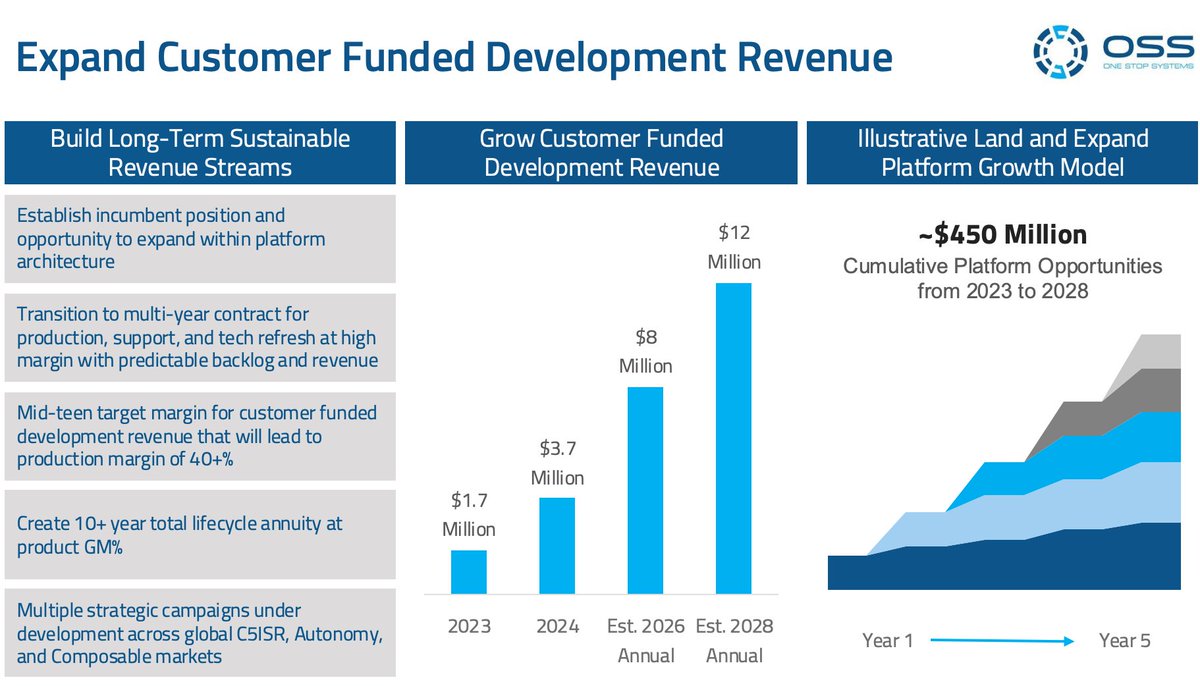
One of the most powerful and overlooked aspects of OSS's business model is its rapidly growing "customer-funded development revenue."
This revenue stream, which surged an incredible 118% to $3.7 million in 2024, is a critical leading indicator for future large-scale production contracts.
Here’s how it works: major customers, like defense primes or medical device OEMs, pay OSS to custom-design and engineer computing solutions specifically for their platforms.
They are essentially paying to have OSS technology "designed in" from the ground up. This process creates an incredibly strong incumbency advantage and exceptionally high switching costs.
Once an OSS system is qualified and integrated into the core architecture of a reconnaissance aircraft or an MRI machine, it becomes extremely difficult and cost-prohibitive for that customer to switch to a competitor.
This model provides a de-risked revenue stream, offers clear validation of the company's technology, and gives a direct line of sight into future high-margin production orders.
7
Path to Commercialization: From Design to Production $OSS
OSS has a clear and proven path from development to large-scale commercialization. The customer-funded development programs are the first step, establishing OSS as the incumbent technology provider for large, multi-year programs.
Management has explicitly stated that they expect development relationships initiated in 2024 to begin transitioning into production orders and sales throughout 2025 and beyond.
We are already seeing this happen with the follow-on production order from the medical imaging OEM, which started as a development program.
This model of getting paid to develop a solution and then securing the long-term production contract is the engine of their growth.
The company is actively pursuing these opportunities across its target markets, including datacenter, healthcare, aerospace, and multiple programs within the U.S. Department of Defense, laying the groundwork for a significant ramp-up in recurring revenue.
OSS has a clear and proven path from development to large-scale commercialization. The customer-funded development programs are the first step, establishing OSS as the incumbent technology provider for large, multi-year programs.
Management has explicitly stated that they expect development relationships initiated in 2024 to begin transitioning into production orders and sales throughout 2025 and beyond.
We are already seeing this happen with the follow-on production order from the medical imaging OEM, which started as a development program.
This model of getting paid to develop a solution and then securing the long-term production contract is the engine of their growth.
The company is actively pursuing these opportunities across its target markets, including datacenter, healthcare, aerospace, and multiple programs within the U.S. Department of Defense, laying the groundwork for a significant ramp-up in recurring revenue.
8
The Crown Jewel: A Transformative Partnership $OSS
The most powerful validation of OSS's technology and market position is its contract with the U.S. Army.
The company has been designated as the sole-source provider for the computing and storage hardware for a critical 360° situational awareness vehicle modernization program.
The potential value of this single contract is estimated to be over $200 million over the next three to five years. A figure that is more than double the company's entire market capitalization.
The "sole-source" designation is crucial. It removes competitive bidding risk and provides a clear, verifiable path to revenue.
This program is a transformative event that, upon execution, would fundamentally reshape the company's financial landscape.
It serves as an undeniable endorsement from one of the world's most demanding customers and provides a powerful reference case for securing other large-scale defense programs.
The most powerful validation of OSS's technology and market position is its contract with the U.S. Army.
The company has been designated as the sole-source provider for the computing and storage hardware for a critical 360° situational awareness vehicle modernization program.
The potential value of this single contract is estimated to be over $200 million over the next three to five years. A figure that is more than double the company's entire market capitalization.
The "sole-source" designation is crucial. It removes competitive bidding risk and provides a clear, verifiable path to revenue.
This program is a transformative event that, upon execution, would fundamentally reshape the company's financial landscape.
It serves as an undeniable endorsement from one of the world's most demanding customers and provides a powerful reference case for securing other large-scale defense programs.
9
The Billion-Dollar Roadmap $OSS
The $200M+ Army contract is just the tip of the iceberg. Management has repeatedly confirmed a qualified sales pipeline that now exceeds $1 billion.
The sheer scale of this pipeline relative to the company's current size is staggering and suggests the potential for exponential growth. This is not a wish list. It is a diversified portfolio of concrete opportunities across their key markets.
It includes multiple programs within the U.S. Department of Defense, renewals for established platforms like the U.S. Navy P-8 program, and major commercial applications.
For instance, the company is pursuing a potential $200 million multi-year opportunity within the composable infrastructure/datacenter market alone.
This massive, validated pipeline shows that the demand for their specialized technology is immense and provides a clear roadmap for the company's long-term growth ambitions.
The $200M+ Army contract is just the tip of the iceberg. Management has repeatedly confirmed a qualified sales pipeline that now exceeds $1 billion.
The sheer scale of this pipeline relative to the company's current size is staggering and suggests the potential for exponential growth. This is not a wish list. It is a diversified portfolio of concrete opportunities across their key markets.
It includes multiple programs within the U.S. Department of Defense, renewals for established platforms like the U.S. Navy P-8 program, and major commercial applications.
For instance, the company is pursuing a potential $200 million multi-year opportunity within the composable infrastructure/datacenter market alone.
This massive, validated pipeline shows that the demand for their specialized technology is immense and provides a clear roadmap for the company's long-term growth ambitions.
10
The De-Risking Catalyst: A New CEO $OSS
For any small company with a massive pipeline, the biggest question is always execution.
In May 2024, OSS made a strategic move to address this head-on by appointing Michael Knowles as CEO. This was not a routine leadership change. Mr. Knowles previously served as a Vice President in the C5ISR sector at Cubic, a major defense contractor.
This means the person now leading OSS has spent years selling advanced technology directly to the same military and prime contractor customers that make up the company's primary target market.
His deep domain expertise, extensive network, and firsthand experience navigating the complex defense procurement landscape directly address what the market perceives as the company's greatest challenge.
This appointment significantly de-risks the execution required to convert their billion-dollar sales pipeline into tangible revenue, making the investment thesis far more compelling.
For any small company with a massive pipeline, the biggest question is always execution.
In May 2024, OSS made a strategic move to address this head-on by appointing Michael Knowles as CEO. This was not a routine leadership change. Mr. Knowles previously served as a Vice President in the C5ISR sector at Cubic, a major defense contractor.
This means the person now leading OSS has spent years selling advanced technology directly to the same military and prime contractor customers that make up the company's primary target market.
His deep domain expertise, extensive network, and firsthand experience navigating the complex defense procurement landscape directly address what the market perceives as the company's greatest challenge.
This appointment significantly de-risks the execution required to convert their billion-dollar sales pipeline into tangible revenue, making the investment thesis far more compelling.
11
Decoding the CEO's Strategy $OSS
CEO Mike Knowles' public statements reveal a clear and confident strategy.
At the recent AUSA defense exposition, he said, "Our focus this year is on bringing the power of the data center to the fight by delivering unique Enterprise Class compute capabilities directly to the battlefield".
This is a precise articulation of their value proposition. Following a recent $12.5 million capital raise, he stated the offering "provides the capital to support our current and future sales growth, while also strengthening our balance sheet".
This shows a proactive approach to ensuring they have the financial firepower to deliver on the large orders in their pipeline.
His comments consistently emphasize a focus on higher-margin core markets, financial discipline, and leveraging their proven technology to establish incumbent positions on major platforms.
This signals a mature, focused leadership team that understands exactly what it needs to do to scale the business.
CEO Mike Knowles' public statements reveal a clear and confident strategy.
At the recent AUSA defense exposition, he said, "Our focus this year is on bringing the power of the data center to the fight by delivering unique Enterprise Class compute capabilities directly to the battlefield".
This is a precise articulation of their value proposition. Following a recent $12.5 million capital raise, he stated the offering "provides the capital to support our current and future sales growth, while also strengthening our balance sheet".
This shows a proactive approach to ensuring they have the financial firepower to deliver on the large orders in their pipeline.
His comments consistently emphasize a focus on higher-margin core markets, financial discipline, and leveraging their proven technology to establish incumbent positions on major platforms.
This signals a mature, focused leadership team that understands exactly what it needs to do to scale the business.
12
Recent Developments & Upcoming Catalysts $OSS
The momentum at OSS is accelerating. In just the last few months, the company has announced several key developments. They closed a $12.5 million capi tal raise, strengthening their balance sheet to fund the large orders they expect to receive.
They secured the $1.5 million initial order in commercial aerospace with a $6 million pipeline and a $2 million follow-on order in medical imaging with a $25 million+ potential.
They also announced new awards totaling $3.9 million to support the P-8A Poseidon reconnaissance aircraft.
Looking ahead, the next major milestone for investors is the company's stated goal of achieving EBITDA break-even for the full year of 2025.
Achieving this would be a critical proof point that their strategic pivot to higher-margin business is succeeding and that they are on a clear path to sustained profitability.
The momentum at OSS is accelerating. In just the last few months, the company has announced several key developments. They closed a $12.5 million capi tal raise, strengthening their balance sheet to fund the large orders they expect to receive.
They secured the $1.5 million initial order in commercial aerospace with a $6 million pipeline and a $2 million follow-on order in medical imaging with a $25 million+ potential.
They also announced new awards totaling $3.9 million to support the P-8A Poseidon reconnaissance aircraft.
Looking ahead, the next major milestone for investors is the company's stated goal of achieving EBITDA break-even for the full year of 2025.
Achieving this would be a critical proof point that their strategic pivot to higher-margin business is succeeding and that they are on a clear path to sustained profitability.
13
The Financial Pivot to Profitability $OSS
A key part of the OSS story is the deliberate strategic pivot that is already transforming its financial profile.
The company operates in two segments: the core, U.S.-based OSS segment, and the European-based Bressner segment, which is more of a legacy system integrator.
The difference in profitability is stark. In the most recent quarter, the core OSS segment reported a healthy gross margin of 41.3%.
The Bressner segment, by contrast, had a gross margin of just 24.3%. Management is actively focusing resources on the higher-growth, higher-margin opportunities within the core OSS segment, which is projected to grow over 20% this year.
As the revenue mix shifts decisively toward these more profitable products, the company's consolidated gross margin will naturally expand, accelerating its path to achieving its goal of EBITDA break-even and, ultimately, sustained net profitability.
A key part of the OSS story is the deliberate strategic pivot that is already transforming its financial profile.
The company operates in two segments: the core, U.S.-based OSS segment, and the European-based Bressner segment, which is more of a legacy system integrator.
The difference in profitability is stark. In the most recent quarter, the core OSS segment reported a healthy gross margin of 41.3%.
The Bressner segment, by contrast, had a gross margin of just 24.3%. Management is actively focusing resources on the higher-growth, higher-margin opportunities within the core OSS segment, which is projected to grow over 20% this year.
As the revenue mix shifts decisively toward these more profitable products, the company's consolidated gross margin will naturally expand, accelerating its path to achieving its goal of EBITDA break-even and, ultimately, sustained net profitability.
14
Acknowledging the Risks $OSS
No investment thesis is complete without a clear-eyed view of the risks, and OSS is a speculative investment.
The primary risk is execution and concentration. The company's future is heavily dependent on converting a few very large programs within its pipeline, particularly the $200M+ Army contract.
Government procurement cycles can be long and unpredictable, and any significant delays or cancellations would be a major setback.
The company also has a history of unprofitability, and achieving sustained profitability is not guaranteed.
Finally, as a micro-cap stock, OSS is subject to higher volatility and lower liquidity, making it suitable only for investors with a high tolerance for risk and a long-term investment horizon.
These risks are real, but they are also what create the potential for an asymmetric reward if the company successfully executes its plan.
No investment thesis is complete without a clear-eyed view of the risks, and OSS is a speculative investment.
The primary risk is execution and concentration. The company's future is heavily dependent on converting a few very large programs within its pipeline, particularly the $200M+ Army contract.
Government procurement cycles can be long and unpredictable, and any significant delays or cancellations would be a major setback.
The company also has a history of unprofitability, and achieving sustained profitability is not guaranteed.
Finally, as a micro-cap stock, OSS is subject to higher volatility and lower liquidity, making it suitable only for investors with a high tolerance for risk and a long-term investment horizon.
These risks are real, but they are also what create the potential for an asymmetric reward if the company successfully executes its plan.
15
Long-Term Ambition & Valuation Scenarios $OSS
The long-term ambition for OSS is to become the "Intel Inside" for rugged AI hardware.
Their $1B+ qualified sales pipeline shows this is their stated roadmap of opportunity. Wall Street analysts see the potential, with an average price target around $8.16 and a high target of $9.45.
To put this in perspective, let's look at a relevant competitor, Mercury Systems $MRCY, a larger defense electronics player. MRCY trades at an EV/Sales multiple of approximately 5.7x.
If OSS successfully converts just $200 million of its pipeline into annual revenue over the next several years and earns a more conservative 3x EV/Sales multiple, it would imply an enterprise value of $600 million which is a significant increase from its current valuation.
This demonstrates the multi-bagger potential if management executes on its plan.
(Disclaimer: This is speculative modeling based on public competitor data and analyst reports. It is not a guarantee of future performance.)
The long-term ambition for OSS is to become the "Intel Inside" for rugged AI hardware.
Their $1B+ qualified sales pipeline shows this is their stated roadmap of opportunity. Wall Street analysts see the potential, with an average price target around $8.16 and a high target of $9.45.
To put this in perspective, let's look at a relevant competitor, Mercury Systems $MRCY, a larger defense electronics player. MRCY trades at an EV/Sales multiple of approximately 5.7x.
If OSS successfully converts just $200 million of its pipeline into annual revenue over the next several years and earns a more conservative 3x EV/Sales multiple, it would imply an enterprise value of $600 million which is a significant increase from its current valuation.
This demonstrates the multi-bagger potential if management executes on its plan.
(Disclaimer: This is speculative modeling based on public competitor data and analyst reports. It is not a guarantee of future performance.)
16
Final Thesis: The Asymmetric Opportunity
To sum it up, $OSS presents a compelling, asymmetric risk/reward opportunity. It is a pure-play investment in the foundational hardware layer of the AI revolution at the tactical edge.
The company is at an inflection point, with a new, deeply experienced CEO who is actively de-risking the execution of a massive, validated $1B+ sales pipeline.
With a transformative $200M+ sole-source government contract providing a potential revenue floor and a clear strategic pivot toward higher-margin business, the disconnect between its current micro-cap valuation and its long-term potential is profound.
For investors with a tolerance for risk, OSS offers a rare chance to invest in the essential hardware of a multi-trillion-dollar industry upgrade at a very early stage.
To sum it up, $OSS presents a compelling, asymmetric risk/reward opportunity. It is a pure-play investment in the foundational hardware layer of the AI revolution at the tactical edge.
The company is at an inflection point, with a new, deeply experienced CEO who is actively de-risking the execution of a massive, validated $1B+ sales pipeline.
With a transformative $200M+ sole-source government contract providing a potential revenue floor and a clear strategic pivot toward higher-margin business, the disconnect between its current micro-cap valuation and its long-term potential is profound.
For investors with a tolerance for risk, OSS offers a rare chance to invest in the essential hardware of a multi-trillion-dollar industry upgrade at a very early stage.
17
Disclaimer: We are long $OSS . None of this is financial advice or a reccomendation
