My brain broke when I read this paper. A tiny 7 Million parameter...

Jackson Atkins@JacksonAtkinsX
30 views
Oct 08, 2025
~3 min read
Advertisement
1
My brain broke when I read this paper.
A tiny 7 Million parameter model just beat DeepSeek-R1, Gemini 2.5 pro, and o3-mini at reasoning on both ARG-AGI 1 and ARC-AGI 2.
It's called Tiny Recursive Model (TRM) from Samsung.
How can a model 10,000x smaller be smarter?
Here's how it works:
1. Draft an Initial Answer: Unlike an LLM that writes word-by-word, TRM first generates a quick, complete "draft" of the solution. Think of this as its first rough guess.
2. Create a "Scratchpad": It then creates a separate space for its internal thoughts, a latent reasoning "scratchpad." This is where the real magic happens.
3. Intensely Self-Critique: The model enters an intense inner loop. It compares its draft answer to the original problem and refines its reasoning on the scratchpad over and over (6 times in a row), asking itself, "Does my logic hold up? Where are the errors?"
4. Revise the Answer: After this focused "thinking," it uses the improved logic from its scratchpad to create a brand new, much better draft of the final answer.
5. Repeat until Confident: The entire process, draft, think, revise, is repeated up to 16 times. Each cycle pushes the model closer to a correct, logically sound solution.
Why this matters:
Business Leaders: This is what algorithmic advantage looks like. While competitors are paying massive inference costs for brute-force scale, a smarter, more efficient model can deliver superior performance for a tiny fraction of the cost.
Researchers: This is a major validation for neuro-symbolic ideas. The model's ability to recursively "think" before "acting" demonstrates that architecture, not just scale, can be a primary driver of reasoning ability.
Practitioners: SOTA reasoning is no longer gated behind billion-dollar GPU clusters. This paper provides a highly efficient, parameter-light blueprint for building specialized reasoners that can run anywhere.
This isn't just scaling down; it's a completely different, more deliberate way of solving problems.
A tiny 7 Million parameter model just beat DeepSeek-R1, Gemini 2.5 pro, and o3-mini at reasoning on both ARG-AGI 1 and ARC-AGI 2.
It's called Tiny Recursive Model (TRM) from Samsung.
How can a model 10,000x smaller be smarter?
Here's how it works:
1. Draft an Initial Answer: Unlike an LLM that writes word-by-word, TRM first generates a quick, complete "draft" of the solution. Think of this as its first rough guess.
2. Create a "Scratchpad": It then creates a separate space for its internal thoughts, a latent reasoning "scratchpad." This is where the real magic happens.
3. Intensely Self-Critique: The model enters an intense inner loop. It compares its draft answer to the original problem and refines its reasoning on the scratchpad over and over (6 times in a row), asking itself, "Does my logic hold up? Where are the errors?"
4. Revise the Answer: After this focused "thinking," it uses the improved logic from its scratchpad to create a brand new, much better draft of the final answer.
5. Repeat until Confident: The entire process, draft, think, revise, is repeated up to 16 times. Each cycle pushes the model closer to a correct, logically sound solution.
Why this matters:
Business Leaders: This is what algorithmic advantage looks like. While competitors are paying massive inference costs for brute-force scale, a smarter, more efficient model can deliver superior performance for a tiny fraction of the cost.
Researchers: This is a major validation for neuro-symbolic ideas. The model's ability to recursively "think" before "acting" demonstrates that architecture, not just scale, can be a primary driver of reasoning ability.
Practitioners: SOTA reasoning is no longer gated behind billion-dollar GPU clusters. This paper provides a highly efficient, parameter-light blueprint for building specialized reasoners that can run anywhere.
This isn't just scaling down; it's a completely different, more deliberate way of solving problems.
2
The new AI model architecture Tiny Recursive Model (TRM) beats DeepSeek R1, Gemini 2.5 Pro, and o3-mini on ARC-AGI 1 and ARC-AGI-2.
It has only 7 Million parameters and used 1000 training samples.
It has only 7 Million parameters and used 1000 training samples.
3
Less is More: Recursive Reasoning with Tiny Networks
Abstract:
Hierarchical Reasoning Model (HRM) is a novel approach using two small neural networks recursing at different frequencies. This biologically inspired method beats Large Language models (LLMs) on hard puzzle tasks such as Sudoku, Maze, and ARC-AGI while trained with small models (27M parameters) on small data (around 1000 examples). HRM holds great promise for solving hard problems with small networks, but it is not yet well understood and may be suboptimal. We propose Tiny Recursive Model (TRM), a much simpler recursive reasoning approach that achieves significantly higher generalization than HRM, while using a single tiny network with only 2 layers. With only 7M parameters, TRM obtains 45% test-accuracy on ARC-AGI-1 and 8% on ARC-AGI-2, higher than most LLMs (e.g., Deepseek R1, o3-mini, Gemini 2.5 Pro) with less than 0.01% of the parameters.
Submitted on 6 Oct 2025
arxiv.org/abs/2510.04871…
Abstract:
Hierarchical Reasoning Model (HRM) is a novel approach using two small neural networks recursing at different frequencies. This biologically inspired method beats Large Language models (LLMs) on hard puzzle tasks such as Sudoku, Maze, and ARC-AGI while trained with small models (27M parameters) on small data (around 1000 examples). HRM holds great promise for solving hard problems with small networks, but it is not yet well understood and may be suboptimal. We propose Tiny Recursive Model (TRM), a much simpler recursive reasoning approach that achieves significantly higher generalization than HRM, while using a single tiny network with only 2 layers. With only 7M parameters, TRM obtains 45% test-accuracy on ARC-AGI-1 and 8% on ARC-AGI-2, higher than most LLMs (e.g., Deepseek R1, o3-mini, Gemini 2.5 Pro) with less than 0.01% of the parameters.
Submitted on 6 Oct 2025
arxiv.org/abs/2510.04871…
4
Samsung published the code this morning on Github.

🦋 Just This Guy@justthisguy
@JacksonAtkinsX github.com/SamsungSAILMon…
5
Is TRM just overfitting or benchmark maxing?
The author @jm_alexia directly address this question. The model was trained on 1,000 Sudoku examples and achieved 87.4% accuracy on a test set of 423K puzzles. This demonstrates the model was able to generalize within a domain.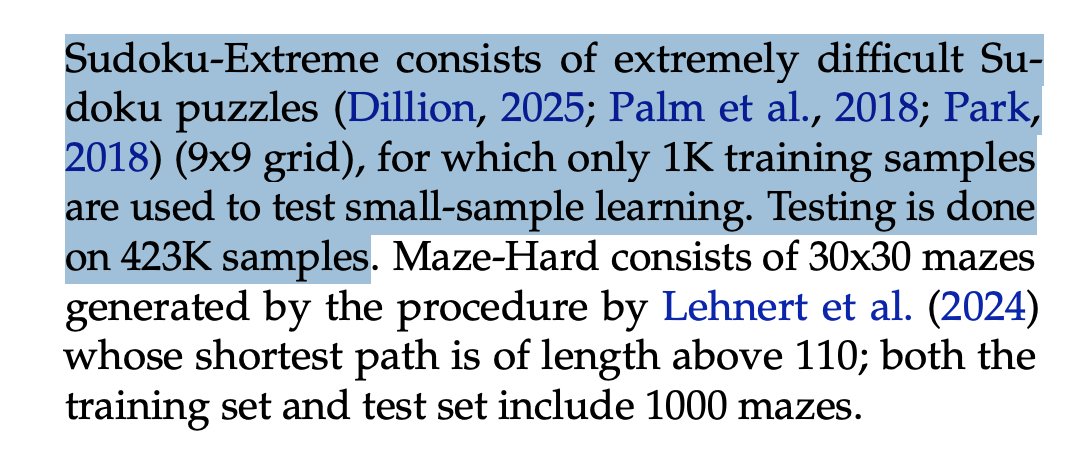
The author @jm_alexia directly address this question. The model was trained on 1,000 Sudoku examples and achieved 87.4% accuracy on a test set of 423K puzzles. This demonstrates the model was able to generalize within a domain.
6
@GregKamradt, the president of @arcprize might put out a bounty to get TRM tested on the private set.
I'd love to see this.

I'd love to see this.
Greg Kamradt@GregKamradt
Wow small
Get this in the ARC Prize 2025 on Kaggle!
Then you’ll get a verified score on the v2 *private* test set for
Might put out a bounty to make it happen
If you’re up for it DM me
Get this in the ARC Prize 2025 on Kaggle!
Then you’ll get a verified score on the v2 *private* test set for
Might put out a bounty to make it happen
If you’re up for it DM me
7
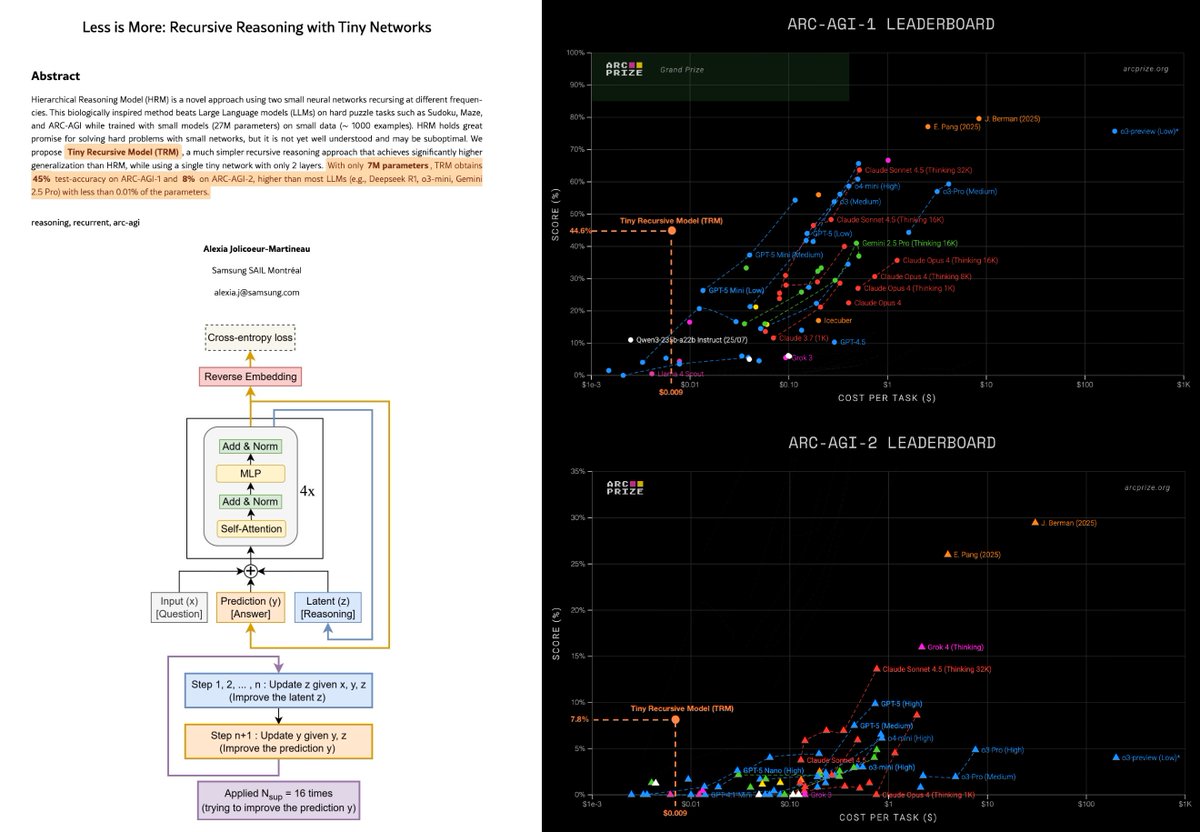
Nice breakdown on the costs of running TRM including plots on ARC-AGI 1 and 2 so you can see how it compares to other models.

Deedy@deedydas
The TRM paper feels like a significant AI breakthrough.
It destroys the pareto frontier on the ARC AGI 1 and 2 benchmarks (and Sudoku and Maze solving) with an estd < $0.01 cost per task and cost < $500 to train the 7M model on 2 H100s for 2 days.
[Training and test specifics]
For ARC, it trained on 160 examples from ConceptARC. At test-time, it uses the most common answer of 1000 augmentations at test-time and embeds a fixed shape of the task in the input.
[Industry implications]
Most AI companies today use general purpose LLMs with prompting for tasks. For specific tasks, smaller models may not just be cheaper, but far higher quality! Startups could (and should) train models for < $1000 for specific "fixed length" subtasks (specific PDF extraction, time series forecasting, etc) and use it as a tool to the general model to not only push performance, but build some meaningful IP at the task they're trying to automate.
It destroys the pareto frontier on the ARC AGI 1 and 2 benchmarks (and Sudoku and Maze solving) with an estd < $0.01 cost per task and cost < $500 to train the 7M model on 2 H100s for 2 days.
[Training and test specifics]
For ARC, it trained on 160 examples from ConceptARC. At test-time, it uses the most common answer of 1000 augmentations at test-time and embeds a fixed shape of the task in the input.
[Industry implications]
Most AI companies today use general purpose LLMs with prompting for tasks. For specific tasks, smaller models may not just be cheaper, but far higher quality! Startups could (and should) train models for < $1000 for specific "fixed length" subtasks (specific PDF extraction, time series forecasting, etc) and use it as a tool to the general model to not only push performance, but build some meaningful IP at the task they're trying to automate.
8
TRM was tested on the ARC-AGI 1 and 2 semi-private sets.
Results are close to the promise in the paper.
ARC-AGI 1: 40.0%
ARC-AGI 2: 6.3%


Results are close to the promise in the paper.
ARC-AGI 1: 40.0%
ARC-AGI 2: 6.3%
ARC Prize@arcprize
Tiny Recursion Model (TRM) results on ARC-AGI
- ARC-AGI-1: 40%, $1.76/task
- ARC-AGI-2: 6.2%, $2.10/task
Thank you to @jm_alexia for contributing TRM, a well written, open source, and thorough research to the community based on the HRM from @makingAGI
- ARC-AGI-1: 40%, $1.76/task
- ARC-AGI-2: 6.2%, $2.10/task
Thank you to @jm_alexia for contributing TRM, a well written, open source, and thorough research to the community based on the HRM from @makingAGI
9
The team at alphaXiv reproduced the results of TRM, released the code, and provided an API.
Great work!

Great work!
alphaXiv@askalphaxiv
Tiny Recursive Models: A tiny 7M parameter model that recursively refines its answer beats LLMs 100x larger on hard puzzles like ARC-AGI
We independently reproduced the paper, corroborated results, and released the weights + API access for those looking to benchmark it 🔍
We independently reproduced the paper, corroborated results, and released the weights + API access for those looking to benchmark it 🔍
10
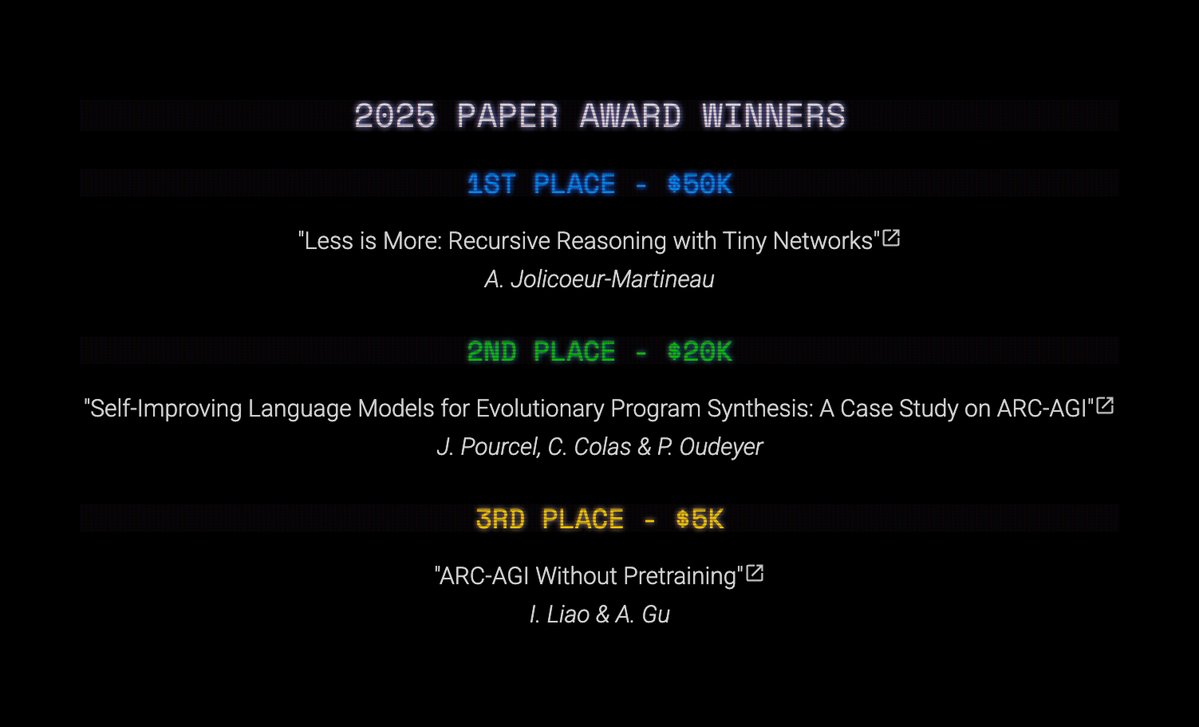
Congrats to @jm_alexia for winning first prize in the ARC 2025 Papers Awards for her cutting edge work with Tiny Recursive Model (TRM)!🥇
ARC Prize@arcprize
ARC Prize 2025 Paper Award Winners
1st / "Less is More: Recursive Reasoning with Tiny Networks" (TRM) / A. Jolicoeur-Martineau / $50k
2nd / "Self-Improving Language Models for Evolutionary Program Synthesis: A Case Study on ARC-AGI" (SOAR) / J. Pourcel et al. / $20k
3rd / "ARC-AGI Without Pretraining" / I. Liao et al. / $5k
1st / "Less is More: Recursive Reasoning with Tiny Networks" (TRM) / A. Jolicoeur-Martineau / $50k
2nd / "Self-Improving Language Models for Evolutionary Program Synthesis: A Case Study on ARC-AGI" (SOAR) / J. Pourcel et al. / $20k
3rd / "ARC-AGI Without Pretraining" / I. Liao et al. / $5k