🚫 Stop Chasing the Perfect Strategy 🚫 I often receive messages from...

Concretum Research@ConcretumR
33 views
Sep 10, 2025
~2 min read
Advertisement
1
🚫 Stop Chasing the Perfect Strategy 🚫
I often receive messages from readers searching for the perfect set of parameters to optimize a trading strategy. The truth is that adding more filters and tweaking parameters usually improves the in-sample Sharpe ratio—but almost always leads to much worse out-of-sample results.
So my sincere advice to all aspiring quants is this: don’t waste time chasing the holy grail in a single strategy. Instead, focus on combining multiple simple strategies and aim to capture the essence of the edge, not its most fragile historical outliers.
As highlighted in a recent research by MAN AHL, there is significant dispersion of performance among leading CTA funds each year, often due to parameter design choices. Fast trend signals may thrive in crisis periods but lag in calmer markets. Trying to forecast which parameter set will dominate next has proven challenging even for the largest, most experienced funds.
A better approach is to build an ensemble of trading strategies, even within the same style.
For example, in the intraday trend-following space, we are currently adding a new simple trend model to our portfolio, which already includes seven different intraday solutions. These eight strategies differentiate themselves by the assets traded, rebalancing frequency, entry and exit rules, and trailing-stop mechanisms. Within this bucket, we don’t expect strategies to be uncorrelated (after all, we want to be fully long/short when strong intraday trends emerge). But with an average pairwise correlation of around 0.50, we managed to:
✅ Improve the aggregate Sharpe Ratio of the portfolio from 1.06 to 1.50
✅ Reduce the risk of being overly concentrated in a single strategy that might lose its edge
Attached you’ll find three charts:
1️⃣ Correlation matrix showing pairwise correlations among strategies
2️⃣ Rank board: each year strategies are sorted by return, with fixed colors per strategy—notice how some of the worst performers in one year often become top performers the next
3️⃣ Equity curves of each strategy, along with the combined portfolio (black line)
Bottom Line: Long-term success in systematic trading doesn’t come from chasing the “perfect” strategy, but from building robust portfolios of simple, complementary edges.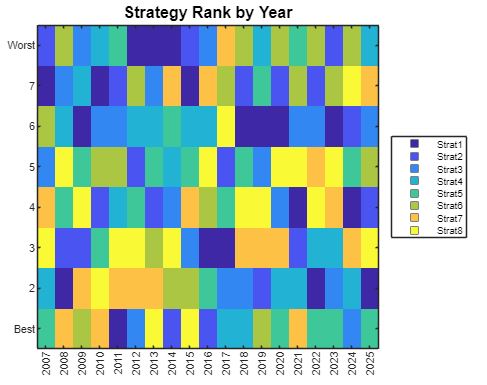


I often receive messages from readers searching for the perfect set of parameters to optimize a trading strategy. The truth is that adding more filters and tweaking parameters usually improves the in-sample Sharpe ratio—but almost always leads to much worse out-of-sample results.
So my sincere advice to all aspiring quants is this: don’t waste time chasing the holy grail in a single strategy. Instead, focus on combining multiple simple strategies and aim to capture the essence of the edge, not its most fragile historical outliers.
As highlighted in a recent research by MAN AHL, there is significant dispersion of performance among leading CTA funds each year, often due to parameter design choices. Fast trend signals may thrive in crisis periods but lag in calmer markets. Trying to forecast which parameter set will dominate next has proven challenging even for the largest, most experienced funds.
A better approach is to build an ensemble of trading strategies, even within the same style.
For example, in the intraday trend-following space, we are currently adding a new simple trend model to our portfolio, which already includes seven different intraday solutions. These eight strategies differentiate themselves by the assets traded, rebalancing frequency, entry and exit rules, and trailing-stop mechanisms. Within this bucket, we don’t expect strategies to be uncorrelated (after all, we want to be fully long/short when strong intraday trends emerge). But with an average pairwise correlation of around 0.50, we managed to:
✅ Improve the aggregate Sharpe Ratio of the portfolio from 1.06 to 1.50
✅ Reduce the risk of being overly concentrated in a single strategy that might lose its edge
Attached you’ll find three charts:
1️⃣ Correlation matrix showing pairwise correlations among strategies
2️⃣ Rank board: each year strategies are sorted by return, with fixed colors per strategy—notice how some of the worst performers in one year often become top performers the next
3️⃣ Equity curves of each strategy, along with the combined portfolio (black line)
Bottom Line: Long-term success in systematic trading doesn’t come from chasing the “perfect” strategy, but from building robust portfolios of simple, complementary edges.
2
📖 For those interested, you can also find an example of an intraday trend-following strategy in our paper Beat the Market, freely available here -->bit.ly/BeatTheMarketS…
📝 You can find the reseach note by MAN AHL here -->man.com/insights/deep-…
📩 In case you have any doubts do not hesitate to reach out: carlo@concretumgroup.com
📝 You can find the reseach note by MAN AHL here -->man.com/insights/deep-…
📩 In case you have any doubts do not hesitate to reach out: carlo@concretumgroup.com
