''Don't be fooled by the name'' - My $DAVE thesis! DAVE is still...

TacticzHazel@TacticzH
7 views
Sep 09, 2025
~11 min read
Advertisement
1
''Don't be fooled by the name'' - My $DAVE thesis!
DAVE is still under everyone's radar. It's fast-growing, has a simple business model and I think it's very undervalued.
🧵A big thread - Let's dive in 👇
DAVE is still under everyone's radar. It's fast-growing, has a simple business model and I think it's very undervalued.
🧵A big thread - Let's dive in 👇
2
1.1 / Company overview
$DAVE is one of those companies that is unloved because of history. Their old business model justified this hate and things did not look good. But, a company can change. And that provides a new opportunity. And that is exactly what Dave did!
So what do they do?
Simply put: Dave is a U.S. fintech company that helps people manage their money through their mobile app. Their main focus is on micro-lending and they are the current leader in this space.
Basically, Dave helps people avoid overdraft fees, budget better, and get small cash advances before payday.
$DAVE is one of those companies that is unloved because of history. Their old business model justified this hate and things did not look good. But, a company can change. And that provides a new opportunity. And that is exactly what Dave did!
So what do they do?
Simply put: Dave is a U.S. fintech company that helps people manage their money through their mobile app. Their main focus is on micro-lending and they are the current leader in this space.
Basically, Dave helps people avoid overdraft fees, budget better, and get small cash advances before payday.
3
1.2/ Company overview/ the app
What makes $DAVE unique, is that they have significantly lower fees due to a lower cost to service, and a scalable AI engine (CashAI) that helps to keep delinquency rates low.
Their app was launched in 2017 and since then they have reached 12M members. The founder, Jason Wilk, is still running the company. He went through hell and back as he is a major shareholder, and held his shares all the way down (stock went down 95%). Talk about commitment! More on that later.
What makes $DAVE unique, is that they have significantly lower fees due to a lower cost to service, and a scalable AI engine (CashAI) that helps to keep delinquency rates low.
Their app was launched in 2017 and since then they have reached 12M members. The founder, Jason Wilk, is still running the company. He went through hell and back as he is a major shareholder, and held his shares all the way down (stock went down 95%). Talk about commitment! More on that later.
4
2.1 / IPO Struggles
$DAVE came on the market in 2022 through a SPAC merger. That combined with it's kind of ''weird'' name, made it look like a meme-stock.
Combine that with a DOJ lawsuit and losing a lot of money and you have yourself a prime candidate for a huge stock drawdown, and that's exactly what happened.
DAVE shares fell over 95% in a very short period.
In my opinion, that sell-off back then was completely justified. The company was highly unprofitable things were going south.
But, those days are gone....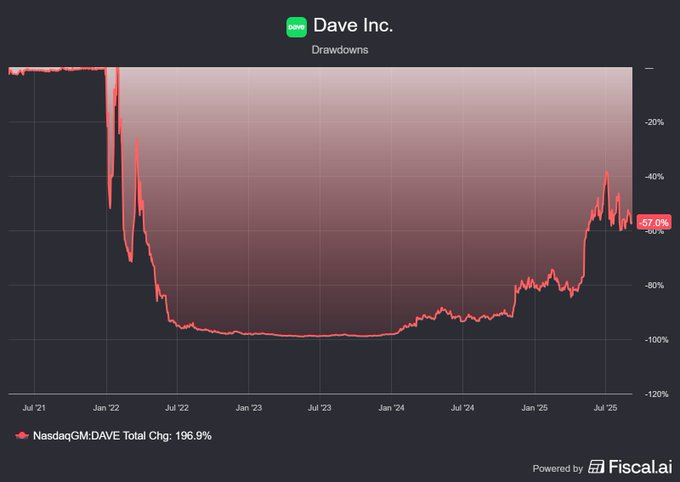
$DAVE came on the market in 2022 through a SPAC merger. That combined with it's kind of ''weird'' name, made it look like a meme-stock.
Combine that with a DOJ lawsuit and losing a lot of money and you have yourself a prime candidate for a huge stock drawdown, and that's exactly what happened.
DAVE shares fell over 95% in a very short period.
In my opinion, that sell-off back then was completely justified. The company was highly unprofitable things were going south.
But, those days are gone....
5
2.2/ High Deliquency rates
One of the key problems for DAVE was their high delinquency rates, which were about 10% back then. Their rates were high because they were first focusing on growing and not so much on profitability.
They managed to get their delinquency rates under control, and they are now between 1.5% and 2.5%. I will explain later how they did this.
Now, DAVE is a profitable company and they are ready to scale.
One of the key problems for DAVE was their high delinquency rates, which were about 10% back then. Their rates were high because they were first focusing on growing and not so much on profitability.
They managed to get their delinquency rates under control, and they are now between 1.5% and 2.5%. I will explain later how they did this.
Now, DAVE is a profitable company and they are ready to scale.
6
3.1 / Business Model - Old
First we have to understand the old business model to appreciate the recent changes.
When DAVE first started, you could basically go to Dave and loan money for ''free''. It would take a couple of days for the money to arrive. If you wanted instant access, you would pay a small fee.
Furthermore, they included a ''tip model''. That model was highly confusing as people were unsure if this was optional or voluntary. Common consensus was that Dave was basically ''tricking'' people into giving them a tip.
This was also the prime reason they are facing the DOJ lawsuit.
Arguably, Dave was scammy. And they still have this glare over them.
But now, it’s unjustified. Why? Because they changed the way they work and conduct their business.
First we have to understand the old business model to appreciate the recent changes.
When DAVE first started, you could basically go to Dave and loan money for ''free''. It would take a couple of days for the money to arrive. If you wanted instant access, you would pay a small fee.
Furthermore, they included a ''tip model''. That model was highly confusing as people were unsure if this was optional or voluntary. Common consensus was that Dave was basically ''tricking'' people into giving them a tip.
This was also the prime reason they are facing the DOJ lawsuit.
Arguably, Dave was scammy. And they still have this glare over them.
But now, it’s unjustified. Why? Because they changed the way they work and conduct their business.
7
3.2/ The New Business Model
Very recently, since March of 2025, they changed to a new business model. Now they charge a flat 5$ fee with a cap of $15 instead of the debatable tip model.
This new model is a lot more transparent and more easy to understand for customers.
The funny thing is, it's also more profitable. On average they generate 15% more per loan since they implemented the new model.
Compare their fee structure to other lending operators, and you can clearly see the appeal of Dave and why they have been growing so fast.
Very recently, since March of 2025, they changed to a new business model. Now they charge a flat 5$ fee with a cap of $15 instead of the debatable tip model.
This new model is a lot more transparent and more easy to understand for customers.
The funny thing is, it's also more profitable. On average they generate 15% more per loan since they implemented the new model.
Compare their fee structure to other lending operators, and you can clearly see the appeal of Dave and why they have been growing so fast.
8
4/ The CEO - Jason Wilk
In 2016, Jason Wilk founded Dave, aiming to reduce the cost of banking and overdraft fees for everyday Americans. Under his leadership, Dave grew to over 10 million users and went public in January 2022.
Wilk's innovative approach to banking has earned him recognition, including being named 2020 Entrepreneur of the Year in Los Angeles by EY. He has also been featured on Forbes' Fintech 50 list and was ranked number five on the 2021 Inc. 5000 list for fastest-growing companies.
Despite all the regulatory scrutiny, Wilk continues to lead Dave with a focus on providing accessible financial services to underserved communities. He has held all of his shares through the major drawdown, which in my opinion, shows he is truly committed for the long run.
In 2016, Jason Wilk founded Dave, aiming to reduce the cost of banking and overdraft fees for everyday Americans. Under his leadership, Dave grew to over 10 million users and went public in January 2022.
Wilk's innovative approach to banking has earned him recognition, including being named 2020 Entrepreneur of the Year in Los Angeles by EY. He has also been featured on Forbes' Fintech 50 list and was ranked number five on the 2021 Inc. 5000 list for fastest-growing companies.
Despite all the regulatory scrutiny, Wilk continues to lead Dave with a focus on providing accessible financial services to underserved communities. He has held all of his shares through the major drawdown, which in my opinion, shows he is truly committed for the long run.
9
5.1 / Revenue Drivers - ExtraCash Services
$DAVE basically has three key revenue drivers, of which their net processing fees segment is by far the largest.
ExtraCash Services
As discussed earlier, they give out small loans to customers, on which they earn a small flat fee. This business replaced the old tipping model. This segment has been growing very rapidly as you can see below. It’s been growing at 55% CAGR.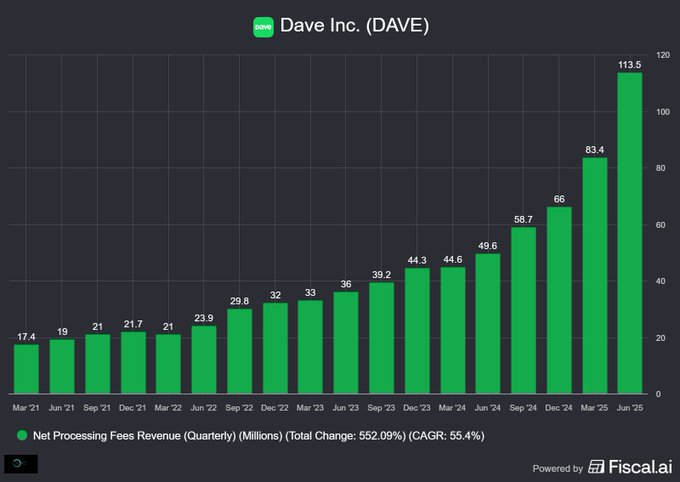
$DAVE basically has three key revenue drivers, of which their net processing fees segment is by far the largest.
ExtraCash Services
As discussed earlier, they give out small loans to customers, on which they earn a small flat fee. This business replaced the old tipping model. This segment has been growing very rapidly as you can see below. It’s been growing at 55% CAGR.
10
5.2/ Revenue Drivers - Subscription revenue
The second stream of revenue that $DAVE has are their subscription fees. Dave asks $1 per month for their services. This subscription gives direct access to their ExtraCash service, several budgeting tools and credit building services.
As members continue to grow, this part of revenue grows along.
The second stream of revenue that $DAVE has are their subscription fees. Dave asks $1 per month for their services. This subscription gives direct access to their ExtraCash service, several budgeting tools and credit building services.
As members continue to grow, this part of revenue grows along.
11
5.3/ Revenue Drivers - Interchange Revenue
Interchange revenue is the money Dave earns when customers use their Dave debit card to make purchases. Each time a transaction happens, the merchant pays a small fee to the card issuer; Dave’s partner bank collects that fee and shares it with Dave. The more customers swipe their cards, the more interchange revenue Dave makes. This only represents a small part of Dave’s revenue, but it’s still worth mentioning.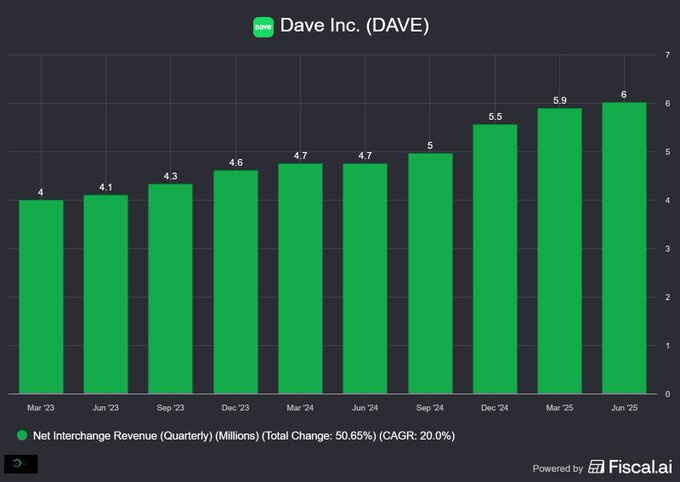
Interchange revenue is the money Dave earns when customers use their Dave debit card to make purchases. Each time a transaction happens, the merchant pays a small fee to the card issuer; Dave’s partner bank collects that fee and shares it with Dave. The more customers swipe their cards, the more interchange revenue Dave makes. This only represents a small part of Dave’s revenue, but it’s still worth mentioning.
12
6/ Delinquency Rates - Plaid - AI
Compared to their competitors $DAVE has very low delinquency rates. While others sit between 3-4 with their rates, Dave sits between 1.5 and 2.5. How do they pull this off?
Dave connects to users’ bank accounts through the Plaid API. Their AI analyzes transaction history to decide whether to approve advances. Plaid also lets Dave automatically pull funds from a user’s account on the repayment date. This saves customers from having to make manual payments, but it also makes it difficult to avoid repayment once you’ve agreed.
Dave’s AI model analyzes a person’s bank transactions, like income, spending patterns, and recurring bills, to predict their ability to repay. It works well because it relies on real-time financial behavior instead of credit scores, making it more accurate and inclusive for people with little or no credit history.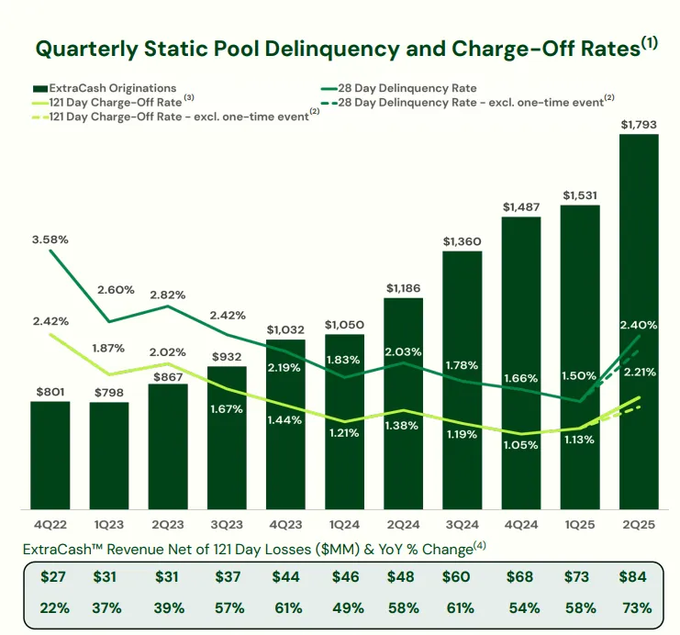
Compared to their competitors $DAVE has very low delinquency rates. While others sit between 3-4 with their rates, Dave sits between 1.5 and 2.5. How do they pull this off?
Dave connects to users’ bank accounts through the Plaid API. Their AI analyzes transaction history to decide whether to approve advances. Plaid also lets Dave automatically pull funds from a user’s account on the repayment date. This saves customers from having to make manual payments, but it also makes it difficult to avoid repayment once you’ve agreed.
Dave’s AI model analyzes a person’s bank transactions, like income, spending patterns, and recurring bills, to predict their ability to repay. It works well because it relies on real-time financial behavior instead of credit scores, making it more accurate and inclusive for people with little or no credit history.
13
7/ Competitors
Competitors like regular payday lenders, Earnin, Brigit, Chime, and MoneyLion have all entered the space, but most of them are still not profitable.
$DAVE stands out as the first mover and the largest player, with stronger underwriting and lower charge-offs than anyone else in the industry. This gives Dave a clear advantage and shows why it continues to lead the market.
Competitors like regular payday lenders, Earnin, Brigit, Chime, and MoneyLion have all entered the space, but most of them are still not profitable.
$DAVE stands out as the first mover and the largest player, with stronger underwriting and lower charge-offs than anyone else in the industry. This gives Dave a clear advantage and shows why it continues to lead the market.
14
8.1/ Growth - Revenue
Over the last few years growth has been very strong. I will show you some charts to give an overview of the main drivers that pushed the stock up lately.
Revenue has compounded at a CAGR of 32.6% since 2020.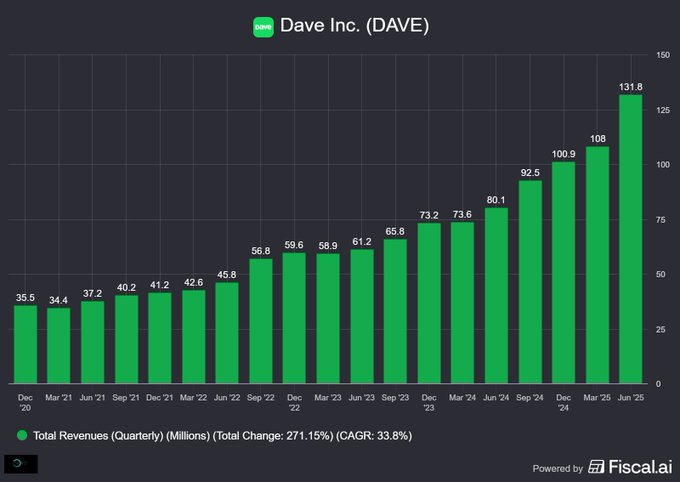
Over the last few years growth has been very strong. I will show you some charts to give an overview of the main drivers that pushed the stock up lately.
Revenue has compounded at a CAGR of 32.6% since 2020.
15
8.2/ Growth - Members
This is partly because members more than doubled in that same period, from 6M million to 12.9M.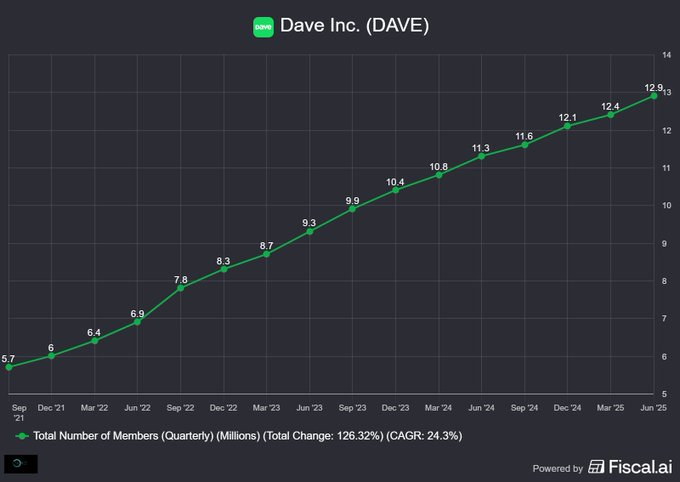
This is partly because members more than doubled in that same period, from 6M million to 12.9M.
16
8.3/Growth - Revenue per month member
Their revenue per monthly transacting member has also almost doubled in that same period.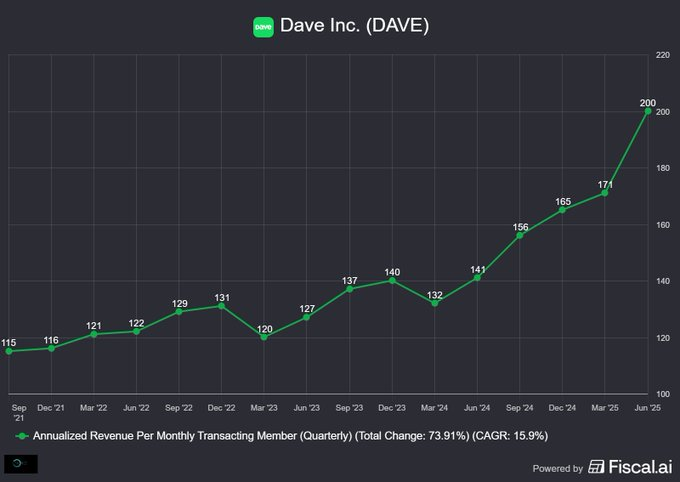
Their revenue per monthly transacting member has also almost doubled in that same period.
17
8.4/ Growth - ExtraCash Origination Volume
ExtraCash Origination Volume, which is their bread and butter has grown at a 55% CAGR in the same period.
ExtraCash Origination Volume, which is their bread and butter has grown at a 55% CAGR in the same period.
18
8.5/ Growth - Free Cash Flow
Since turning profitable, free cash flow has increased sharply. Dave is using its cash carefully by allocating $50M for buybacks, strengthening and fortifying its balance sheet, and keeping funds available to underwrite loans when needed. The company can scale efficiently without deploying all of its cash, giving it both safety and flexibility.
Since turning profitable, free cash flow has increased sharply. Dave is using its cash carefully by allocating $50M for buybacks, strengthening and fortifying its balance sheet, and keeping funds available to underwrite loans when needed. The company can scale efficiently without deploying all of its cash, giving it both safety and flexibility.
19
9.1/ Q2 Earnings
I hear you think. Well, this is just perfect. Nothing can go wrong. Well, Q2 earnings proved that it’s not just smooth sailing. Even though Dave posted a blowout quarter, under the hood there were some ‘‘problems’’ as well. At least, that’s what the market thought.
I hear you think. Well, this is just perfect. Nothing can go wrong. Well, Q2 earnings proved that it’s not just smooth sailing. Even though Dave posted a blowout quarter, under the hood there were some ‘‘problems’’ as well. At least, that’s what the market thought.
20
9.2/ Earnings highlights
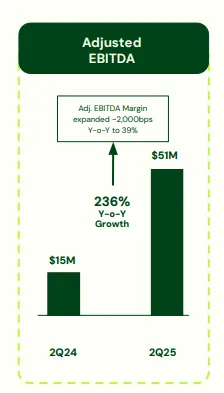
The stock fell close to 20% after the earnings report. Keep in mind, they posted 64% YoY revenue growth, adjusted EBITDA was up 236%.
The stock fell close to 20% after the earnings report. Keep in mind, they posted 64% YoY revenue growth, adjusted EBITDA was up 236%.
21
9.3/ Earnings highlights
They even raised their guidance: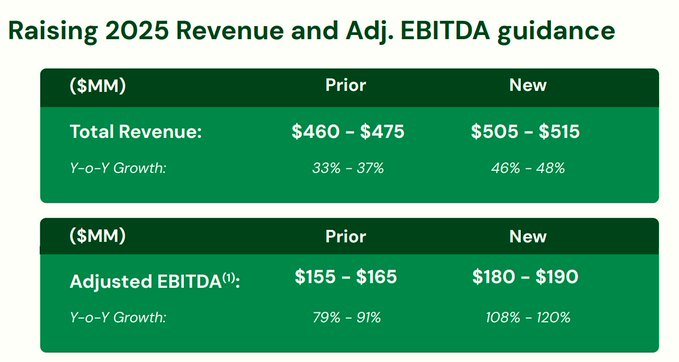
They even raised their guidance:
22
9.4/ Was it really bad - conclusion
But, meanwhile: GAAP net income fell from $28.8M to $9.1M. Gross margin dropped down from 77% to 70% and as mentioned before the delinquencies ticked up from 2.03% to 2.40%
Most of the growth was driven by the implementation of the new business model and that worried investors. Users were still growing, but not as fast as before.
But to give you some nuance to the above: the lower delinquency rate can be contributed to a third party settlement delay. If we adjust for that, the rate comes close to 2.21%, which is close to management’s goal.
The fall in net income can be mostly contributed to seasonality. They also addressed this in their earnings presentation
To me, this drawdown after Q2-earnings was overblown and provides for an opportunity for investors that can see through the weeds.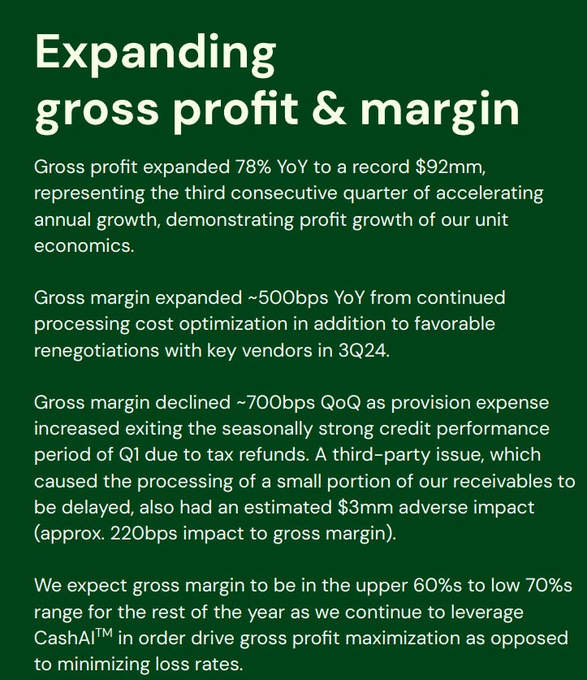
But, meanwhile: GAAP net income fell from $28.8M to $9.1M. Gross margin dropped down from 77% to 70% and as mentioned before the delinquencies ticked up from 2.03% to 2.40%
Most of the growth was driven by the implementation of the new business model and that worried investors. Users were still growing, but not as fast as before.
But to give you some nuance to the above: the lower delinquency rate can be contributed to a third party settlement delay. If we adjust for that, the rate comes close to 2.21%, which is close to management’s goal.
The fall in net income can be mostly contributed to seasonality. They also addressed this in their earnings presentation
To me, this drawdown after Q2-earnings was overblown and provides for an opportunity for investors that can see through the weeds.
23
10/ The Lawsuit
Another concern that’s overhanging Dave right now, is the ongoing lawsuit.
The FTC has raised claims that Dave charged certain customers hidden fees and tips without clear consent. Dave’s management strongly disagrees, pointing out that other regulators have previously reviewed their model without issue and calling the allegations inaccurate and an example of government overreach. They plan to defend themselves ‘‘vigorously’’.
It’s important to note this is a one-time legal expense. Dave has already updated its revenue model, moving away from tipping to the straightforward 5% flat fee. As a result, the company’s operations remain unaffected and its business going forward is not impacted.
Another concern that’s overhanging Dave right now, is the ongoing lawsuit.
The FTC has raised claims that Dave charged certain customers hidden fees and tips without clear consent. Dave’s management strongly disagrees, pointing out that other regulators have previously reviewed their model without issue and calling the allegations inaccurate and an example of government overreach. They plan to defend themselves ‘‘vigorously’’.
It’s important to note this is a one-time legal expense. Dave has already updated its revenue model, moving away from tipping to the straightforward 5% flat fee. As a result, the company’s operations remain unaffected and its business going forward is not impacted.
24
11.1 / Valuation - EBITDA
The best way to value Dave is to look at their EBITDA. EBITDA is the most appropriate way to value Dave, because the company has minimal interest expenses, making debt less relevant, and net income is lowered by non-cash loan loss provisions. By excluding these items, EBITDA provides a clear view of Dave’s actual operating performance and cash-generation potential.
The best way to value Dave is to look at their EBITDA. EBITDA is the most appropriate way to value Dave, because the company has minimal interest expenses, making debt less relevant, and net income is lowered by non-cash loan loss provisions. By excluding these items, EBITDA provides a clear view of Dave’s actual operating performance and cash-generation potential.
25
11.2/ Valuation - My bullish stance
Lets look at the guidance: management guides for $180M - $190M EBITDA for FY 2025.
But, I’m actually more bullish. I think they can reach anywhere between $220M and $230M EBITDA for 2025 and between $285M and $295M for 2025. I merely expect them to continue growing their EBITDA. Keep in mind that Dave has increased their guidance almost every quarter ( 7 quarters in a row now).
Let’s take the middle of my estimate and put a multiple of 25 on that. We get a market cap of $7.25B, compared to their current market cap of $2.68B, that’s almost a 3X.
Lets look at the guidance: management guides for $180M - $190M EBITDA for FY 2025.
But, I’m actually more bullish. I think they can reach anywhere between $220M and $230M EBITDA for 2025 and between $285M and $295M for 2025. I merely expect them to continue growing their EBITDA. Keep in mind that Dave has increased their guidance almost every quarter ( 7 quarters in a row now).
Let’s take the middle of my estimate and put a multiple of 25 on that. We get a market cap of $7.25B, compared to their current market cap of $2.68B, that’s almost a 3X.
26
11.3/ Valuation - More conservative stance
If we take a more conservative stance and say they only increase their EBITDA by 25%, and use the the middle of their guidance for 2025. That would mean $231M in EBITDA for 2026.
If we take a conservative multiple of 20, we still get a market cap of just above $4.6B, which is almost a 2X from here.
If we take a more conservative stance and say they only increase their EBITDA by 25%, and use the the middle of their guidance for 2025. That would mean $231M in EBITDA for 2026.
If we take a conservative multiple of 20, we still get a market cap of just above $4.6B, which is almost a 2X from here.
27
12/ Risks
So, does this investment come without risk? Of course not. There are still some important risks to keep in mind:
✅ FTC and DOJ investigations over alleged undisclosed fees and misleading practices
✅Targeting underbanked consumers can lead to higher default rates, affecting profitability
✅Reliance on partners like Evolve Bank; regulatory issues with partners could disrupt operations
✅Competition is fierce, with lots of other fintechs and neobanks, such as Chime and MoneyLion
✅Dave is vulnerable to downturns, unemployment, and inflation, which can increase defaults and reduce demand
So, does this investment come without risk? Of course not. There are still some important risks to keep in mind:
✅ FTC and DOJ investigations over alleged undisclosed fees and misleading practices
✅Targeting underbanked consumers can lead to higher default rates, affecting profitability
✅Reliance on partners like Evolve Bank; regulatory issues with partners could disrupt operations
✅Competition is fierce, with lots of other fintechs and neobanks, such as Chime and MoneyLion
✅Dave is vulnerable to downturns, unemployment, and inflation, which can increase defaults and reduce demand
28
13/ Conclusion
Dave is at an infliction point right now. Their new business model is the right way forward and their results show it. But is it long-term sustainable? I think it is.
The company is still unloved, and the FTC and DOJ investigations still provide a negative overhang.
To me, this screams opportunity. The growth speaks for itself and the valuation still seems very favorable. The product is sticky, the product is relevant and they hold a dominant position in the market. Their low delinquency rates (compared to competitors) makes them unique in what they do, and in my opinion, a solid investment.
I will open a starter position in the next few days. I’m looking for buys below the 200$ level and I will continue to research the company as we go.
Thanks for reading, and I’m happy to hear your thoughts on my thesis!
Still learning about the company, so any feedback or criticism is highly appreciated.
Dave is at an infliction point right now. Their new business model is the right way forward and their results show it. But is it long-term sustainable? I think it is.
The company is still unloved, and the FTC and DOJ investigations still provide a negative overhang.
To me, this screams opportunity. The growth speaks for itself and the valuation still seems very favorable. The product is sticky, the product is relevant and they hold a dominant position in the market. Their low delinquency rates (compared to competitors) makes them unique in what they do, and in my opinion, a solid investment.
I will open a starter position in the next few days. I’m looking for buys below the 200$ level and I will continue to research the company as we go.
Thanks for reading, and I’m happy to hear your thoughts on my thesis!
Still learning about the company, so any feedback or criticism is highly appreciated.
29
You can also check-out my analysis on my SS:
substack.com/@tacticzhazel/…
substack.com/@tacticzhazel/…