I see this study is making the rounds. It raises some valid points...

Jack Andreasen Cavanaugh@AndreasenJack
10 views
Sep 08, 2025
~5 min read
Advertisement
1
I see this study is making the rounds. It raises some valid points and misses others.
But it certainly does not show "that Earth can safely store around 1,460 gigatons of carbon dioxide."
Let's look at what the study really says🧵

But it certainly does not show "that Earth can safely store around 1,460 gigatons of carbon dioxide."
Let's look at what the study really says🧵
David Wallace-Wells@dwallacewells
“Researchers report that Earth can safely store around 1,460 gigatonnes of carbon dioxide (GtCO₂) — a number much lower than the 10,000–40,000 GtCO₂ often cited in previous studies.” nature.com/articles/d4158…
2
First off, the estimated 1,400 Gt of capacity is massive in and of itself, equivalent to ~40 years of today’s global emissions
With that estimate, geologic storage could offset 0.7°C of warming. And as we know, every degree, or .1°C matters
Good news!
With that estimate, geologic storage could offset 0.7°C of warming. And as we know, every degree, or .1°C matters
Good news!
3
I have three main issues with the paper:
1. Language used by the authors in the study
2. Decisions made on exclusion criteria
3. Reporting/response by some people on here (not the author's fault)
1. Language used by the authors in the study
2. Decisions made on exclusion criteria
3. Reporting/response by some people on here (not the author's fault)
4
Let's start with #1, the language used
I think what this paper actually does, or maybe what the title should be is "A reassessment of the lower level bounds of global sedimentary basin geologic storage based on abritrary exlucsion criteria focusing on harm prevention."
I think what this paper actually does, or maybe what the title should be is "A reassessment of the lower level bounds of global sedimentary basin geologic storage based on abritrary exlucsion criteria focusing on harm prevention."
5
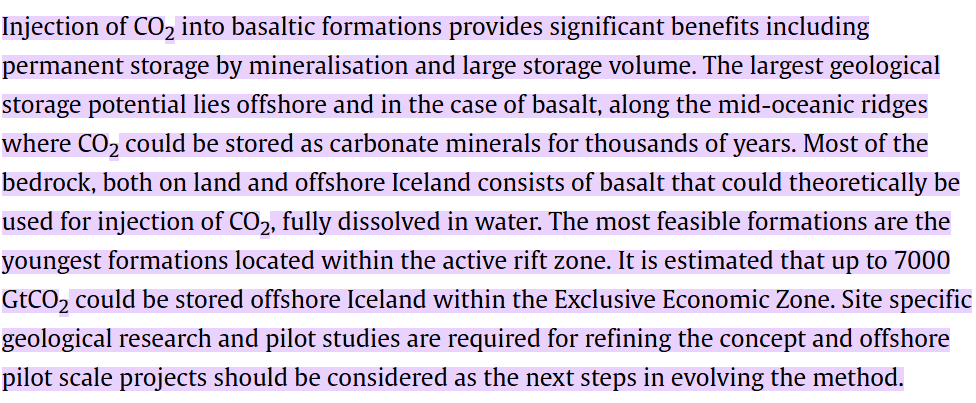
I'm not being pithy or pedantic either, by the authors own admission they don't include mineral storage (of any geology) or coal mine seams.
Those exclusions are important, as this study notes, peridotites alone have the capacity to store 100,000+ GtCO2
frontiersin.org/journals/clima…
Those exclusions are important, as this study notes, peridotites alone have the capacity to store 100,000+ GtCO2
frontiersin.org/journals/clima…
6
7
And of course, those are capacity estimates, and with technical due diligence, even with this study's exclusion criteria, they would be lower.
But the point is that the study is titled, "A prudent planetary limit for geologic carbon storage" which is gives the impression it's...
But the point is that the study is titled, "A prudent planetary limit for geologic carbon storage" which is gives the impression it's...
8
total storage capacity. Which it isn't. And to be fair to the author's they note that in the study.
But I wouldn't call that prudent.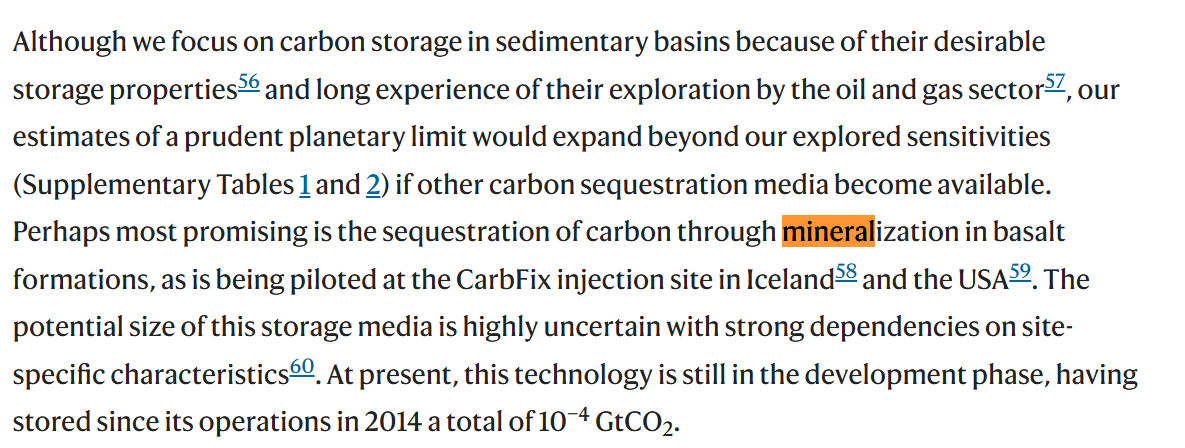
But I wouldn't call that prudent.
9
I understand Nature loves the provocative titles, so that could have played into the decision too.
It's a choice in language these authors made, I find it misleading, even though they qualify it in the study. We all know people don't read the study lol
It's a choice in language these authors made, I find it misleading, even though they qualify it in the study. We all know people don't read the study lol
10
The harm prevention principle is important because although it is an academic term, it is colloquially loaded. That's not entirely the authors fault, but a choice they made, nonetheless.
After all, in writing this critique, am I anti-harm prevention? Of course not.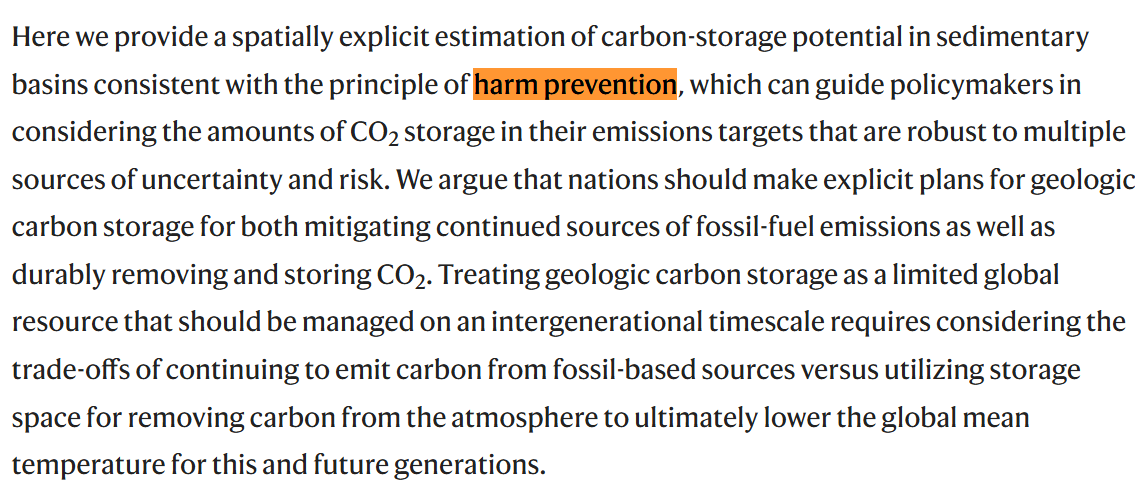
After all, in writing this critique, am I anti-harm prevention? Of course not.
11
This bleeds into my last language critique which goes into the exclusion layers. It's not entirely clear to me why the criteria they have chosen are the exhaustive "harm prevention" exclusion layers to include or why they only chose exclusionary layers.
12
You could equally imagine a study that looked at both exclusionary and inclusionary layers that worked with harm prevention. Most notably, the harm of not deploying enough storage and the subsequent rise in global temps plus local pollution.
13
But the study is looking at limits, so their goal was to shrink the capacity. So fair play. Not in the purview of this study. Still an odd choice when calling your study "prudent".
14
But digging deeper into the study I noticed some choices they made in their "exclusion layers" (basically screening criteria), that seemed strange to me
The exclusion zones are listed on the vertical axis, and we can see the reduction in geologic potential based on the exclusion
The exclusion zones are listed on the vertical axis, and we can see the reduction in geologic potential based on the exclusion
15
For methods, sake, each one of these exclusion layers was applied sequentially.
Protected areas, polar circles, seismic hazard, population buffer and sedimentary depth restructions drive the onshore potential down.
Protected areas, polar circles, seismic hazard, population buffer and sedimentary depth restructions drive the onshore potential down.
16
See below for the methodology on their population buffer.
I find the criteria, for the central case, a bit weird. By excluding storage within this buffer zone the model creates a situation where the risk tolerance is 0. No acceptable risk, however small.
Is this level of risk..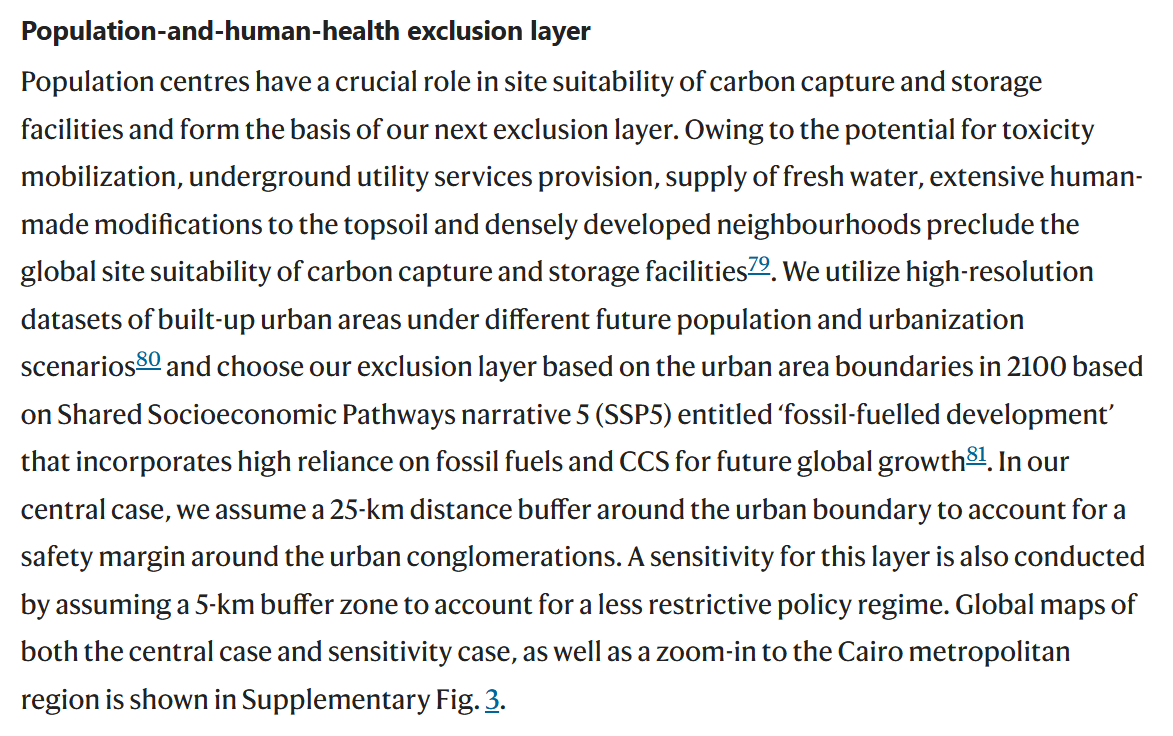
I find the criteria, for the central case, a bit weird. By excluding storage within this buffer zone the model creates a situation where the risk tolerance is 0. No acceptable risk, however small.
Is this level of risk..
17
applied to other forms of technology near urban boundaries? Why or why not?
Why is 25km chosen for the central case and not 50km or 100km.
I understand they do a sensitivity analysis but the main figure in the paper, and the thrust of the reporting, is on the central case.
Why is 25km chosen for the central case and not 50km or 100km.
I understand they do a sensitivity analysis but the main figure in the paper, and the thrust of the reporting, is on the central case.
18
Excluding 0.6 Gt of storage from urban areas without any geotechnical criteria, or discussion of how regulations can ensure risks are minimized (like the Class VI program) isn't a technical limit, it's an arbitrary one.
It's a valid, but vibes-based choice.
It's a valid, but vibes-based choice.
19
And importantly, we can mitigate all the risks they list. There isn't an inherent reason why urban areas should have this buffer.
20
Next, and my biggest gripe, the sedimentary depth maximum and minimum limits, a whopping 2.3 Gt of reduced storage capacity!
What is the methodology?
What is the methodology?
21
1000m minimum depth, as they note they want to apply a "conservative depth requirement" for their central case, even though current literature bounds minimums at 800m.
Maximum estimate bounded at 2.5km for the central case, even noting a 4km bound in the current literature.
Maximum estimate bounded at 2.5km for the central case, even noting a 4km bound in the current literature.
22
My issue with this is strictly technical. We can drill deep injection wells, and have. This is mostly an economic limit, not a technical one.

23
Finally on the exclusion criteria and to my early point, why stop at these? Why not include other issues the authors point out later in the paper?
You could drive the storage potential to 0 if you wanted to.
You could drive the storage potential to 0 if you wanted to.
24
The paper fails to note the lower bound limit doesn't take into account future advances in technology, nor new geologic storage exploration and discovery.
We don't actually know the full extent of storage globally, but we do know, it's more than we have now.
We don't actually know the full extent of storage globally, but we do know, it's more than we have now.
25
Finally the early response to it.
David Wallace Wells (who I don't know) pulls a quote that doesn't include any of the context I laid out above. And it's immediately boosted across the site.
I don't know David's intention but the quote lacks context.
David Wallace Wells (who I don't know) pulls a quote that doesn't include any of the context I laid out above. And it's immediately boosted across the site.
I don't know David's intention but the quote lacks context.
David Wallace-Wells@dwallacewells
“Researchers report that Earth can safely store around 1,460 gigatonnes of carbon dioxide (GtCO₂) — a number much lower than the 10,000–40,000 GtCO₂ often cited in previous studies.” nature.com/articles/d4158…
26
And then Dr. Guenther completely misrepresents the study and its conclusion.
The study considers both CDR and CCS. And there are many forms of CDR that don't use in-situ geologic storage (i.e. enhanced rock weather, biomass burial, ocean alkalinity and so on)
The study considers both CDR and CCS. And there are many forms of CDR that don't use in-situ geologic storage (i.e. enhanced rock weather, biomass burial, ocean alkalinity and so on)
27
Which is strange because she knows this, she wrote a book, in part, on it.
And as I started this whole thread, "as little as 0.7C" is a big deal! But maybe we are in agreement?
And as I started this whole thread, "as little as 0.7C" is a big deal! But maybe we are in agreement?