'Struggles' occur *within* common sense and established values,...

MΣƬΛXY@m_e_t_a_x_y
16 views
Feb 17, 2026
~10 min read
Advertisement
1
'Struggles' occur *within* common sense and established values, aiming at the attainment of existing goods (wealth, power).
Nietzschean transvaluation instead seeks a "completely other model" from a "terra incognita."
Nietzschean transvaluation instead seeks a "completely other model" from a "terra incognita."
2
In deviating from common sense and established values, the Nietzschean free spirit displays a "bad nature" and "ill will" - in contrast to the "good nature" and "good will" of the rational agent.

3
The Kantian critique is "ultimately respectful", allowing that thought has at its base a "good natural law".
The 'dead God' and the 'fractured Self' are no more than a "passing bad moment", and both return stronger than ever.
x.com/m_e_t_a_x_y/st…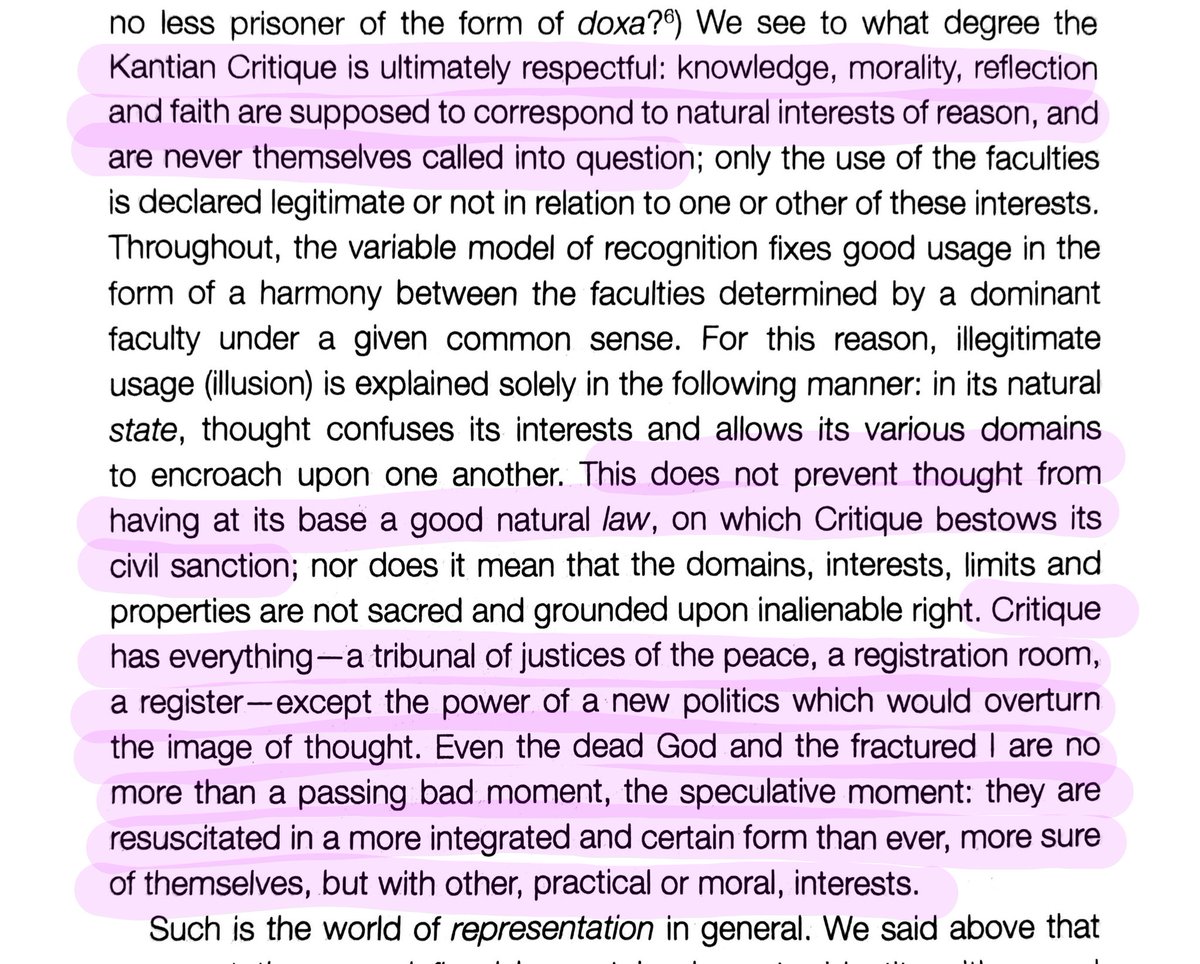
The 'dead God' and the 'fractured Self' are no more than a "passing bad moment", and both return stronger than ever.
x.com/m_e_t_a_x_y/st…
4
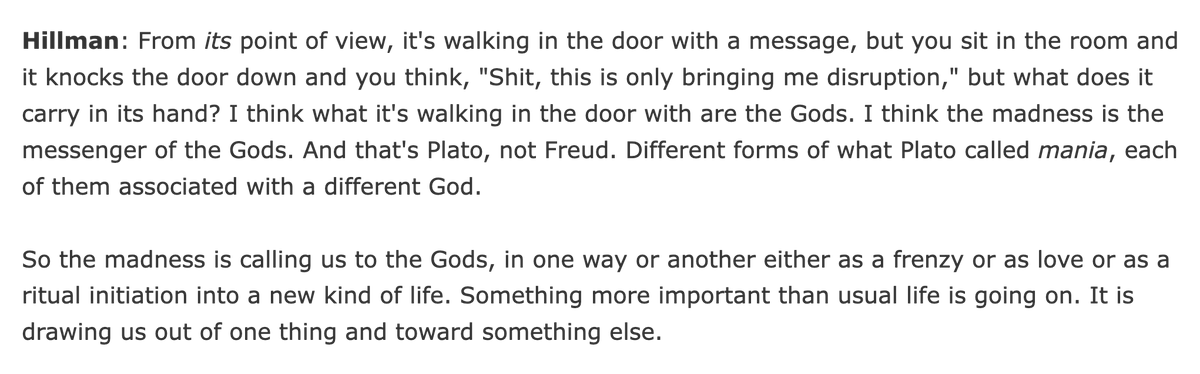
For Deleuze, genuine thinking begins with the rupture of *the new* - an "encounter" with something that disturbs, confounds, or resists recognition.
Problems and 'signs' are the true source of thinking, not concepts and solutions.

Problems and 'signs' are the true source of thinking, not concepts and solutions.
MΣƬΛXY@m_e_t_a_x_y
A brutal rupture - of ecstatic, aggressive madness - laying waste to civilised man. An "initiation into a new kind of life." The return of the gods, of barbarian rites. @OGRolandRat's "Spark." Renewal.
x.com/OGRolandRat/st…
x.com/OGRolandRat/st…
5
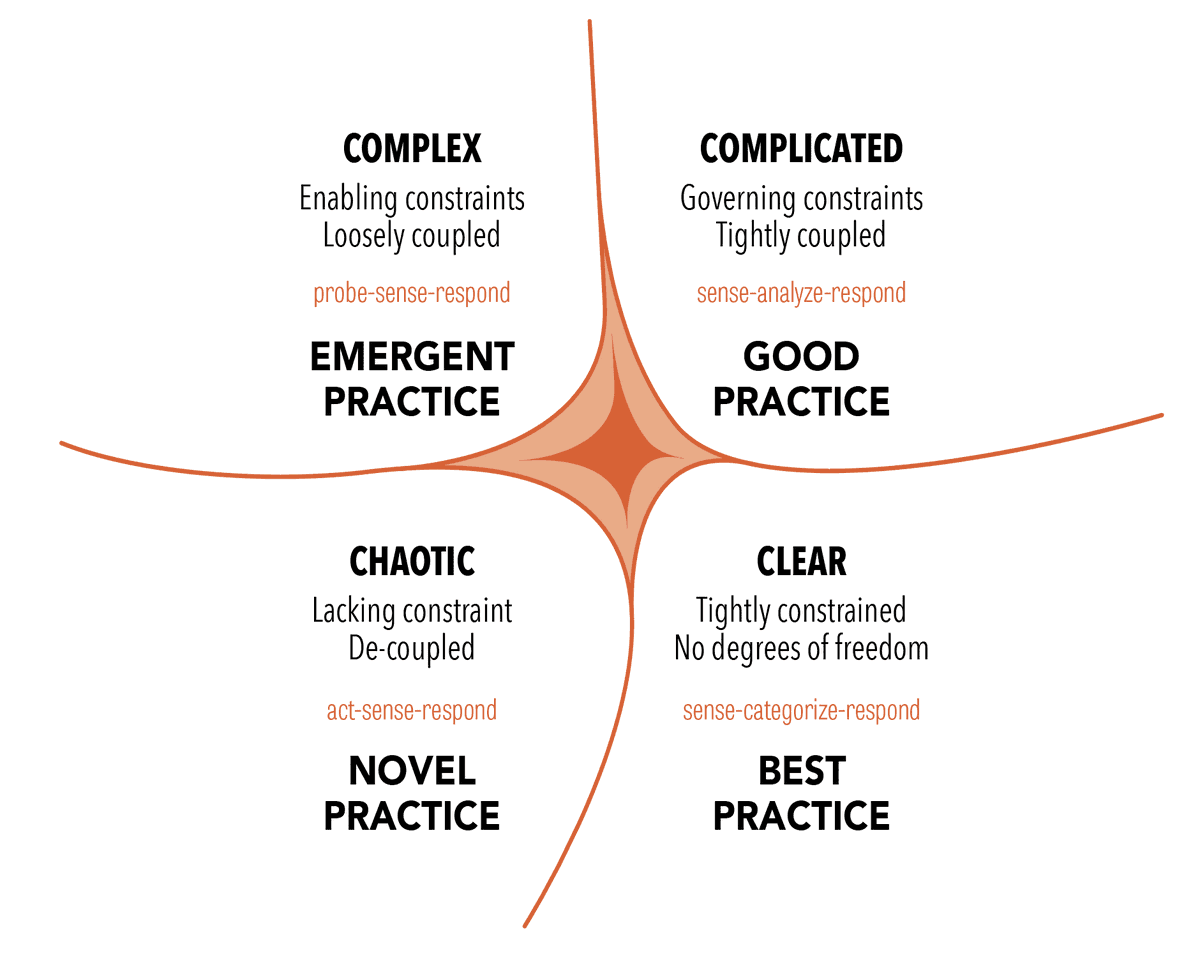
In terms of Snowden's Cynefin model, real thinking happens in the 'complex' or 'chaotic' domains (unknown), not the 'complicated' or 'clear' (known).


MΣƬΛXY@m_e_t_a_x_y
Through *method* we ward off error - but we also shut the door to rejuvenating creativity.
Method is appropriate in closed, or ‘Clear,’ environments - those amenable to ‘best practice’ algorithms.
Another way to describe such environments: Lifeless.
x.com/m_e_t_a_x_y/st…
Method is appropriate in closed, or ‘Clear,’ environments - those amenable to ‘best practice’ algorithms.
Another way to describe such environments: Lifeless.
x.com/m_e_t_a_x_y/st…
6
It takes the "bad will" of the free spirit to break the surface of the known and open a portal to the beyond. Deleuze names this site the "aleatory point."
What we encounter here is not the gods, but demons - the monstrous Other.

What we encounter here is not the gods, but demons - the monstrous Other.
7
"... he sought an opening ..."

8
"... the claws of a strangeness or an enmity ... the contingency of an encounter ... Thought is trespass and violence, the enemy, and nothing presupposes philosophy: everything begins with misosophy."

9
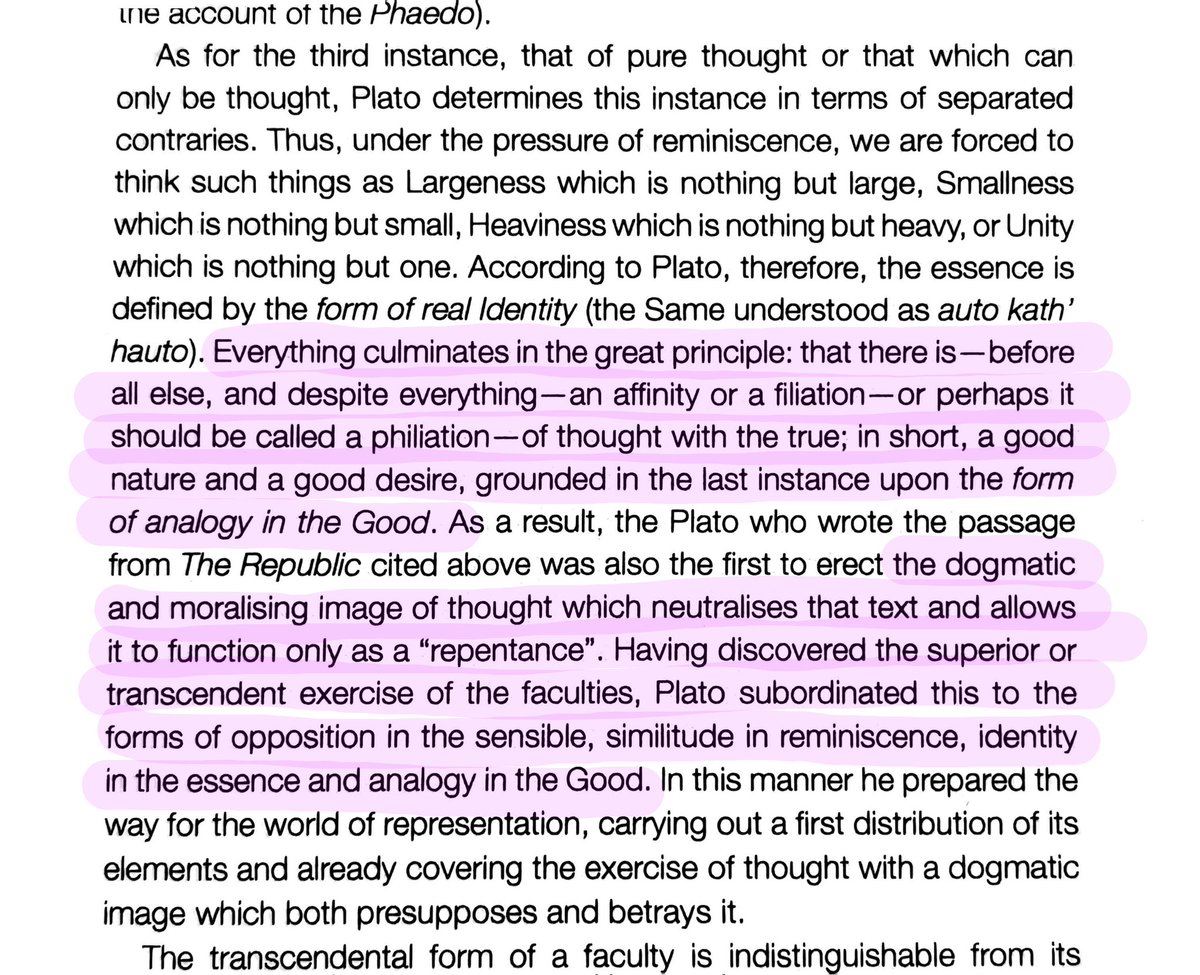
The "moralising image of thought": all opposites converge on a "multi-dimensional nexus" or "through-line".
Beneath all errors and confusions there is a 'good nature' and a 'good desire', embodied in the rational/moral agent.


Beneath all errors and confusions there is a 'good nature' and a 'good desire', embodied in the rational/moral agent.
MΣƬΛXY@m_e_t_a_x_y
As an aside, it's ironic that famed Nietzschean Jordan Peterson appears to be enticed by the prospect of finding a 'meta-through-line' which would lead to 'the resolution of all opposing conflicts' ...
10
Thought now takes on a moral structure: to think is to turn toward the Good, to renounce ‘mere opinion’, and to ascend to truth.
Dialogue loses its vitality, reduced to a moral lesson - to 'dialogos'; the text becomes a spiritual exercise in repentance.
Dialogue loses its vitality, reduced to a moral lesson - to 'dialogos'; the text becomes a spiritual exercise in repentance.
11
Deleuze proposes a "transcendental empiricism," in which the transcendental is made answerable to a "superior empiricism": each faculty traced to its monstrous limit, where it encounters an opening, an “aleatory point.”

12
Free or untamed states of "difference in itself" disclose a hidden path, 'behind the marketplace' ...
No figure, no story, nothing to “interpret” - only a strange mood, a tension, a sense of lightness … an intensity apprehended immediately, unconditioned by representation ...

No figure, no story, nothing to “interpret” - only a strange mood, a tension, a sense of lightness … an intensity apprehended immediately, unconditioned by representation ...
13
... towards an opening ...

14
"It is not the gods which we encounter: even hidden, the gods are only forms of recognition.
What we encounter are the demons, the sign-bearers: powers of the leap, the interval, the intensive and the instant ..."
What we encounter are the demons, the sign-bearers: powers of the leap, the interval, the intensive and the instant ..."
15
"... it is always by means of an intensity that thought comes to us."
Although BAP derides Deleuze, there is much overlap between them here.
"... all begins with sensibility."
Although BAP derides Deleuze, there is much overlap between them here.
"... all begins with sensibility."
16
"Clarity and distinctness form the logic of recognition, just as innateness is the theology of common sense: both have already pushed the Idea over into representation."
The Idea is rescued through the discovery of a "Dionysian value," through the 'demonic.'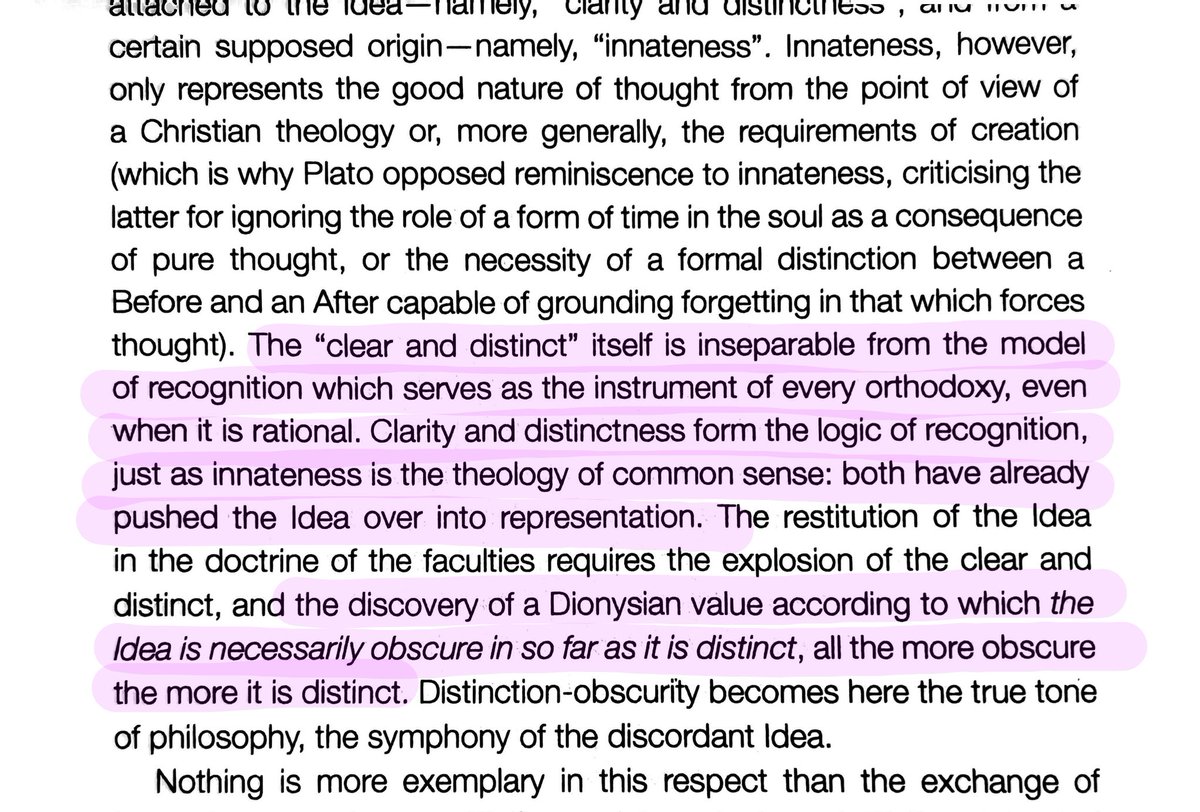
The Idea is rescued through the discovery of a "Dionysian value," through the 'demonic.'
17
The real task of dialectics is not to find solutions or conclusions, but to pose problems and questions.

18
This isn't 'negative dialectics', which remains trapped within the logic of representation and the metaphysics of identity.
Where the *contradiction* signals the failure of identity, the *problem* affirms the productivity of difference.
Where the *contradiction* signals the failure of identity, the *problem* affirms the productivity of difference.
19
When identity is primary, problems are judged in terms of solutions and hard or timeless problems are sidelined.
A metaphysics of difference instead views such problems as points of rupture - "fields of potential" where new forms and meanings can emerge.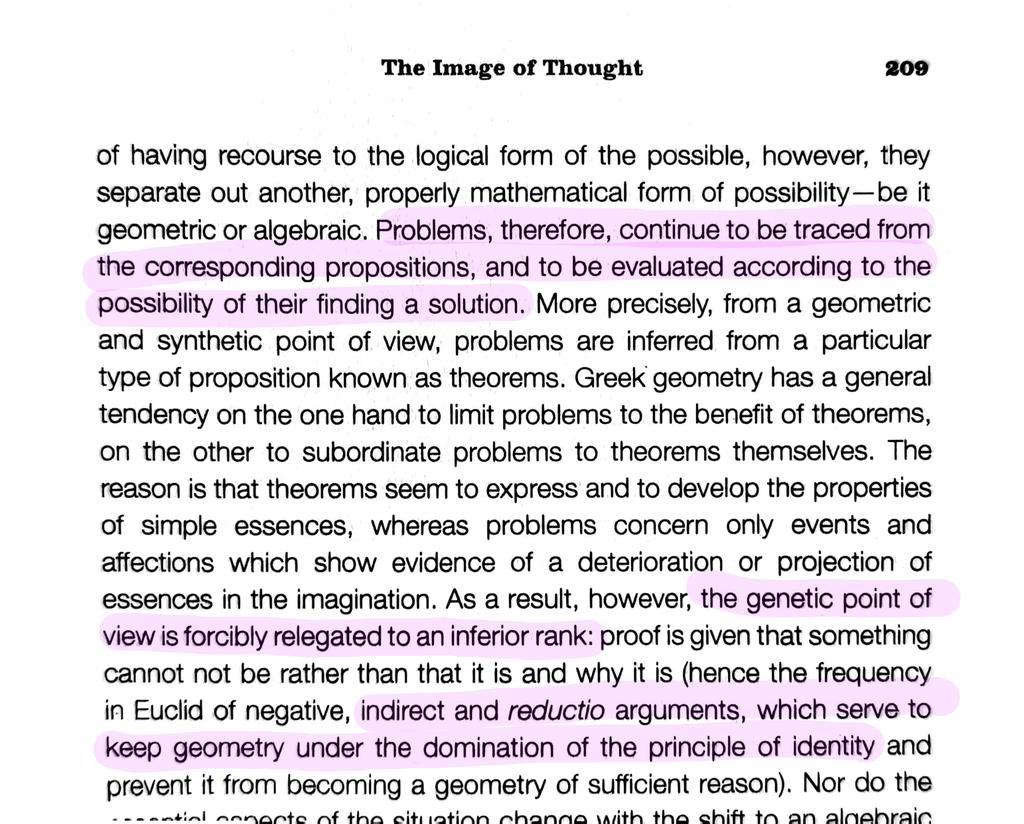
A metaphysics of difference instead views such problems as points of rupture - "fields of potential" where new forms and meanings can emerge.
20
Hillman advocates this more complex, Deleuzian view of problems.
In "staying with the image," we let the problem unfold according to its own "internal character," rather than imposing an external solution or 'definitive interpretation.'


In "staying with the image," we let the problem unfold according to its own "internal character," rather than imposing an external solution or 'definitive interpretation.'
MΣƬΛXY@m_e_t_a_x_y
I'm reminded of Hillman's idea of "staying with the image"
Hillman opposed therapy's tendency to treat dream images, symptoms, or conflicts as symbols to be decoded into rational meaning or resolved within a developmental narrative.
Hillman opposed therapy's tendency to treat dream images, symptoms, or conflicts as symbols to be decoded into rational meaning or resolved within a developmental narrative.
21
Hegel perverts the dialectic by interpreting differential tensions in terms of a common sense, collapsing a turbulent multiplicity into a simple opposition.
Difference is subsumed under identity, problems are reduced to answers and thought becomes judgement rather than creation.
Difference is subsumed under identity, problems are reduced to answers and thought becomes judgement rather than creation.
22
Again, we're brought back to the Platonic/Sophist split.
The latter remains in the cave, enjoying the 'turbulent multiplicity' of dancing shadows.

The latter remains in the cave, enjoying the 'turbulent multiplicity' of dancing shadows.
MΣƬΛXY@m_e_t_a_x_y
The sophist is "the one who raises everything to the level of simulacra and maintains them in that state."
He resists the redemptive, unifying meta-level, preferring instead the 'play of particulars.'
x.com/m_e_t_a_x_y/st…
He resists the redemptive, unifying meta-level, preferring instead the 'play of particulars.'
x.com/m_e_t_a_x_y/st…
23
Nietzsche: "through seeing nothing but types [the sophist] introduces something great into all things"
The ascendency of the Platonic represents the victory of the reactive and contradictory over the active and affirmative.

The ascendency of the Platonic represents the victory of the reactive and contradictory over the active and affirmative.
MΣƬΛXY@m_e_t_a_x_y
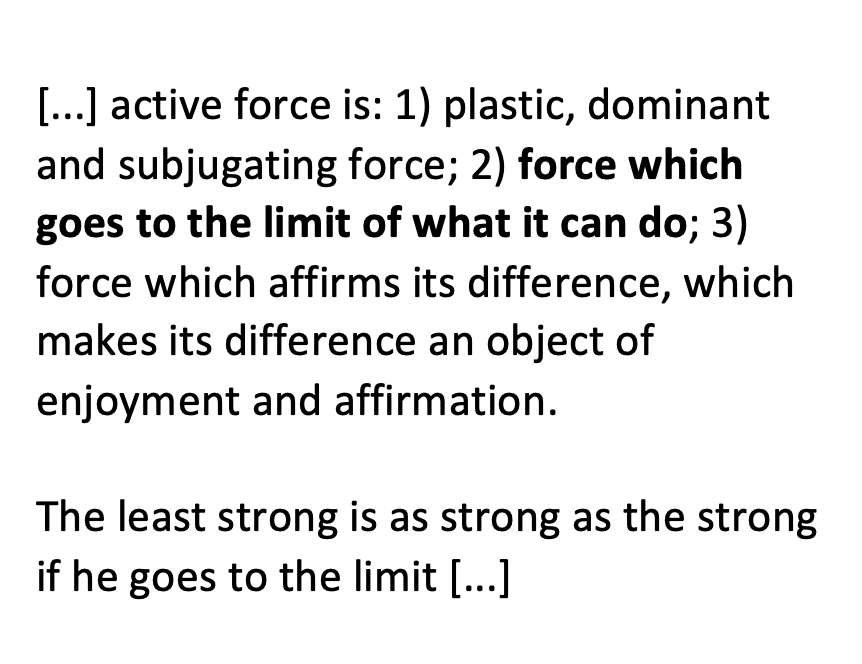
Active forces are creative, plastic, and vital. They revel in the ‘play of difference’ and the frenzy of agonistics.
Active forces are irrepressible, going to the ‘limit of what they can do.’
Active forces are irrepressible, going to the ‘limit of what they can do.’
24
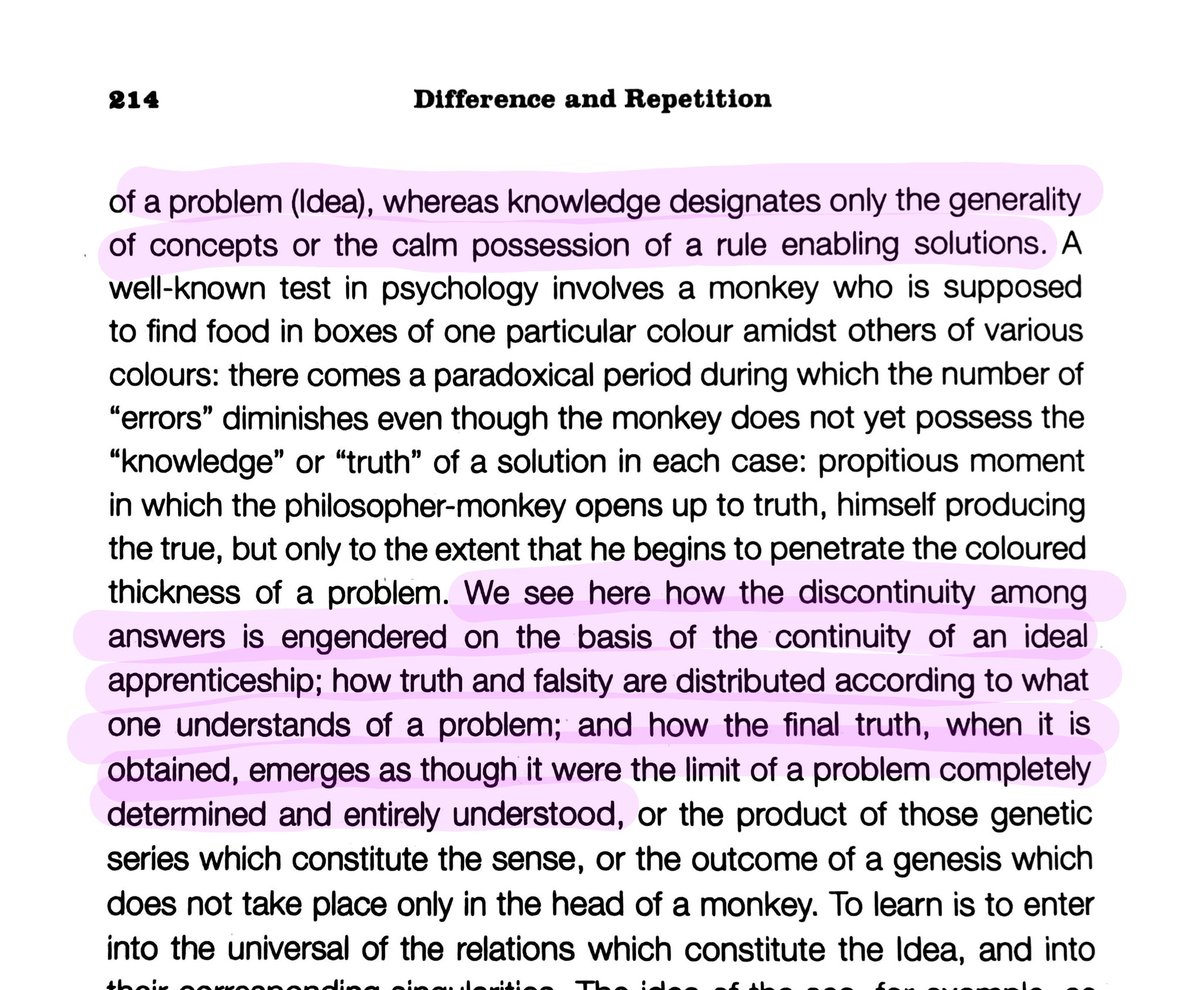
Deleuze distinguishes between "knowledge," which presupposes a stable, domesticated domain where problems are well-defined and docile, and "learning," which ventures to the frontier of becoming, where problems remain wild and unruly.
25
The learner who operates within a structured system - a curriculum or set of rules - we can call the 'pupil.'
The task of the pupil is to recognise, repeat, and apply best practice. Learning is measured by correctness - how well the pupil conforms to a model of “the right way.”
The task of the pupil is to recognise, repeat, and apply best practice. Learning is measured by correctness - how well the pupil conforms to a model of “the right way.”
26
The 'apprentice', by contrast, works in an open-ended, dynamic environment, with fluid constraints and emerging problems.
Learning happens through exposure, trial and error, and 'encounters' with the unrecognisable or disorienting.
Learning happens through exposure, trial and error, and 'encounters' with the unrecognisable or disorienting.
27
In terms of Cynefin, the pupil operates within the simple/clear domain, using 'correct thinking' and best practice.
The apprentice operates within the complex domain ('unknown unknowns'), using experimental approaches and emergent practices.
The apprentice operates within the complex domain ('unknown unknowns'), using experimental approaches and emergent practices.
MΣƬΛXY@m_e_t_a_x_y
In terms of Snowden's Cynefin model, real thinking happens in the 'complex' or 'chaotic' domains (unknown), not the 'complicated' or 'clear' (known).
x.com/m_e_t_a_x_y/st…
x.com/m_e_t_a_x_y/st…
28
"Teacher says it's okay": the pupil's slavish adherence to established curriculum - need for correct answers and gold stars from teacher.


Bronze Age Pervert@bronzeagemantis
Left-twatter orbits #frogtwitter and the frogs in general, and is very strange to me. People very proud of their collitch miseducation, unaware of how ignorant they are...uptight kiss-ass types who are very much into "teacher says it's OK"
29
Deleuze attempts to move us away from the Clear or Complicated and to 'think in complexity' (to 'think in the new way') - that is, to engage with immanence, difference, and emergence.

MΣƬΛXY@m_e_t_a_x_y
The world we think in and the world we live in are not the same. Where Newtonian reality stretched the everyday idiom, Quantum reality seems to depart from it completely.
It's been over a century, and we're still struggling to 'think in the new way.'
It's been over a century, and we're still struggling to 'think in the new way.'
30
Carribbean Rhythms, ep.71
"To found a moral code that lasts ages - to found a people, in other words - you need to be able to stand outside all moral codes."


"To found a moral code that lasts ages - to found a people, in other words - you need to be able to stand outside all moral codes."
MΣƬΛXY@m_e_t_a_x_y
BAP speaks for the Great Man, or in McGowan's terms the 'ideal man.'
Notably, the ideal man - being aggressive, violent, and wild - doesn't belong in society. His heroism safeguards civilisation, but also bars him from it. The Strider archetype.
Notably, the ideal man - being aggressive, violent, and wild - doesn't belong in society. His heroism safeguards civilisation, but also bars him from it. The Strider archetype.
31
The pupil's use of *inductive* or deductive reasoning allows him to find certainties within the limits of what is already known, whereas the apprentice's use of *abductive* reasoning allows him to explore novel approaches beyond what is already known.


32
The 'dogmatic image of thought' subordinates learning to knowledge, and culture to *method* - crushing thought under an image of Sameness and alienating the powers of difference and repetition.

MΣƬΛXY@m_e_t_a_x_y
Through *method* we ward off error - but we also shut the door to rejuvenating creativity.
Method is appropriate in closed, or ‘Clear,’ environments - those amenable to ‘best practice’ algorithms.
Another way to describe such environments: Lifeless.
x.com/m_e_t_a_x_y/st…
Method is appropriate in closed, or ‘Clear,’ environments - those amenable to ‘best practice’ algorithms.
Another way to describe such environments: Lifeless.
x.com/m_e_t_a_x_y/st…
33
Within Deleuze's 'metaphysics of difference,' the Platonic Idea is reconceived not as a transcendent model but as a 'problematic field.'
The mundane form is no longer an imperfect copy of a perfect model, but an emergent solution generated within the problem-space.
The mundane form is no longer an imperfect copy of a perfect model, but an emergent solution generated within the problem-space.
34
Although each form constitutes a solution to the problem, the Idea itself remains inexhaustible, admitting no final resolution.
Underlying this is a relational ontology, in which entities emerge from an underlying network of relations.
Underlying this is a relational ontology, in which entities emerge from an underlying network of relations.
35
The relational network is a "system of differences without positive terms."
Positive terms (nodes, identities, entities) are expressions of differential relations. Differences come *before* what they differentiate.
Positive terms (nodes, identities, entities) are expressions of differential relations. Differences come *before* what they differentiate.

37
Static ontology: there is a stable identity or essence which underlies all variations ("order is primary")
Process ontology: beneath every stable identity is a system of relations i.e. a problem-space of all possible variations ("chaos is primary")
Process ontology: beneath every stable identity is a system of relations i.e. a problem-space of all possible variations ("chaos is primary")
38
The constraints of the problem-space function like a sort of 'operational' essence.
Rather than stating “what it is” in timeless terms, they state “what transformations are possible” within the limits of the Idea.
Rather than stating “what it is” in timeless terms, they state “what transformations are possible” within the limits of the Idea.
39
The Idea is like an attractor basin: internal movement is permitted, but to leave the basin necessitates a phase shift or 'deterritorialisation' - a qualitative break.
A chair has continuity with a stool or sofa, but not an apple.
A chair has continuity with a stool or sofa, but not an apple.
40
Because the Idea is inexhaustible, 'learning' is not the accumulation of facts, but a continuous becoming.
Unlike the dialectician, the sophist doesn't fool himself into thinking that by accumulating facts he's forming a perfect solution or perfect knowledge.
Unlike the dialectician, the sophist doesn't fool himself into thinking that by accumulating facts he's forming a perfect solution or perfect knowledge.
41
Where the pupil comes to *know*, the apprentice continues to *learn.*
To know is to possess knowledge; to learn is to remain in active relation with the forces, constraints, and possibilities that shape what can be known - to play the 'infinite game.'

To know is to possess knowledge; to learn is to remain in active relation with the forces, constraints, and possibilities that shape what can be known - to play the 'infinite game.'
MΣƬΛXY@m_e_t_a_x_y
To see life as a game or an aesthetic phenomenon is to understand that it is to be affirmed, not overcome; to be taken playfully/creatively, not seriously/literally.
The player-artist-child knows that the game is never over.
The player-artist-child knows that the game is never over.
42
To play requires an ironic stance - a mode of ‘pure thought’ that can hold contradictions, tensions, and differences (akin to Keats’ 'negative capability') - as opposed to the utilitarian attitude that rushes toward resolution.


43
To think in complexity, one must adopt an ironic attitude.
Irony is “the art of multiplicities” - the capacity to hold multiple perspectives, meanings, and tensions at once.
Irony is “the art of multiplicities” - the capacity to hold multiple perspectives, meanings, and tensions at once.
44
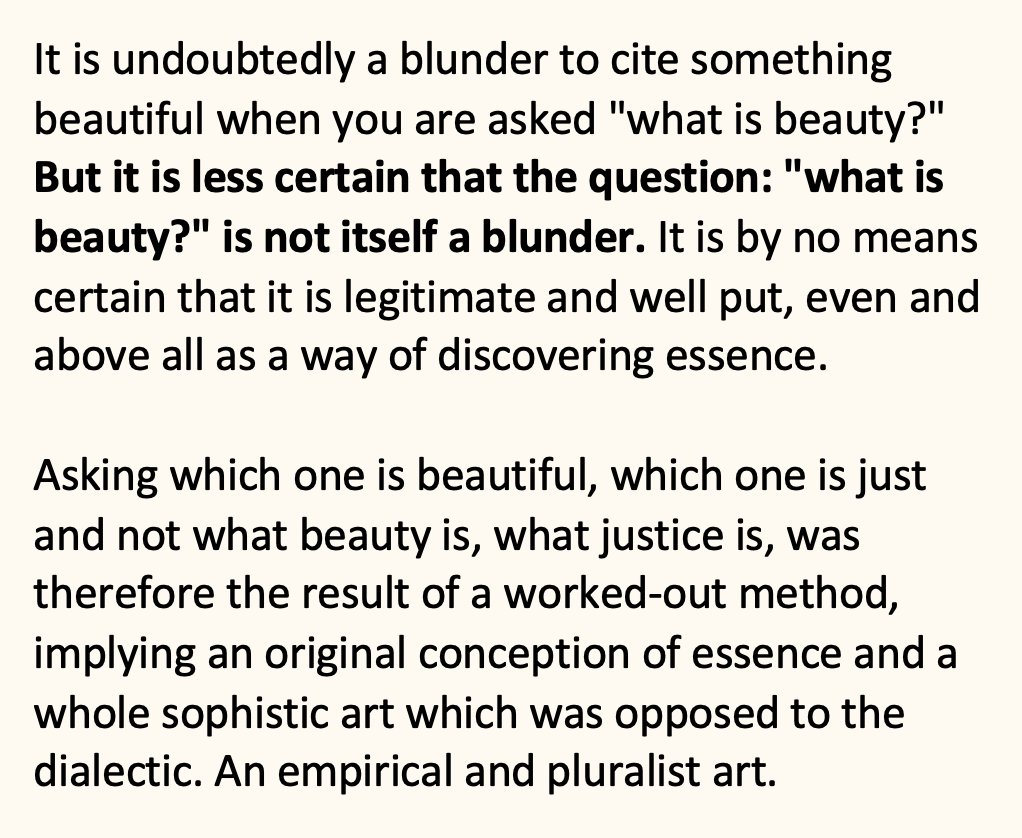
The dialectician asks serious, lofty questions aimed at essence, or the One ("What is?").
The sophist asks playful, 'down to earth' questions, concerned with accidents and multiplicities ("How much?", "In what cases?", "Who?")

The sophist asks playful, 'down to earth' questions, concerned with accidents and multiplicities ("How much?", "In what cases?", "Who?")
MΣƬΛXY@m_e_t_a_x_y
Because the dialectician is oriented towards universal truth, he associates “more encompassing” with “more real.”
Nietzsche asserts the opposite. Essence, for him, is found in the concrete and particular – in “which one?”, not “what is?”
Nietzsche asserts the opposite. Essence, for him, is found in the concrete and particular – in “which one?”, not “what is?”
45
"When Socratic irony was taken seriously ... extremely troublesome consequences followed."
When taken seriously, "What is X?" tends vertically toward the One. Taken playfully, it extends horizontally toward the many.
When taken seriously, "What is X?" tends vertically toward the One. Taken playfully, it extends horizontally toward the many.
46
Nietzsche was notable, in part, for placing his trust in the question “What is X?” to "have Ideas," rather than to find God.
47
'Cosmos' is an emergent structure, a “patterned solution” imposed upon an underlying 'chaosmos'.
Ontology isn't about describing what already exists, but about understanding the play of differences and the “throw” that brings forms into existence.
Ontology isn't about describing what already exists, but about understanding the play of differences and the “throw” that brings forms into existence.
48
"...the Ideas enter and leave only by that fracture in the I, which means that another always thinks in me, another who must also be thought."


49
Metaphysics of difference: *problems endure* and difference manifests in ongoing insubstantial answers to such problems.
Metaphysics of sameness: *answers endure* and problems always seek to find these perfect answers.
Metaphysics of sameness: *answers endure* and problems always seek to find these perfect answers.
50
In seeing problems as fundamental, the metaphysics of difference comes to the tragic realisation that existence is inherently problematic and cannot be 'solved.'

MΣƬΛXY@m_e_t_a_x_y
The essence of the tragic is multiple and pluralist affirmation – the ‘joy of multiplicity.’
Tragedy stands in opposition to democratic levelling and peaceful compromise; to consensus, middle ground, and grand unified solutions.
Tragedy stands in opposition to democratic levelling and peaceful compromise; to consensus, middle ground, and grand unified solutions.
51
The negative is derivative, not originary.
The dualism of affirmation and negation arises as an artefact of propositional thought. In forming hypotheses, we flatten the complex multiplicity of problems into simple oppositions - generating the 'illusion of negativity.'
The dualism of affirmation and negation arises as an artefact of propositional thought. In forming hypotheses, we flatten the complex multiplicity of problems into simple oppositions - generating the 'illusion of negativity.'
52
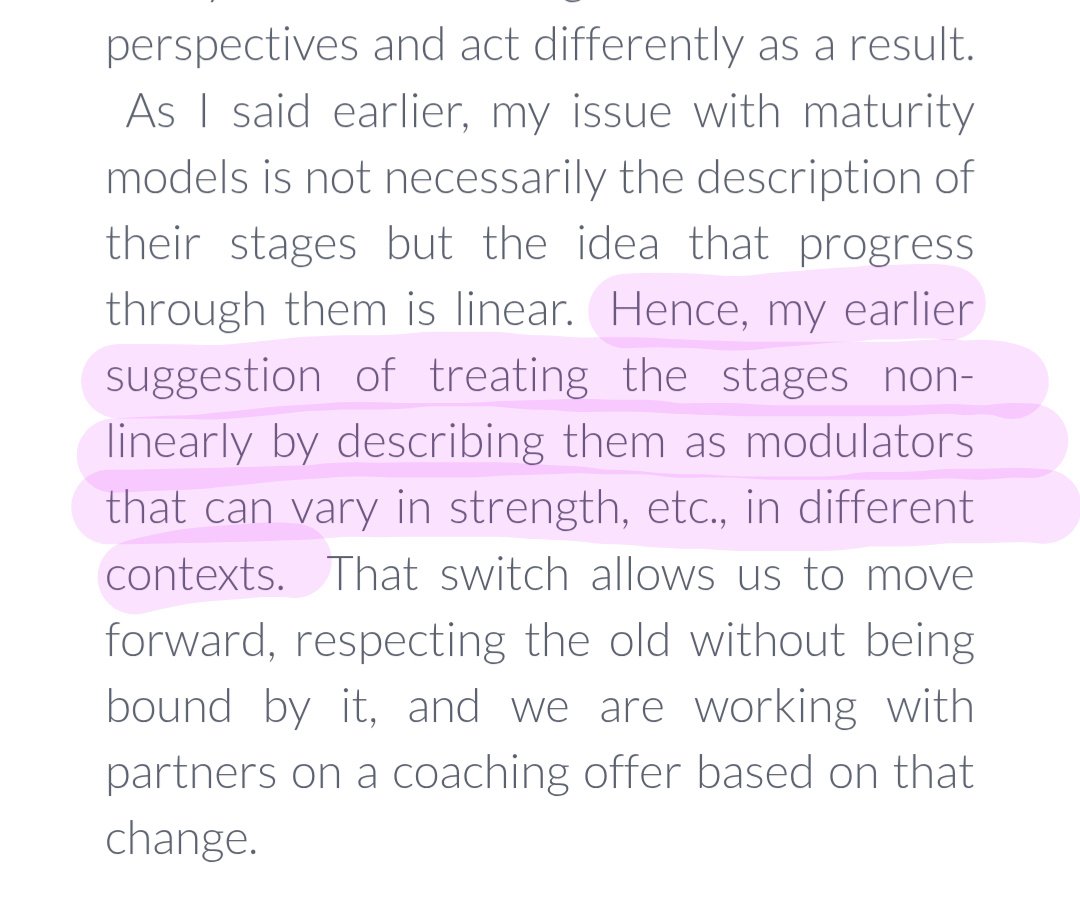
Beneath “distinctive opposition” lies “differential position”; beneath “developmental stages,” the play of “intensive modulators”; beneath negativity, an originary positivity.

MΣƬΛXY@m_e_t_a_x_y
@PhoebeTickell @NoraBateson @snowded sees the stages/memes as modulators which switch on and off in different contexts. I like this idea, although in terms of 'adjacent possibles' it may be that certain 'activation patterns' tend to follow others.
53
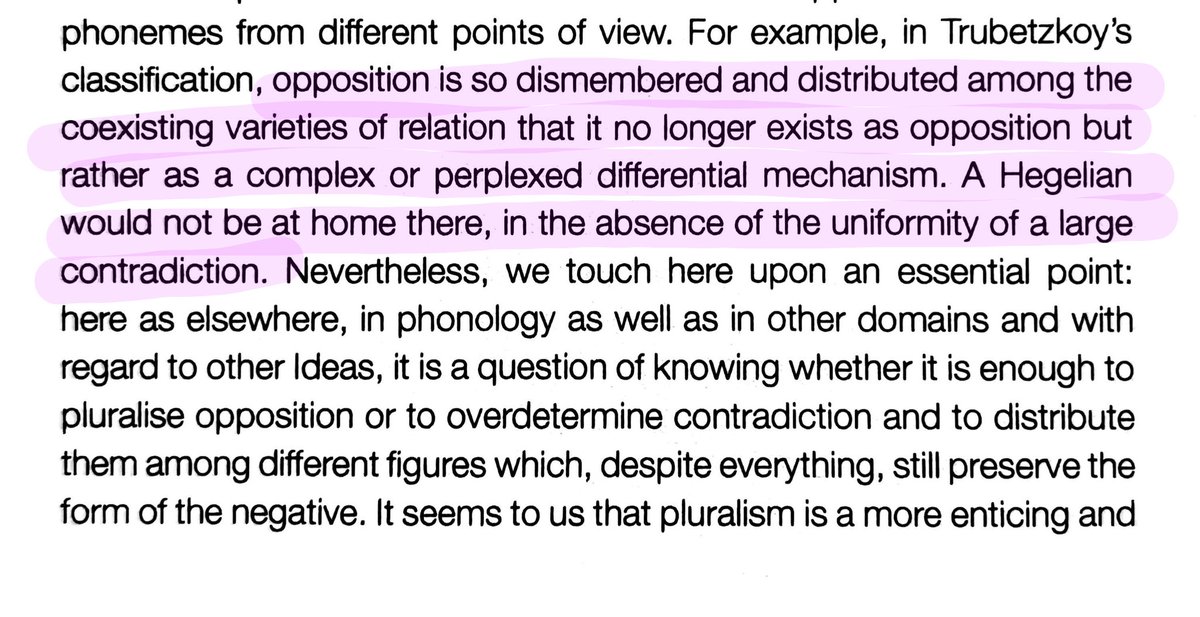
"A Hegelian would not be at home ... in the absence of the uniformity of a large contradiction."
54
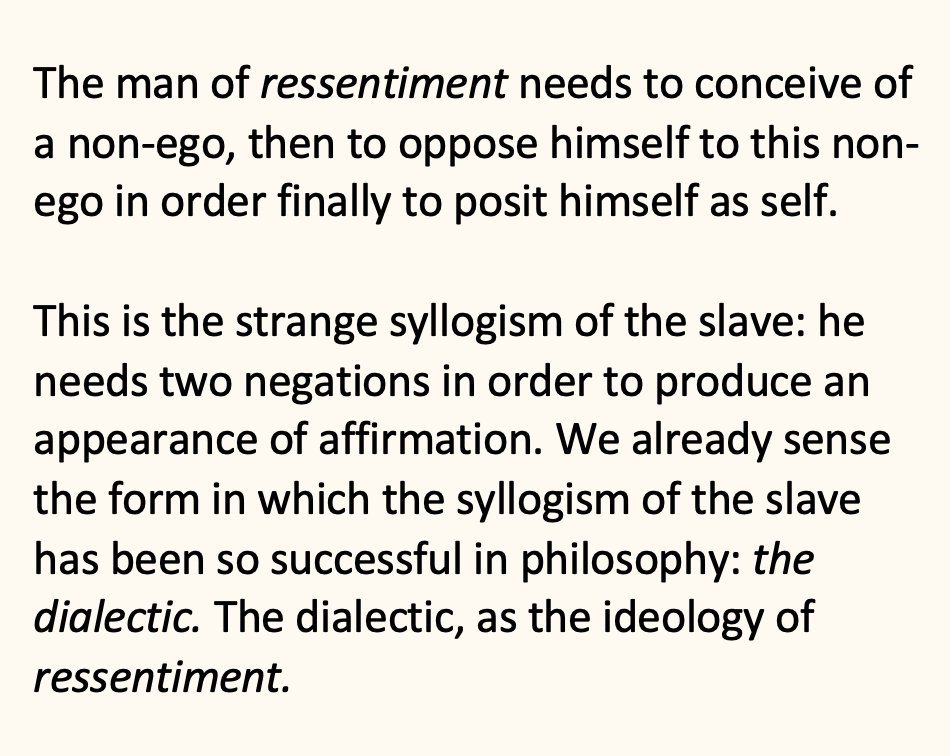
The listener (slave) finds meaning via the negative - by establishing oppositions. His position is always reactive, at a remove.
The speaker (master) simply expresses himself, assigning meaning through his speech rather than deriving it by comparison.

The speaker (master) simply expresses himself, assigning meaning through his speech rather than deriving it by comparison.
MΣƬΛXY@m_e_t_a_x_y
The ‘self’ of the slave is formed via negation - 'I am not that' - and so always remains empty. It ‘is not’, but never ‘is.’ For him, the negative is "the original idea.”
The slave is naturally oppositional/dialectical, always looking to the other as a means to know himself.
The slave is naturally oppositional/dialectical, always looking to the other as a means to know himself.
55
We can make a distinction here between two types of irony: a Sausurrean 'negative irony' and a Deleuzian 'positive irony.'
56
Both accept the primacy of relations and differences, but positive irony assumes that the system of differences is not arbitrary or 'empty'; it arises from an underlying field of positive intensities.
MΣƬΛXY@m_e_t_a_x_y
The relational network is a "system of differences without positive terms."
Positive terms (nodes, identities, entities) are expressions of differential relations. Differences come *before* what they differentiate.
Positive terms (nodes, identities, entities) are expressions of differential relations. Differences come *before* what they differentiate.
57
I think perhaps this explains BAP's ambivalence towards irony - he dislikes irony when it is uncommitted and merely 'plays with signs', instead endorsing an irony founded on felt intensities and 'operational essences.'

Bronze Age Pervert@bronzeagemantis
Please note that Twatter locked @CityBureaucrat for 12 hours... as an avatar of global capital this site supports the left's ongoing war against humorous social critique and real irony...
58
Opposition and negation are outgrowths of Axial morality, which takes the multiplicity of pagan life and compresses it into a linear, progressive dialectic, governed by the simple concept or regulative ideal - God, Self, the One.
59
This reduction is framed as a stripping away of deception, revealing a simpler truth or reality.
MΣƬΛXY@m_e_t_a_x_y
Equally, the monotheistic order of Christianity redeemed the polytheistic chaos of pre-Christian cultures; which are now framed as 'demonic.'
The meta-level is enshrined: there's no going back.
youtu.be/3LvbPS6w4U0?si…
The meta-level is enshrined: there's no going back.
youtu.be/3LvbPS6w4U0?si…
60
The shift from local to universal, pagan to Axial, poly to mono, brings an intensification of propositionality - and with it, negativity.
Life moves from affirmative, relational multiplicities to structured, bounded oppositions.
Life moves from affirmative, relational multiplicities to structured, bounded oppositions.
MΣƬΛXY@m_e_t_a_x_y
Here we see the contrast between the ‘Axial’ and the ‘traditional.’
The former needs always to redeem life by imposing a plan, or Logos, which leads away from chaos and towards *perfect order* – Platonic forms / Heaven / socialist utopia / Singularity/ etc.
The former needs always to redeem life by imposing a plan, or Logos, which leads away from chaos and towards *perfect order* – Platonic forms / Heaven / socialist utopia / Singularity/ etc.
61
The assertion of a single True Path produces a proliferation of false ones - and with them, an explosion of prohibitions.
Life becomes more reflective and codified, but also more reactive.
Life becomes more reflective and codified, but also more reactive.
62
Again, Nietzsche is significant because he represents the first break with Axial morality.
His transvaluation resembles a return to pagan metaphysics, but is really a forward step into the unknown.
His transvaluation resembles a return to pagan metaphysics, but is really a forward step into the unknown.
MΣƬΛXY@m_e_t_a_x_y
@heaveninterface Sometimes I think postmodernism is a portal or threshold to a new world--hence why denying the postmodern turn (a la Peterson) is ultimately futile...
x.com/TalalAAli/stat…
x.com/TalalAAli/stat…
63
In this sense, history has three movements: pre-Axial, Axial, and post-Axial.
The likes of Marx, Freud, Lacan remain "Axial" thinkers because they retain the dualist structure of Axial morality. The new world is still interpreted in terms of the old.

The likes of Marx, Freud, Lacan remain "Axial" thinkers because they retain the dualist structure of Axial morality. The new world is still interpreted in terms of the old.
MΣƬΛXY@m_e_t_a_x_y
To reduce the unconscious to a site of limitation/opposition is to view it as merely an extension of consciousness - to understand it in terms of identity - and thus condemn it to negativity.
In insisting on the positivity of the unconscious, Deleuze departs from Freud & Lacan.
In insisting on the positivity of the unconscious, Deleuze departs from Freud & Lacan.
64
Nietzsche and Deleuze attempt to step through the opening and 'think in the new way' - to think multiplicity without falling back into moral categories.

MΣƬΛXY@m_e_t_a_x_y
The world we think in and the world we live in are not the same. Where Newtonian reality stretched the everyday idiom, Quantum reality seems to depart from it completely.
It's been over a century, and we're still struggling to 'think in the new way.'
It's been over a century, and we're still struggling to 'think in the new way.'
65
The *fetish* is a cul-de-sac of libidinal energy.
Consciousness clings to the fetishised object rather than engaging the differential relations that produce it. To grasp the problem, one must break apart its false unity - escaping the dead-end of fetishistic common sense.
Consciousness clings to the fetishised object rather than engaging the differential relations that produce it. To grasp the problem, one must break apart its false unity - escaping the dead-end of fetishistic common sense.
66
'Revolution' is the eruption of difference against fetishistic unity - the moment when the multiplicity of the Idea exceeds the constraints of a given form.


