At @OpenAI, we believe that AI can accelerate science and drug...

Boris Power@BorisMPower
42 views
Aug 25, 2025
~2 min read
Advertisement
1
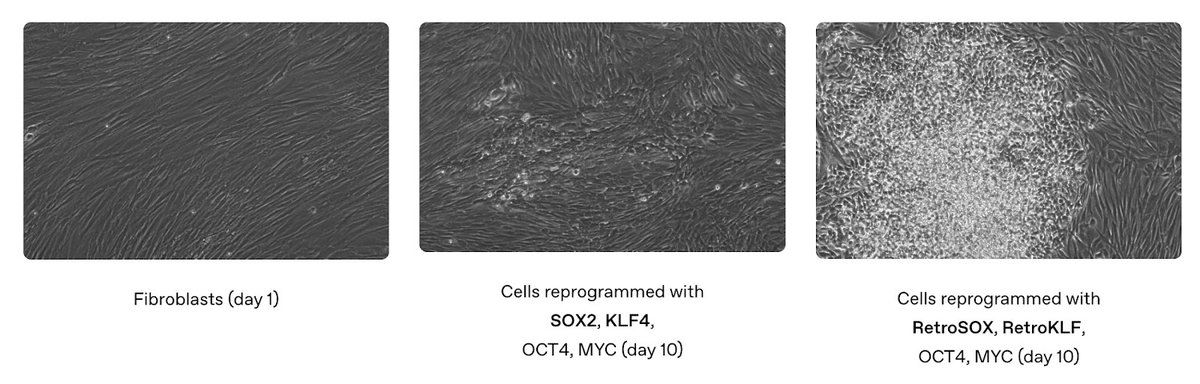
At @OpenAI, we believe that AI can accelerate science and drug discovery. An exciting example is our work with @RetroBiosciences, where a custom model designed improved variants of the Nobel-prize winning Yamanaka proteins. Today we published a closer look at the breakthrough. ⬇️
2
The Yamanaka factors (OSKM) are four proteins that have revolutionized biology due to their ability to generate induced pluripotent stem cells (iPSCs) and rejuvenate cells. Unfortunately, they suffer from extremely low levels of reprogramming efficiency.

3
Together with the team at @RetroBiosciences, we’ve designed novel variants of the Yamanaka factors that achieve a 50x increase in reprogramming efficiency in vitro compared to standard OSKM proteins – a groundbreaking improvement.

4
The key to our success was the development of GPT-4b micro – a new experimental biology LLM that we developed to test our vision that AI is able to push the frontiers of science.
5
GPT-4b micro shares the same architecture as GPT-4o, but uses a new training approach with a custom biology dataset that we developed with the goal of enabling scientists to steerably redesign proteins for their needs.
6
The teams at @OpenAI and @RetroBiosciences worked hard for several months to develop GPT-4b micro, and through the process rediscovered several phenomena from text-based models such as scaling laws and in-context learning.
7
To test the limits of our model, we applied it to the task of redesigning the Yamanaka factors to see if it was capable enough to generate proteins with real clinical value. We evaluated it against baseline OSKM and variants proposed by Retro’s scientists.
8
The model produced the best variants across all candidates, but it did so while proposing more diverse sequences and simultaneously maintaining a higher hit rate than our human scientist baseline.

9
The results above were quite surprising, so we’ve spent the past few months running several further validations. We are excited to finally be able to share that these results have held up.
10
In addition to having enhanced reprogramming efficiency, we also find that our reengineered proteins have enhanced DNA damage repair capabilities. More testing is necessary here, but these early results suggest that the proteins may be useful for rejuvenating aged cells.

11
Huge congratulations to the team for their incredible work! In particular @johnohallman, Aaron Jaech, @ricomnl who led the development of GPT-4b micro, and @Andrei_Tarkhov @JLarouche13 @madiueland @KevinJosephK for leading the science.
12
To read our full writeup, check out the link to our blog post below
openai.com/index/accelera…
openai.com/index/accelera…