Hegel's dialectical method has an exoteric, forward-facing...

Yuri Bezmenov's Ghost@Ne_pas_couvrir
34 views
Sep 15, 2025
~7 min read
Advertisement
1
Hegel's dialectical method has an exoteric, forward-facing description, an esoteric structure it plagiarized, and a promise to uncover truths. But that promise is built on an esoteric myth. The rupture it intends to solve is not real, and thus all it finds is, like the middle of an onion, nothing and failure.
Explained in its outward form, Hegel's dialectic represents a fundamental method in his philosophy, serving as the engine for the development of ideas, history, and reality itself. At its core, the dialectic describes a process through which concepts or historical states evolve by confronting their inherent contradictions, leading to a higher level of resolution. Hegel does not present it as a rigid formula (he never used "thesis-antithesis-synthesis") but rather as an immanent logic where contradictions arise organically from within a given state and propel it forward.
That's a little thick, so to understand this, consider how Hegel begins his Science of Logic with the most basic category: pure Being. Being, in its absolute indeterminacy, is so empty that it immediately equates to Nothing, its opposite. This opposition does not result in stasis or annihilation. Instead, the tension between Being and Nothing generates Becoming, a dynamic unity that preserves elements of both while transcending their limitations. This movement exemplifies what Hegel calls negation. Here negation is not destruction. It's a determinate negation that reveals the inadequacy of the initial position and incorporates it into something more concrete.
The key mechanism here is Aufhebung, which is often translated as sublation. This captures a threefold action: 1) to cancel or negate, 2) to preserve or retain, and 3) to elevate or lift to a higher plane. Here, each stage in the dialectic builds on the previous one, turning apparent conflicts into progressive integrations. So, specifically in the literature, in the Phenomenology of Spirit, Hegel traces the evolution of consciousness from immediate sense-certainty, which negates itself when it encounters the flux of perception, to self-consciousness, which further develops through social interactions. This is like the master-slave relation. The master-slave is a classic. Here, the master's dominance is negated by dependence on the slave's labor, while the slave's initial subservience leads to self-realization through work, ultimately sublated into mutual recognition in a rational society.
So, Hegel extends this logic to history in his Philosophy of History, viewing it as the unfolding of Geist, or Spirit (the collective human mind or divine reason realizing itself over time). Historical epochs, such as an ancient despotic state, contain seeds of their own undoing, giving way to higher forms like the modern constitutional state, where individual freedom aligns with communal order in ethical life, or Sittlichkeit.
This process is teleological (which means it has a purposeful end: the full self-actualization of freedom and reason). Hegel argues that contradictions are not flaws to be avoided but they are the essential drivers of advancement, as reality is inherently rational and develops toward greater coherence.
He structures his entire system triadically: the Logic outlines pure thought categories, Nature depicts Spirit alienated in externality, and Spirit proper returns to itself through subjective mind, objective institutions, and absolute forms like art, religion, and philosophy. The dialectic thus operates at multiple levels (logical, natural, and spiritual) revealing how the Absolute, or ultimate reality, achieves self-knowledge through finite manifestations.
Beneath Hegel's formal logic, there is an esoteric undercurrent. Fun fact, Hegel's philosophy is not merely a product of rational inquiry but a sophisticated reworking of Hermetic, alchemical, and Kabbalistic motifs, absorbed through figures like Jakob Böhme, Giordano Bruno, Paracelsus, and Franz von Baader. Hegel's Württemberg upbringing exposed him to Pietist mysticism and texts like Knorr von Rosenroth's Kabbala Denudata, which translated Jewish Kabbalistic ideas, including those from Isaac Luria, into a Christian framework accessible to European intellectuals. So Hermeticism, alchemy, and Kabbalah, which all stress the unity of opposites (what Hermeticists call coincidentia oppositorum) as the key to transformation. Hegel encountered these ideas in Christian mysticism and in writers such as Jakob Böhme, a German mystic who taught that God comes to self-awareness through a struggle of opposing qualities (Hegel admired Böhme so much he called him "the first German philosopher"). Alchemists used the motto solve et coagula ("dissolve and recombine"), implying that something must be broken apart and then purified by reuniting it. Hegel's Aufhebung clearly mirrors this principle: opposites are negated and then elevated into a higher synthesis.
Because it was plagiarized from Luria via Bohme, you'll find striking parallels in Lurianic Kabbalah. This doctrine describes creation in three stages:
1) Withdrawal (tzimtzum): God contracts His infinite light to create space for a finite world.
2) Shattering (shevirat ha-kelim): The initial divine vessels break apart, scattering sparks of divine essence into the material world.
3) Repair (tikkun): Through spiritual effort, the scattered sparks are gathered back and the world is restored toward wholeness.
Wouldn't you know it, but Hegel's dialectic follows same pattern, but with different words (lol).
1) The Absolute "withdraws" into pure abstraction at the start of his system,
2) then "shatters" into the fragmented world of nature, and
3) finally achieves reunion and self-knowledge in the stage of Spirit.
In other words, he plagiarized effectively this esoteric mystical drama of exile and return and repackaged it into the language of philosophy and history. So, what Kabbalah depicts as God's light being lost and restored, Hegel depicts as the Idea becoming alienated in nature and then reconciled with itself in Spirit (return to wholeness).
The dialectic has a naked esoteric dimension, and he's continuing the esoteric quest to restore unity to a claimed fractured reality. it's a modern retelling of the mystical journey from separation back to wholeness.
However, the premise itself is just not true. The dialectic's vow, that it will reveal beauty or marginalized truths post-rupture, fails over and over. The premise it borrows here is false.
Guess what; there is no genuine break. The "husks" negated as oppressive illusions weren't actually false and the marginalized shards weren't true authenticity. Stripping yields not synthesis, and a higher understanding, but voids, like peeling an onion to its nonexistent core.
While history is full of these failures, let's stick to art. Here, negation promises conceptual depth, but hwat it really delivers is delivers stagnation. Minimalism negated expressionism's chaos with bare forms, claiming essence-revelation, yet birthed endless repetition. Think of white canvases, silent installations, all devoid of vitality. Punk rock shredded prog's complexity for raw authenticity, but post-punk dissolved into derivative echoes or silence, and no richer genre emerged at all, did it. Design's functionalism negated ornament as excess, birthing sleek minimalism (e.g., Bauhaus), but innovation halted in sterile uniformity, where "less is more" became less is nothing.
This failure stems from the lie: the rupture is invented, a Hermetic-Kabbalistic plagiarism that, in the end, justifies destruction without creation. Sure, sometimes contradictions are real drivers (say, like in science, where peeling away Newtonian absolutes uncovered relativistic truths, sparking further innovations). But even then, the esoteric claims of hidden sparks presume a shatter that never occurred. Negation thus uncovers emptiness, not redemption. It's derivative at best, recycling old forms thinly, or outright failure; the dialectic's 'progress' masks regression, its esoteric allure a trap leading to cultural nihilism or worse (say, like gulags and graves).

Explained in its outward form, Hegel's dialectic represents a fundamental method in his philosophy, serving as the engine for the development of ideas, history, and reality itself. At its core, the dialectic describes a process through which concepts or historical states evolve by confronting their inherent contradictions, leading to a higher level of resolution. Hegel does not present it as a rigid formula (he never used "thesis-antithesis-synthesis") but rather as an immanent logic where contradictions arise organically from within a given state and propel it forward.
That's a little thick, so to understand this, consider how Hegel begins his Science of Logic with the most basic category: pure Being. Being, in its absolute indeterminacy, is so empty that it immediately equates to Nothing, its opposite. This opposition does not result in stasis or annihilation. Instead, the tension between Being and Nothing generates Becoming, a dynamic unity that preserves elements of both while transcending their limitations. This movement exemplifies what Hegel calls negation. Here negation is not destruction. It's a determinate negation that reveals the inadequacy of the initial position and incorporates it into something more concrete.
The key mechanism here is Aufhebung, which is often translated as sublation. This captures a threefold action: 1) to cancel or negate, 2) to preserve or retain, and 3) to elevate or lift to a higher plane. Here, each stage in the dialectic builds on the previous one, turning apparent conflicts into progressive integrations. So, specifically in the literature, in the Phenomenology of Spirit, Hegel traces the evolution of consciousness from immediate sense-certainty, which negates itself when it encounters the flux of perception, to self-consciousness, which further develops through social interactions. This is like the master-slave relation. The master-slave is a classic. Here, the master's dominance is negated by dependence on the slave's labor, while the slave's initial subservience leads to self-realization through work, ultimately sublated into mutual recognition in a rational society.
So, Hegel extends this logic to history in his Philosophy of History, viewing it as the unfolding of Geist, or Spirit (the collective human mind or divine reason realizing itself over time). Historical epochs, such as an ancient despotic state, contain seeds of their own undoing, giving way to higher forms like the modern constitutional state, where individual freedom aligns with communal order in ethical life, or Sittlichkeit.
This process is teleological (which means it has a purposeful end: the full self-actualization of freedom and reason). Hegel argues that contradictions are not flaws to be avoided but they are the essential drivers of advancement, as reality is inherently rational and develops toward greater coherence.
He structures his entire system triadically: the Logic outlines pure thought categories, Nature depicts Spirit alienated in externality, and Spirit proper returns to itself through subjective mind, objective institutions, and absolute forms like art, religion, and philosophy. The dialectic thus operates at multiple levels (logical, natural, and spiritual) revealing how the Absolute, or ultimate reality, achieves self-knowledge through finite manifestations.
Beneath Hegel's formal logic, there is an esoteric undercurrent. Fun fact, Hegel's philosophy is not merely a product of rational inquiry but a sophisticated reworking of Hermetic, alchemical, and Kabbalistic motifs, absorbed through figures like Jakob Böhme, Giordano Bruno, Paracelsus, and Franz von Baader. Hegel's Württemberg upbringing exposed him to Pietist mysticism and texts like Knorr von Rosenroth's Kabbala Denudata, which translated Jewish Kabbalistic ideas, including those from Isaac Luria, into a Christian framework accessible to European intellectuals. So Hermeticism, alchemy, and Kabbalah, which all stress the unity of opposites (what Hermeticists call coincidentia oppositorum) as the key to transformation. Hegel encountered these ideas in Christian mysticism and in writers such as Jakob Böhme, a German mystic who taught that God comes to self-awareness through a struggle of opposing qualities (Hegel admired Böhme so much he called him "the first German philosopher"). Alchemists used the motto solve et coagula ("dissolve and recombine"), implying that something must be broken apart and then purified by reuniting it. Hegel's Aufhebung clearly mirrors this principle: opposites are negated and then elevated into a higher synthesis.
Because it was plagiarized from Luria via Bohme, you'll find striking parallels in Lurianic Kabbalah. This doctrine describes creation in three stages:
1) Withdrawal (tzimtzum): God contracts His infinite light to create space for a finite world.
2) Shattering (shevirat ha-kelim): The initial divine vessels break apart, scattering sparks of divine essence into the material world.
3) Repair (tikkun): Through spiritual effort, the scattered sparks are gathered back and the world is restored toward wholeness.
Wouldn't you know it, but Hegel's dialectic follows same pattern, but with different words (lol).
1) The Absolute "withdraws" into pure abstraction at the start of his system,
2) then "shatters" into the fragmented world of nature, and
3) finally achieves reunion and self-knowledge in the stage of Spirit.
In other words, he plagiarized effectively this esoteric mystical drama of exile and return and repackaged it into the language of philosophy and history. So, what Kabbalah depicts as God's light being lost and restored, Hegel depicts as the Idea becoming alienated in nature and then reconciled with itself in Spirit (return to wholeness).
The dialectic has a naked esoteric dimension, and he's continuing the esoteric quest to restore unity to a claimed fractured reality. it's a modern retelling of the mystical journey from separation back to wholeness.
However, the premise itself is just not true. The dialectic's vow, that it will reveal beauty or marginalized truths post-rupture, fails over and over. The premise it borrows here is false.
Guess what; there is no genuine break. The "husks" negated as oppressive illusions weren't actually false and the marginalized shards weren't true authenticity. Stripping yields not synthesis, and a higher understanding, but voids, like peeling an onion to its nonexistent core.
While history is full of these failures, let's stick to art. Here, negation promises conceptual depth, but hwat it really delivers is delivers stagnation. Minimalism negated expressionism's chaos with bare forms, claiming essence-revelation, yet birthed endless repetition. Think of white canvases, silent installations, all devoid of vitality. Punk rock shredded prog's complexity for raw authenticity, but post-punk dissolved into derivative echoes or silence, and no richer genre emerged at all, did it. Design's functionalism negated ornament as excess, birthing sleek minimalism (e.g., Bauhaus), but innovation halted in sterile uniformity, where "less is more" became less is nothing.
This failure stems from the lie: the rupture is invented, a Hermetic-Kabbalistic plagiarism that, in the end, justifies destruction without creation. Sure, sometimes contradictions are real drivers (say, like in science, where peeling away Newtonian absolutes uncovered relativistic truths, sparking further innovations). But even then, the esoteric claims of hidden sparks presume a shatter that never occurred. Negation thus uncovers emptiness, not redemption. It's derivative at best, recycling old forms thinly, or outright failure; the dialectic's 'progress' masks regression, its esoteric allure a trap leading to cultural nihilism or worse (say, like gulags and graves).
0:24
Merton@Merton191265
@KevinUtz9 He's not "decoding" anything though, he's leading you people deeper into false ideas. For example, going all the way back to Spinoza through Marx, "negation" is intimately linked to things becoming MORE, not LESS determinate, MORE, not LESS concrete. Its a CREATIVE force
2
0:52
3

Yuri Bezmenov's Ghost@Ne_pas_couvrir
Abstract ➔ negation ➔ concrete strips away complexity & expression, leaving only basic function. Negation can’t create; it only reduces, leaving something cold, impersonal, & purely utilitarian without beauty or vision—leading to ugliness.
E.g. see Eastern-bloc architecture.
E.g. see Eastern-bloc architecture.
4
"Walk around in the average parking lot, and you’ll find yourself in a sea of black, white, and silver vehicles. Watch Netflix at home or catch a film in the theaters, and you’ll get the same washed-out color grade on either screen. Glance at the logos of the world’s largest companies, and you’ll notice a shrinking palette.
It all points to one thing: color is vanishing from our world.
This isn’t just a hunch. Studies of everything from car paint to consumer objects show that we’re in the midst of a vast aesthetic shift. What used to be vibrant has become sterile. What used to pop out and catch our attention now fades into the background."
theculturist.io/p/why-is-the-w…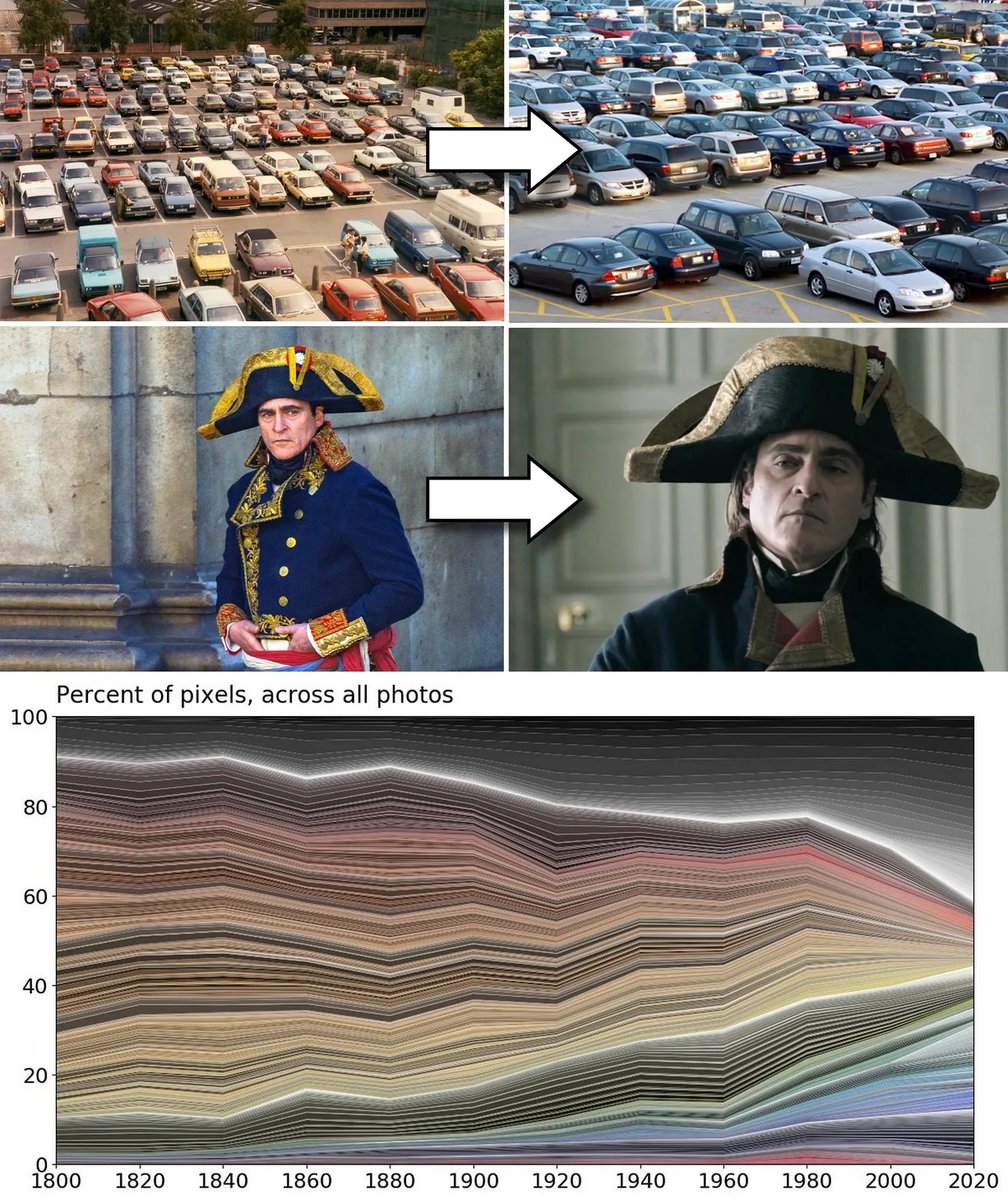
It all points to one thing: color is vanishing from our world.
This isn’t just a hunch. Studies of everything from car paint to consumer objects show that we’re in the midst of a vast aesthetic shift. What used to be vibrant has become sterile. What used to pop out and catch our attention now fades into the background."
theculturist.io/p/why-is-the-w…
