Two recent papers used deep learning to either create, or discover,...

Niko McCarty.@NikoMcCarty
9 views
Aug 16, 2025
~3 min read
Advertisement
1
Two recent papers used deep learning to either create, or discover, new antibiotics.
I'll first look at the paper that made new antibiotics from scratch (and then maybe write another post about the discovery paper.) The crazy thing about this paper, in particular, is that they screened 45 million chemical "fragments" entirely in silico and made a new antibiotic that is:
i) Structurally dissimilar from all known antibiotics.
ii) Seems to work through a mechanism of action to which resistance has not yet evolved.
...and also, importantly, the whole process is repeatable and could be adapted for other antibiotics.
More specifically: The team, from MIT (and now at Integrated Biosciences, Inc.) started with models that had previously been "trained and benchmarked on...growth inhibition data for 38,765 compounds screened against" two microbes: N. gonorrhoeae and Staph. aureus.
(The same group of researchers made that model for a previous paper, published in Nature in 2024:
nature.com/articles/s4158…)
Next, they built a database of >45 million chemical fragments "with chemically meaningful structures," and automatically compared them to a "manually compiled set of 559 known antibacterial compounds." They did this step to make sure that their generated batch of 45 million chemical fragments would stretch into chemical space that is not widely covered by existing molecules. They wanted to sample a wide swath of chemical space, in other words.
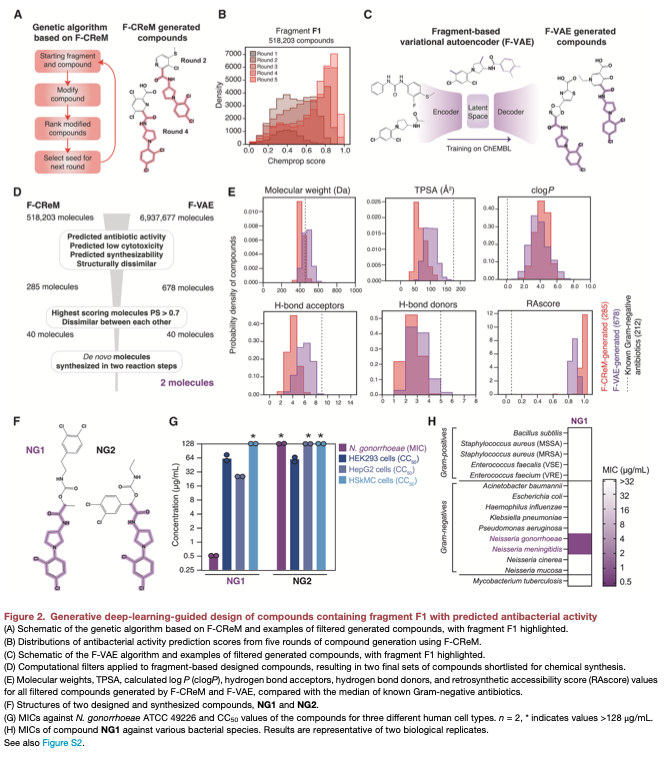
Then, the authors "virtually screened" this large fragment library using models called Chemprop, which predict whether each molecule is likely to have antibiotic activity. More than 1 million molecules passed this filter. After filtering out molecules likely to be toxic, and running other generative ML algorithms to refine these molecules, they obtained a few hundred molecules.
Finally, they selected 80 compounds that were "structurally dissimilar from each other and had the highest predicted antibacterial scores," of which just TWO could be synthesized with high purity. Those two molecules were called NG1 and NG2. (They tried to synthesize 27 compounds in total, but NG1 and NG2 were the only ones with purities >95%).
NG1, but not NG2, inhibited growth of N. gonorrhoeae in the laboratory. Also, it did not seem to inhibit other microbes, meaning it has a narrow-spectrum of activity. After doing some other experiments, the paper fairly conclusively shows that "NG1 is antibacterial against multidrug-resistant and pathogenic strains of N. gonorrhoeae, suggesting that it might act through a mechanism of action to which resistance has not yet evolved."
In other words, the authors made an antibiotic, using computational methods, that is extremely distinct, structurally, from all known antibiotics and which may act through an entirely uncharacterized mechanism. That is amazing.
Another cool thing about this paper is that the protocol to screen and make molecules is "modular," meaning you could theoretically run it again and again to find lots of antibiotics. The hard part is just building the training datasets for the graph neural networks in the first place. Keep in mind that the thing that made THIS paper possible is that these same researchers had previously collected wet-lab, experimental data on almost 40,000 compounds!
So that's the thing we probably need now for antibiotics: Huge efforts to collect wet-lab on various antibiotics, and random chemicals, against hundreds of microbial strains. All of these data should, ideally, be made public in repositories. Who is working on that?
Direct link to paper:
mit.edu/~wongf/papers/…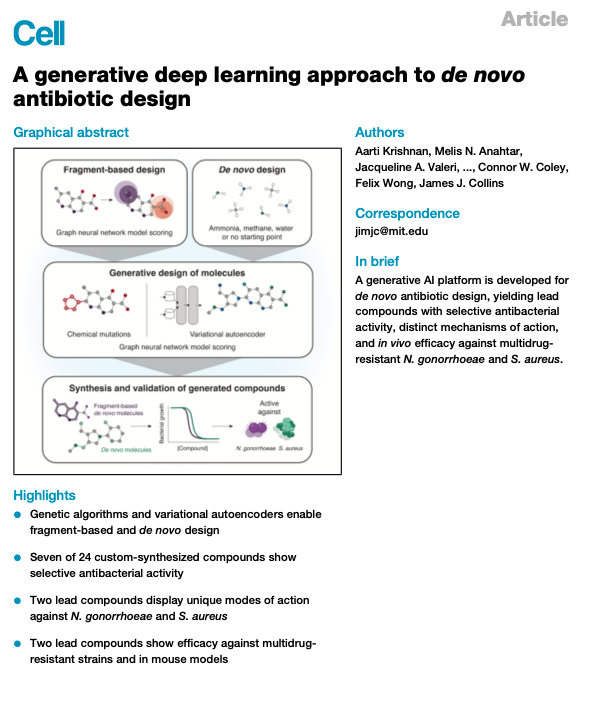
I'll first look at the paper that made new antibiotics from scratch (and then maybe write another post about the discovery paper.) The crazy thing about this paper, in particular, is that they screened 45 million chemical "fragments" entirely in silico and made a new antibiotic that is:
i) Structurally dissimilar from all known antibiotics.
ii) Seems to work through a mechanism of action to which resistance has not yet evolved.
...and also, importantly, the whole process is repeatable and could be adapted for other antibiotics.
More specifically: The team, from MIT (and now at Integrated Biosciences, Inc.) started with models that had previously been "trained and benchmarked on...growth inhibition data for 38,765 compounds screened against" two microbes: N. gonorrhoeae and Staph. aureus.
(The same group of researchers made that model for a previous paper, published in Nature in 2024:
nature.com/articles/s4158…)
Next, they built a database of >45 million chemical fragments "with chemically meaningful structures," and automatically compared them to a "manually compiled set of 559 known antibacterial compounds." They did this step to make sure that their generated batch of 45 million chemical fragments would stretch into chemical space that is not widely covered by existing molecules. They wanted to sample a wide swath of chemical space, in other words.
Then, the authors "virtually screened" this large fragment library using models called Chemprop, which predict whether each molecule is likely to have antibiotic activity. More than 1 million molecules passed this filter. After filtering out molecules likely to be toxic, and running other generative ML algorithms to refine these molecules, they obtained a few hundred molecules.
Finally, they selected 80 compounds that were "structurally dissimilar from each other and had the highest predicted antibacterial scores," of which just TWO could be synthesized with high purity. Those two molecules were called NG1 and NG2. (They tried to synthesize 27 compounds in total, but NG1 and NG2 were the only ones with purities >95%).
NG1, but not NG2, inhibited growth of N. gonorrhoeae in the laboratory. Also, it did not seem to inhibit other microbes, meaning it has a narrow-spectrum of activity. After doing some other experiments, the paper fairly conclusively shows that "NG1 is antibacterial against multidrug-resistant and pathogenic strains of N. gonorrhoeae, suggesting that it might act through a mechanism of action to which resistance has not yet evolved."
In other words, the authors made an antibiotic, using computational methods, that is extremely distinct, structurally, from all known antibiotics and which may act through an entirely uncharacterized mechanism. That is amazing.
Another cool thing about this paper is that the protocol to screen and make molecules is "modular," meaning you could theoretically run it again and again to find lots of antibiotics. The hard part is just building the training datasets for the graph neural networks in the first place. Keep in mind that the thing that made THIS paper possible is that these same researchers had previously collected wet-lab, experimental data on almost 40,000 compounds!
So that's the thing we probably need now for antibiotics: Huge efforts to collect wet-lab on various antibiotics, and random chemicals, against hundreds of microbial strains. All of these data should, ideally, be made public in repositories. Who is working on that?
Direct link to paper:
mit.edu/~wongf/papers/…
2