Nobody in Switzerland is losing sleep over this chap’s feelings —...

Alexander Stahel 🌻@BurggrabenH
7 views
Aug 09, 2025
~4 min read
Advertisement
1
Nobody in Switzerland is losing sleep over this chap’s feelings — trust me.
But this outrage? Pure rookie econ — from someone who says he was at Goldman. Let’s unpack why.
1/2 @patrick_saner

But this outrage? Pure rookie econ — from someone who says he was at Goldman. Let’s unpack why.
1/2 @patrick_saner
Robin Brooks@robin_j_brooks
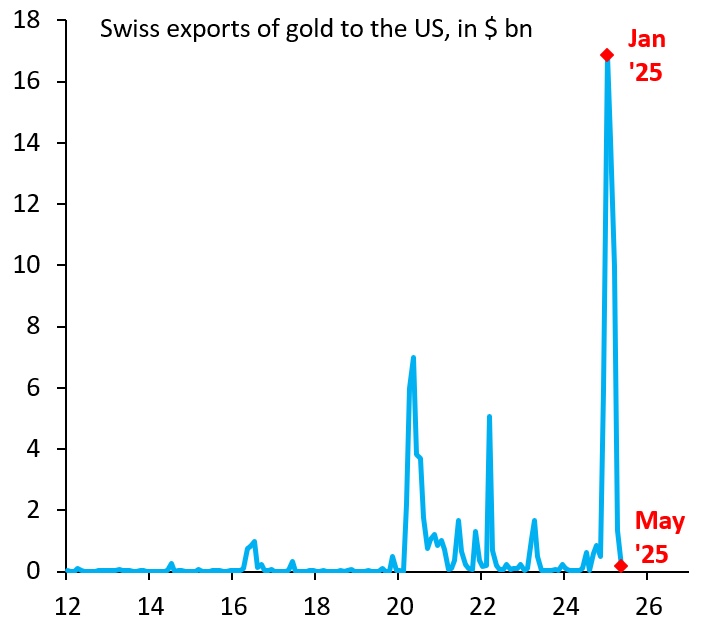
I'm having a tough time summoning feelings of sympathy for Switzerland. Front-running of tariffs was so huge (in gold), it threw off the entire US trade deficit. In fact, the US should push for transparency on all the Russian money hiding in Swiss bank accounts while we're at it.
2
2/3
Translated from @NZZ
With the proposed 39% tariff, Donald Trump has caught the Swiss economy off guard. The American president is using the trade balance deficit as a benchmark — and the United States imports far more goods from Switzerland than it exports there. One product group contributes significantly to this imbalance: gold.
Ironically, it was Trump’s own election that drastically worsened this “problem” in trade statistics. This overview explains what has happened in the gold trade with the U.S.
Why Does Switzerland Export Gold at all?
Switzerland’s last gold mine shut down in 1961. But gold mined abroad still needs to be processed and refined — that’s where gold refineries come in. These facilities extract gold from ore, purify it, and concentrate it. It is then cast into bars or stamped into new forms, like coins. Gold is also alloyed with other precious metals to create materials for industries such as watchmaking.
Roughly 30 to 40% of the world’s gold is processed in Switzerland, spread across four major refineries — one in Neuchâtel and three in Ticino. This is for historical reasons: for much of the 20th century, Italy was the center of the global jewelry industry. To meet demand, refineries set up nearby — but chose neutral, stable Switzerland for processing the precious metal.
The gold is imported from sources like Canada or Finland or arrives as recycled gold. From Switzerland, the refined gold is exported worldwide. Because gold trade skews the foreign trade balance so heavily, Switzerland calculates its trade statistics both with and without the impact of precious metals. After chemical-pharmaceutical products, precious metals and gemstones are Switzerland’s second-largest export category — and the largest import category.
Why Has Gold Trade With the U.S. Suddenly Come Into Focus?
As the world’s leading financial center, the U.S. is one of the largest gold importers — banks and investors there purchase large amounts of gold bars. Since Trump became president, Swiss gold exports to the U.S. have risen sharply. Between 2021 and 2023, their value ranged from CHF 6.1 to 9.1 billion, according to the Federal Office for Customs and Border Security (BAZG). But in 2024, exports surged to CHF 11 billion.
The cause? The end of the year, shortly after Trump’s election: about half of that year’s total — CHF 5.6 billion — was shipped in December 2024 alone. Rising gold prices played a role, but the main reason was a massive surge in export volume to the U.S., fueling the trade imbalance. In 2024, Switzerland posted a CHF 39 billion trade surplus with the United States.
What Caused the Sudden Explosion in Gold Exports to the U.S.?
Fear of tariffs. Banks, asset managers, and investors feared that Trump might impose duties on imported gold bars. So they started moving gold reserves out of London and rushed to get them to New York in time.
Here’s the issue: London stores gold in 400-ounce bars (approx. 12.4 kg) — a historical standard. But in New York, at the commodities exchange Comex, the required format is a 1 kg bar. To be accepted in the U.S., the gold must be melted down and recast.
Swiss refineries had the necessary capacity — and they’re just a small detour between London and New York. The result? An unprecedented flood of orders and full utilization at the Swiss plants.
How Long Did This Frenzy Last?
The Trump tariff on gold bars was never implemented. So the rush faded after just a few months. The peak came in January 2025, when 195 tons of gold were exported from Switzerland to the U.S. In April, it was only 14 tons; in May and June, just over 2 tons each.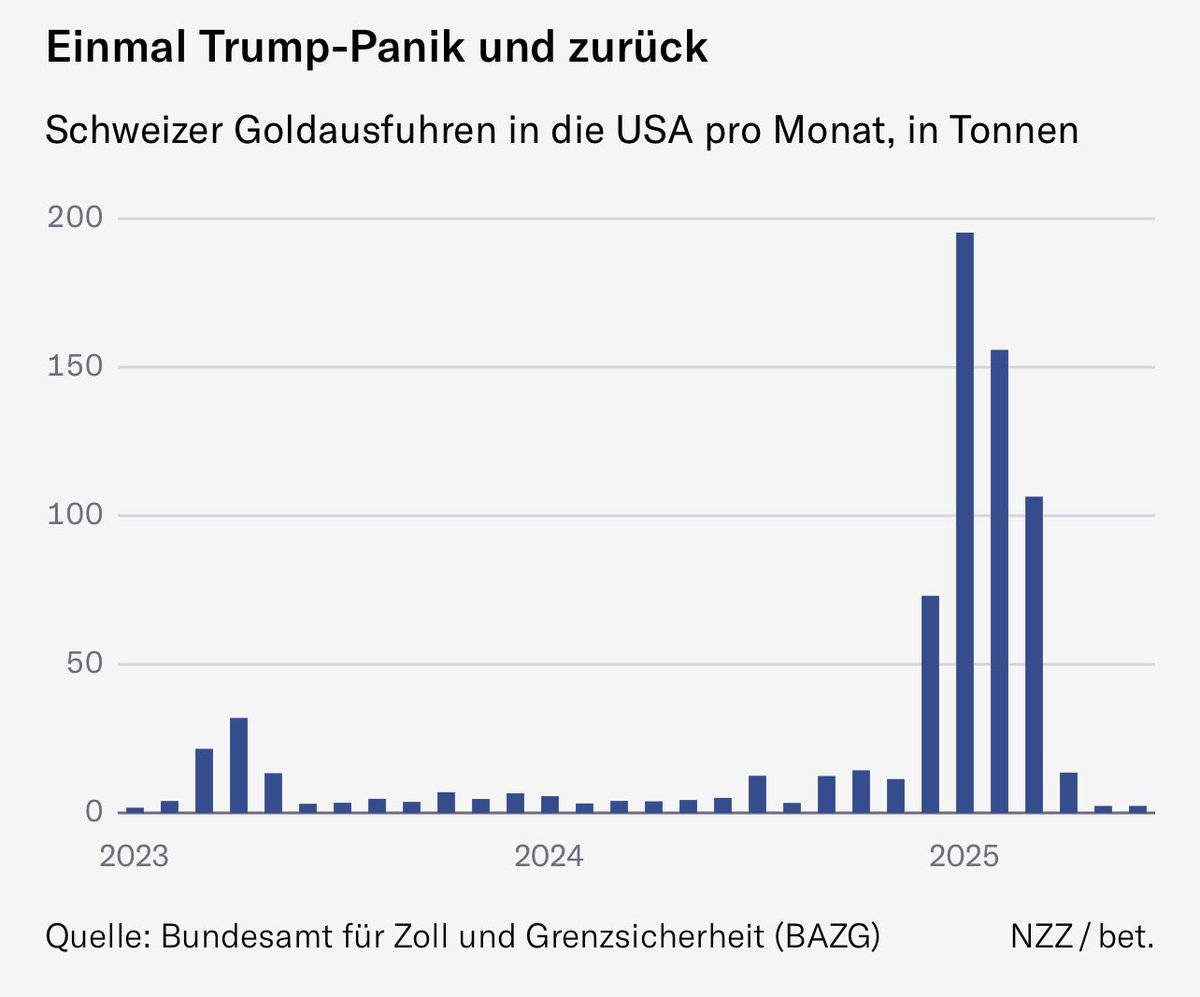
Translated from @NZZ
With the proposed 39% tariff, Donald Trump has caught the Swiss economy off guard. The American president is using the trade balance deficit as a benchmark — and the United States imports far more goods from Switzerland than it exports there. One product group contributes significantly to this imbalance: gold.
Ironically, it was Trump’s own election that drastically worsened this “problem” in trade statistics. This overview explains what has happened in the gold trade with the U.S.
Why Does Switzerland Export Gold at all?
Switzerland’s last gold mine shut down in 1961. But gold mined abroad still needs to be processed and refined — that’s where gold refineries come in. These facilities extract gold from ore, purify it, and concentrate it. It is then cast into bars or stamped into new forms, like coins. Gold is also alloyed with other precious metals to create materials for industries such as watchmaking.
Roughly 30 to 40% of the world’s gold is processed in Switzerland, spread across four major refineries — one in Neuchâtel and three in Ticino. This is for historical reasons: for much of the 20th century, Italy was the center of the global jewelry industry. To meet demand, refineries set up nearby — but chose neutral, stable Switzerland for processing the precious metal.
The gold is imported from sources like Canada or Finland or arrives as recycled gold. From Switzerland, the refined gold is exported worldwide. Because gold trade skews the foreign trade balance so heavily, Switzerland calculates its trade statistics both with and without the impact of precious metals. After chemical-pharmaceutical products, precious metals and gemstones are Switzerland’s second-largest export category — and the largest import category.
Why Has Gold Trade With the U.S. Suddenly Come Into Focus?
As the world’s leading financial center, the U.S. is one of the largest gold importers — banks and investors there purchase large amounts of gold bars. Since Trump became president, Swiss gold exports to the U.S. have risen sharply. Between 2021 and 2023, their value ranged from CHF 6.1 to 9.1 billion, according to the Federal Office for Customs and Border Security (BAZG). But in 2024, exports surged to CHF 11 billion.
The cause? The end of the year, shortly after Trump’s election: about half of that year’s total — CHF 5.6 billion — was shipped in December 2024 alone. Rising gold prices played a role, but the main reason was a massive surge in export volume to the U.S., fueling the trade imbalance. In 2024, Switzerland posted a CHF 39 billion trade surplus with the United States.
What Caused the Sudden Explosion in Gold Exports to the U.S.?
Fear of tariffs. Banks, asset managers, and investors feared that Trump might impose duties on imported gold bars. So they started moving gold reserves out of London and rushed to get them to New York in time.
Here’s the issue: London stores gold in 400-ounce bars (approx. 12.4 kg) — a historical standard. But in New York, at the commodities exchange Comex, the required format is a 1 kg bar. To be accepted in the U.S., the gold must be melted down and recast.
Swiss refineries had the necessary capacity — and they’re just a small detour between London and New York. The result? An unprecedented flood of orders and full utilization at the Swiss plants.
How Long Did This Frenzy Last?
The Trump tariff on gold bars was never implemented. So the rush faded after just a few months. The peak came in January 2025, when 195 tons of gold were exported from Switzerland to the U.S. In April, it was only 14 tons; in May and June, just over 2 tons each.
3
3/3
How Does Trump Undermine His Own Tariff Logic?
The U.S. has not imposed tariffs on cast gold bars or unrefined doré bars (raw precious metal mix). However, stamped bars and minted coins (like the famous Swiss Goldvreneli) are subject to tariffs.
This follows Trump’s narrative of increasing domestic value creation. Stamped bars and coins are considered finished products. Cast bars, on the other hand, can be melted down and transformed into final products — taxing them would contradict this strategy.
But here’s the flaw: if the U.S. deliberately excludes cast bars from tariffs, then it makes no sense to use the trade deficit — inflated by those very imports — as a reason to impose high tariffs on other Swiss goods.
End
How Does Trump Undermine His Own Tariff Logic?
The U.S. has not imposed tariffs on cast gold bars or unrefined doré bars (raw precious metal mix). However, stamped bars and minted coins (like the famous Swiss Goldvreneli) are subject to tariffs.
This follows Trump’s narrative of increasing domestic value creation. Stamped bars and coins are considered finished products. Cast bars, on the other hand, can be melted down and transformed into final products — taxing them would contradict this strategy.
But here’s the flaw: if the U.S. deliberately excludes cast bars from tariffs, then it makes no sense to use the trade deficit — inflated by those very imports — as a reason to impose high tariffs on other Swiss goods.
End
