OnOpportunity Zones, by David Neumark TL;DR: place-based policy...

Paul Novosad@paulnovosad
54 views
Jul 27, 2025
~2 min read
1
OnOpportunity Zones, by David Neumark
TL;DR: place-based policy doesn't predictably address the problems of people in a given place, especially when it's in a place where people can easily come and go! 1/
TL;DR: place-based policy doesn't predictably address the problems of people in a given place, especially when it's in a place where people can easily come and go! 1/
2
Opportunity Zones: the purpose is "to spur economic growth and job creation in distressed communities."
Low mobility of Americans has made people more interested in place-based policies — if people aren't moving, can we improve economic circumstances where they are? 2/
Low mobility of Americans has made people more interested in place-based policies — if people aren't moving, can we improve economic circumstances where they are? 2/
3
Neumark argues OZs weren't so well designed:
- targeting wasn't well-designed, favoritism picking areas already growing
- targeting too granular (tract-level), so there will probably be spillovers
- no returns to making good investments — you make an investment, you get funds 3/
- targeting wasn't well-designed, favoritism picking areas already growing
- targeting too granular (tract-level), so there will probably be spillovers
- no returns to making good investments — you make an investment, you get funds 3/
4
Prior evidence bore out the skepticism:
- strong selection on improving tracts
- once taken into account, no evidence of gains in earnings or poverty reduction
- but some papers found positive job growth effects 4/
- strong selection on improving tracts
- once taken into account, no evidence of gains in earnings or poverty reduction
- but some papers found positive job growth effects 4/
5
This paper: longer-run impacts, focus a little more on spillovers.
5/
5/
6
Key (preliminary) findings:
- increased employment rates, but jobs favor people in neighboring, richer census tracts
- limited impacts on people living in the low-income tracts to begin with
- job gains are offset 1-to-1 by nearby low-income tracts — not great
6/
- increased employment rates, but jobs favor people in neighboring, richer census tracts
- limited impacts on people living in the low-income tracts to begin with
- job gains are offset 1-to-1 by nearby low-income tracts — not great
6/
7
Identification strategy: compare treated tracts to eligible tracts which weren't designated opportunity zones. Obv question is why — treated tracts were indeed doing a bit worse. 7/
8
Hard diff-in-diff situation — dashed line is event study — OZs started poorer but were already catching up.
So hard to interpret 2018-19 as good results
So hard to interpret 2018-19 as good results
9
I missed the methodlogy but somehow the "doubly robust" estimator is killing the pre-trends (compare red/green "reliable estimates" vs. blue "naive diff-in-diff").
We see some clear employment gains (1%?) 9/
We see some clear employment gains (1%?) 9/
10
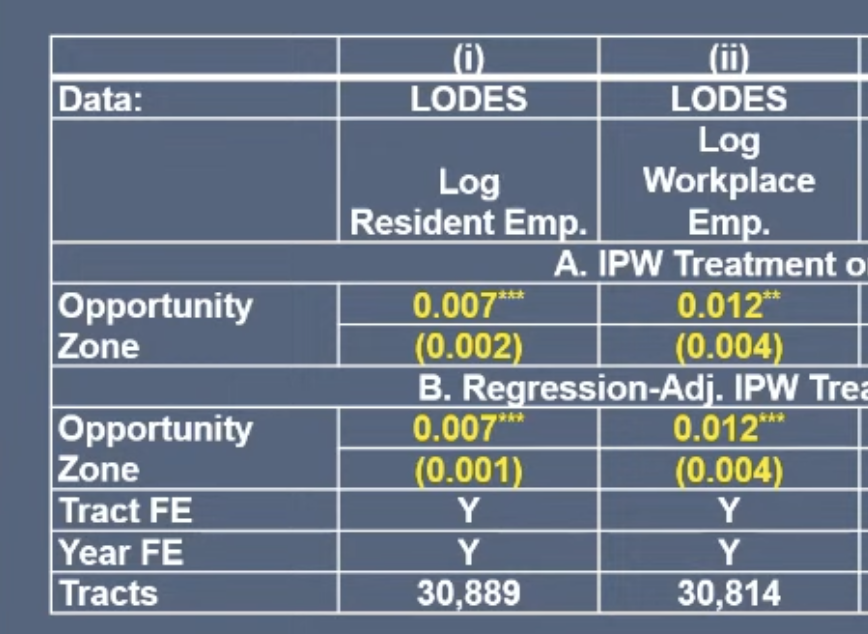
Not sure how this squares with the preview — it seems like resident employment does go up, though less than "jobs in OZ" 10/
11
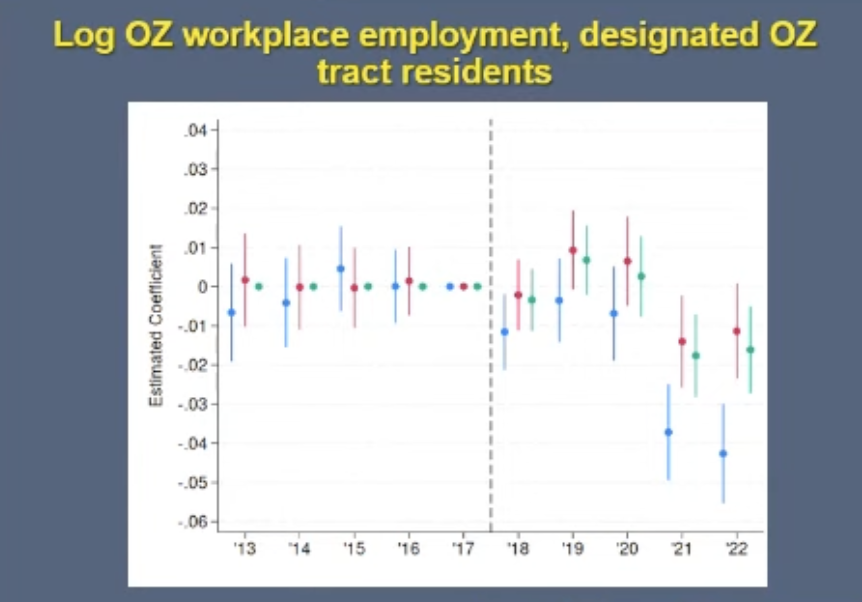
Here we go — no clear gains to workplace jobs for people living in the same tract — biggest gains are jobs in Opportunity Zones, held by people in nearby higher-income tracts.
Likely the jobs are going to higher-education workers. 11/
Likely the jobs are going to higher-education workers. 11/
12
Here's the negative spillovers result — bottom two yellow numbers (p<0.1), estimate as if the neighboring tracts were the ones treated.
Noisy, small, but about the same effect size as any positive effect detected in the own census tract earlier. 12/
Noisy, small, but about the same effect size as any positive effect detected in the own census tract earlier. 12/
13
Interesting paper, author is clear it's preliminary.
However, we should expect at least some results if you're doing place-based policy at the census tract level. Important research!
Link to paper: conference.nber.org/conf_papers/f2…
However, we should expect at least some results if you're doing place-based policy at the census tract level. Important research!
Link to paper: conference.nber.org/conf_papers/f2…