🇺🇸🇮🇷 This is probably one of the greatest US military fails. A PR...

Spetsnaℤ 007 🇷🇺@Alex_Oloyede2
14 views
Jun 23, 2025
~3 min read
Advertisement
1
🇺🇸🇮🇷 This is probably one of the greatest US military fails. A PR disaster waiting to backfire.
Iran's Nuclear Facility in Fordow remains intact with little to no damages. The nuclear program not only still exists but is being sped up thanks for new foreign support.
🧵1/12
Iran's Nuclear Facility in Fordow remains intact with little to no damages. The nuclear program not only still exists but is being sped up thanks for new foreign support.
🧵1/12
2
From higher resolution images we can see the use of 6 US GBU-57 "bunker buster" bombs.
The GBU-57 carried by the B-2 bomber is capable of approximately 60m of penetration.
But, Iran's nuclear facility is reported to be 20 or even 30m deeper. (80-90m)
2/12
The GBU-57 carried by the B-2 bomber is capable of approximately 60m of penetration.
But, Iran's nuclear facility is reported to be 20 or even 30m deeper. (80-90m)
2/12
3
Fordow is located in the Zagros belt
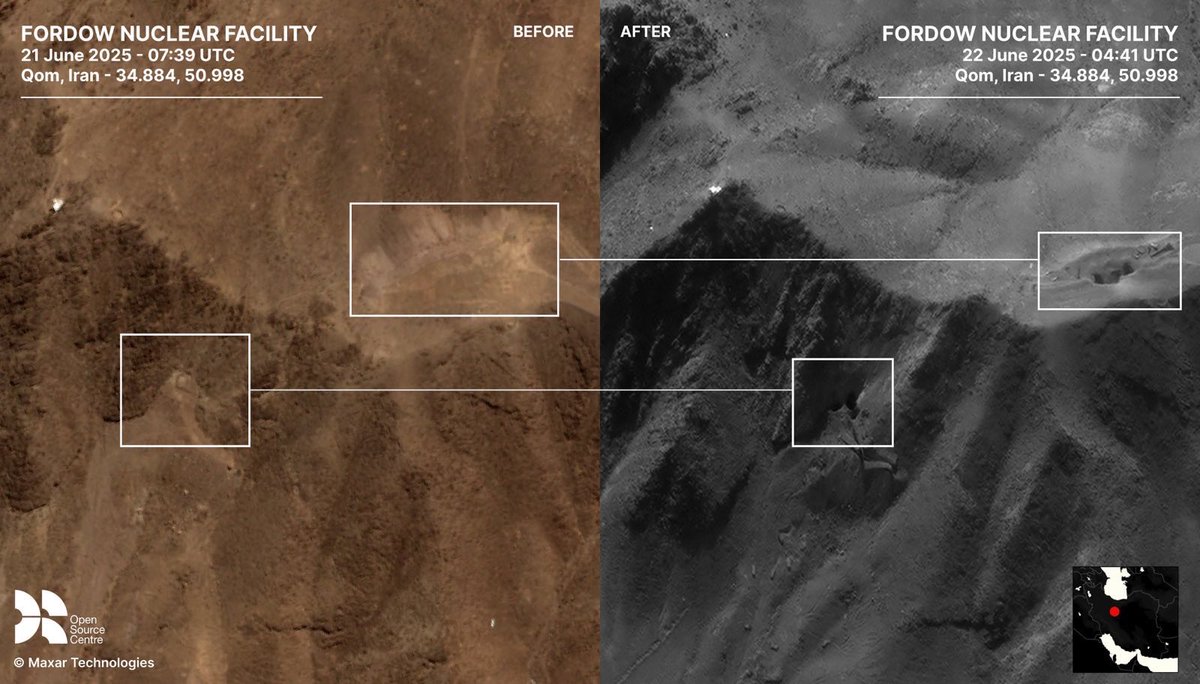
Many argue that a once red desert is covered in grey residue. Insisting that concrete was hit. While plausible there's no clear evidence it was penetrated.
Iran is rich in limestone, a grey-white stone used in the production of cement.
3/12
Many argue that a once red desert is covered in grey residue. Insisting that concrete was hit. While plausible there's no clear evidence it was penetrated.
Iran is rich in limestone, a grey-white stone used in the production of cement.
3/12
4
If you are going to further argue about penetration and the crater. You should read up on this post, great analysis.
4/12

4/12
Mike Mihajlovic@MihajlovicMike
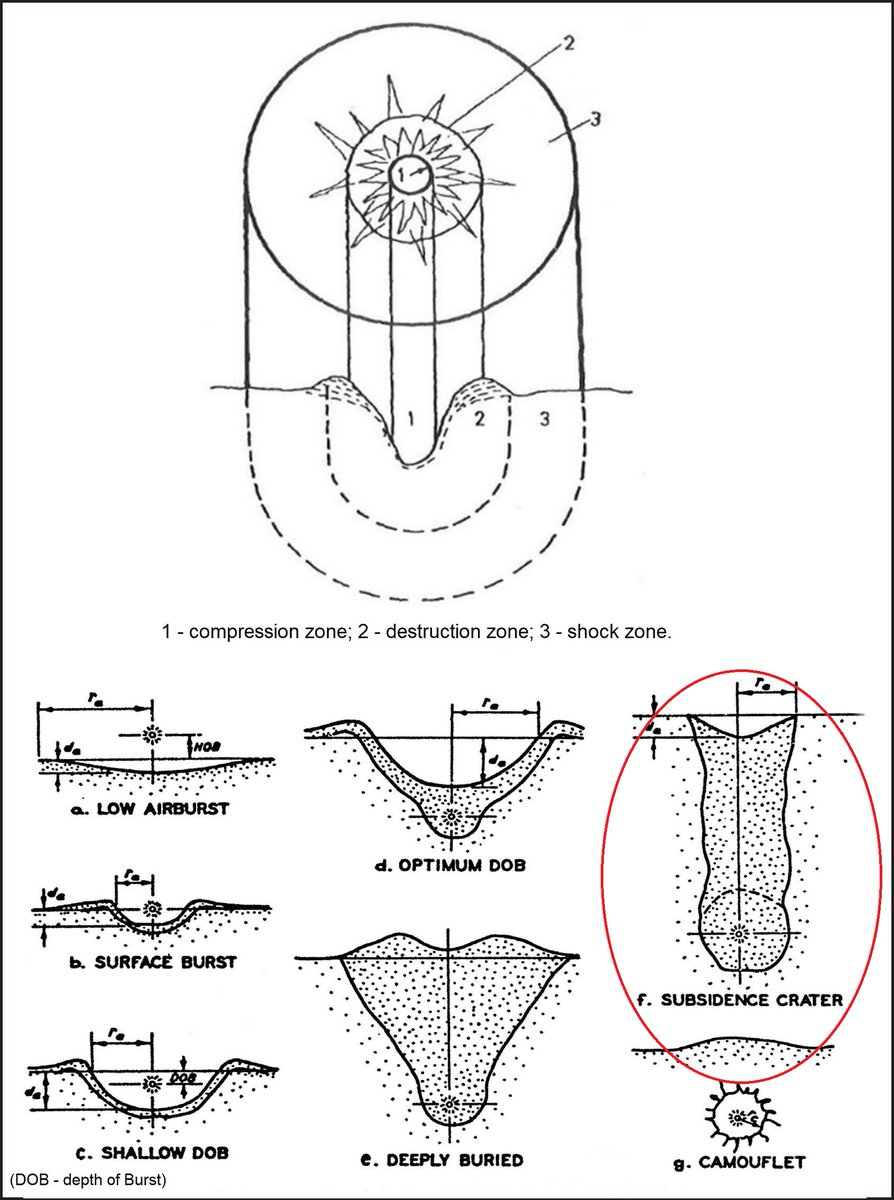
What we see in the pre- and post-strike satellite imagery at the impact locations appears to resemble a subsidence crater.
A subsidence crater forms when an underground explosion causes the overlying material to collapse into the void left behind. Unlike a traditional blast crater, which involves visible ejection of debris, a subsidence crater is caused by structural failure of underground cavities, often leaving a subtle depression with minimal surface disruption.
In military terms, a subsidence crater can be a signature of a failed or partial penetration, where the weapon either:
- Detonates in a shaft or soft medium (e.g., gravel, soil),
- Fails to reach the intended depth, or
- Triggers collapse in a tunnel or void below the surface.
Signs of a Subsidence Crater in Post-Strike Imagery
Shallow depression, not sharp or fresh-looking like a direct impact
- No surrounding blast pattern or fragmentation
- No signs of high-temperature surface exposure (scorching or soot)
- Minimal disruption to nearby structures
This type of crater suggests:
- The bomb may have entered a void or shaft—real or decoy
- The explosion may have caused a localized collapse, not structural destruction
- The target was likely not deeply affected, unless the collapse intersected a critical node (e.g., tunnel access or ventilation route)
If Iran built in structural void layers (or decoys), a subsidence crater might be exactly what they wanted attackers to hit.
It supports the idea of hitting a “camouflet” trap—a deception shaft or false structural target.
Even if real tunnels were collapsed, redundancy and clearance teams could restore functionality in weeks.
Bottom Line: A subsidence crater is not proof of a successful deep penetration, but possibly of a failed attempt to achieve one—or a successful deception by the defenders.
A subsidence crater forms when an underground explosion causes the overlying material to collapse into the void left behind. Unlike a traditional blast crater, which involves visible ejection of debris, a subsidence crater is caused by structural failure of underground cavities, often leaving a subtle depression with minimal surface disruption.
In military terms, a subsidence crater can be a signature of a failed or partial penetration, where the weapon either:
- Detonates in a shaft or soft medium (e.g., gravel, soil),
- Fails to reach the intended depth, or
- Triggers collapse in a tunnel or void below the surface.
Signs of a Subsidence Crater in Post-Strike Imagery
Shallow depression, not sharp or fresh-looking like a direct impact
- No surrounding blast pattern or fragmentation
- No signs of high-temperature surface exposure (scorching or soot)
- Minimal disruption to nearby structures
This type of crater suggests:
- The bomb may have entered a void or shaft—real or decoy
- The explosion may have caused a localized collapse, not structural destruction
- The target was likely not deeply affected, unless the collapse intersected a critical node (e.g., tunnel access or ventilation route)
If Iran built in structural void layers (or decoys), a subsidence crater might be exactly what they wanted attackers to hit.
It supports the idea of hitting a “camouflet” trap—a deception shaft or false structural target.
Even if real tunnels were collapsed, redundancy and clearance teams could restore functionality in weeks.
Bottom Line: A subsidence crater is not proof of a successful deep penetration, but possibly of a failed attempt to achieve one—or a successful deception by the defenders.
5
I'm still trying to piece out where and what the US was aiming for. Many suggest it was the ventilation structure, highly probable to render the facility unusable for a while but not long enough.
Image by, great research work (isis-online.org/isis-reports/t…)
5/12
Image by, great research work (isis-online.org/isis-reports/t…)
5/12
6
Comparing the before and after and then to the image provided by the Institute for Science and International security could be supported that the ventilation structure was taken out.
And a likely attempt at the support hall. The main facility is said to be even deeper.
6/12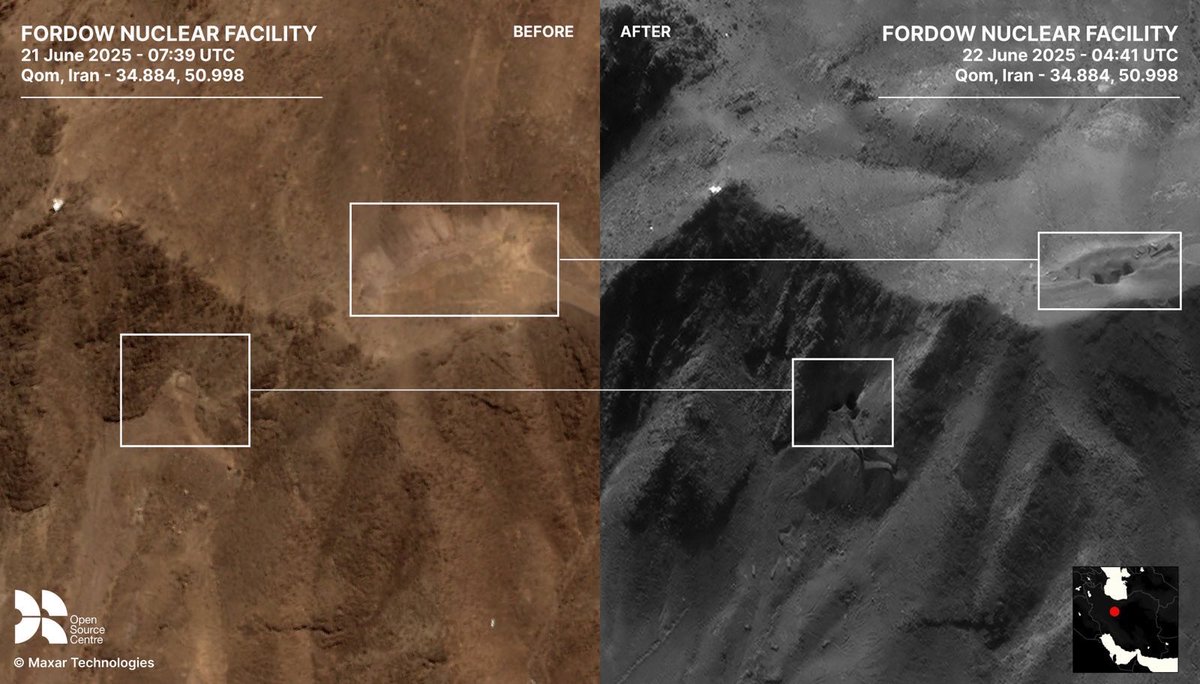
And a likely attempt at the support hall. The main facility is said to be even deeper.
6/12
7
Not even most US officials are convinced the facility was destroyed merely putting it offline for a while.
"Even 12 bunker busting bombs could not destroy the site."
7/12
"Even 12 bunker busting bombs could not destroy the site."
7/12
8
So what can we say the US achieved?
> Iran speeds up it's Nuclear enrichment
> Trump loses more than half his base
> The world now sees the agressor
> Russia, China, NKorea will support Iran
This was clearly a major failure, not only militarily but geopolitically.
8/12
> Iran speeds up it's Nuclear enrichment
> Trump loses more than half his base
> The world now sees the agressor
> Russia, China, NKorea will support Iran
This was clearly a major failure, not only militarily but geopolitically.
8/12
9
The ball is now in Iran's court, what they do with it determines the future.
> Close the strait of Hormuz (economic)
> Strike US military bases (military)
> Push on with the program (nuclear)
It's all up to the Ayatollah. Doesn't seem like Iran would surrender.
9/12
> Close the strait of Hormuz (economic)
> Strike US military bases (military)
> Push on with the program (nuclear)
It's all up to the Ayatollah. Doesn't seem like Iran would surrender.
9/12
10
The world now understands who the US president works for. The Americans were promised peace, no wars and security.
How does striking Iran guarantee those promises? This is all to Israel's advantage. Congratulations to Bibi.
10/12
How does striking Iran guarantee those promises? This is all to Israel's advantage. Congratulations to Bibi.
10/12
11
And Merkel said you can't compare with Ukraine.
She's right, Russia is defending itself by preventing a genocide of its people, US biolabs and an alliance created to kiII Russians.
The US attacked a nation which hasn't harmed Americans. An act of war in Israel's favour.
11/12
She's right, Russia is defending itself by preventing a genocide of its people, US biolabs and an alliance created to kiII Russians.
The US attacked a nation which hasn't harmed Americans. An act of war in Israel's favour.
11/12
12
In short this was a huge mistake. I once supported Trump, hoped for peace with the US but now, I have lost all hope in him.
It's up to the Americans what they think and not me. The Russian people who looked ahead to peace with the US are disappointed.
12/12
It's up to the Americans what they think and not me. The Russian people who looked ahead to peace with the US are disappointed.
12/12
13
We stand by Iran in its fight against the same globalists who fund a proxy war against the Russian Federation.
🇷🇺🤝🇮🇷
🇷🇺🤝🇮🇷
14
Enjoy, took me about 2hrs.
Spetsnaℤ 007 🇷🇺@Alex_Oloyede2
🇺🇸🇮🇷 This is probably one of the greatest US military fails. A PR disaster waiting to backfire.
Iran's Nuclear Facility in Fordow remains intact with little to no damages. The nuclear program not only still exists but is being sped up thanks for new foreign support.
🧵1/12
Iran's Nuclear Facility in Fordow remains intact with little to no damages. The nuclear program not only still exists but is being sped up thanks for new foreign support.
🧵1/12
15
You can follow me on Telegram as a backup, and also serves as my calm space where we can talk freely without censorship.
Let's build a great community together.
t.me/spets007
Let's build a great community together.
t.me/spets007