1/ May global manufacturing PMIs have dropped for the third...

Patrick Zweifel@PkZweifel
11 views
Jun 11, 2025
~1 min read
Advertisement
1
1/
May global manufacturing PMIs have dropped for the third consecutive month by one-tenth of a point to 49.2
Both activity and price components decreased in the month where the impact of tariffs— inflationary for the US— is more than offset by its disinflationary effect on the rest of the world
May global manufacturing PMIs have dropped for the third consecutive month by one-tenth of a point to 49.2
Both activity and price components decreased in the month where the impact of tariffs— inflationary for the US— is more than offset by its disinflationary effect on the rest of the world
2
2/
Due to tariffs and the uncertainty they create, manufacturing figures are more challenging to interpret:
. The rebound in global manufacturing production (+3.2% y/y) is at its highest since 2022, driven by strong pre-tariff demand
. This contrasts with declining surveys anticipating tougher months due to the recessionary impact of tariffs
. Global monetary easing, with a net share of central banks cutting rates above 60%, signals a potential manufacturing sector rebound given its high sensitivity to interest rates. The question is which of the two forces—tariffs vs. rates—will dominate the other.
3
3/
Activity components are declining across all regions, with emerging markets outperforming advanced ones, although the latter are no longer in last place thanks to a recovery in the eurozone.
Activity components are declining across all regions, with emerging markets outperforming advanced ones, although the latter are no longer in last place thanks to a recovery in the eurozone.
4
4/
By country, activity components indicate an acceleration in most Eurozone countries—led by France and Italy—India maintains the highest PMI, while the US and China show a deterioration.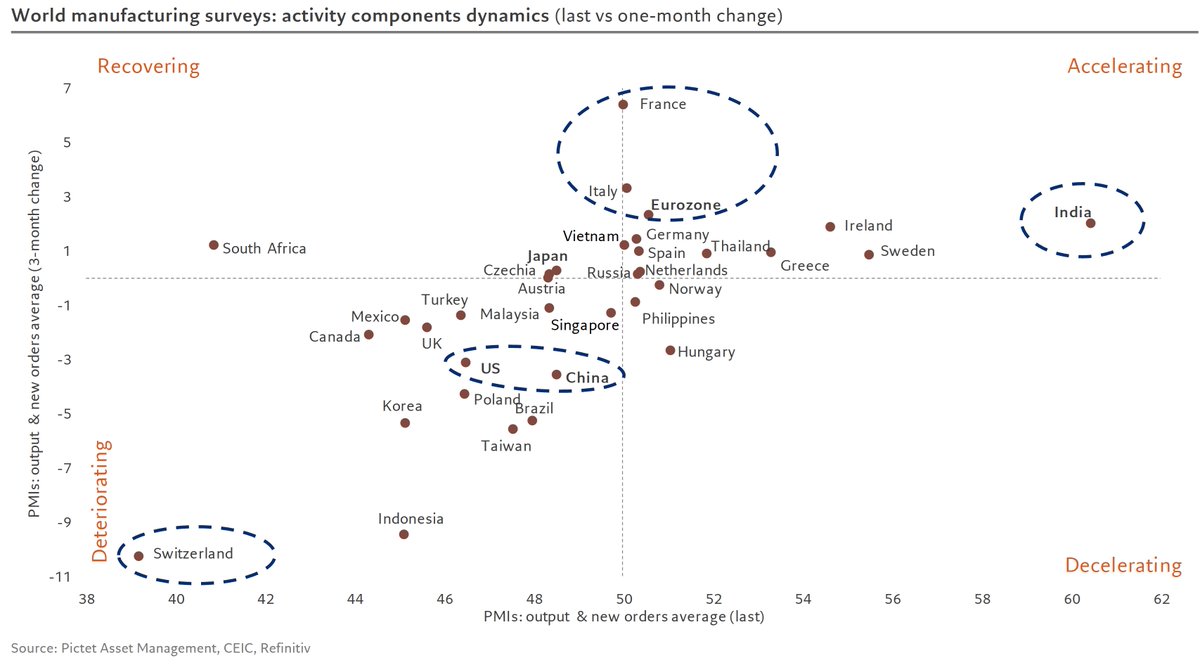
By country, activity components indicate an acceleration in most Eurozone countries—led by France and Italy—India maintains the highest PMI, while the US and China show a deterioration.
5
5/
Regarding the price component, the country-specific situation remains largely unchanged: the US faces both the highest pressures and the strongest increase over 3 months, while the most significant disinflationary impact is still observed within the Eurozone, with Germany and Italy leading the trend.
Regarding the price component, the country-specific situation remains largely unchanged: the US faces both the highest pressures and the strongest increase over 3 months, while the most significant disinflationary impact is still observed within the Eurozone, with Germany and Italy leading the trend.
6
6/
Unsurprisingly, the low levels of manufacturing surveys still do not indicate a rebound in commodity prices, which, as previously mentioned, depend on which factor will emerge victorious in the tariffs vs. rates showdown.
Unsurprisingly, the low levels of manufacturing surveys still do not indicate a rebound in commodity prices, which, as previously mentioned, depend on which factor will emerge victorious in the tariffs vs. rates showdown.