Cast, Not Carved 🧵 Here’s the theory in a nutshell—the one I’ll be...

Marcell Fóti 🪨@FoMaHun
38 views
May 15, 2025
~6 min read
Advertisement
1
1. Cast, Not Carved 🧵
Here’s the theory in a nutshell—the one I’ll be using to explain all those ridiculous questions "influencers" keep asking about ancient stones.
"How did our ancestors lift 60-ton stones?"
Well they clearly did not, or if they did, they did it in buckets! 🪣🪣🪣🪣
How did they carve the stones to fit together so precisely?
Again, they didn’t—they poured one next to the other.
Why are all the stones different? Why isn’t there a single one that’s the same?
Because they poured them straight into the wall, not into molds—so they didn’t have to lift them later.
Where are the molds then?
Nowhere. They didn’t need them. A few wooden planks or a bit of animal hide was enough.
And I’m not just talking hot air—I actually pour stones: Inca stone, sandstone, granite, limestone.
Alright, now let’s get to the examples.
2
2. Bench in Cusco
This bench is found on a street in Cusco, and what’s interesting is that it’s not a bench, but a wall slightly dislodged by an earthquake, showing how precisely they “carved”… I mean how the upper row pressed down on the still-not-fully-solidified stones of the lower row.
Of course, one could still argue they were carved, as the point is such precise carving, but let’s look at the next example.
3
3. Giant Stone in Machu Picchu
This section of wall in Machu Picchu is interesting because the bottom stone was inexplicably and unnecessarily carved as if there were plank impressions on it.
These are surely the imprints of sacred planks, otherwise, this meticulous effort is hard to understand.
Unless we see the marks of how they held the soft material in place until it solidified.
Such plank marks are ubiquitous in Sacsayhuamán, where the Holy Plank was a very popular sacred motif at the time.
4
4. Sillustani Pebbles
Staying in Peru, on the shore of Lake Titicaca, there are many cylindrical towers where it can be observed how precisely (not) they piled up the interiors of these towers. The walls are only precise on the outside; viewed from the back, it’s a big mess.
When I was there, I suspected the Peruvian state had erected such junk to deceive tourists. But it’s original.
What makes this particularly interesting is that although it’s sloppy inside, some people carved precise indentations in the stones to fit the large pebbles wedged between them with millimeter precision.
They must have lifted each large stone twenty-eight times, carving further to improve the fit. Or not.
But let’s see more examples of unnecessary yet precise carvings.
5
5. Oops, Over-Carved!
Not every Inca stone maker was equal. But it’s rare to see someone dumber than this. This Inca person simply over-carved the dividing line between stones, ruining the whole precise wall with this primitive mistake.
Unless… he dragged his finger further to create a separate stone where there isn’t one? Like a modern mason would?
6
6. Stone within Stone
These photos prove that there are stones within the carved stones. Experts say these are natural inclusions, but come on, every stone has a stone inside, we just don’t see it!
These few prove the building technique of filling the wall with watermelon-sized stones, then smearing the mix around them.
These photos prove that there are stones within the carved stones. Experts say these are natural inclusions, but come on, every stone has a stone inside, we just don’t see it!
These few prove the building technique of filling the wall with watermelon-sized stones, then smearing the mix around them.
7
7. Hands in the Wall
In Wyoming, on White Mountain, there’s a rock into which diligent hands have carved human handprints with immense effort.
In honor of the Holy Handprint, I guess.
If they had known that pressing their hands into a soft material would suffice, they’d be tearing their hair out in frustration.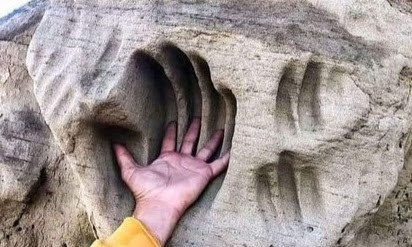
In Wyoming, on White Mountain, there’s a rock into which diligent hands have carved human handprints with immense effort.
In honor of the Holy Handprint, I guess.
If they had known that pressing their hands into a soft material would suffice, they’d be tearing their hair out in frustration.
8
8. Ba'albek Trilithon
In Lebanon, the Ba'albek Trilithon consists of three colossal limestone blocks, each weighing approximately 800 tons.
The orthodox explanation is that they were quarried and transported over 1 km. Really?
20 years after Davidovits proved that artificial limestone is possible?
If these stones were cast on site using a mix that could harden quickly, it would explain the precision and sheer scale. The local materials could have been brought in buckets and mixed on site, eliminating the need for moving these massive stones.
9
9. Pyramid Stones
Talking about Davidovits, and his artificial limestone formula, let's deal with the biggest mystery ever: The Great Pyramid
The Great Pyramid’s core stones fit together with incredible precision. Traditional theories suggest laborious chiseling and fitting. More than 2 milllion pieces.
Sure.
What if the stones were cast in place using a mixture that hardened rapidly? This would account for the tight joints and the ease of constructing such massive structures.
Even the 20 years of construction time is feasible if we forget that bloody chiseling.
10
10. Easter Island Moai
The Moai statues on Easter Island are massive and were transported several kilometers.
The traditional theory involves complex sledging methods.
And here comes Davidovits again, proving that the stones contain organic material, namely: bird poop.
This could mean two things: either The Big Bird God did it, or the people mixed it in the stone material for a reason.
And because the religiuos example is always the best, we can safely say that The Big Bird God did it, and the statues are from a "shitty material"
11
11. Giant Spheres of Costa Rica
The stone spheres of Costa Rica, some weighing up to 15 tons, are almost perfectly round.
If they were cast rather than carved, it would explain their perfect shapes and uniformity.
Casting allows for a more controlled and uniform creation process compared to carving.
But where are the molds? Well, spheres absolutely don't need molds. A perfect circle—like the rim of a glass—carves out a flawless 3D sphere from the material. I’ve done it tons of times, it’s no challenge at all. Let me show my perfect stone sphere.
Chiseling my ass 🤣
12
12. Petra, Jordan
I have a long post about Petra somewhere here on X, now suffice to say that if you carve this rock, it's color will change. What?
Because no one has cleared the surface of this building in the last milennia, it's there in the open just like the rest of the mountain, yet, it has a light pink-ish color, much lighter than the original rock.
What if? Yeah. Plastered back.
13
13. Olmec heads
When I cast an artificial stone, I always have to fight with bubbles. It seem to me bubbles are inevitable with certaind ingredients.
And if you cannot use vibration to remove those bubbles, you'll end up like these Olmec people with these giant heads.
Bubbles everywhere. Sorry Olmec people, you should try harder to come up with a better mix!
14
14. Puma Punku
Last, but not least, a site where it is very hard to deny casting instead of chiseling.
Here in Puma Punku, ancient people used the copper chisel so precisely that you cannot repeat their work even with today's precision tools.
Except if these stones were cast. Were they?
Now you can start crying for a mold, because these stones are uniform, requiring a mold to create these. But there are no molds here.
Why? Easy. No mold form wood or any organic material can survive x thousand years.
End of story. Or the beginning of a much bigger story?
