The impact assessment suggests there could be up to 4,559 assisted...

Dan Hitchens@ddhitchens
9 views
May 07, 2025
~2 min read
Advertisement
1
1. The impact assessment suggests there could be up to 4,559 assisted suicides per year by 2039.
Already somewhat higher than the “40 patients per year” predicted by Leadbeater ally @SadikAlHassanMP.
But there is good reason to think 4500 is a serious underestimate. Here’s why:
Already somewhat higher than the “40 patients per year” predicted by Leadbeater ally @SadikAlHassanMP.
But there is good reason to think 4500 is a serious underestimate. Here’s why:
2
2. The civil servants based that figure on a crude calculation: Oregon has a little under 1% deaths by assisted suicide, this bill is similar, so let’s say a little under 1%.
They don’t make any great claims for this method. Nor should they—because there are crucial differences.
They don’t make any great claims for this method. Nor should they—because there are crucial differences.
3
3. Oregon, to state the obvious, does not have an NHS. It has a maze of different insurers and health providers.
Finding compliant doctors in the maze is so hard that—according to Oregon’s main AS group—only 1 in 25 who want lethal drugs get access to them. (Guardian, July 2014)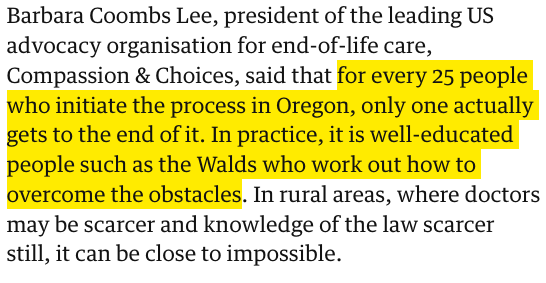
Finding compliant doctors in the maze is so hard that—according to Oregon’s main AS group—only 1 in 25 who want lethal drugs get access to them. (Guardian, July 2014)
4
4. Oregon has a kind of accidental safeguard: a healthcare system full of obstacles and dead ends.
A study in the American Journal of Bioethics found many Oregonians “want [AS] but…lack the education and confidence to assert their rights forcefully enough to obtain assistance.”
A study in the American Journal of Bioethics found many Oregonians “want [AS] but…lack the education and confidence to assert their rights forcefully enough to obtain assistance.”
5
5. Linda Ganzini, one the leading academic experts on Oregon’s law, found that the typical Oregonian who receives assisted suicide is “self-directed, in charge, strong-willed, and stubborn.”
6
6. Compare the Leadbeater Bill.
An all-embracing nationwide system, in which every single doctor, at your request, is legally obliged either to start the assisted suicide process, refer you to someone who can do it, or direct you towards information to help you access it. (Cl 5)
An all-embracing nationwide system, in which every single doctor, at your request, is legally obliged either to start the assisted suicide process, refer you to someone who can do it, or direct you towards information to help you access it. (Cl 5)
7
7. Then there’s the financial motive.
Leadbeater admitted to the committee you could get an assisted suicide if your *only* reason was the cost of care.
Where is that more likely to happen—a wealthy US state like Oregon (median household income $80k=£60k) or in the UK (£37k)?
Leadbeater admitted to the committee you could get an assisted suicide if your *only* reason was the cost of care.
Where is that more likely to happen—a wealthy US state like Oregon (median household income $80k=£60k) or in the UK (£37k)?
3:49
8
8. Leadbeater has said she wants assisted suicide totally integrated into UK healthcare. There just will not be the same accidental obstacles as in Oregon.
Dan Hitchens@ddhitchens
Big takeaway—apart from the evasiveness on profit-making—is that KL wants this integrated into existing care pathways.
“This shouldn’t be a separate service… It shouldn’t be separated from the rest of end-of-life care, and that’s one of the things I feel very strongly about.”
“This shouldn’t be a separate service… It shouldn’t be separated from the rest of end-of-life care, and that’s one of the things I feel very strongly about.”
9
9. Leadbeater originally said numbers could be up to 17,000 a year. (Telegraph, Jan 22)
The truth is we do not know the upper limit. Nobody has ever introduced AS in a population this size, or one with Britain’s particular characteristics. It is totally uncharted territory.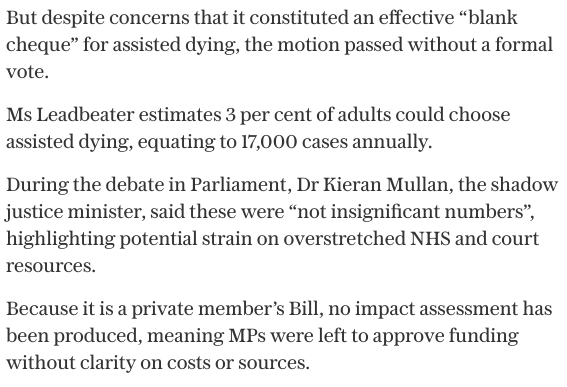
The truth is we do not know the upper limit. Nobody has ever introduced AS in a population this size, or one with Britain’s particular characteristics. It is totally uncharted territory.
10
10. To begin with, the line from Leadbeater/Dignity in Dying was that this would be for a small number of tragic cases.
Now that has become untenable, the CEO of Dignity in Dying celebrates the Bill for being “inclusive”. Which is one way of putting it.

Now that has become untenable, the CEO of Dignity in Dying celebrates the Bill for being “inclusive”. Which is one way of putting it.
Sarah Wootton@sarah_wootton
The Bill is inclusive – it includes safeguards to protect people who may be more vulnerable, would apply equally to all sexes equally, may have a positive impact on those from lower socioeconomic backgrounds and does not discriminate against people with mental illness