How long until CUA (computer using agents) cause white collar...

David Shapiro (L/0)@DaveShapi
13 views
Apr 28, 2025
~4 min read
Advertisement
1
How long until CUA (computer using agents) cause white collar workers to lose their jobs?
Let's do the math!
First, we have to define the scope of vulnerable workers, what I call "KVM jobs" - work that can be done entirely with a keyboard, video, and mouse (and maybe a webcam or headset). These jobs are:
1. Individual contributor roles
2. Low-liability (writing individual features, SEO optimizing, etc)
3. Can basically be done remotely by anyone (remote work is a good proxy for KVM jobs)
We looked at the ratio of KVM jobs in the US, EU, and globally. By and large, 30% to 45% of all jobs in developed nations are KVM jobs. America is on the lower end while EU is on the higher end. But this band proved to be a very durable ratio of KVM jobs for developed nations.
The next thing we had to determine was "how fast will CUA be adopted?"
For this, we looked at numerous recent technological adoption curves: VMware virtualization, Office 365, Smartphones, and MS Copilot. The TLDR is that tech adoption curves are accelerating, but roughly stable around the 7-8 year S-curve. This "8 Year S Curve" also proved to be EXTREMELY durable for mass adoption (enterprise, Fortune 500, and mass consumption).
TLDR: Computer Using Agents will reach a critical mass around 2029 to 2033.
While this is cool, the scary numbers are "how many jobs suffer from labor substitution because of this?"
Check below for "how many jobs are lost and how fast?"
Let's do the math!
First, we have to define the scope of vulnerable workers, what I call "KVM jobs" - work that can be done entirely with a keyboard, video, and mouse (and maybe a webcam or headset). These jobs are:
1. Individual contributor roles
2. Low-liability (writing individual features, SEO optimizing, etc)
3. Can basically be done remotely by anyone (remote work is a good proxy for KVM jobs)
We looked at the ratio of KVM jobs in the US, EU, and globally. By and large, 30% to 45% of all jobs in developed nations are KVM jobs. America is on the lower end while EU is on the higher end. But this band proved to be a very durable ratio of KVM jobs for developed nations.
The next thing we had to determine was "how fast will CUA be adopted?"
For this, we looked at numerous recent technological adoption curves: VMware virtualization, Office 365, Smartphones, and MS Copilot. The TLDR is that tech adoption curves are accelerating, but roughly stable around the 7-8 year S-curve. This "8 Year S Curve" also proved to be EXTREMELY durable for mass adoption (enterprise, Fortune 500, and mass consumption).
TLDR: Computer Using Agents will reach a critical mass around 2029 to 2033.
While this is cool, the scary numbers are "how many jobs suffer from labor substitution because of this?"
Check below for "how many jobs are lost and how fast?"
2
"Labor substitution" is the process by which you remove human labor in favor of machines. So this is why I call it "Post-Labor Economics" - we're going to get rid of human labor constraints. But how fast?
We already determined that 30% to 45% of all jobs in developed nations are in the purely KVM category - there are no legal protections for the vast majority of IT, marketing, or even finance jobs. Therefore, as CUA SaaS ramps up (and costs 10x to 100x less than human employees) the labor substitution rate is pretty stark.
In America, we estimate that >30M white collar KVM jobs will be permanently gone by 2040.
Of course, this is all forecasting and speculation, but we did our best to anchor it on empirical data and recent precedent across multiple tech stacks. This final chart assumes "CUA adoption equals labor substitution" but it's possible that it will create more jobs elsewhere, but what do you think? Are white collar desk jockey jobs cooked inside 15 years?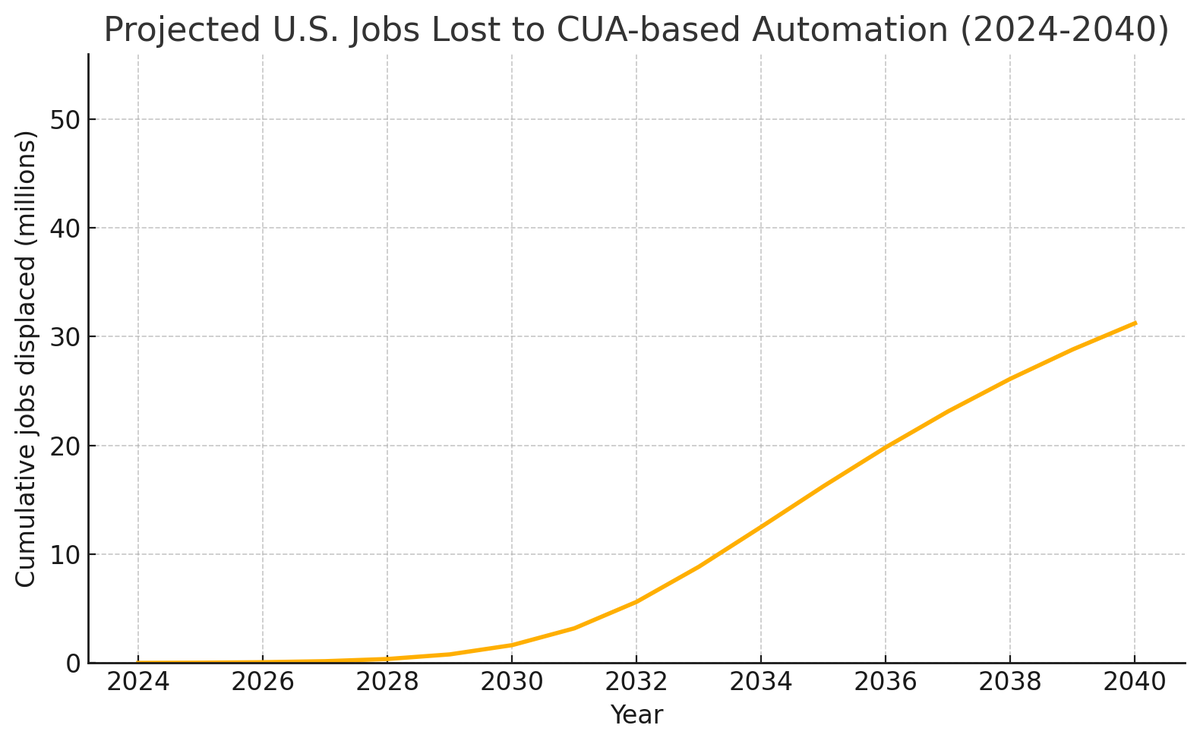
We already determined that 30% to 45% of all jobs in developed nations are in the purely KVM category - there are no legal protections for the vast majority of IT, marketing, or even finance jobs. Therefore, as CUA SaaS ramps up (and costs 10x to 100x less than human employees) the labor substitution rate is pretty stark.
In America, we estimate that >30M white collar KVM jobs will be permanently gone by 2040.
Of course, this is all forecasting and speculation, but we did our best to anchor it on empirical data and recent precedent across multiple tech stacks. This final chart assumes "CUA adoption equals labor substitution" but it's possible that it will create more jobs elsewhere, but what do you think? Are white collar desk jockey jobs cooked inside 15 years?
3
"That's just KVM white collar jobs, but what about blue collar jobs?"
America has a total of 57M "hands on, on your feet" blue collar jobs, including food service, construction, farming, etc.
So this creates a reasonable target to hit - America needs 57M general purpose humanoid robots to replace our current workforce.
We deliberately excluded a few things from this assumption:
1. Robots will be much more expensive up front, but will get cheaper over time, but start off pretty expensive.
2. As labor supply expands due to layoffs, labor cost goes down, which makes it hard to justify expensive robots.
At the same time, robots are definitely coming.
For this, we're assuming that general purpose humanoid robots are "feature complete" around 2028 - that means they can weld, fix HVAC, and work in automotive bays. Not just move boxes around warehouses or pick apples.
As before, production ramping up is the biggest bottleneck. Standing up a "robot gigafactory" takes a while, and we would need a bunch of them to get above the "few thousand units per year" we're at right now.
However, when we lower the target threshold to 57M and assume there are no production constraints, an aggressive timetable still puts us at 2038 to 2045 for "all American blue collar workers are replaced by robots"
On an epochal scale, this is still insanely fast. It also dovetails very closely with the ramp up of KVM-killing agents.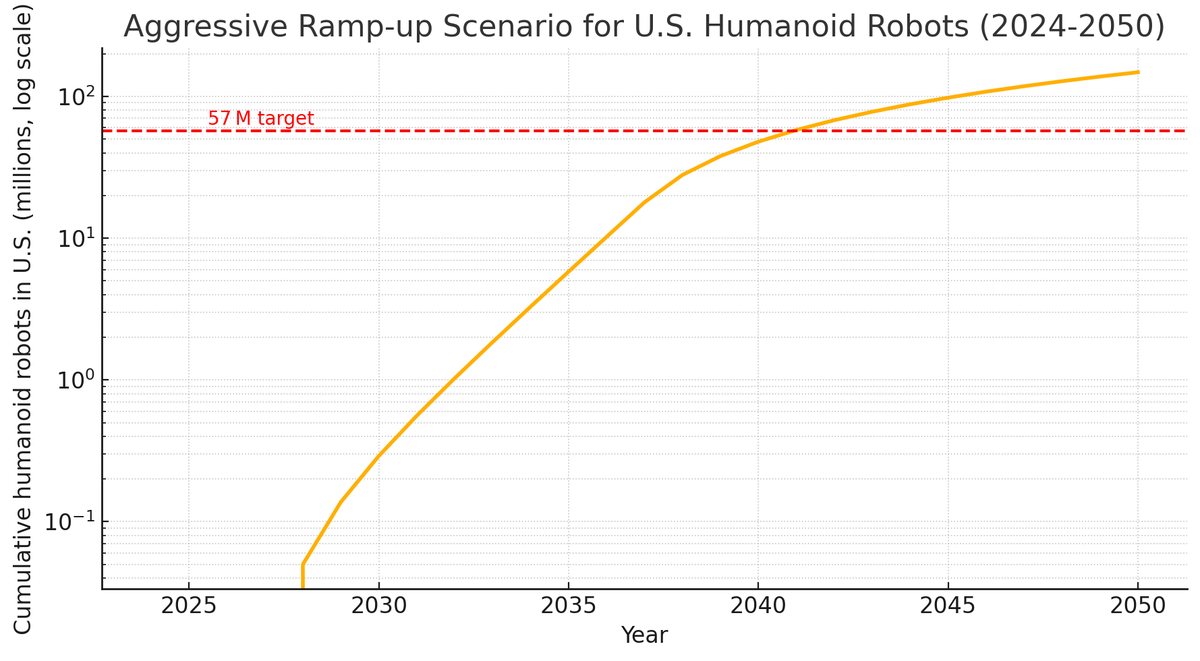
America has a total of 57M "hands on, on your feet" blue collar jobs, including food service, construction, farming, etc.
So this creates a reasonable target to hit - America needs 57M general purpose humanoid robots to replace our current workforce.
We deliberately excluded a few things from this assumption:
1. Robots will be much more expensive up front, but will get cheaper over time, but start off pretty expensive.
2. As labor supply expands due to layoffs, labor cost goes down, which makes it hard to justify expensive robots.
At the same time, robots are definitely coming.
For this, we're assuming that general purpose humanoid robots are "feature complete" around 2028 - that means they can weld, fix HVAC, and work in automotive bays. Not just move boxes around warehouses or pick apples.
As before, production ramping up is the biggest bottleneck. Standing up a "robot gigafactory" takes a while, and we would need a bunch of them to get above the "few thousand units per year" we're at right now.
However, when we lower the target threshold to 57M and assume there are no production constraints, an aggressive timetable still puts us at 2038 to 2045 for "all American blue collar workers are replaced by robots"
On an epochal scale, this is still insanely fast. It also dovetails very closely with the ramp up of KVM-killing agents.
4
Replacing all extant blue collar workers is one thing, but how long until every US home has its own domestic robot?
If production keeps scaling, we'll only need to wait a few more years to cross the 130M units so that every home can have their own Rosie the Robot or C3P0
The bad news is that it's closer to 2050 before every US home likely has its own fully functional humanoid robot.
Important to note: this does NOT exclude the possibility of mass produced, smaller robots that are "light duty"
Consider this: doing dishes, laundry, and cooking requires far less strength than a factory, warehouse, or construction bot. Less weight means lighter chassis, smaller actuators, and smaller batteries. The cost of a domestic droid could be a fraction of a 6-foot construction droid.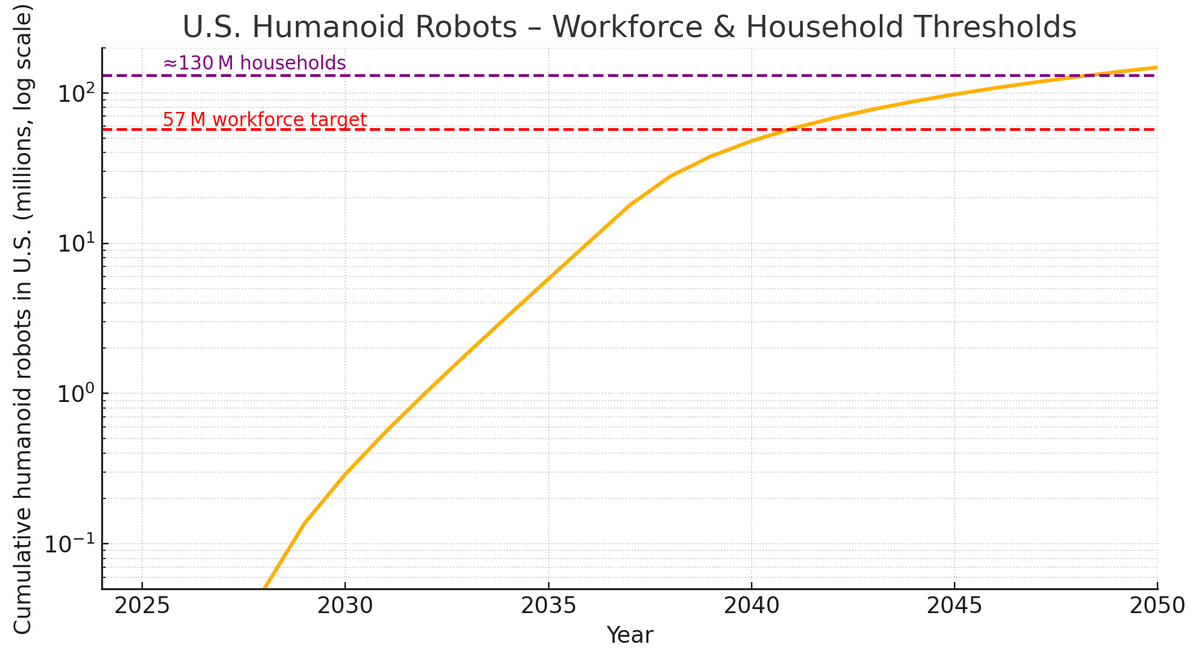
If production keeps scaling, we'll only need to wait a few more years to cross the 130M units so that every home can have their own Rosie the Robot or C3P0
The bad news is that it's closer to 2050 before every US home likely has its own fully functional humanoid robot.
Important to note: this does NOT exclude the possibility of mass produced, smaller robots that are "light duty"
Consider this: doing dishes, laundry, and cooking requires far less strength than a factory, warehouse, or construction bot. Less weight means lighter chassis, smaller actuators, and smaller batteries. The cost of a domestic droid could be a fraction of a 6-foot construction droid.
