Caffeine is the most widely used psychoactive substance in the...

Akshay Dawra@IronSage_
17 views
Apr 07, 2025
~2 min read
Advertisement
1
Caffeine is the most widely used psychoactive substance in the world.
It can make you tired, anxious, and groggy—unless you know how to use it right.
Here’s how to use caffeine effectively (backed by science):
It can make you tired, anxious, and groggy—unless you know how to use it right.
Here’s how to use caffeine effectively (backed by science):
2
90% of adults worldwide consume caffeine every day.
Most people use it to boost their alertness, energy, and focus, but too much of a good thing can lead to serious problems.
In the 1980s, NASA compared caffeine to other drugs.
Here’s what they found:
Most people use it to boost their alertness, energy, and focus, but too much of a good thing can lead to serious problems.
In the 1980s, NASA compared caffeine to other drugs.
Here’s what they found:
3
NASA exposed spiders to caffeine, LSD, weed, and speed.
The results?
Caffeine caused the worst damage to their ability to build webs.
If caffeine affects spiders like this, imagine what it’s doing to you.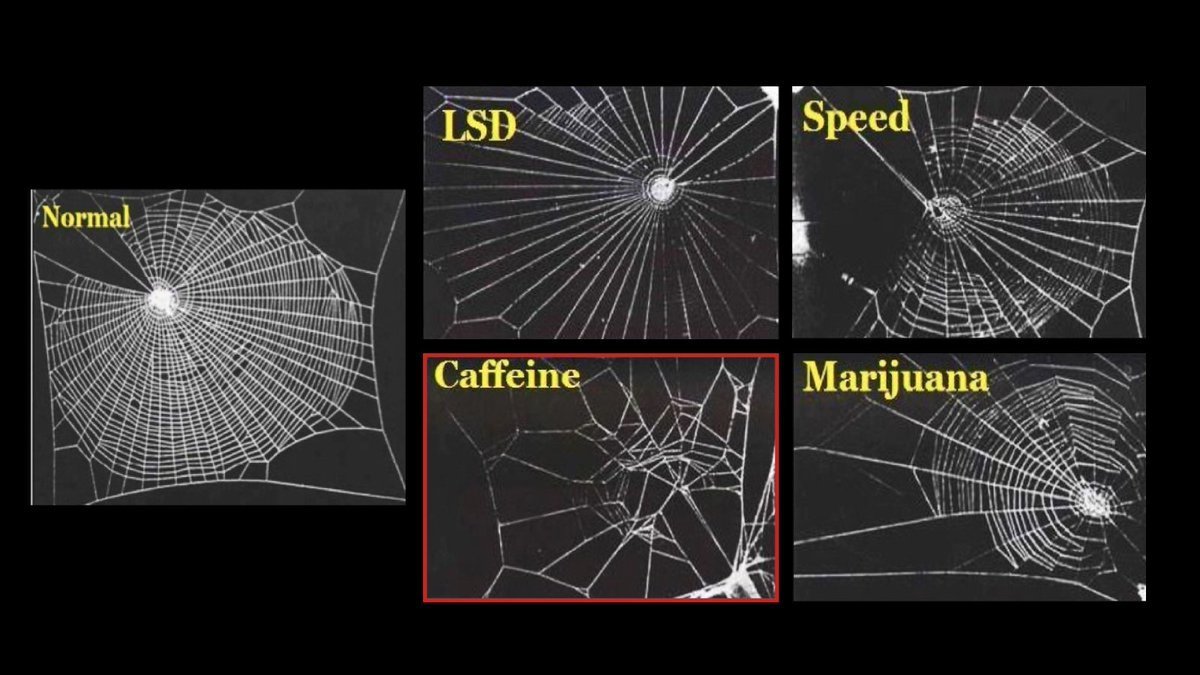
The results?
Caffeine caused the worst damage to their ability to build webs.
If caffeine affects spiders like this, imagine what it’s doing to you.
4
Caffeine stays in your body for up to 12 hours.
During that time, it blocks adenosine, a chemical crucial for sleep.
Once the caffeine wears off, the built-up adenosine floods your brain, leading to the dreaded caffeine crash.
During that time, it blocks adenosine, a chemical crucial for sleep.
Once the caffeine wears off, the built-up adenosine floods your brain, leading to the dreaded caffeine crash.
5
When most people feel the crash coming, what do they turn to?
More caffeine.
But that only makes things worse, leading to:
• Anxiety
• Poor sleep
• Dependence
The only way to clear built-up adenosine is sleep.
But caffeine makes quality sleep hard to come by.
More caffeine.
But that only makes things worse, leading to:
• Anxiety
• Poor sleep
• Dependence
The only way to clear built-up adenosine is sleep.
But caffeine makes quality sleep hard to come by.
0:59
6
We all know someone who says:
"I can drink coffee and still sleep just fine."
What they really mean is they can fall asleep fine.
Falling asleep isn’t nearly as important as getting deep, restorative sleep.
All research shows caffeine reduces the quality of deep sleep by 20%.
"I can drink coffee and still sleep just fine."
What they really mean is they can fall asleep fine.
Falling asleep isn’t nearly as important as getting deep, restorative sleep.
All research shows caffeine reduces the quality of deep sleep by 20%.
0:33
7
If you think switching to decaf is the answer, I’ve got news for you:
Decaf doesn’t mean “caffeine-free.”
Decaf still contains 30% of the caffeine in a regular cup.
This doesn’t mean you need to quit caffeine forever.
You just need to use it smarter. Here’s how:
Decaf doesn’t mean “caffeine-free.”
Decaf still contains 30% of the caffeine in a regular cup.
This doesn’t mean you need to quit caffeine forever.
You just need to use it smarter. Here’s how:
8
How to Drink Coffee (The Right Way):
1. Delay your morning coffee by 90 minutes
2. Limit your intake to 100-400 mg per day (1-4 cups).
3. Avoid caffeine 10-14 hours before bed.
Follow these rules, and coffee becomes a performance enhancer — not a crutch.
1. Delay your morning coffee by 90 minutes
2. Limit your intake to 100-400 mg per day (1-4 cups).
3. Avoid caffeine 10-14 hours before bed.
Follow these rules, and coffee becomes a performance enhancer — not a crutch.
0:49
9
When should you skip caffeine entirely?
If you suffer from:
• Anxiety
• Poor sleep
• Digestive issues
Caffeine can amplify these problems.
If you suffer from:
• Anxiety
• Poor sleep
• Digestive issues
Caffeine can amplify these problems.
0:28
10
But if your sleep and health are solid, it can boost:
• Focus
• Workouts
• Mental clarity
Caffeine is a powerful tool — but only if you respect it and use it wisely.
• Focus
• Workouts
• Mental clarity
Caffeine is a powerful tool — but only if you respect it and use it wisely.
1:45
11
30 days is all you need to change your life.
Get '100 Mental Models' to:
• Make better decisions
• Learn critical thinking
• Excel at everything
• Live a happy life
gumroad.com/a/827761939/Ax…
Get '100 Mental Models' to:
• Make better decisions
• Learn critical thinking
• Excel at everything
• Live a happy life
gumroad.com/a/827761939/Ax…