The brain is full of mitochondria! But how many, and where?...

Martin Picard@MitoPsychoBio
20 views
Apr 13, 2025
~1 min read
Advertisement
1
The brain is full of mitochondria!
But how many, and where?
Different types of mitochondria specialize for energy transformation and other functions
In MitoBrainMap v1.0 we provide the first maps of mitochondrial content and OxPhos capacity across the human brain
But how many, and where?
Different types of mitochondria specialize for energy transformation and other functions
In MitoBrainMap v1.0 we provide the first maps of mitochondrial content and OxPhos capacity across the human brain
0:09
2
The first challenge in this project was to partition the frozen human brain into small pieces, from which we could measure mitochondrial enzyme activities
The solution was to physically voxelize the brain. Eugene Mosharov created small cubes of brain using a CNC cutter
The solution was to physically voxelize the brain. Eugene Mosharov created small cubes of brain using a CNC cutter
0:39
3
In four different voxels, @AnnaMonzel and colleagues performed single-nucleus RNA sequencing to profile mitochondria in different cell types
We learnt that mitochondria are both specialized across cell types and brain regions
We learnt that mitochondria are both specialized across cell types and brain regions
4
The human brain is absolutely beautiful!
@MichelTdS thought that we could use standard neuroimaging data, train a model to predict mitochondrial features, and project the results at the scale of the whole brain
@MichelTdS thought that we could use standard neuroimaging data, train a model to predict mitochondrial features, and project the results at the scale of the whole brain
0:07
5
6
Research briefing with a bit of the backstory behind the paper 😀
nature.com/articles/d4158…
Full text: picardlab.org/uploads/7/7/8/…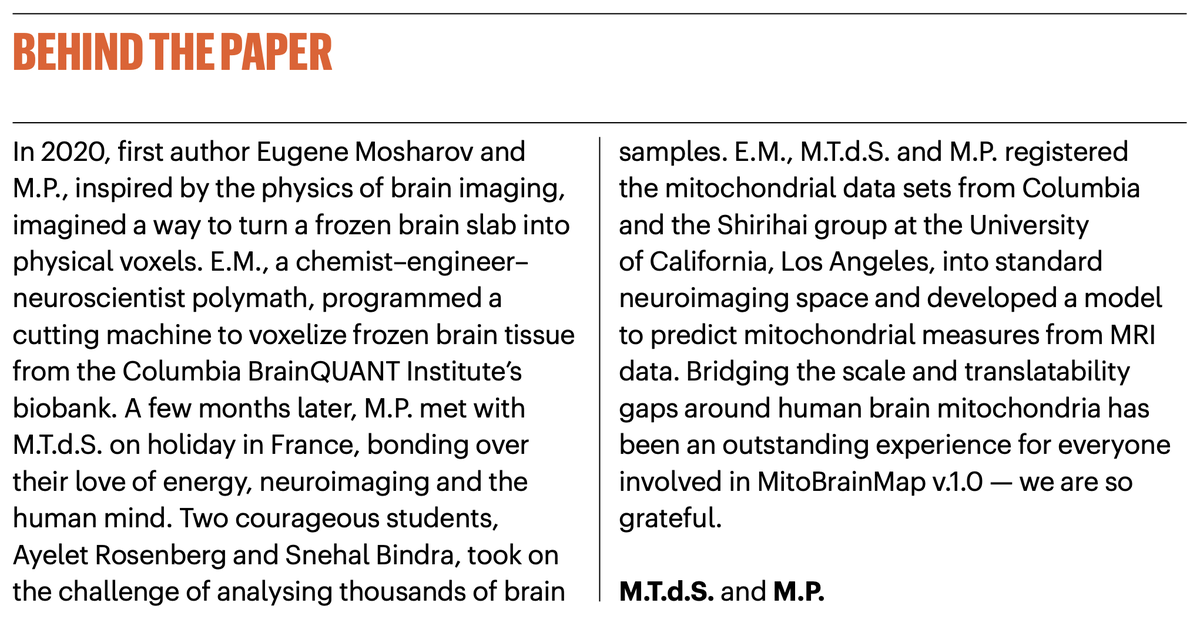
nature.com/articles/d4158…
Full text: picardlab.org/uploads/7/7/8/…
7
So grateful to @janellison @BaszuckiGroup and NIH for supporting this work
We hope it sets the stage for expanding our understanding of the mind-mitochondria connection
Thanks to @curiousdrgeorge for handling this paper to publication
We hope it sets the stage for expanding our understanding of the mind-mitochondria connection
Thanks to @curiousdrgeorge for handling this paper to publication
8
Some more thoughts about why this project was meaningful and where it may lead to
cuimc.columbia.edu/news/atlas-bra…
cuimc.columbia.edu/news/atlas-bra…
9
All data available here: humanmitobrainmap.bcblab.com
10

11
Maybe the spatial distribution and functional properties of brain mitochondria tell us something about how different energy patterns are sensed or transduced in the brain? @msahsorin


Nirosha J. Murugan@niroshajmurugan
You’re absolutely right —this deserves far more attention.
Many of us (@mcer33, @MitoPsychoBio, @StuartHameroff, et al.) are working to better understand the source and propagation of endogenous biological light, especially its role in the brain.
Once we unravel the source and propagation of biological light, we can start to explore possibilities like #optical biocomputation & non-invasive tools to detect and read out biological states.