(Yet) another tale of Rise and Fall: DeepSeek R1 is claimed to...

Jenia Jitsev 🏳️🌈 🇺🇦 🇮🇱 🇮🇷@JJitsev
19 views
Jan 27, 2025
~5 min read
Advertisement
1
(Yet) another tale of Rise and Fall: DeepSeek R1 is claimed to match o1/o1-preview on olympiad level math & coding problems. Can it handle versions of AIW problems that reveal generalization & basic reasoning deficits in SOTA LLMs? (arxiv.org/abs/2406.02061) 🧵1/n

2
After its release, DeepSeek R1 was reported to match or outperform o1 on various benchmarks containing PhD or olympiad level problems. . This fueled high expectations also from scientific community nature.com/articles/d4158… 2/n


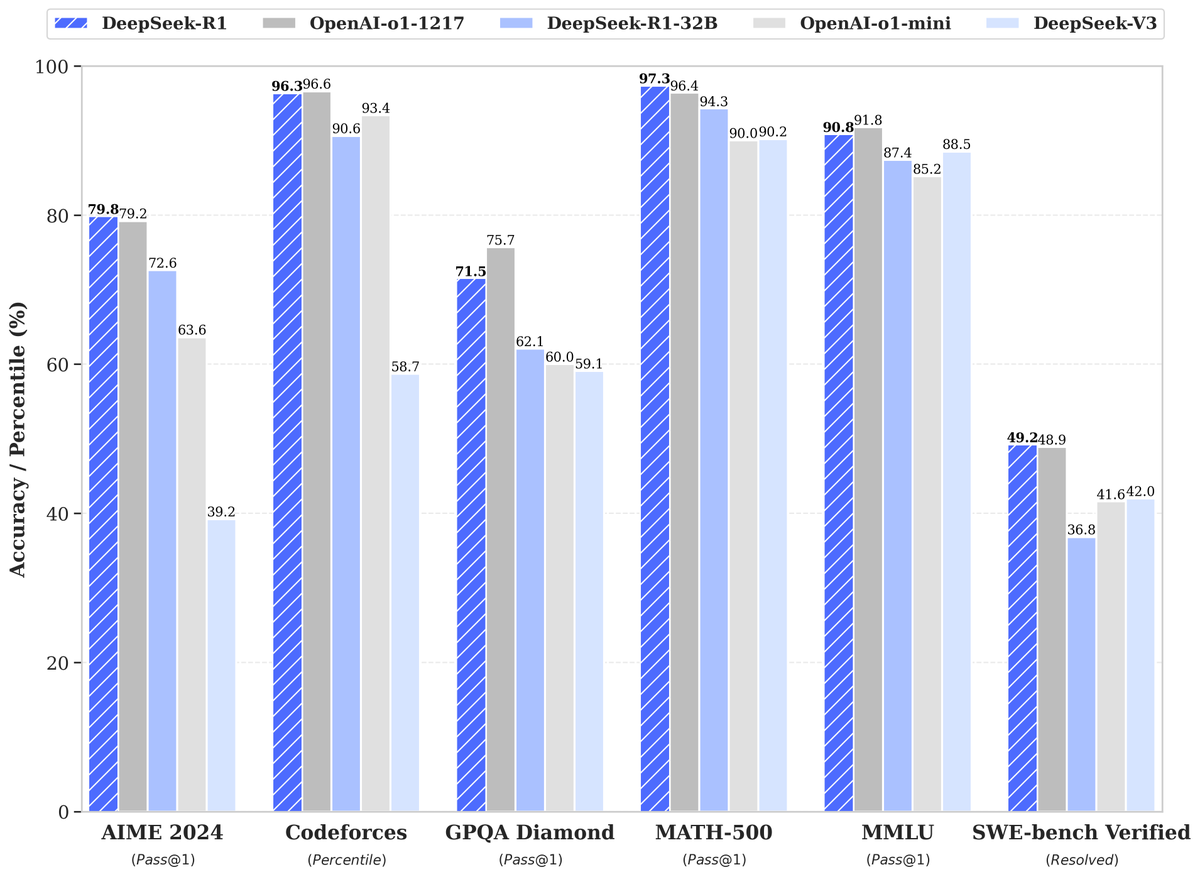
DeepSeek@deepseek_ai
🚀 DeepSeek-R1 is here!
⚡ Performance on par with OpenAI-o1
📖 Fully open-source model & technical report
🏆 MIT licensed: Distill & commercialize freely!
🌐 Website & API are live now! Try DeepThink at chat.deepseek.com today!
🐋 1/n
3
This creates impression that DeepSeek R1 is able to solve robustly highly non-trivial, even graduate or olympiad level problems from various disciplines. If it holds, it surely should handle with ease AIW problems introduced in arxiv.org/abs/2406.02061 : 4/n
4
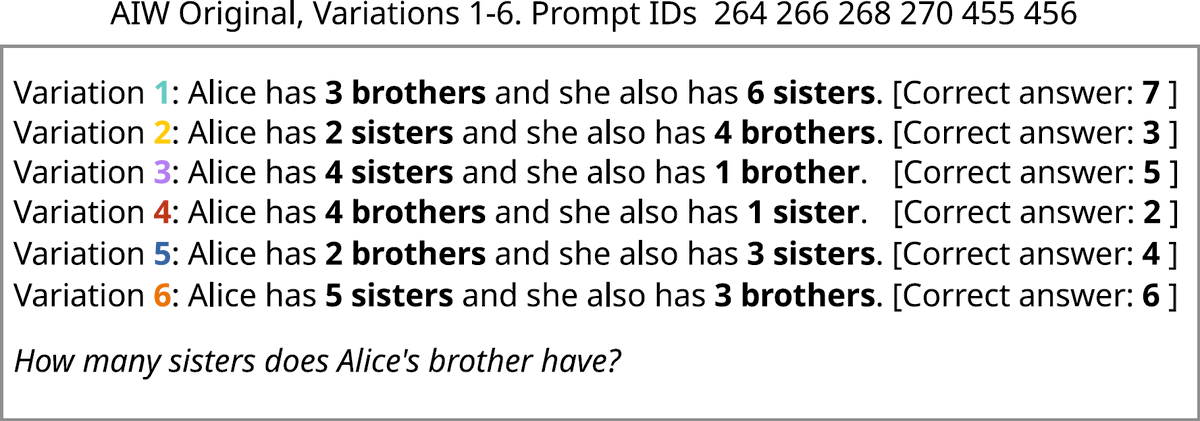
AIW instances are generated from a template that defines problem structure. Importantly, we can introduce natural problem variations by doing modifications that do not change structure or its difficulty. Those variations should not affect problem solving at all. AIW example: 5/n
5
In our work arxiv.org/abs/2406.02061, we showed SOTA LLMs suffer from strong performance fluctuations on number variations in simple AIW problem template. As variations are irrelevant for the problem, this behavior point to severe deficits in generalization and basic reasoning 6/n

6
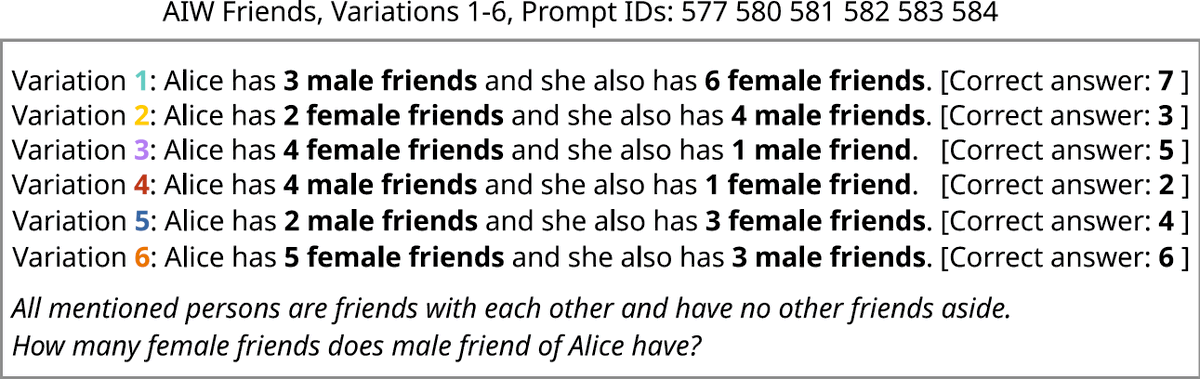
For reasoning models like o1, very simple AIW problems like above is not a challenge anymore (see ). We therefore test on AIW versions with increased difficulty, AIW Friends and AIW+. Let's start with AIW Friends (see also github.com/LAION-AI/AIW/b…): 7/n

Jenia Jitsev 🏳️🌈 🇺🇦 🇮🇱 🇮🇷@JJitsev
(Yet) another tale of Rise and Fall:
o1-mini was claimed to match much larger scale o1-preview on olympiad level math & coding problems. Can it handle simple AIW problems that reveal generalization & basic reasoning deficits in SOTA LLMs? (arxiv.org/abs/2406.02061) 🧵1/n
7
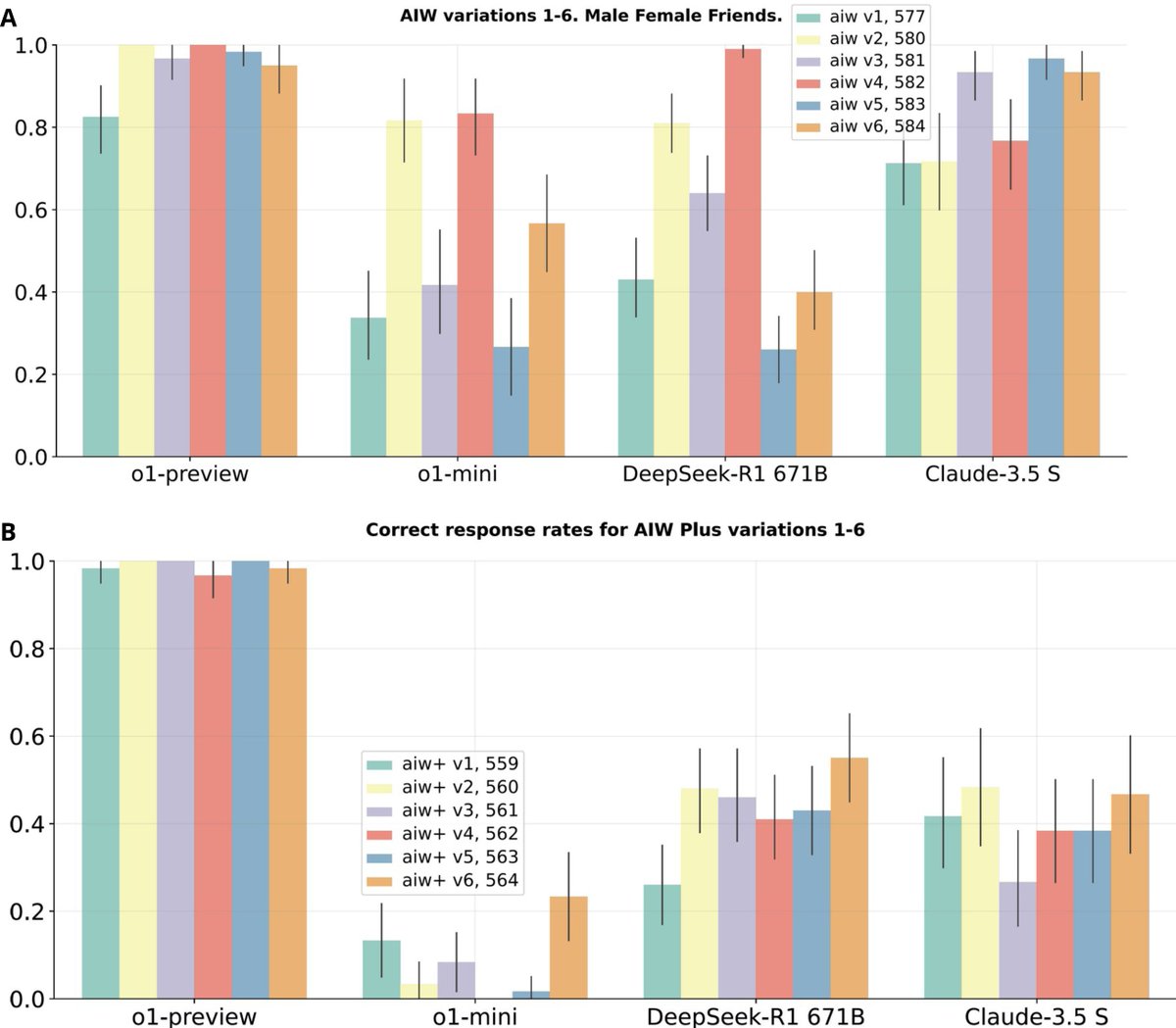
We expose DeepSeek R1 to the variations of AIW Friends problem and compare model behavior to o1-preview, o1-mini and Claude 3.5 Sonnet. o1-preview handles the problem robustly, DeepSeek R1 shows strong fluctuations across variations with distribution very similar to o1-mini. 8/n

8
Comparing DeepSeek R1 to other models, we see it clearly **below** o1-preview while matching o1-mini and clearly outperforming SOTA LLMs like open-weights Llama 3.1 405B, Qwen 2.5 72B and closed GPT-4o. Claims of matching o1 function based on "tough" benchmarks do not hold. 9/n

9
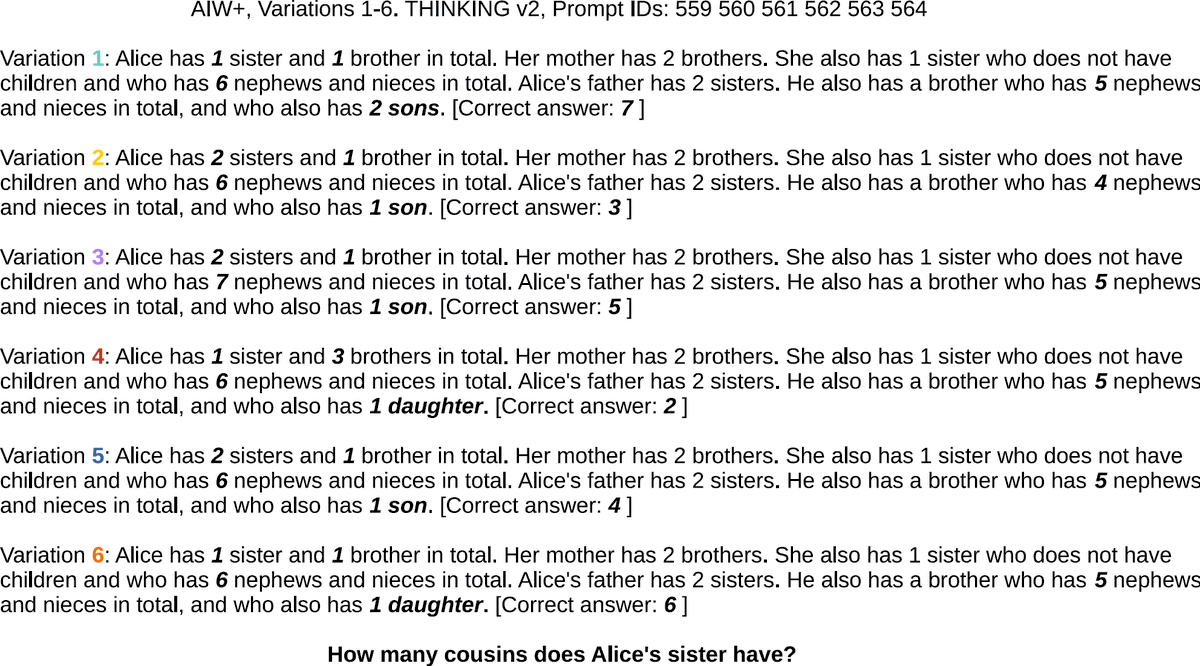
We look now at variations of AIW+ which further increases problem difficulty (prompts IDs 559 560 561 562 563 564, see for full prompts github.com/LAION-AI/AIW/b…) 10/n
10
We compare again DeepSeek R1 on variations of AIW+ problem to o1-preview, o1-mini and Claude 3.5 Sonnet. o1-preview handles the problem robustly, DeepSeek R1 shows strong fluctuations across variations with distribution very similar to Claude 3.5 S. o1-mini collapses. 11/n

11
Model comparison reveals again DeepSeek R1 being **below** o1-preview while clearly outperforming open-weights SOTA LLMs like Llama 3.1 405B or Qwen 2.5 72B. This is further evidence that claims of matching o1 function based on "tough" benchmarks do not hold. 12/n

12
Curioser and curioser. DeepSeek R1 claims to handle olympiad/graduate level problems, but suffers clearly on AIW+ and AIW Friends - way below this level. It's a reminder claims about strong function are often made on benchmarks that do not reflect model function properly 13/n

13
What is to keep in mind as well especially when seeing how Llama 3.1 405B or Qwen 2.5 72B are shattered by DeepSeek R1 - to be fair, one has to take into account how much more compute DeepSeek R1 spends answering. Outputs are very long, raw data: github.com/LAION-AI/AIW/t… 14/n
14
We see that DeepSeek R1 is fragile, far from claimed match to o1-preview, while matching o1-mini clearly outperforming non-reasoning LLMs. One thing is clear: high scores on standardized benchmarks with tough problems are deceiving and not well suitable for model comparison. 18/n
15
Joint work with @marnezhurina, @LuciaCKun,
@mehdidc, @laion_ai & Open-ψ Collective - leading to Wonderland.
Code & Data: github.com/LAION-AI/AIW
Homepage: marianna13.github.io/aiw/
Data Explorer: huggingface.co/spaces/mariann…
arxiv.org/abs/2406.02061openreview.net/forum?id=Mkl7d…
The end?
16
Special acknowledgement for ever amazing @marnezhurina for putting in place vLLM software stack for local deployment which was used for local model evaluation. Additional computational resources were provided by the German AI Service Center WestAI (@BMBF_Bund, grant westai0007).
17
P.S. : there is a striking similarity in shape of full distribution of correct response rates, as evident for AIW Friends in (A) between DeepSeek R1 and o1-mini, and for AIW+ in (B) between DeepSeek R1 and Claude 3.5 S. Too curious why is that so, just a coincidence?
18
We might wonder why releasing open-weights for DeepSeek R1 was not a problem, but the data used for training remains closed. Could it be we would see massive amount of both o1-mini and Claude 3.5 Sonnet traces in there? With the data closed, we can only guess.
19
P.P.S : I think instead of ever increasing problem difficulty in contemporary benchmarks which then obviously fail to provide proper model comparison, we should work on better measurement techniques which do not require complex problems to properly reflect model capabilities.
20
For instance, using problem structure and difficulty preserving variations allows nicely to measure model sensitivity to such variations and thus reveal lack of generalization, which seems to remain hidden if testing with difficult, but static problems/tasks.
21
P.P.P.S : while it is important to tone down claims that are too strong - handling graduate and PhD level tasks as suggested by benchmarks - it is also important to emphasize how good it is to have an open-weights model that is likely on the level of o1-mini and Claude 3.5 S
22
Same important it is also to emphasize that for research, this is way better than closed models, but not good enough. Data for training has to be necessarily open as well, otherwise reproduction of claims is not possible. Only then it deserves a label of open-source.
23
@modelsarereal See openreview.net/forum?id=Mkl7d… for control tasks that show that all low level components in those problems - number, names, other attributes - can be inferred by the models without problems. What we see is generalization deficit, invariant scene inference despite variations.
24
@modelsarereal See also here for overview: hackmd.io/_uploads/ByCpj…
25
@modelsarereal A system capable of generalization would be able to extract that common non ambiguous problem structure and using that, variations become irrelevant, and solution can be obtained without fluctuations. Like invariance to view conditions in visual scene for object recognition.