10 years ago, many considered large-cap stocks “uninvestable”. As a...

Zach Melloh, CFP®@zachmelloh26
50 views
Jan 23, 2025
~3 min read
Advertisement
1
10 years ago, many considered large-cap stocks “uninvestable”.
As a financial advisor in 2025, I commonly hear:
"I only own the S&P 500."
5 reasons this could be a mistake over the next decade: (With visuals and data)
As a financial advisor in 2025, I commonly hear:
"I only own the S&P 500."
5 reasons this could be a mistake over the next decade: (With visuals and data)
2
Recency Bias could be a client’s worst enemy.
When a thing or idea is going well, human bias inclines us to believe it will continue.
Past performance ends up being a big driver of retail investment selection.
When a thing or idea is going well, human bias inclines us to believe it will continue.
Past performance ends up being a big driver of retail investment selection.
3
But here's the thing: past performance doesn't guarantee future success.
If the S&P 500 has been soaring at 15% a year, why would you even consider something that's only returned 8%?
5 points to consider:
If the S&P 500 has been soaring at 15% a year, why would you even consider something that's only returned 8%?
5 points to consider:
4
1. S&P 500 Concentration is at an all-time high
In 2025:
• The top 10 stocks in the S&P 500 make up a higher concentration than the 2000 tech bubble at nearly 37%
Top 10 stock concentration as of 2023:
In 2025:
• The top 10 stocks in the S&P 500 make up a higher concentration than the 2000 tech bubble at nearly 37%
Top 10 stock concentration as of 2023:
5
Today, if you own $10,000 of the S&P 500...
• Nearly $4000 of your investment would be spread across 10 companies.
The is the least amount of diversification the S&P 500 has ever offered.
• Nearly $4000 of your investment would be spread across 10 companies.
The is the least amount of diversification the S&P 500 has ever offered.
6
2. Recency bias drives investment decisions
From 2000-2010…
Had you held just the S&P 500, you would have achieved a decade of negative returns: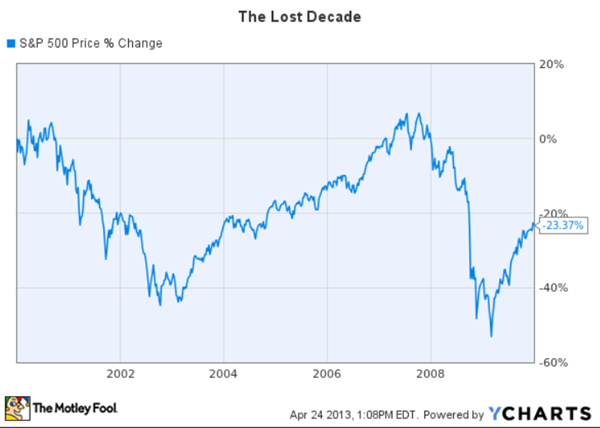
From 2000-2010…
Had you held just the S&P 500, you would have achieved a decade of negative returns:
7
But… from 2000-2009:
• Emerging markets returned 9.82%
• US Mid-caps returned 7.7 %
• US Small / Micro caps returned 8.8%
• Total International returned 11.89%
• Reits returned just over 10% annually (00-’10)
• Emerging markets returned 9.82%
• US Mid-caps returned 7.7 %
• US Small / Micro caps returned 8.8%
• Total International returned 11.89%
• Reits returned just over 10% annually (00-’10)
8
3. Diversification can feel disappointing
But the results speak for themselves.
Blackrock’s diversified 60/40 portfolio outperformed the S&P over a 20 year period:
But the results speak for themselves.
Blackrock’s diversified 60/40 portfolio outperformed the S&P over a 20 year period:
9
Yes, the years in the Blackrock Chart are “cherry-picked”… but the result holds, nonetheless.
Diversification:
• Mitigates volatility
• Controls investor emotions
• & sometimes leads to a better outcome
History proves it.
Diversification:
• Mitigates volatility
• Controls investor emotions
• & sometimes leads to a better outcome
History proves it.
10
4. Fewer opportunities to tax loss harvest
When you own a single asset class / single fund… The opportunities for loss harvesting become fewer as sectors rotate
And sectors performance has wide variance by year…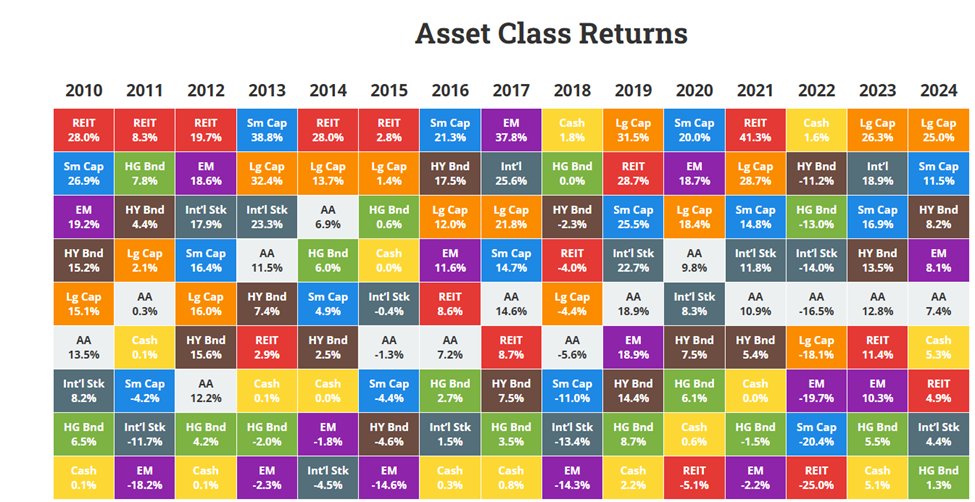
When you own a single asset class / single fund… The opportunities for loss harvesting become fewer as sectors rotate
And sectors performance has wide variance by year…
11
Vanguard produced a study on tax-loss harvesting:
The results?
• Potential boost of a portfolio’s value by 0.5% to around 4% over the long-term.
• The most likely value is around a 1% increase in overall portfolio gains
It matters!
The results?
• Potential boost of a portfolio’s value by 0.5% to around 4% over the long-term.
• The most likely value is around a 1% increase in overall portfolio gains
It matters!
12
5. Sequence of return risk can be detrimental to asset longevity in retirement
As you near or enter a period of withdrawals on your portfolio...
Most cannot withstand a decade of negative returns…
Example:
As you near or enter a period of withdrawals on your portfolio...
Most cannot withstand a decade of negative returns…
Example:
13
2 investors start retirement with:
• $1M each
• Withdrawing $45K annually (adjusted for 3% inflation)
Investor 1:
•Years 1-3: Positive returns (25%, 10%, 5%)
•Year 4: Negative return (-15%)
• $1M each
• Withdrawing $45K annually (adjusted for 3% inflation)
Investor 1:
•Years 1-3: Positive returns (25%, 10%, 5%)
•Year 4: Negative return (-15%)
14
Investor 2:
• Year 1: Negative return (-15%)
• Years 2-4: Positive returns (5%, 10%, 25%)
Result:
Investor 1: 40 years retirement income
Investor 2: 25 years retirement income
• Year 1: Negative return (-15%)
• Years 2-4: Positive returns (5%, 10%, 25%)
Result:
Investor 1: 40 years retirement income
Investor 2: 25 years retirement income
15
Investor 1's early gains helped their portfolio grow...
Allowing for 40 years of income.
Investor 2's early losses hindered their portfolio's recovery...
Leading to depletion after 25 years...
Allowing for 40 years of income.
Investor 2's early losses hindered their portfolio's recovery...
Leading to depletion after 25 years...
16
Diversification and loss mitigation in the years leading up to / following retirement...
can "make or break" your retirement plan.
can "make or break" your retirement plan.
17
If you found value in this thread...
Follow me (so my profile doesn't get lost in the algorithm)
And check out the highlight section of my profile for dozens of actionable financial planning threads!
Follow me (so my profile doesn't get lost in the algorithm)
And check out the highlight section of my profile for dozens of actionable financial planning threads!

