I WANT TO BE A FOUNDER, SHOULD I DO BANKING / PE? MY FRAMEWORK A...

Restructuring__@Restructuring__
20 views
Dec 25, 2024
~8 min read
Advertisement
1
I WANT TO BE A FOUNDER, SHOULD I DO BANKING / PE? MY FRAMEWORK
A few weeks ago, a smart senior in college reached out asking for advice on what to do next.
He has an offer to join a strong investment bank after graduation but deep down he wants to build / start a business.
I did IB, now work in Large-Cap PE, and I run Pari Passu on the side so I am well positioned to answer.
A Thread 🧵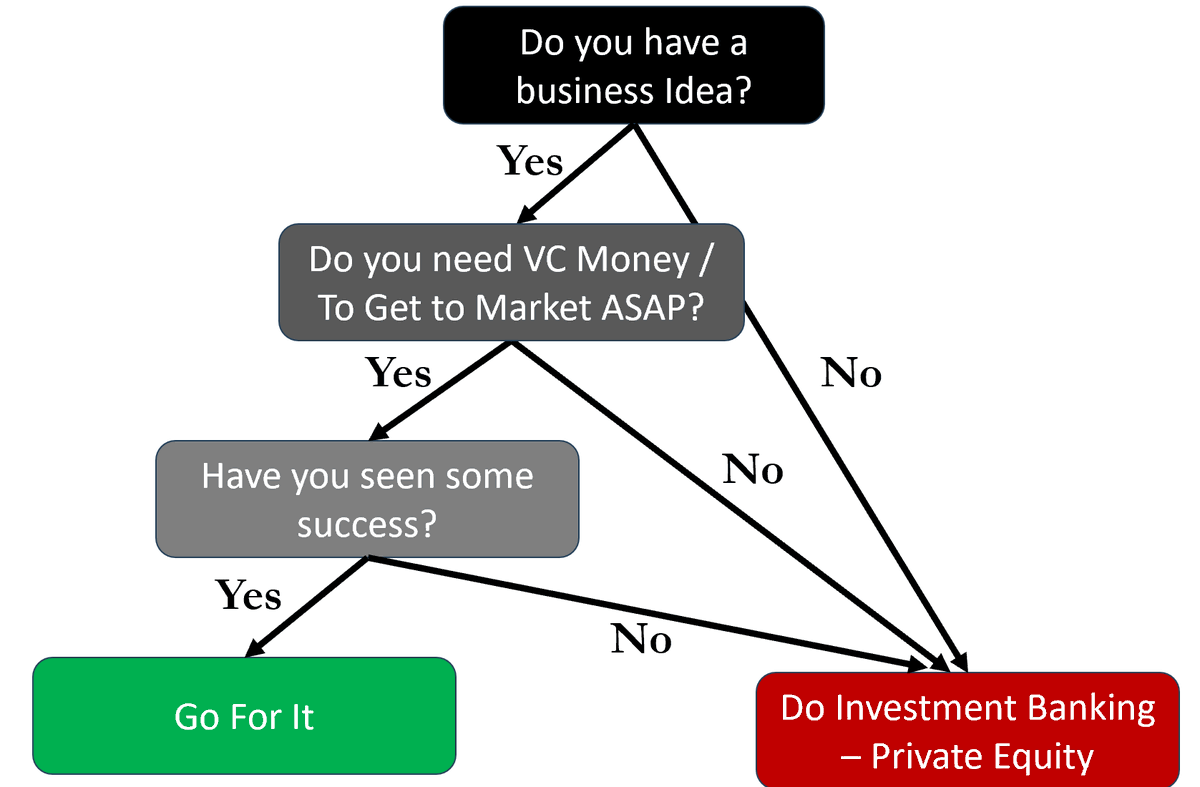
A few weeks ago, a smart senior in college reached out asking for advice on what to do next.
He has an offer to join a strong investment bank after graduation but deep down he wants to build / start a business.
I did IB, now work in Large-Cap PE, and I run Pari Passu on the side so I am well positioned to answer.
A Thread 🧵
2
1) Banking / Private Equity will show you how things work
I will not spend any time going over how IB / PE will teach you PPT / XLS, sure that is true but if you are doing two years in banking to learn Microsoft Suite, I am not sure you are on the right path…
Everyone (myself included) loves talking about the negative aspects of IB / PE (hours, expectations, etc.) but the truth is that the amount of experience and exposure is hard to compare to any other first job out of college. Less in banking but more in private equity, you not only understand how deals happen but also how companies work.
I am not just talking about how the financing considerations behind a deal, but also about day to day operations that move companies forward: how a new vendor is onboarded, how a budget is discussed and approved, how hiring and firing works. While these topics are not sexy (and after a while these calls often become boring), I feel very lucky that I get exposure as they solidify my understanding of everything that happens around me.
When I look back to myself as a senior in college, I am shocked at how little I understood about how the world works.
Coming back to our goal of starting a business, having a better understanding of what surrounds you will make you a more complete professional / founder. Period.
I will not spend any time going over how IB / PE will teach you PPT / XLS, sure that is true but if you are doing two years in banking to learn Microsoft Suite, I am not sure you are on the right path…
Everyone (myself included) loves talking about the negative aspects of IB / PE (hours, expectations, etc.) but the truth is that the amount of experience and exposure is hard to compare to any other first job out of college. Less in banking but more in private equity, you not only understand how deals happen but also how companies work.
I am not just talking about how the financing considerations behind a deal, but also about day to day operations that move companies forward: how a new vendor is onboarded, how a budget is discussed and approved, how hiring and firing works. While these topics are not sexy (and after a while these calls often become boring), I feel very lucky that I get exposure as they solidify my understanding of everything that happens around me.
When I look back to myself as a senior in college, I am shocked at how little I understood about how the world works.
Coming back to our goal of starting a business, having a better understanding of what surrounds you will make you a more complete professional / founder. Period.
3
2) Banking / PE will give you ideas
Connected to what we just went over, I believe a massive positive about doing IB / PE with the goal of starting a business is that you get a ton of business ideas. Unless you are the next Zuck who got a Trillion business idea as a sophomore in college, it is not easy to get brilliant ideas right off the bat (especially as a college student you are not as exposed to everything that goes on in the world).
I can guarantee you that you will have several business ideas after working four years in finance (assuming two in banking and two in private equity) especially if you get in from day 1 looking for opportunities.
A beautiful aspect of seeing the Pari Passu Newsletter grow this year has been the ability to work with great companies that exemplify this concept. For example, let’s look at @Daloopa1, @FundamentEdge and @invest10east (three past sponsors of the newsletter).
While these companies are very different for the product they sell (data, education, access), I would argue that these companies have a similar root: working professionals who saw an opportunity to create something they saw missing when working in the industry.
Connected to what we just went over, I believe a massive positive about doing IB / PE with the goal of starting a business is that you get a ton of business ideas. Unless you are the next Zuck who got a Trillion business idea as a sophomore in college, it is not easy to get brilliant ideas right off the bat (especially as a college student you are not as exposed to everything that goes on in the world).
I can guarantee you that you will have several business ideas after working four years in finance (assuming two in banking and two in private equity) especially if you get in from day 1 looking for opportunities.
A beautiful aspect of seeing the Pari Passu Newsletter grow this year has been the ability to work with great companies that exemplify this concept. For example, let’s look at @Daloopa1, @FundamentEdge and @invest10east (three past sponsors of the newsletter).
While these companies are very different for the product they sell (data, education, access), I would argue that these companies have a similar root: working professionals who saw an opportunity to create something they saw missing when working in the industry.
4
3) Banking / PE give you cash to focus on (i) building something great vs. profitable from day 1 and (ii) building something that you fully believe in.
I have never been a full-time founder so I do not know on my skin, but I can only imagine how stressful it must be to have no financing security as you have no downside protection. If your business fails, you are out of luck.
While this can definitely be a strong incentive, I believe this added pressure can be a negative as well. Let’s make a very simple example with a business similar to Pari Passu (media business generating revenue from selling ad space). Since Pari Passu is my “hobby” and not my source of cash to eat, I can make decisions that might be against maximizing today’s income but increase long-term success.
For example, let’s say I get a great offer from a sponsor with a shady business but for a very solid rate. I am lucky enough that I do not have to take it, but if my life depended on Pari Passu to eat, I might make a different decision.
I am oversimplifying here, but I think that having the ability to build a business without being obsessed about having to generate profits from day 1 is very beneficial (of course, we are assuming you are not able to get VC funding right away)
The second point connected to this is that having a great main job increases the opportunity cost. I believe this is great because it will make you think more carefully about what idea you are pursuing. If you are graduating and you want to just build, you might end up pursuing an idea that is very unlikely to succeed, but the alternative is basically 0 so you might end up going for it anyway
I have never been a full-time founder so I do not know on my skin, but I can only imagine how stressful it must be to have no financing security as you have no downside protection. If your business fails, you are out of luck.
While this can definitely be a strong incentive, I believe this added pressure can be a negative as well. Let’s make a very simple example with a business similar to Pari Passu (media business generating revenue from selling ad space). Since Pari Passu is my “hobby” and not my source of cash to eat, I can make decisions that might be against maximizing today’s income but increase long-term success.
For example, let’s say I get a great offer from a sponsor with a shady business but for a very solid rate. I am lucky enough that I do not have to take it, but if my life depended on Pari Passu to eat, I might make a different decision.
I am oversimplifying here, but I think that having the ability to build a business without being obsessed about having to generate profits from day 1 is very beneficial (of course, we are assuming you are not able to get VC funding right away)
The second point connected to this is that having a great main job increases the opportunity cost. I believe this is great because it will make you think more carefully about what idea you are pursuing. If you are graduating and you want to just build, you might end up pursuing an idea that is very unlikely to succeed, but the alternative is basically 0 so you might end up going for it anyway
5
4) You can start a business while working in Banking / PE but…
I also believe that, despite the very very very long hours, you can start your business while working your first jobs after graduation.
This will be very hard, it will mean literally “working” basically every single hour you are awake. But even if we assume you work your main job 70 hours (no one really works 80+ hours consistently), this will give you ~20 hours a week to build your business.
Sure, 90 hours a week means no going out 3x week / drinking / having much fun outside of work, but if you actually want to build, those 20 hours dedicated to building your business should feel like play so I actually think this is doable for a few years (Elon has been doing it for decades).
In addition, if your idea is really that great, you should see some success right away, even after working 30 hours a week on it.
If you want to work 50 hours a week and enjoy life, needless to say, this is not a great idea.
I also believe that, despite the very very very long hours, you can start your business while working your first jobs after graduation.
This will be very hard, it will mean literally “working” basically every single hour you are awake. But even if we assume you work your main job 70 hours (no one really works 80+ hours consistently), this will give you ~20 hours a week to build your business.
Sure, 90 hours a week means no going out 3x week / drinking / having much fun outside of work, but if you actually want to build, those 20 hours dedicated to building your business should feel like play so I actually think this is doable for a few years (Elon has been doing it for decades).
In addition, if your idea is really that great, you should see some success right away, even after working 30 hours a week on it.
If you want to work 50 hours a week and enjoy life, needless to say, this is not a great idea.
6
5)…Banking / PE will slow you down and you will not be able to raise VC Money
So far, we have mentioned many positives (personal development, idea generation, funding), let’s now turn to the negatives.
The first one, obviously, is that you will be much slower at building. Even if you can work 20/30 hours per week, this will put you at a significant disadvantage compared to everyone else who is working full-time on their ideas.
Unless your product is something like AI (you really need to build it now and do it quickly), I still think that the positives outweigh this negative. This said, if speed to market is your edge and being first is all that matters, I would not suggest you go the IB / PE route.
I also think that if you have so much conviction about an idea which you think should be brought to market ASAP, it also implies you would not benefit as much from getting business ideas from working full-time so you should just go build.
On a similar note, if you absolutely need VC money to get started, working in IB / PE will not work. Funds will want to see you full-time on your ideas so this is just not going to cut it.
This said, even if you have an idea and you either need to develop the idea now to win or you need VC funding to win, I still think you should ask yourself one last question before going all-in
So far, we have mentioned many positives (personal development, idea generation, funding), let’s now turn to the negatives.
The first one, obviously, is that you will be much slower at building. Even if you can work 20/30 hours per week, this will put you at a significant disadvantage compared to everyone else who is working full-time on their ideas.
Unless your product is something like AI (you really need to build it now and do it quickly), I still think that the positives outweigh this negative. This said, if speed to market is your edge and being first is all that matters, I would not suggest you go the IB / PE route.
I also think that if you have so much conviction about an idea which you think should be brought to market ASAP, it also implies you would not benefit as much from getting business ideas from working full-time so you should just go build.
On a similar note, if you absolutely need VC money to get started, working in IB / PE will not work. Funds will want to see you full-time on your ideas so this is just not going to cut it.
This said, even if you have an idea and you either need to develop the idea now to win or you need VC funding to win, I still think you should ask yourself one last question before going all-in
7
6) Have you seen success from your idea?
Finally, the last question you should ask yourself before deciding to go all-in and skip IB / PE is an honest initial review of the idea.
Of course, I understand that getting a sense of success before even starting is hard (assuming having a product takes many months if not years), but even a survey or the feedback of the people you talk with can be an indication of success.
And sure, people do not know what they want until you give it to them but ask the three smartest people you know what they think of your idea and you will get some useful info.
If you have done no initial work or have no indication of success, I still think you should start your full-time role. If you then get any traction, then yes, go for it!
Finally, the last question you should ask yourself before deciding to go all-in and skip IB / PE is an honest initial review of the idea.
Of course, I understand that getting a sense of success before even starting is hard (assuming having a product takes many months if not years), but even a survey or the feedback of the people you talk with can be an indication of success.
And sure, people do not know what they want until you give it to them but ask the three smartest people you know what they think of your idea and you will get some useful info.
If you have done no initial work or have no indication of success, I still think you should start your full-time role. If you then get any traction, then yes, go for it!
8
7) Conclusion – should you do it?
To summarize, my thoughts are included in the below chart. The only case in which you should skip IB / PE and go build are: (i) you have an idea, (ii) the idea needs to be developed now to win or you need VC funding to win, and (iii) you have seen some success.
I am a relatively risk-adverse individual so feel free to ignore me and go build today 😊
Looking forward to reading everyone’s view and happy holidays!
To summarize, my thoughts are included in the below chart. The only case in which you should skip IB / PE and go build are: (i) you have an idea, (ii) the idea needs to be developed now to win or you need VC funding to win, and (iii) you have seen some success.
I am a relatively risk-adverse individual so feel free to ignore me and go build today 😊
Looking forward to reading everyone’s view and happy holidays!
9
For context, I am a curious large-cap PE associate and this page and the newsletter (restructuringnewsletter.com) is all I do with my (very limited) free time.
Over there, I publish mostly advanced restructuring writeups (recent ones include Trinseo, Double and Triple Dips, Cooperation Agreements) and occasionally company and industry deep dives.
Join 18,000+ investors from firms like Apollo, KKR, Farallon, Point 72 now.
Pari Passu articles go behind paywall after being published, subscribe NOW to get all future articles for free!
Over there, I publish mostly advanced restructuring writeups (recent ones include Trinseo, Double and Triple Dips, Cooperation Agreements) and occasionally company and industry deep dives.
Join 18,000+ investors from firms like Apollo, KKR, Farallon, Point 72 now.
Pari Passu articles go behind paywall after being published, subscribe NOW to get all future articles for free!