Ibn Muǧāhid is widely regarded as the canonizer of the seven...

Marijn van Putten@PhDniX
51 views
Dec 18, 2024
~2 min read
1
Ibn Muǧāhid is widely regarded as the canonizer of the seven reading traditions, but if you actually look at the ʾIsnāds through which people trace the readings he barely visible. How come?
🧵
🧵
2
Ibn Muǧāhid collects information about the seven readings from many different sources and authors before him, but it seems that he spent very little time actually reciting these reading traditions to a teacher.
We can see this in the way he presents his ʾisnāds.
We can see this in the way he presents his ʾisnāds.
3
For the ʾIsnāds, Ibn Muǧāhid first gives a so-called tilāwah ʾisnād, a chain of transmission where each link recited the full Quran to their teacher back to the canonical readers.
After that he gives a riwāyah ʾisnād, which is textual transmission of details without recitation.
After that he gives a riwāyah ʾisnād, which is textual transmission of details without recitation.
4
These are distinguished by the verbiage. Ibn Muǧāhid uses the wording qaraʾa bihā ʿalā fulān (recited according to it to so-and-so) for tilāwah, and ʾaḫbaranī bihā fulān (So-and-so reported it to me) for riwāyah ʾisnād.

5
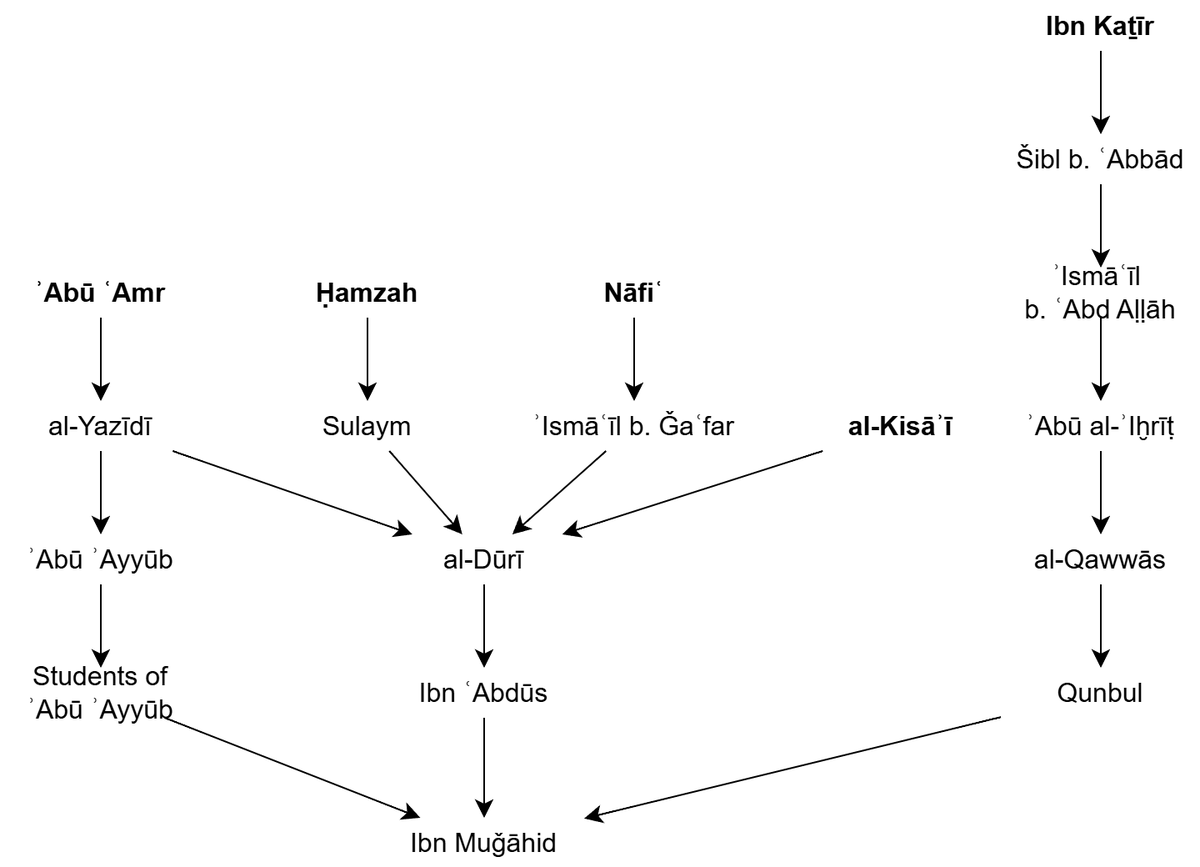
So if we only look at the readings which he actually recited to a teacher all the way back to the eponymous readers, we find he does not even have ʾIsnāds for all the seven canonical readers! Ibn ʿĀmir and the now dominant ʿĀṣim are completely absent!
6
Four of the five readers he gets exclusively through the path of Ibn ʿAbdūs < al-Dūrī. Had he not recited to Ibn ʿAbdūs, he'd only have two tilāwah ʾisnāds.
7
It's also worth noting that only three of them go through canonical transmissions paths.
1. Qunbul < ... < Ibn Kaṯīr
2. al-Dūrī < al-Kisāʾī
3. al-Dūrī < ... < ʾAbū ʿAmr
The other three tilāwah paths he has are no longer considered canonical.
1. Qunbul < ... < Ibn Kaṯīr
2. al-Dūrī < al-Kisāʾī
3. al-Dūrī < ... < ʾAbū ʿAmr
The other three tilāwah paths he has are no longer considered canonical.
8
So Ibn Muǧāhid's centrality as "canonizer" of the seven reading traditions seems to have been primarily about his book collecting a large amount of detailed technical data, but not because he recited or taught to recite all seven readings to a huge amount of students.