🚨 New Paper 🚨 Can LLMs perform latent multi-hop reasoning without...

Sohee Yang@soheeyang_
16 views
Sep 12, 2025
~2 min read
Advertisement
1
🚨 New Paper 🚨
Can LLMs perform latent multi-hop reasoning without exploiting shortcuts? We find the answer is yes – they can recall and compose facts not seen together in training or guessing the answer, but success greatly depends on the type of the bridge entity (80%+ for country, 6% for year)! 1/N
Can LLMs perform latent multi-hop reasoning without exploiting shortcuts? We find the answer is yes – they can recall and compose facts not seen together in training or guessing the answer, but success greatly depends on the type of the bridge entity (80%+ for country, 6% for year)! 1/N
2
Our study measures latent multi-hop reasoning ability of today's LLMs. Why? The ability can signal whether LLMs learn compressed representations of facts and can latently compose them. It has implications for knowledge localization, controllability, and editing capabilities. 2/N

3
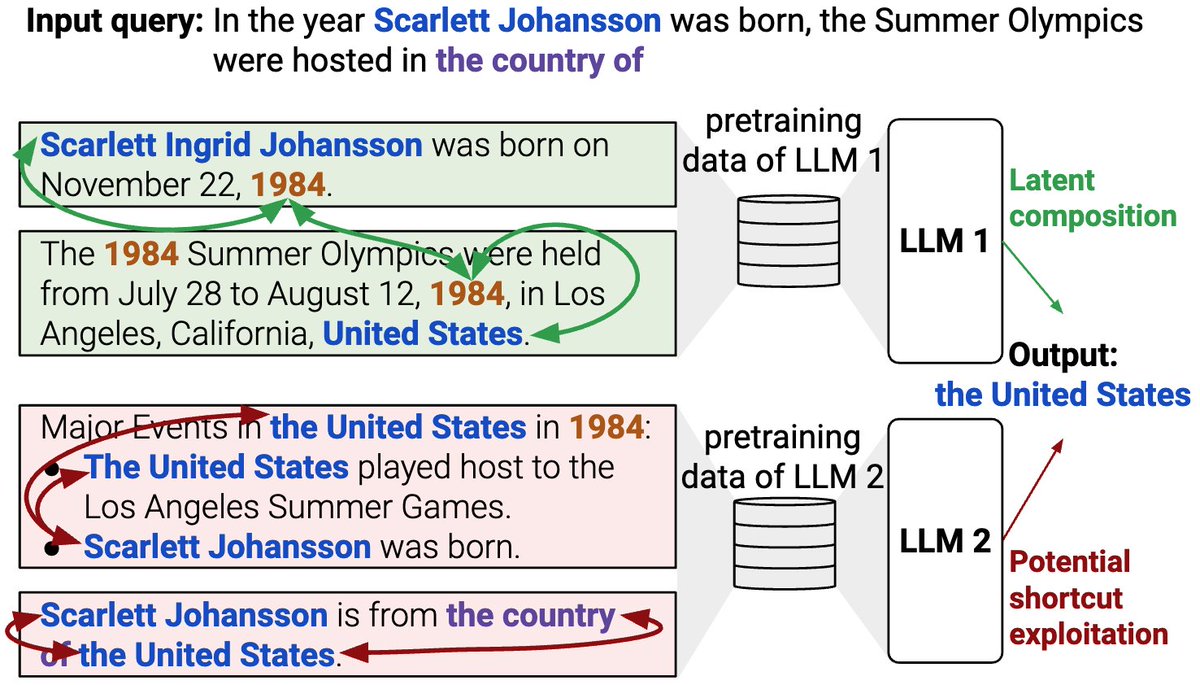
However, if models bypass true reasoning by exploiting shortcuts (e.g., seeing "Scarlett Johansson" with "United States" in training, or guessing the answer as "United States"), we can't accurately measure the ability. Previous works haven't adequately considered shortcuts. 3/N
4
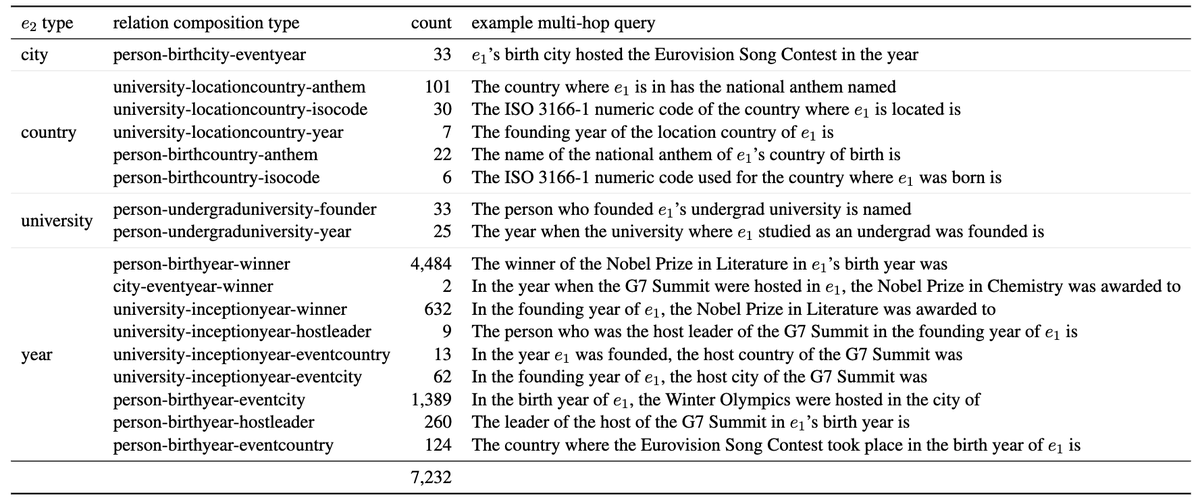
We introduce SOCRATES (ShOrtCut-fRee lATent rEaSoning), a dataset of 7K queries where head and answer entities have minimal chance of co-occurring in training data, which is carefully curated for shortcut-free evaluation of latent multi-hop reasoning. 4/N
5
How do we check training co-occurrences without access to LLMs' data? We remove all test queries where the head/answer entities co-appear in any of ~4.8B unique docs from 6 training corpora. (Results remain similar with web-scale co-occurrence checks with Google Search.) 5/N
6
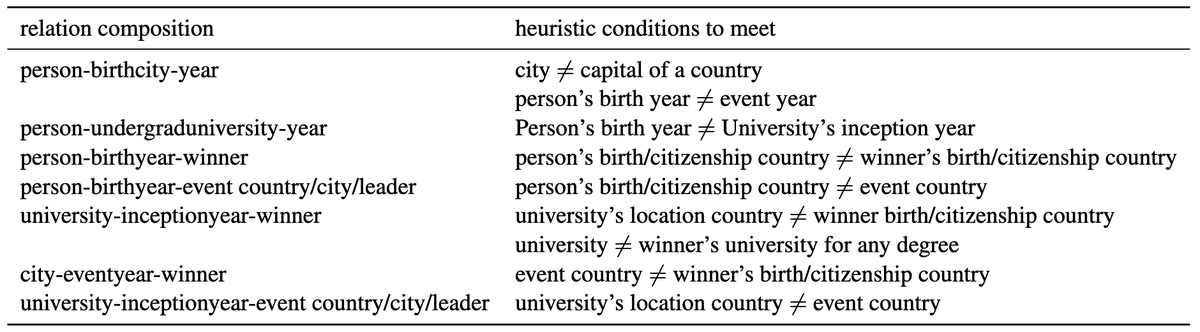
Our dataset also excludes facts where head/answer entities are directly connected or answers are guessable from part of the head entity. During evaluation, we filter cases where models are likely to be guessing the answer from relation patterns or perform explicit reasoning. 6/N
7
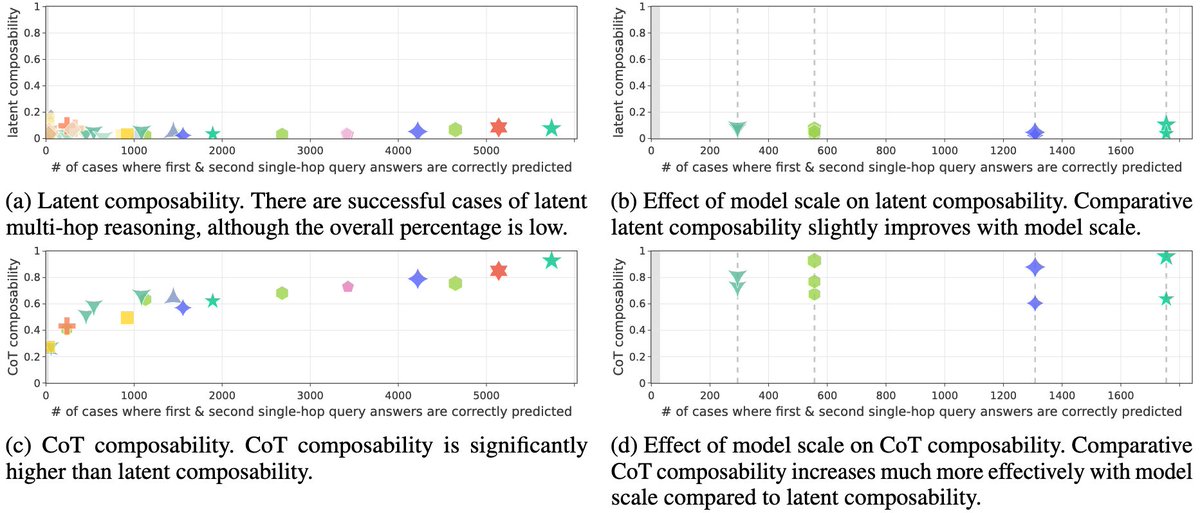
Results reveal striking differences across bridge entity types – 80%+ accuracy with countries vs ~6% with years. This variation vanishes with Chain-of-Thought (CoT) reasoning, suggesting different internal mechanisms. 7/N

8
Results for knowing more single-hop facts and model scaling also differ: models that know more single-hop facts and larger models show only marginal improvements for latent reasoning, but dramatic improvements for CoT reasoning. 8/N
9
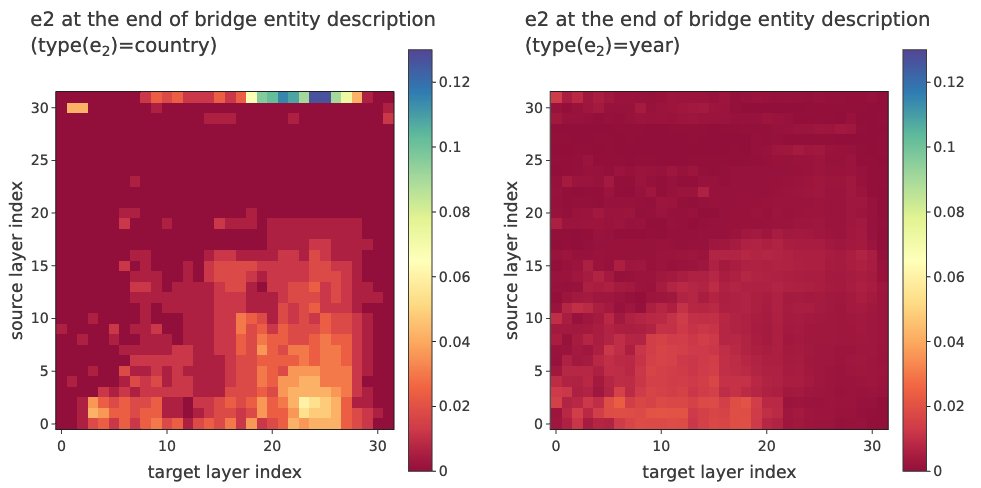
Using Patchscopes analysis, we discover that bridge entity representations are constructed more clearly in queries with higher latent composability. This helps explain the internal mechanism behind why some types of connections are easier for models to reason about. 9/N
10
With OLMo's pretraining checkpoints grounded to entity co-occurrences in the training sequences, we observe the emergence of latent reasoning: the model tends to first learn to answer single-hop queries correctly, then develop the ability to compose them. 10/N

11
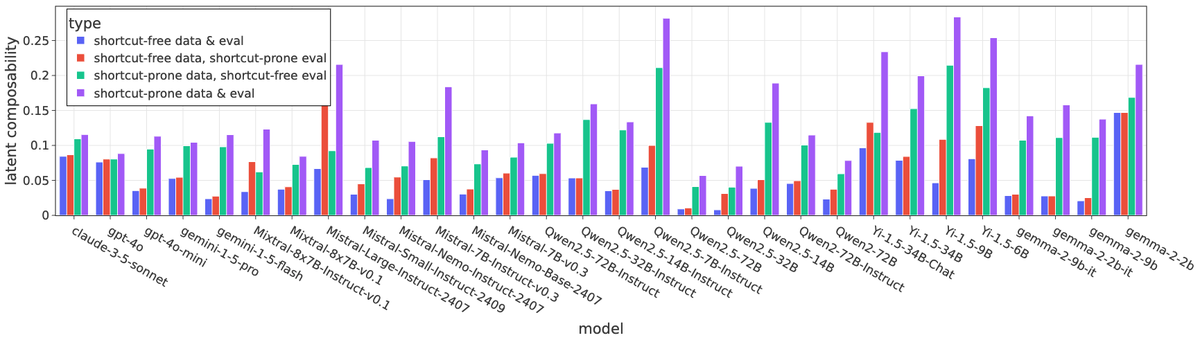
When we compare with shortcut-prone evaluation, we find that not accounting for shortcuts can overestimate latent composability by up to 5-6x! This highlights the importance of careful evaluation dataset and procedure that minimizes the chance of shortcuts. 11/N
12
Our findings show that LLMs can perform true latent reasoning without shortcuts, but this ability is highly constrained by the types of facts being composed. Our work provides resources and insights for evaluating, understanding, and improving latent multi-hop reasoning. 12/N
13
Work done with my fantastic collaborators and advisors @KassnerNora, @elenagri_, @riedelcastro, @megamor2 at @GoogleDeepMind! ✨
Check out our paper for full details 👉 arxiv.org/abs/2411.16679 🧵🔚
Check out our paper for full details 👉 arxiv.org/abs/2411.16679 🧵🔚