The bacteria in your gut depend on where you are in the social...

Nicholas A. Christakis@NAChristakis
40 views
Feb 02, 2025
~3 min read
Advertisement
1
The bacteria in your gut depend on where you are in the social network.
And the microbes within us treat our social networks as the extended environment in which they thrive. They can spread from person to person.
New #HNL work out today in @Nature. 1/
And the microbes within us treat our social networks as the extended environment in which they thrive. They can spread from person to person.
New #HNL work out today in @Nature. 1/
2
"Gut microbiome strain-sharing within isolated village social networks" nature.com/articles/s4158… with @chocophlan, @JacksonPullman1, @mqdicer, @ShivkumarVs, @DrewPrinster, @adarshsingh110, RM Juárez, @eairoldi, @ilanabrito123 #HNL 2/

3
This work took >6 years of my life (with maddening delays due to COVID19), but it started as a kernel of an idea left over from our 2007 paper on the spread of obesity (nejm.org/doi/pdf/10.105… ) in which we noted that social contagion and biological contagion could both occur 3/


4
To discern the social metagenomics of the microbiome, we used a subset of villages in an ongoing longitudinal cohort of 24,702 people living in 176 isolated Honduras villages (who were in this RCT in @ScienceMagazine in 2024: science.org/doi/10.1126/sc…). 4/
5
Our team carted liquid nitrogen to 18 Honduras villages and persuaded 1,787 people to give us samples of their poop, which we subjected to shotgun metagenomic sequencing to discern species and strains of gut microbes. This was not easy in any way. 5/
6
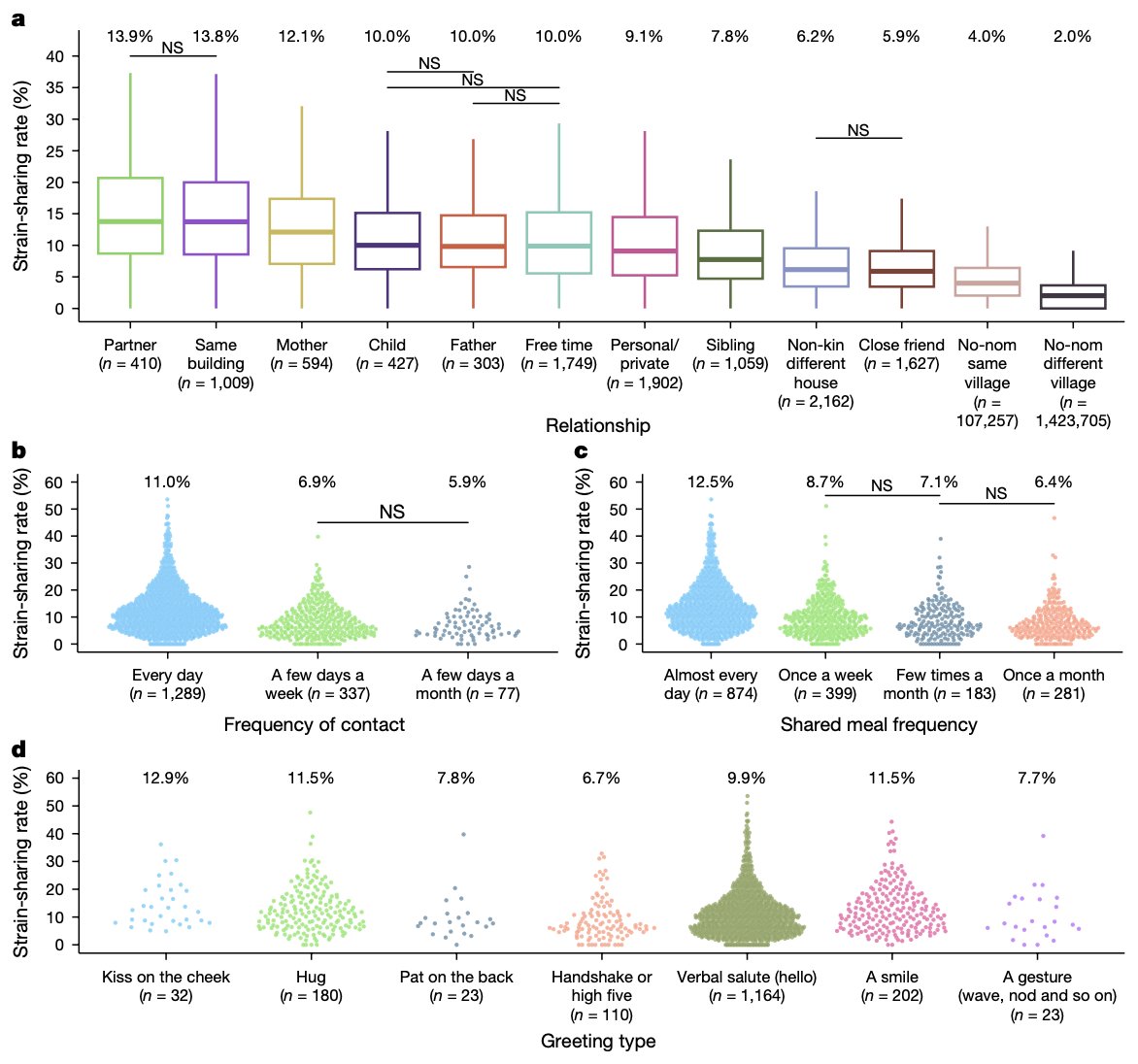
Using both species-level and strain-level data, we show that microbial sharing occurs in many relationship types, notably including non-familial and non-household connections. 6/
7
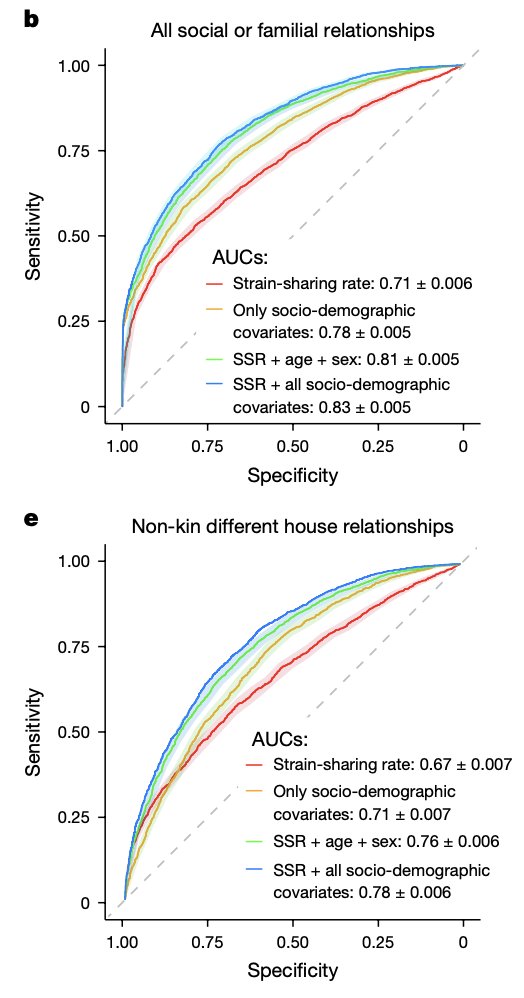
We can actually predict who your friends are based on whether you have similar bacteria in your poop! And that metric outperforms other more usual social features, such as how you resemble your friends on a host of traits like age, sex, wealth, etc. 7/
8
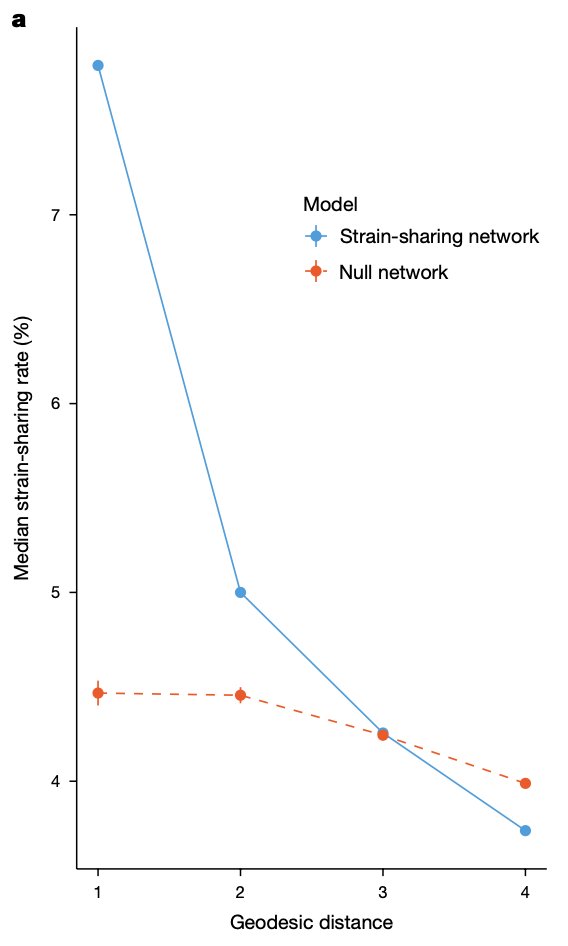
Furthermore, gut microbiome strain-sharing extends to one's friends’ friends within social networks, indicating the relevance of a person’s broader social network, at two degrees of separation. 8/
9
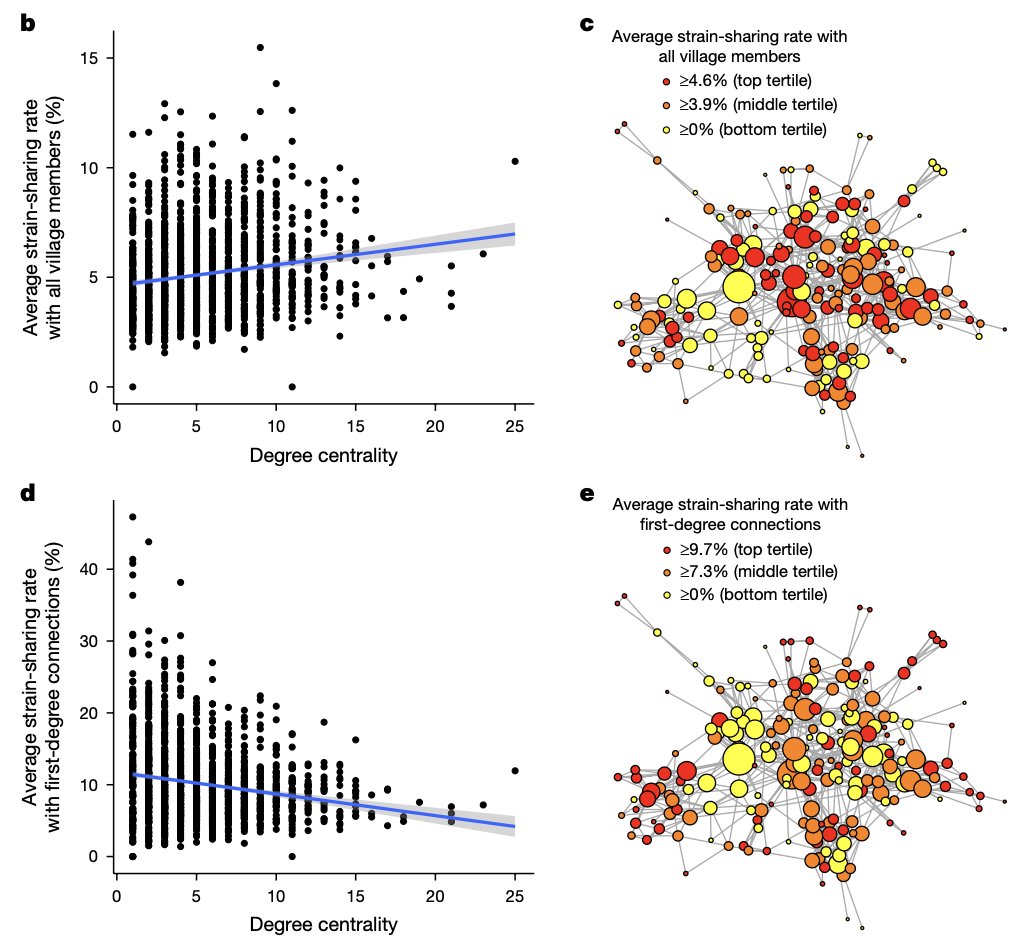
We also observe that socially central people are more microbially similar to the overall village than socially peripheral people. But popular people resemble the microbiomes of individual friends less. 9/
10
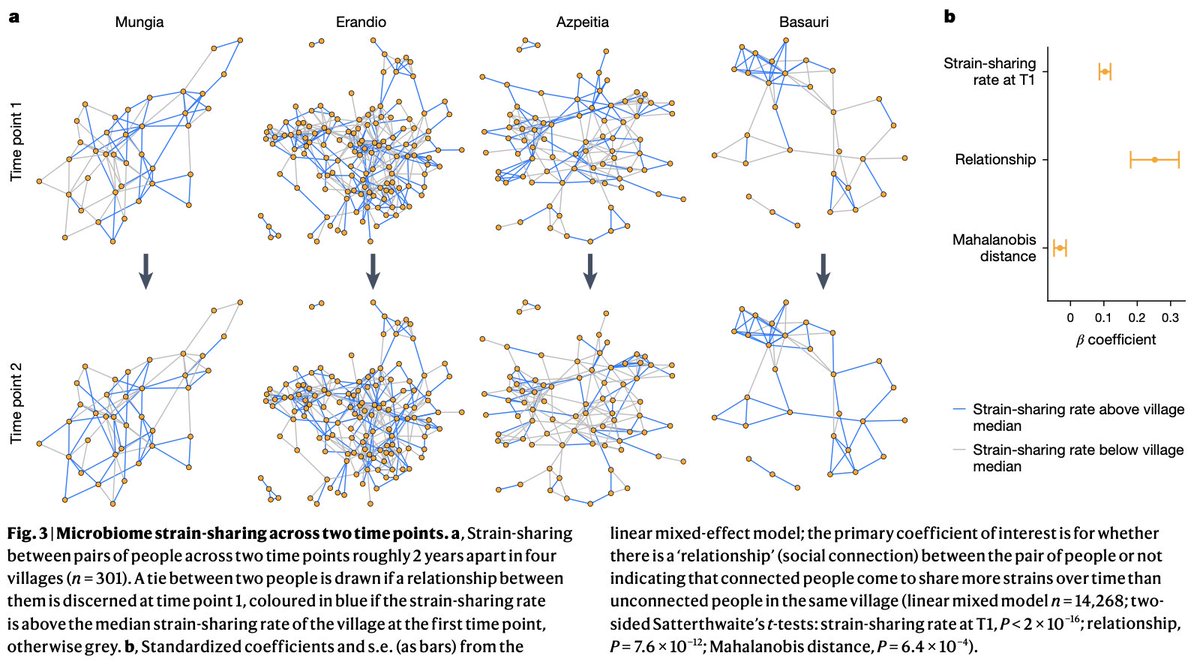
Among 301 people in 4 villages whose microbiome was re-measured 2 years later, we observe greater convergence in gut microbiome strain-sharing in connected versus otherwise similar unconnected co-villagers. 10/
11
Clusters of microbiome species and strains occur within clusters of people in village social networks. It’s like clouds of microbes occurring within clusters of people. nature.com/articles/s4158… 11/

12
Social networks provide the social niches within which microbiome biology and phenotypic impact are manifested. 12/
13
This work has implications for a radical idea: diseases formerly thought to be biologically non-communicable (e.g., obesity, depression, hypertension, arthritis, etc.) may actually be (somewhat!) communicable, via the spread of the microbiome. nature.com/articles/s4158… 13/
14
That is, using both observational and experimental methods, diverse phenomena have been shown to spread interpersonally, including phenotypes such as obesity and depression (e.g., onlinelibrary.wiley.com/doi/abs/10.100… but a new review will appear before long). 14/
15
To the extent that the microbiome can be associated with physical or mental states (there is much evidence now that it can!), then any spread of the microbiome via biological contagion may partly explain the spread of certain other attributes via social contagion. 15/
16
It may prove to be the case that groups of inter-connected people might share phenotypes not only because of shared genes or transmitted behaviors, but also because of shared microbes. nature.com/articles/s4158… 16/
17
News coverage of “Gut microbiome strain-sharing within isolated village social networks” via @nature is here: nature.com/articles/d4158… 17/
18
A related paper using the same cohort, but investigating the associations between the microbiome and a variety of human phenotypes and attributes, came out in July 2024 in @CellReports: cell.com/cell-reports/f… 18/

19
This work was supported by the NOMIS foundation, with additional support via @SchmidtFutures @ericschmidt @PershingSqFdn @BillAckman @JMRothberg. Underlying cohort supported by @gatesfoundation & @NIH. New support for work on the biology of social life at #HNL via @paulg. 19/
20
The co-first author, Jackson Pullman, was an undergraduate at @Yale @yaledatascience when he joined our lab #HNL and this work done. :-) news.yale.edu/2024/11/20/gut… 20/
21
"[It] was a long labor of love (if one can use that expression for the collection of hundreds of stool specimens from isolated jungle villages)," sociologist and physician Nicholas Christakis, also from Yale, told @ScienceAlert sciencealert.com/the-people-in-… 21/