Mega Backdoor Roth is the best loophole in the tax code. It allows...

The Money Cruncher, CPA@money_cruncher
36 views
Nov 27, 2024
~3 min read
Advertisement
1
Mega Backdoor Roth is the best loophole in the tax code.
It allows you to contribute $50,000+ to a Roth IRA account every single year.
Here's everything you need to know:
It allows you to contribute $50,000+ to a Roth IRA account every single year.
Here's everything you need to know:
2
Mega Backdoor Roth is a strategy that allows funding Roth accounts far in excess of normal limits.
For example, say you are a higher earner and already max out your Roth IRA, max out your 401(k) of $23,000/year and get a $10,000 match.
For example, say you are a higher earner and already max out your Roth IRA, max out your 401(k) of $23,000/year and get a $10,000 match.
3
Now, this strategy allows you to contribute an additional $36,000 into a Roth account. ($69,000 is the total 401(k) limit - $23,000 - $10,000).
This strategy could be a great way to get as much money as possible into a Roth before investing additional amounts in a brokerage.
This strategy could be a great way to get as much money as possible into a Roth before investing additional amounts in a brokerage.
4
This strategy is only available through the 401(k) retirement plan.
If your employer does not allow for after-tax contributions (particularly because of the nondiscrimination testing), you cannot use this strategy, so ask your HR first.
If your employer does not allow for after-tax contributions (particularly because of the nondiscrimination testing), you cannot use this strategy, so ask your HR first.
5
It’s a 2 step process:
1. Contribute to a 401k after-tax account (don’t confuse it with the Roth 401k)
2. Roll the funds over to the Roth IRA or Roth 401k
Here is a simple visualization of it: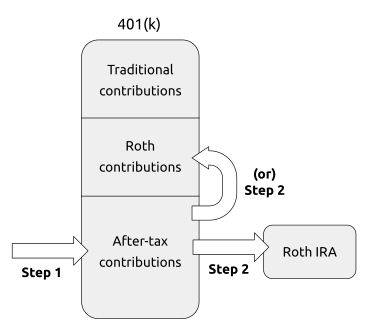
1. Contribute to a 401k after-tax account (don’t confuse it with the Roth 401k)
2. Roll the funds over to the Roth IRA or Roth 401k
Here is a simple visualization of it:
6
The rules will usually vary from plan to plan, and how they label their accounts, so it’s also important to check your Summary Plan Description.
For example, here is a screenshot with the Mega Backdoor Roth option enabled: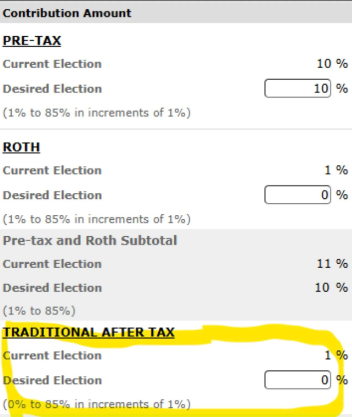
For example, here is a screenshot with the Mega Backdoor Roth option enabled:
7
Step 2 requires you to roll the after-tax contribution into either a Roth 401k or a Roth IRA.
So, which is better?
First of all, your plan might only allow you to roll into a Roth 401k, so it’s important to check that first.
So, which is better?
First of all, your plan might only allow you to roll into a Roth 401k, so it’s important to check that first.
8
But if you have both options available, here are the benefits of each:
Roth 401k – Allows minimizing taxable earnings by automatic conversion, easy to set up
Roth IRA – Offers a greater variety of investments and has flexibility of withdrawals
Roth 401k – Allows minimizing taxable earnings by automatic conversion, easy to set up
Roth IRA – Offers a greater variety of investments and has flexibility of withdrawals
9
When you contribute to after-tax (step 1), the amount is automatically invested. Then, when you roll the balance into a Roth IRA (step 2), you might have some earnings. These earnings are taxable income.
To reduce the taxable amount, do steps 1 and 2 as soon as possible.
To reduce the taxable amount, do steps 1 and 2 as soon as possible.
10
Some employers might issue separate checks to split the contributions and earnings. In that regard, you might put the after-tax contributions into a Roth IRA and the earnings into a Traditional IRA to avoid paying taxes (impacts your Backdoor Roth though)
11
By the end of the year, you will receive a 1099-R form that you will need to report on your taxes.
Say if you contribute $10,000, get $100 of earnings, and roll it all into Roth, your Tax Form 1040, Line 5a, will be $10,100, and Line 5b will be $100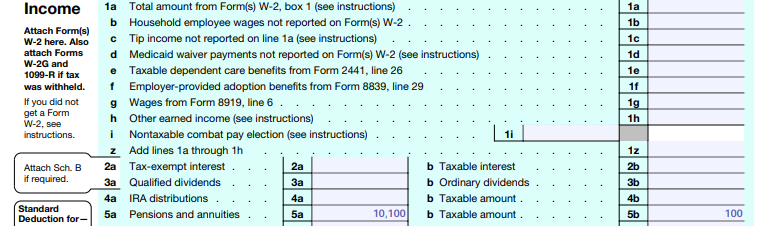
Say if you contribute $10,000, get $100 of earnings, and roll it all into Roth, your Tax Form 1040, Line 5a, will be $10,100, and Line 5b will be $100
12
It's important to point out that the after-tax contribution limits are per plan (employee), so your spouse can also do the Mega Backdoor Roth, if allowed by the 401(k) plan.
In addition, doctors often work for multiple employers and can get ~$100K+ into Roth accounts.
In addition, doctors often work for multiple employers and can get ~$100K+ into Roth accounts.
13
By the way, the entire content of this thread came from my free weekly newsletter.
I post bangers like this one every single week.
You are missing out if you aren't subscribed - thecrunch.co
I post bangers like this one every single week.
You are missing out if you aren't subscribed - thecrunch.co
14
If you enjoyed this post, please:
1. follow me @money_cruncher
2. retweet the first tweet
1. follow me @money_cruncher
2. retweet the first tweet
15
Do you want to learn how wealthy people minimize taxes?
I created an in-depth guide with 11 best strategies.
It’s free: thecrunch.co/how-wealthy-pe…
I created an in-depth guide with 11 best strategies.
It’s free: thecrunch.co/how-wealthy-pe…

