@FransBakker9812 ↔ @TheKamaHsutra conversation

Frans Bakker@FransBakker9812
15 views
Sep 14, 2025
~7 min read
Advertisement
Frans Bakker@FransBakker9812
New: Google buys 1GW former Musselman Tech campus and Joins West Texas Flywheel
While you were all busy with the elections, West Texas gained a powerful new partner in its drive for energy and tech leadership— @Google, LLC has officially arrived! With its acquisition of the 1GW “Cloud West” campus in Haskell county, TX, originally developed by HODL Ranch team, Google brings massive scale, innovation, and job creation to the region, just 40 miles north of @Oracle's expanding Abilene campus.
Google’s move cements West Texas as the epicenter of America’s next energy and tech revolution. By joining flexible compute hubs within a 80 miles radius of IREN’s 1.4GW site and 90 miles northeast of Cipher’s 300MW Barbour Lake campus, Google accelerates the momentum. Together, these players are positioning West Texas as a prime hub for AI, meeting the soaring demand for flexible, grid-supportive power loads that keep @ERCOT_ISO resilient and reliable.
With at least one 345kV 250MVA substation on site, the site is expected to be energized in the coming 9-18 months. Powered by AEP North transmission lines, the site will be directly connected to the Texas grid with an uptime of 99.9%.
Building on a Legacy of Energy and Innovation
From the discovery of oil at Santa Rita #1 to HODL Ranch’s flexible compute breakthroughs, West Texas has always led the way. Today, oil and natural gas, complimented by renewables and battery storage, is teaming up with Bitcoin miners and AI data centers to drive growth and job creation. The West Texas Flywheel—powered by advanced Bitcoin mining and AI data centers—is set to deliver significant local job growth and economic opportunity, meeting both today’s needs and America’s vision for the next 250 years.
Google + West Texas Flywheel = Jobs and Opportunity
Google’s commitment to West Texas will be a major catalyst, expanding the region’s economy and revitalizing infrastructure. Google’s expertise in large-scale data operations, combined with the foundational work of @IREN_Ltd , HODL Ranch and @CipherInc, is setting up long-term job creation. With new roles in data management, technical operations, critical facilities managers, engineering, and site maintenance, Google’s investment is a game-changer, attracting and developing skilled local talent and cementing West Texas as the AI computing headquarters of the world.
Additionally, Google moving to the region, confirms the location as an ideal place to develop high-end data centers for both LLM training and inference.
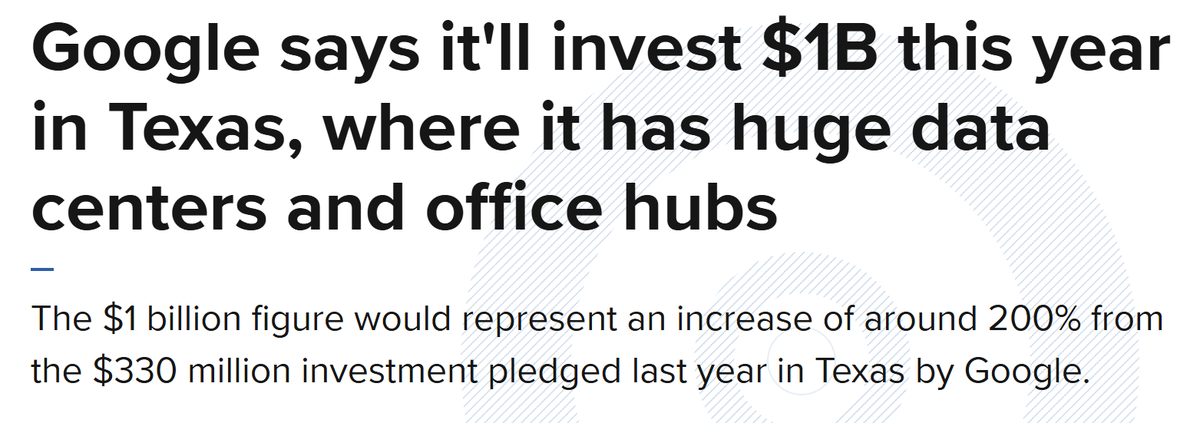
Just 3 months ago Google said to invest $1B in Texas this year, and with the acquisition of this new site in Haskell county, the coming years are expected to demand even more investment in the lone star state.
A Transformative Ecosystem: $IREN, $CIFR, and the West Texas Advantage
This Flywheel effect wouldn’t be possible without HODL Ranch's @JessePeltan, IREN and Cipher, whose wildcatter spirit, education, and infrastructure investments laid the groundwork. As pioneers in flexible load infrastructure, policy education, and local workforce training, their experience in Bitcoin mining has built a talent pool of compute cowboys, ideally suited to support growth and operations of new AI data centers.
Why West Texas? Flexibility and Infinite Potential
With abundant wind, solar, and natural gas resources, forward-thinking ERCOT policies, and a skilled workforce, West Texas has become the perfect landscape for GW+ AI training and inference compute centers. This unique advantage will continue to attract tech giants seeking GW+ renewables powered grid connected compute clusters.
West Texas: Powering America’s Next Chapter
As America moves toward a new era of sustainable energy and economic growth, West Texas stands at the heart of this transformation. Google’s arrival further accelerates the West Texas Flywheel, underscoring the region’s role in defining the future of energy and technology for the nation and beyond.
“The world needs more power, and West Texas is ready to deliver it,”. With Google, IREN, and Cipher leading the charge, this Flywheel isn’t just spinning—it’s powering a new age of opportunity and innovation that will shape America’s future.
#WestTexasFlywheel #EnergyRevolution #GoogleInTexas #JobCreation
@TheKamaHsutra
@matthewsigell
@TexasBlockchain
@benemodi
@GideonOPowell
@Agrippa_Inv
@abundanceinst
@_bradcuddy_
@lee_bratcher
@rftylerpage
@litigious_dulce
@danroberts0101
@asp1re_1nsp1re_
@Umbisam
@DavidSh17762017
@kentpdraper
@GlennHarro
@brianfry01
@AlphaTrader00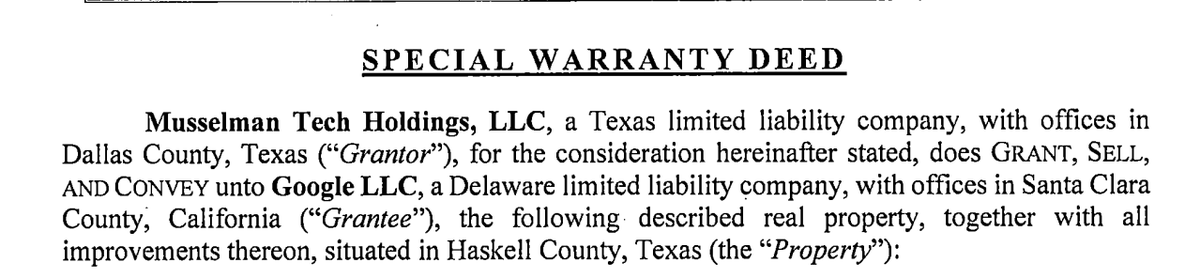


While you were all busy with the elections, West Texas gained a powerful new partner in its drive for energy and tech leadership— @Google, LLC has officially arrived! With its acquisition of the 1GW “Cloud West” campus in Haskell county, TX, originally developed by HODL Ranch team, Google brings massive scale, innovation, and job creation to the region, just 40 miles north of @Oracle's expanding Abilene campus.
Google’s move cements West Texas as the epicenter of America’s next energy and tech revolution. By joining flexible compute hubs within a 80 miles radius of IREN’s 1.4GW site and 90 miles northeast of Cipher’s 300MW Barbour Lake campus, Google accelerates the momentum. Together, these players are positioning West Texas as a prime hub for AI, meeting the soaring demand for flexible, grid-supportive power loads that keep @ERCOT_ISO resilient and reliable.
With at least one 345kV 250MVA substation on site, the site is expected to be energized in the coming 9-18 months. Powered by AEP North transmission lines, the site will be directly connected to the Texas grid with an uptime of 99.9%.
Building on a Legacy of Energy and Innovation
From the discovery of oil at Santa Rita #1 to HODL Ranch’s flexible compute breakthroughs, West Texas has always led the way. Today, oil and natural gas, complimented by renewables and battery storage, is teaming up with Bitcoin miners and AI data centers to drive growth and job creation. The West Texas Flywheel—powered by advanced Bitcoin mining and AI data centers—is set to deliver significant local job growth and economic opportunity, meeting both today’s needs and America’s vision for the next 250 years.
Google + West Texas Flywheel = Jobs and Opportunity
Google’s commitment to West Texas will be a major catalyst, expanding the region’s economy and revitalizing infrastructure. Google’s expertise in large-scale data operations, combined with the foundational work of @IREN_Ltd , HODL Ranch and @CipherInc, is setting up long-term job creation. With new roles in data management, technical operations, critical facilities managers, engineering, and site maintenance, Google’s investment is a game-changer, attracting and developing skilled local talent and cementing West Texas as the AI computing headquarters of the world.
Additionally, Google moving to the region, confirms the location as an ideal place to develop high-end data centers for both LLM training and inference.
Just 3 months ago Google said to invest $1B in Texas this year, and with the acquisition of this new site in Haskell county, the coming years are expected to demand even more investment in the lone star state.
A Transformative Ecosystem: $IREN, $CIFR, and the West Texas Advantage
This Flywheel effect wouldn’t be possible without HODL Ranch's @JessePeltan, IREN and Cipher, whose wildcatter spirit, education, and infrastructure investments laid the groundwork. As pioneers in flexible load infrastructure, policy education, and local workforce training, their experience in Bitcoin mining has built a talent pool of compute cowboys, ideally suited to support growth and operations of new AI data centers.
Why West Texas? Flexibility and Infinite Potential
With abundant wind, solar, and natural gas resources, forward-thinking ERCOT policies, and a skilled workforce, West Texas has become the perfect landscape for GW+ AI training and inference compute centers. This unique advantage will continue to attract tech giants seeking GW+ renewables powered grid connected compute clusters.
West Texas: Powering America’s Next Chapter
As America moves toward a new era of sustainable energy and economic growth, West Texas stands at the heart of this transformation. Google’s arrival further accelerates the West Texas Flywheel, underscoring the region’s role in defining the future of energy and technology for the nation and beyond.
“The world needs more power, and West Texas is ready to deliver it,”. With Google, IREN, and Cipher leading the charge, this Flywheel isn’t just spinning—it’s powering a new age of opportunity and innovation that will shape America’s future.
#WestTexasFlywheel #EnergyRevolution #GoogleInTexas #JobCreation
@TheKamaHsutra
@matthewsigell
@TexasBlockchain
@benemodi
@GideonOPowell
@Agrippa_Inv
@abundanceinst
@_bradcuddy_
@lee_bratcher
@rftylerpage
@litigious_dulce
@danroberts0101
@asp1re_1nsp1re_
@Umbisam
@DavidSh17762017
@kentpdraper
@GlennHarro
@brianfry01
@AlphaTrader00

Kamahsutra@TheKamaHsutra
$GOOG getting into the West Texas area is good for anyone who believes in the "West Texas Flywheel", such as @GideonOPowell. This area has abundant land, multiple fiber optic backbones and trunks, and more importantly a massive amount of renewable power generation. It would appear to be a logical location to be the next hotbed for DCs in the US.
Nuclear power generation for hyperscalers was all the rage for the past few months, but now regulatory hurdles and challenges have given a bit of a wake up call on how quickly nuclear power generation can really become energized for sites. If TTM is valuable to hyperscalers, then it has to come back to renewables, in particular solar generation, as it's the form that can be built at scale by far the quickest.
As we're all aware, the capital for DCs in the Western Hemisphere is Northern Virginia. Below is a map of where all of the major DCs are located in Northern Virginia. It's no surprise that they're almost all located along 3 major highways, I81, I64, and I66. This is not because they need to truck equipment to the sites (does help though), it's because these are also the routes for the major fiber optic backbones and trunks. As previously mentioned in another post, fiber optic lines will almost always run along major highways and railway lands due to the ease of getting easements along the routes.
While Northern Virginia has been a great area for DCs in the past couple of decades, and will continue to play an important role, it has certain challenges and limitations. If looking at the map of where all the major DCs are, it's already a very congested area. Residents in those areas are experiencing data center fatigue, and there is strong push back in many communities for more data centers. There is a long waiting list and time for Dominion Energy to approve more grid connections. In addition, the amount of new energy generation isn't comparable to elsewhere in the US. The total estimated MWs used by all DCs in Northern Virginia is around 2 GW. This certainly no small number. However, considering that numerous sites in Texas are in the 500 MW range, and a few that run into the 1+GW range, Texas is much more suited to be the place to build new DCs for power hungry AI/HPC GPUs, and taking the baton from Northern Virginia for the next leg of AI/HPC compute in the DC journey.
$ORCL was the first hyperscaler to be involved a new DC campus in West Texas at Abilene (A), $GOOG (G) has now joined the party at Haskell. Both of these sites are located along the major fiber optic backbones and trunks, certainly no surprises there. $CIFR's Barber Lake site (C) is also along these lines, as is all of $IREN's sites, and the same for most of the sites owned other BTC miners.
We now have 2 of the major hyperscalers come into this area now, and the biggest driver is the abundance of renewable energy that would be available now or very shortly. There still seems to be a false narrative going around about the need for DCs being in a metropolitan areas for inference. If this is the case, how close are the existing DCs in Northern Virginia to NYC and the rest of the major cities on the Eastern Seaboard? Surely, these are the same DCs that are hosting workloads for some of the very inference use cases such as ChatGPT as we type now, aren't they? Was Oracle making a big mistake going into Abilene? And now Google also making a colossal blunder going for a massive campus in Haskell? Surely, these billion dollar AI/HPC campuses are single purpose for LLM training only, since they're too remote and useless for inference, correct? We'll, I have presented my case on this topic previously, and will just let actions of Oracle and Google speak for itself.
The DC map for West Texas certainly looks sparse at this time. However, with it's massive amounts of renewable power generation, fiber optic connections, and ample land to build on, that map will look considerably different in the next decade. Another factor in this could be that most communities in West Texas are in support of these data centers coming in, and have been very supportive of new businesses coming into their towns and cities to drive up their local GDPs. Abilene is a classic case study of this. Don't be surprised at how many of the other hyperscalers and major DC players will be setting up shop in West Texas by EOY 2025.
