🚨This week’s top AI/ML research papers: - Can LLMs Generate Novel...

The AI Timeline@TheAITimeline
62 views
Sep 17, 2024
~12 min read
Advertisement
1
🚨This week’s top AI/ML research papers:
- Can LLMs Generate Novel Research Ideas?
- LLaMA-Omni
- SaRA
- How Do Your Code LLMs Perform?
- GroUSE
- Open-MAGVIT2
- Qihoo-T2X
- Windows Agent Arena
- Configurable Foundation Models
- Paper Copilot
- MemoRAG
- MMEvol
- INTRA
- DSBench
- PingPong
- Agent Workflow Memory
- Gated Slot Attention for Efficient Linear-Time Sequence Modeling
- Hi3D
- The AdEMAMix Optimizer
- DepthCrafter
- MLR-Copilot
- LinFusion
- gsplat
- SongCreator
- Draw an Audio
overview for each + authors' explanations
read this in thread mode for the best experience
- Can LLMs Generate Novel Research Ideas?
- LLaMA-Omni
- SaRA
- How Do Your Code LLMs Perform?
- GroUSE
- Open-MAGVIT2
- Qihoo-T2X
- Windows Agent Arena
- Configurable Foundation Models
- Paper Copilot
- MemoRAG
- MMEvol
- INTRA
- DSBench
- PingPong
- Agent Workflow Memory
- Gated Slot Attention for Efficient Linear-Time Sequence Modeling
- Hi3D
- The AdEMAMix Optimizer
- DepthCrafter
- MLR-Copilot
- LinFusion
- gsplat
- SongCreator
- Draw an Audio
overview for each + authors' explanations
read this in thread mode for the best experience
2
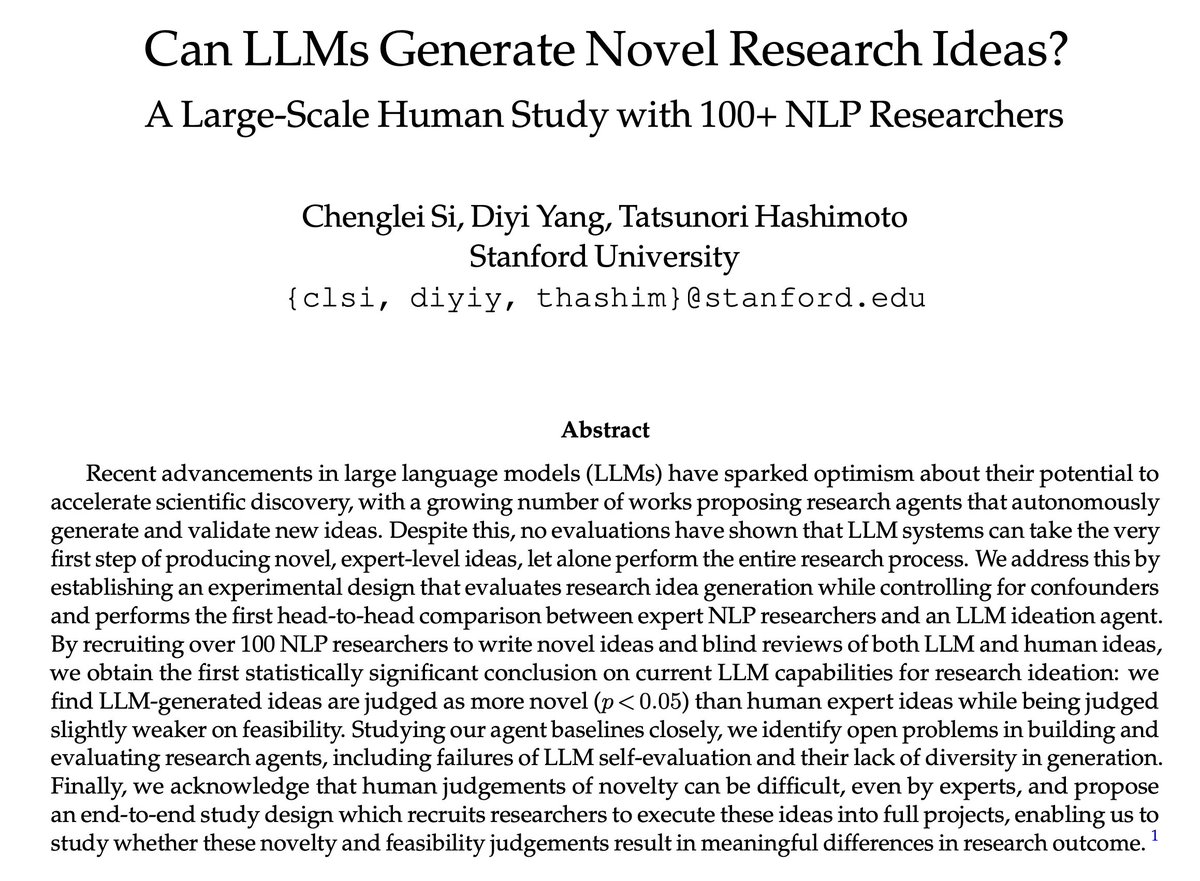
Can LLMs Generate Novel Research Ideas? A Large-Scale Human Study with 100+ NLP Researchers
Author's Explanation:
Overview:
This paper investigates whether LLMs can generate novel research ideas by comparing them to human-generated ideas from over 100 NLP researchers.
The results show that LLM-generated ideas are judged as more novel than human expert ideas, but slightly weaker on feasibility.
However, the study also highlights open problems in building and evaluating research agents, including LLM self-evaluation failures and lack of diversity in generation.
Paper:
arxiv.org/abs/2409.04109


Author's Explanation:
Overview:
This paper investigates whether LLMs can generate novel research ideas by comparing them to human-generated ideas from over 100 NLP researchers.
The results show that LLM-generated ideas are judged as more novel than human expert ideas, but slightly weaker on feasibility.
However, the study also highlights open problems in building and evaluating research agents, including LLM self-evaluation failures and lack of diversity in generation.
Paper:
arxiv.org/abs/2409.04109
CLS@ChengleiSi
Automating AI research is exciting! But can LLMs actually produce novel, expert-level research ideas?
After a year-long study, we obtained the first statistically significant conclusion: LLM-generated ideas are more novel than ideas written by expert human researchers.
After a year-long study, we obtained the first statistically significant conclusion: LLM-generated ideas are more novel than ideas written by expert human researchers.
3
LLaMA-Omni: Seamless Speech Interaction with Large Language Models
Author's Explanation:
Overview:
The authors present LLaMA-Omni, a novel model architecture designed for low-latency and high-quality speech interaction with LLMs.
This model integrates a pretrained speech encoder, speech adaptor, LLM, and streaming speech decoder to generate text and speech responses directly from speech instructions without the need for transcription.
Experimental results on the InstructS2S-200K dataset show that LLaMA-Omni provides better content and style in its responses compared to previous models, with a response latency as low as 226ms.
Paper:
arxiv.org/abs/2409.06666
GitHub:
github.com/ictnlp/LLaMA-O…
Qingkai Fang@Poeroz1204
Thanks for sharing our work! 🥳
4
SaRA: High-Efficient Diffusion Model Fine-tuning with Progressive Sparse Low-Rank Adaptation
Overview:
The authors present SaRA, a novel model fine-tuning method for diffusion models, which leverages ineffective parameters in pre-trained models to enable new task-specific capabilities.
By re-utilizing the smallest 10-20% of parameters, SaRA optimizes a sparse weight matrix to learn task-specific knowledge through a nuclear-norm-based low-rank sparse training scheme.
This approach significantly improves the generative capabilities of pre-trained models and outperforms traditional fine-tuning methods like LoRA in maintaining generalization ability, as demonstrated through experiments on SD models.
Paper:
arxiv.org/abs/2409.06633
5
How Do Your Code LLMs Perform? Empowering Code Instruction Tuning with High-Quality Data
Author's Explanation:
Overview:
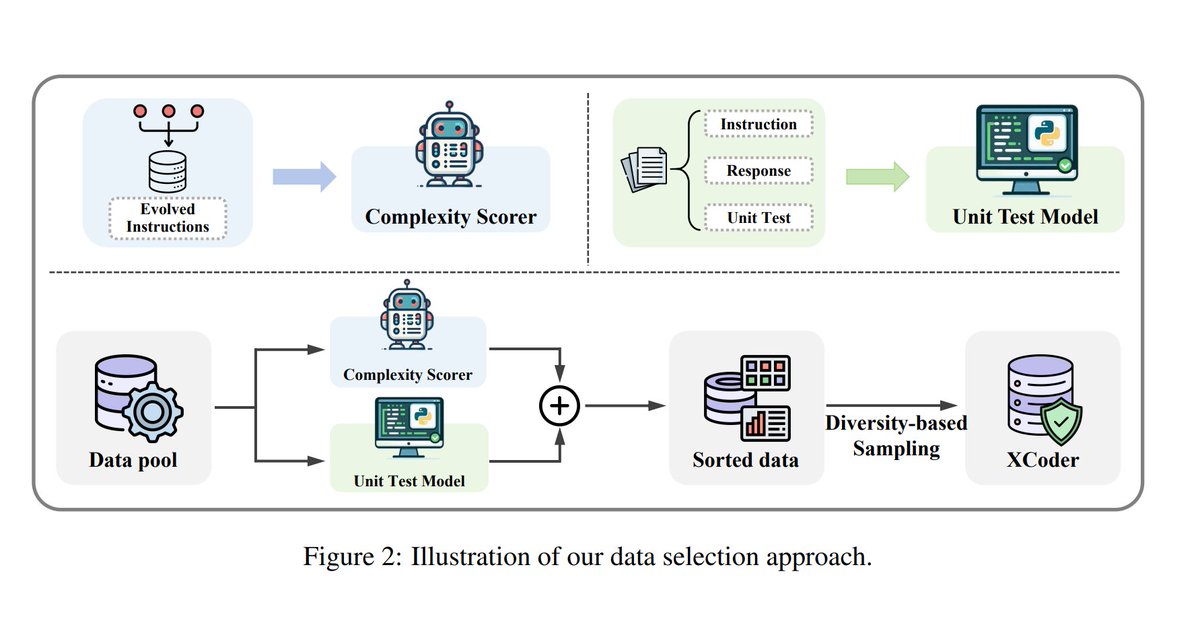
The authors investigate the performance of code LLMs on various benchmarks and discover that many datasets suffer from data leakage, leading to poor performance on certain tasks.
To address this issue, they propose a data pruning strategy based on instruction complexity, response quality, and instruction diversity.
This approach is used to select high-quality data for fine-tuning XCoder, a family of models derived from LLaMA3, which achieves state-of-the-art performance using fewer training data.
The authors also analyze the composition of existing code datasets, revealing differences in characteristics according to their construction methods.
Paper:
arxiv.org/abs/2409.03810

Author's Explanation:
Overview:
The authors investigate the performance of code LLMs on various benchmarks and discover that many datasets suffer from data leakage, leading to poor performance on certain tasks.
To address this issue, they propose a data pruning strategy based on instruction complexity, response quality, and instruction diversity.
This approach is used to select high-quality data for fine-tuning XCoder, a family of models derived from LLaMA3, which achieves state-of-the-art performance using fewer training data.
The authors also analyze the composition of existing code datasets, revealing differences in characteristics according to their construction methods.
Paper:
arxiv.org/abs/2409.03810
Yejie Wang@YejieWang
🚀 Excited to share our latest research!
🧑💻We dive deep into the impact of data leakage and redefine what makes great Code Instruction Tuning data. 🌟
GitHub: [Link](github.com/banksy23/XCoder) 💻
Huggingface: [Link](huggingface.co/papers/2409.03…) 🤖
🧑💻We dive deep into the impact of data leakage and redefine what makes great Code Instruction Tuning data. 🌟
GitHub: [Link](github.com/banksy23/XCoder) 💻
Huggingface: [Link](huggingface.co/papers/2409.03…) 🤖
6
GroUSE: A Benchmark to Evaluate Evaluators in Grounded Question Answering
Author's Explanation:
Overview:
The authors introduce GroUSE, a meta-evaluation benchmark for assessing the calibration and discrimination capabilities of judge models in grounded question answering.
This benchmark consists of 144 unit tests that reveal existing automated RAG evaluation frameworks often overlook important failure modes, even when using GPT-4 as a judge.
The study finds that correlation with GPT-4 is an incomplete proxy for practical performance, and proposes a novel pipeline to improve evaluation frameworks.
Finetuning Llama-3 on GPT-4's reasoning traces significantly boosts its evaluation capabilities.
Paper:
arxiv.org/abs/2409.06595
Sacha Muller@sachamuller_
🪶 How to ensure LLM-as-a-Judge evaluations truly align with the complex metrics they’re measuring?
We introduce GroUSE, a meta-evaluation dataset of 144 unit tests designed to assess the quality of a Grounded QA evaluator | arxiv.org/abs/2409.06595 🧵 (1/N)
We introduce GroUSE, a meta-evaluation dataset of 144 unit tests designed to assess the quality of a Grounded QA evaluator | arxiv.org/abs/2409.06595 🧵 (1/N)
7
Open-MAGVIT2: An Open-Source Project Toward Democratizing Auto-regressive Visual Generation
Author's Explanation:
Overview:
The authors present Open-MAGVIT2, a family of auto-regressive image generation models with 300M to 1.5B parameters.
This project achieves sota reconstruction performance on ImageNet 256 x 256, leveraging an open-source replication of Google's MAGVIT-v2 tokenizer and asymmetric token factorization for efficient vocabulary prediction.
The approach introduces "next sub-token prediction" to enhance sub-token interaction, resulting in improved generation quality.
Paper:
arxiv.org/abs/2409.04410
Yixiao Ge@ge_yixiao
🚀Welcome to explore our Open-MAGVIT2, featuring a state-of-the-art open-source image tokenizer (🔥0.34 rFID for 8x downsampling) and comparable image generation results with DiT on ImageNet using a plain autoregressive Transformer.
🤗github.com/TencentARC/Ope…
🤗github.com/TencentARC/Ope…
8
Qihoo-T2X: An Efficiency-Focused Diffusion Transformer via Proxy Tokens for Text-to-Any-Task
Overview:
The authors present PT-DiT, an efficiency-focused diffusion transformer that addresses redundant computation in global self-attention mechanisms.
By employing sparse representative token attention and introducing window and shift window attention, PT-DiT captures global semantics while reducing computational complexity.
Experimental results show that PT-DiT achieves competitive performance with a significant reduction in computational cost, outperforming baselines like DiT and Pixart-alpha in image and video generation tasks.
The proposed Qihoo-T2X family of models demonstrates sota efficiency on T2I, T2V, and T2MV tasks.
Paper:
arxiv.org/abs/2409.04005
9
Windows Agent Arena: Evaluating Multi-Modal OS Agents at Scale
Author's Explanation:
Overview:
This paper introduces the Windows Agent Arena, a reproducible environment for evaluating multi-modal OS agents at scale.
The arena features 150+ diverse tasks across representative domains within the Windows operating system, requiring agent abilities in planning, screen understanding, and tool usage.
The authors demonstrate the capabilities of this benchmark with Navi, a new multi-modal agent that achieves a success rate of 19.5% on Windows tasks, outperforming other agents and showing strong results on Mind2Web.
The arena allows for scalable and parallelized evaluation, enabling full benchmark evaluations in under 20 minutes.
Paper:
arxiv.org/abs/2409.08264
GitHub:
github.com/microsoft/Wind…
Rogerio Bonatti@rogerio_bonatti
AI assistants have changed the way we use computers to work and search for information. As LLMs become more powerful, what’s next? Agents.
Excited to introduce Windows Agent Arena, a benchmark for evaluating AI models that can reason, plan and act to solve tasks on your PC.
🔗Blog: microsoft.com/applied-scienc…
🌐Webpage: microsoft.github.io/WindowsAgentAr…
📃Paper: arxiv.org/abs/2409.08264
💻Code: github.com/microsoft/Wind…
🧵👇
Excited to introduce Windows Agent Arena, a benchmark for evaluating AI models that can reason, plan and act to solve tasks on your PC.
🔗Blog: microsoft.com/applied-scienc…
🌐Webpage: microsoft.github.io/WindowsAgentAr…
📃Paper: arxiv.org/abs/2409.08264
💻Code: github.com/microsoft/Wind…
🧵👇
10
Configurable Foundation Models: Building LLMs from a Modular Perspective
Overview:
This paper introduces Configurable Foundation Models, a modular approach to building LLMs inspired by the human brain's modularity.
The authors propose dividing LLMs into functional modules, called "bricks", which can be dynamically assembled and configured to tackle complex tasks.
They formalize two types of bricks: emergent and customized, and present four brick-oriented operations: retrieval and routing, merging, updating, and growing.
Empirical analysis on widely-used LLMs reveals that FFN layers exhibit modular patterns with functional specialization of neurons.
Paper:
arxiv.org/abs/2409.02877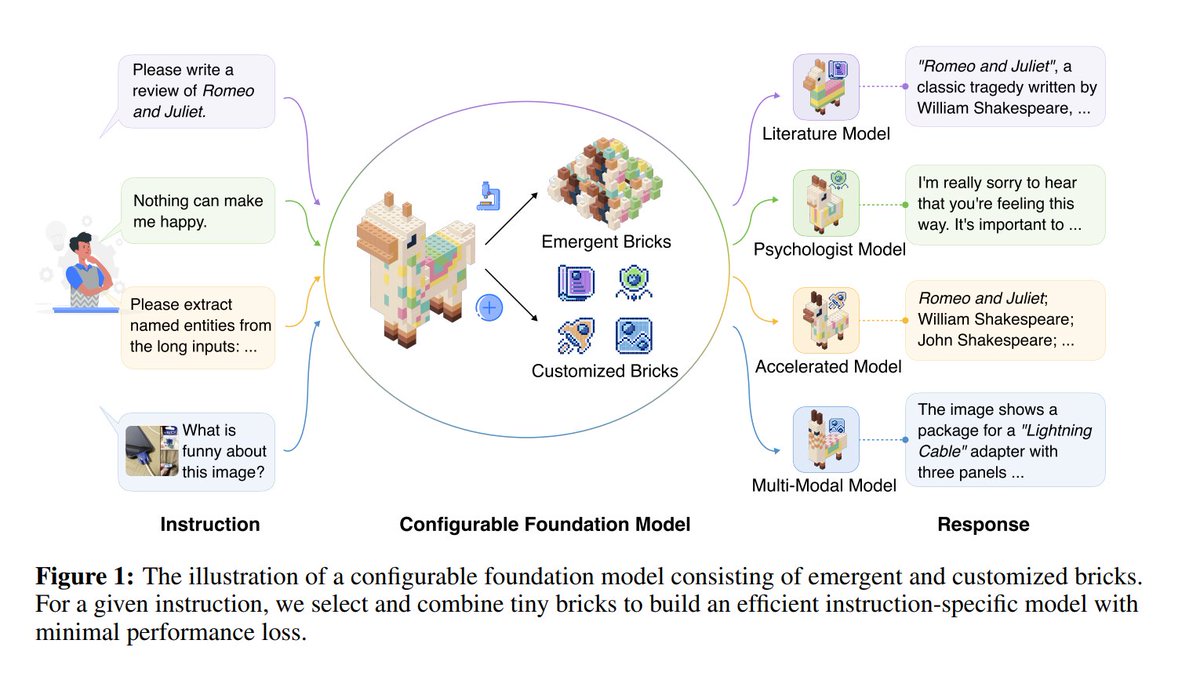
Overview:
This paper introduces Configurable Foundation Models, a modular approach to building LLMs inspired by the human brain's modularity.
The authors propose dividing LLMs into functional modules, called "bricks", which can be dynamically assembled and configured to tackle complex tasks.
They formalize two types of bricks: emergent and customized, and present four brick-oriented operations: retrieval and routing, merging, updating, and growing.
Empirical analysis on widely-used LLMs reveals that FFN layers exhibit modular patterns with functional specialization of neurons.
Paper:
arxiv.org/abs/2409.02877
11
Paper Copilot: A Self-Evolving and Efficient LLM System for Personalized Academic Assistance
Overview:
The authors present Paper Copilot, a self-evolving LLM system designed to provide personalized academic assistance.
It leverages thought-retrieval, user profiling, and high-performance optimization to offer real-time updated research services.
Quantitative evaluation shows that Paper Copilot significantly reduces time spent on research tasks, achieving notable efficiency gains.
The system's design and implementation aim to streamline the research process and enhance personalized academic support.
Paper:
arxiv.org/abs/2409.04593
12
MemoRAG: Moving towards Next-Gen RAG Via Memory-Inspired Knowledge Discovery
Overview:
The authors present MemoRAG, a novel Retrieval-Augmented Generation (RAG) paradigm that leverages long-term memory to enhance the generation quality of LLMs.
MemoRAG employs a dual-system architecture, combining a light but long-range LLM for generating draft answers and an expressive LLM for refining them based on retrieved information.
The approach achieves superior performance across various evaluation tasks, outperforming conventional RAG methods in both complex and straightforward question-answering tasks.
Paper:
arxiv.org/abs/2409.05591
13
MMEvol: Empowering Multimodal Large Language Models with Evol-Instruct
Overview:
This paper introduces MMEvol, a framework that generates complex and diverse image-text instruction data to empower Multimodal Large Language Models.
Starting with an initial dataset, SEED-163K, MMEvol iteratively evolves instruction types, integrates cognitive reasoning steps, and extracts detailed information from images.
The evolved data is used to train LLaVA-NeXT, which achieves a 3.1 point average accuracy improvement across 13 vision-language tasks, reaching sota performance on 9 of these tasks.
Paper:
arxiv.org/abs/2409.05840
14
INTRA: Interaction Relationship-aware Weakly Supervised Affordance Grounding
Overview:
The authors present a new approach to weakly supervised affordance grounding, called INTRA, which identifies unique features of interactions through contrastive learning with exocentric images.
Unlike previous methods, INTRA eliminates the need for paired datasets and leverages vision-language model embeddings to perform affordance grounding flexibly with any text.
The method outperforms prior arts on diverse datasets such as AGD20K, IIT-AFF, CAD, and UMD, demonstrating remarkable domain scalability and capability in handling novel interactions and objects.
Paper:
arxiv.org/abs/2409.06210
15
DSBench: How Far Are Data Science Agents to Becoming Data Science Experts?
Author's Explanation:
Overview:
The authors present DSBench, a comprehensive benchmark to evaluate data science agents with realistic tasks.
This benchmark consists of 466 data analysis tasks and 74 data modeling tasks, sourced from Eloquence and Kaggle competitions, and offers a realistic setting by encompassing long contexts, multimodal task backgrounds, and end-to-end data modeling tasks.
State-of-the-art LLMs, LVLMs, and agents were evaluated on DSBench, showing they struggle with most tasks, with the best agent solving only 34.12% of data analysis tasks.
These findings highlight the need for further advancements in developing more practical data science agents.
Paper:
arxiv.org/abs/2409.07703
Liqiang Jing@jingliqiang6
🚀 Introducing DSBench! 🌟
DSBench evaluates LLMs/LVLMs on 466 data analysis tasks and 74 data modeling tasks. It features realistic challenges like long contexts, complex data files, and end-to-end modeling.
📃Paper: arxiv.org/abs/2409.07703
🔨Project: github.com/LiqiangJing/DS…
DSBench evaluates LLMs/LVLMs on 466 data analysis tasks and 74 data modeling tasks. It features realistic challenges like long contexts, complex data files, and end-to-end modeling.
📃Paper: arxiv.org/abs/2409.07703
🔨Project: github.com/LiqiangJing/DS…
16
PingPong: A Benchmark for Role-Playing Language Models with User Emulation and Multi-Model Evaluation
Overview:
The authors present PingPong, a novel benchmark for evaluating the role-playing capabilities of LLMs in dynamic conversations.
The framework consists of three components: a player model, an interrogator model simulating user behavior, and a judge model evaluating conversation quality.
Experiments show strong correlations between automated evaluations and human annotations across multiple criteria.
This approach provides a more robust evaluation of LLMs' capabilities in interactive scenarios.
Paper:
arxiv.org/abs/2409.06820
17
Agent Workflow Memory
Overview:
The authors introduce Agent Workflow Memory (AWM), a method that enables LLMs-based agents to learn reusable task workflows from past experiences and apply them to future actions.
AWM is evaluated on two web navigation benchmarks, Mind2Web and WebArena, which cover over 1000 tasks across various domains.
The approach substantially improves baseline results by up to 51.1% relative success rate and reduces the number of steps taken to solve tasks.
Additionally, online AWM demonstrates robust generalization in cross-task, website, and domain evaluations, outperforming baselines by up to 14.0 absolute points.
Paper:
arxiv.org/abs/2409.07429
18
Gated Slot Attention for Efficient Linear-Time Sequence Modeling
Author's Explanation:
Overview:
The authors present a novel attention mechanism called Gated Slot Attention (GSA) that enhances linear-time sequence modeling with improved memory capacity and efficiency.
GSA combines a gating mechanism inspired by Gated Linear Attention (GLA) with context-aware memory reading and adaptive forgetting, maintaining a compact recurrent state size.
This design enables efficient training and inference, outperforming traditional Transformers in recall-intensive tasks and fine-tuning pre-trained LLMs to RNNs settings.
Paper:
arxiv.org/abs/2409.07146
Yu Zhang 🐙🌘@yzhang_cs
🍾🍾🍾𝙀𝙭𝙘𝙞𝙩𝙚𝙙 𝙩𝙤 𝙞𝙣𝙩𝙧𝙤𝙙𝙪𝙘𝙚 𝙤𝙪𝙧 𝙡𝙖𝙩𝙚𝙨𝙩 𝙬𝙤𝙧𝙠: 𝙂𝙖𝙩𝙚𝙙 𝙎𝙡𝙤𝙩 𝘼𝙩𝙩𝙚𝙣𝙩𝙞𝙤𝙣 (𝙂𝙎𝘼), a new linear attention model inspired by ABC @haopeng_nlp and GLA @SonglinYang4 @bailin_28.
Paper link:
arxiv.org/abs/2409.07146
huggingface.co/papers/2409.07…
Paper link:
arxiv.org/abs/2409.07146
huggingface.co/papers/2409.07…
19
Hi3D: Pursuing High-Resolution Image-to-3D Generation with Video Diffusion Models
Overview:
The authors present Hi3D, a video diffusion-based paradigm for high-resolution image-to-3D generation that leverages 3D-aware sequential image generation.
By using a pre-trained video diffusion model with 3D-aware prior and refining it with a 3D-aware video-to-video refiner, Hi3D produces multi-view images with highly-detailed textures.
The method is further augmented with novel views through 3D Gaussian Splatting and achieves superior results in novel view synthesis and single view reconstruction tasks.
Hi3D demonstrates significant improvements in generating high-fidelity meshes with detailed textures.
Paper:
arxiv.org/abs/2409.07452
GitHub:
github.com/yanghb22-fdu/H…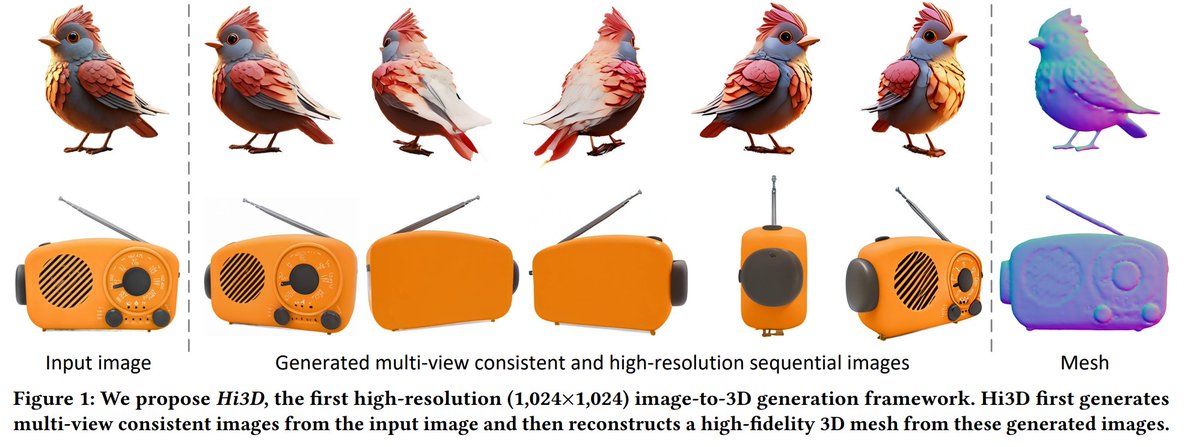
Overview:
The authors present Hi3D, a video diffusion-based paradigm for high-resolution image-to-3D generation that leverages 3D-aware sequential image generation.
By using a pre-trained video diffusion model with 3D-aware prior and refining it with a 3D-aware video-to-video refiner, Hi3D produces multi-view images with highly-detailed textures.
The method is further augmented with novel views through 3D Gaussian Splatting and achieves superior results in novel view synthesis and single view reconstruction tasks.
Hi3D demonstrates significant improvements in generating high-fidelity meshes with detailed textures.
Paper:
arxiv.org/abs/2409.07452
GitHub:
github.com/yanghb22-fdu/H…
20
The AdEMAMix Optimizer: Better, Faster, Older
Author's Explanation:
Overview:
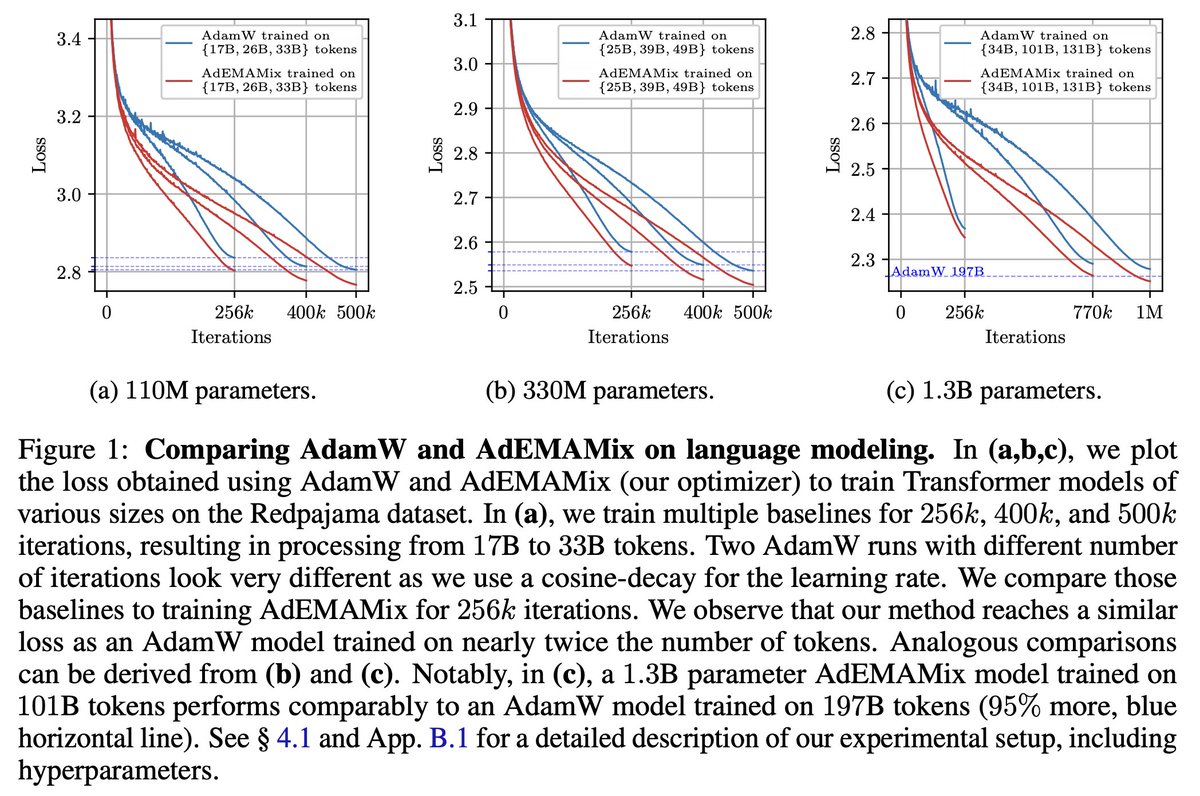
The authors propose AdEMAMix, a modified version of the Adam optimizer that uses a mixture of two Exponential Moving Averages (EMAs) to better utilize past gradients.
This approach allows for both high weight on immediate past gradients and non-negligible weight on older gradients, leading to faster convergence and lower minima.
Experimental results show that AdEMAMix outperforms AdamW in language modeling and image classification tasks, with a 1.3B parameter LLM achieving comparable performance to an AdamW model trained on nearly twice the amount of data.
This work also demonstrates significant reduction in model forgetting during training.
Paper:
arxiv.org/abs/2409.03137


Author's Explanation:
Overview:
The authors propose AdEMAMix, a modified version of the Adam optimizer that uses a mixture of two Exponential Moving Averages (EMAs) to better utilize past gradients.
This approach allows for both high weight on immediate past gradients and non-negligible weight on older gradients, leading to faster convergence and lower minima.
Experimental results show that AdEMAMix outperforms AdamW in language modeling and image classification tasks, with a 1.3B parameter LLM achieving comparable performance to an AdamW model trained on nearly twice the amount of data.
This work also demonstrates significant reduction in model forgetting during training.
Paper:
arxiv.org/abs/2409.03137
Matteo Pagliardini@MatPagliardini
Stop discarding your old gradients! Introducing AdEMAMix, a novel (first-order) optimizer capable of outperforming Adam. Let’s have a thread on momentum and the surprising relevance of very old gradients. A joint work with @GrangierDavid and @PierreAblin #ml #optimization
1/🧵
1/🧵
21
DepthCrafter: Generating Consistent Long Depth Sequences for Open-world Videos
Author's Explanation:
Overview:
DepthCrafter is a novel method for generating temporally consistent long depth sequences with intricate details for open-world videos without requiring supplementary information.
The authors present a three-stage training strategy that enables the model to generate depth sequences of variable lengths, harvesting precise depth details and rich content diversity from realistic and synthetic datasets.
DepthCrafter achieves state-of-the-art performance in open-world video depth estimation under zero-shot settings, facilitating various downstream applications such as depth-based visual effects and conditional video generation.
Paper:
arxiv.org/abs/2409.02095
Project Page for more demo:
depthcrafter.github.io
0:06
Ying Shan@yshan2u
A quick update that we have release the inference code and model for DepthCrafter.
Code: github.com/Tencent/DepthC…
Model: huggingface.co/tencent/DepthC…
Project page: depthcrafter.github.io
Code: github.com/Tencent/DepthC…
Model: huggingface.co/tencent/DepthC…
Project page: depthcrafter.github.io
22
MLR-Copilot: Autonomous Machine Learning Research based on Large Language Models Agents
Author's Explanation:
Overview:
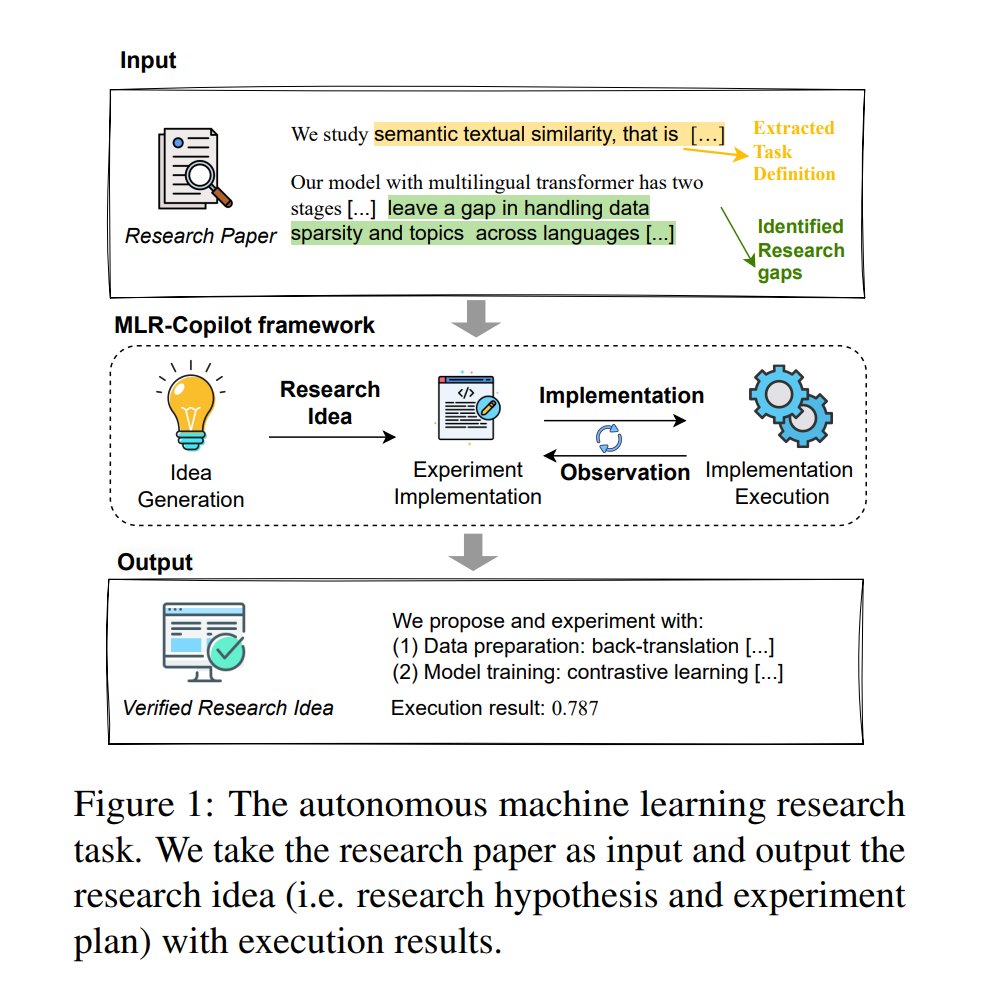
The authors present a systematic framework for autonomous Machine Learning Research with large language models (MLR-Copilot), designed to enhance productivity in ML research.
The framework consists of three phases: research idea generation using IdeaAgent powered by LLMs, experiment implementation through ExperimentAgent, and execution with mechanisms for human feedback and iterative debugging.
Experimental results on five ML research tasks demonstrate the framework's potential to facilitate research progress and innovations, showcasing its ability to automatically generate and implement research ideas using LLM agents.
Paper:
arxiv.org/abs/2408.14033

Author's Explanation:
Overview:
The authors present a systematic framework for autonomous Machine Learning Research with large language models (MLR-Copilot), designed to enhance productivity in ML research.
The framework consists of three phases: research idea generation using IdeaAgent powered by LLMs, experiment implementation through ExperimentAgent, and execution with mechanisms for human feedback and iterative debugging.
Experimental results on five ML research tasks demonstrate the framework's potential to facilitate research progress and innovations, showcasing its ability to automatically generate and implement research ideas using LLM agents.
Paper:
arxiv.org/abs/2408.14033
Xinya Du@Xinya16
Introducing MLR-Copilot: autonomous machine learning research with LLM agents, which
→ generate research ideas
→ implement experiments
→ execute implementation with human feedback
📑Paper arxiv.org/abs/2408.14033
🔨Code github.com/du-nlp-lab/MLR…
🤗Demo huggingface.co/spaces/du-lab/…
→ generate research ideas
→ implement experiments
→ execute implementation with human feedback
📑Paper arxiv.org/abs/2408.14033
🔨Code github.com/du-nlp-lab/MLR…
🤗Demo huggingface.co/spaces/du-lab/…
23
LinFusion: 1 GPU, 1 Minute, 16K Image
Author's Explanation:
Overview:
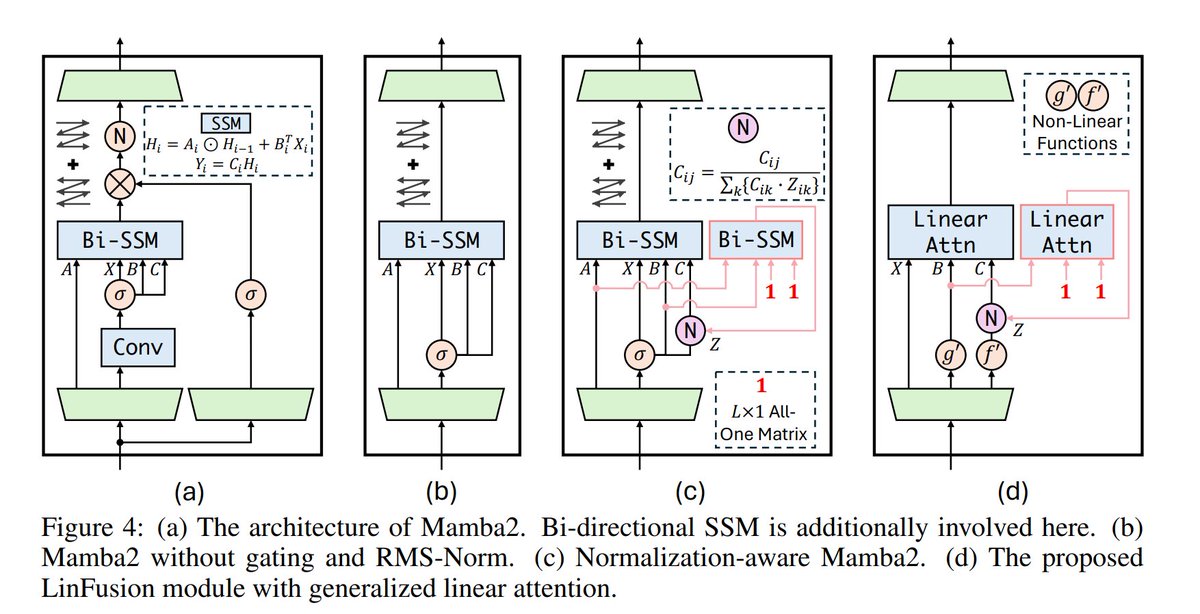
The authors present a novel linear attention mechanism for diffusion models to efficiently generate high-resolution visual content.
They introduce LinFusion, a generalized linear attention paradigm that serves as a low-rank approximation of popular linear token mixers, and initialize it with pre-trained StableDiffusion (SD) knowledge.
LinFusion achieves performance on par with or superior to the original SD after modest training while significantly reducing time and memory complexity, enabling zero-shot cross-resolution generation up to 16K resolution.
Paper:
arxiv.org/abs/2409.02097


Author's Explanation:
Overview:
The authors present a novel linear attention mechanism for diffusion models to efficiently generate high-resolution visual content.
They introduce LinFusion, a generalized linear attention paradigm that serves as a low-rank approximation of popular linear token mixers, and initialize it with pre-trained StableDiffusion (SD) knowledge.
LinFusion achieves performance on par with or superior to the original SD after modest training while significantly reducing time and memory complexity, enabling zero-shot cross-resolution generation up to 16K resolution.
Paper:
arxiv.org/abs/2409.02097
Songhua Liu@songhua_tree
🔥LinFusion: 1 GPU, 1 Minute, 16K Image🔥
LinFusion is a linear-complexity diffusion model and highly compatible with pre-trained components such as ControlNet and IP-Adapter.
Paper: huggingface.co/papers/2409.02…
Github: github.com/Huage001/LinFu…
Gradio Demo: huggingface.co/spaces/Huage00…
LinFusion is a linear-complexity diffusion model and highly compatible with pre-trained components such as ControlNet and IP-Adapter.
Paper: huggingface.co/papers/2409.02…
Github: github.com/Huage001/LinFu…
Gradio Demo: huggingface.co/spaces/Huage00…
24
gsplat: An Open-Source Library for Gaussian Splatting
Overview:
gsplat is a Python library with CUDA kernels for training and developing Gaussian Splatting methods.
It offers optimizations for speed, memory, and convergence times, achieving up to 10% less training time and 4x less memory than the original implementation.
The library is actively maintained on GitHub.
Paper:
arxiv.org/abs/2409.06765
GitHub:
github.com/nerfstudio-pro…
0:16
25
SongCreator: Lyrics-based Universal Song Generation
Overview:
The authors present SongCreator, a system designed for universal song generation from lyrics, addressing a significant challenge in music generation models.
The model features a dual-sequence language model (DSLM) and an attention mask strategy to capture vocals and accompaniment information for song generation.
Experiments demonstrate SongCreator's effectiveness, achieving state-of-the-art or competitive performances on eight tasks, particularly surpassing previous works in lyrics-to-song and lyrics-to-vocals tasks.
Paper:
arxiv.org/abs/2409.06029
Project Page for more demo:
songcreator.github.io
26
Draw an Audio: Leveraging Multi-Instruction for Video-to-Audio Synthesis
Overview:
The authors present a controllable video-to-audio synthesis model called Draw an Audio, which leverages multi-instruction to address audio-visual synchronization challenges in automatic foley tasks.
The model employs a Mask-Attention Module (MAM) and Time-Loudness Module (TLM) to ensure content consistency and alignment between the synthesized audio and target video.
Extensive experiments on large-scale V2A datasets, including VGGSound-Caption, demonstrate that Draw an Audio achieves state-of-the-art performance in video-to-audio synthesis tasks.
Paper:
arxiv.org/abs/2409.06135
Project Page for more demo:
yannqi.github.io/Draw-an-Audio/
0:08
27
do you prefer to have a paper "category" for each paper spotlight (probs right after the title of the paper) so u can choose easily what to read or skip?
28
That's wrap for this week! Thanks for reading:))
and remember to drop a follow @TheAITimeline if you like it!
You can see a few in-depth explanation in my next issues, stay tuned here: mail.bycloud.ai/subscribe
Have a great rest of your weekend🎉
x.com/TheAITimeline/…
and remember to drop a follow @TheAITimeline if you like it!
You can see a few in-depth explanation in my next issues, stay tuned here: mail.bycloud.ai/subscribe
Have a great rest of your weekend🎉
x.com/TheAITimeline/…
