Seed Oils Ruin Thyroid Function: 🟥 Reducing the basal metabolic...

Master Metabolism@lowmegatron
63 views
Mar 02, 2025
~3 min read
1
Seed Oils Ruin Thyroid Function:
🟥 Reducing the basal metabolic rate
🟥 Reducing thyroid hormone binding to transport proteins
🟥 Reducing conversion to the active form of thyroid hormone
🟥 Reducing nuclear receptor binding
🟥 Reducing the basal metabolic rate
🟥 Reducing thyroid hormone binding to transport proteins
🟥 Reducing conversion to the active form of thyroid hormone
🟥 Reducing nuclear receptor binding
2
○ The thyroid gland produces hormones T3, the active hormone, and T4.
○ The purpose of thyroid hormone (T3) is to reach the cell's nucleus and activate the nuclear receptor.
○ When T3 activation of the nuclear receptor is high, your body is more efficient at converting the food you eat into usable energy - rather than storing it as fat.
○ 'Calories out' increases.
○ The purpose of thyroid hormone (T3) is to reach the cell's nucleus and activate the nuclear receptor.
○ When T3 activation of the nuclear receptor is high, your body is more efficient at converting the food you eat into usable energy - rather than storing it as fat.
○ 'Calories out' increases.
3
○ At rest, your body needs energy to maintain vital functions like breathing, circulating blood, and repairing cells.
○ The amount of calories used for these purposes is the basal metabolic rate.
○ Anything that interferes with T3 can lead to issues including fatigue, weight gain, depression, hormonal imbalances, sexual dysfunction, mental health problems, and serious cardiovascular conditions.
○ The amount of calories used for these purposes is the basal metabolic rate.
○ Anything that interferes with T3 can lead to issues including fatigue, weight gain, depression, hormonal imbalances, sexual dysfunction, mental health problems, and serious cardiovascular conditions.
4
○ A higher basal metabolic rate (BMR) means a higher resting metabolism.
○ When rats are fed a diet very ⬇ low in seed oil fatty acids, their 🟩 BMR is significantly increased.
○ Rats fed corn oil gain more weight than those fed coconut oil.
○ Coconut oil is low in PUFAs, the class of fatty acids which most interfere with thyroid function.
○ A high seed oil diet produces "increased feed efficiency," the ability to gain more weight from the same or fewer calories.
○ When rats are fed a diet very ⬇ low in seed oil fatty acids, their 🟩 BMR is significantly increased.
○ Rats fed corn oil gain more weight than those fed coconut oil.
○ Coconut oil is low in PUFAs, the class of fatty acids which most interfere with thyroid function.
○ A high seed oil diet produces "increased feed efficiency," the ability to gain more weight from the same or fewer calories.
5
○ In one of the few human experiments designed to deplete 'essential' fatty acids:
🟩 The metabolic rate significantly increased, and fatigue disappeared.
○ Those nominally 'essential' fatty acids are abundant in seed oils.
🟥 Regardless of their essentiality status, we are consuming way more than necessary.
🟩 The metabolic rate significantly increased, and fatigue disappeared.
○ Those nominally 'essential' fatty acids are abundant in seed oils.
🟥 Regardless of their essentiality status, we are consuming way more than necessary.
6
○ As seed oil consumption ⬆ increases in the population, the basal metabolic ⬇ rate drops.
○ It is a common belief that we are eating more and moving less; however, in reality, our metabolisms are slowing down.
○ The drop in metabolic rate caused by consuming seed oils indicates that they inhibit thyroid hormone in some way.
○ Let's look at some of those mechanisms.
○ It is a common belief that we are eating more and moving less; however, in reality, our metabolisms are slowing down.
○ The drop in metabolic rate caused by consuming seed oils indicates that they inhibit thyroid hormone in some way.
○ Let's look at some of those mechanisms.
7
○ Thyroid hormones are transported around the body by binding proteins in blood serum.
○ A number of fatty acids reduce thyroid hormone binding in human blood serum.
○ Arachidonic acid and linoleic acid have the most potent anti-thyroid effect.
○ Linoleic and arachidonic acids prevent binding but saturated fatty acids do not.
○ Linoleic acid is the major fatty acid in seed oils like soybean oil. We consume multiple times more linoleic acid than our grandparents did.
○ Arachidonic acid comes from animal foods, and we can make it from linoleic acid. These two are the major omega-6 fatty acids.
○ A number of fatty acids reduce thyroid hormone binding in human blood serum.
○ Arachidonic acid and linoleic acid have the most potent anti-thyroid effect.
○ Linoleic and arachidonic acids prevent binding but saturated fatty acids do not.
○ Linoleic acid is the major fatty acid in seed oils like soybean oil. We consume multiple times more linoleic acid than our grandparents did.
○ Arachidonic acid comes from animal foods, and we can make it from linoleic acid. These two are the major omega-6 fatty acids.
8
○ Extrathyroidal conversion is the conversion of T4 to T3 outside the thyroid gland.
○ It's a critical process, as most of your T3 is not released by the thyroid gland, but must be converted from T4 elsewhere in the body.
○ Researchers discovered that the same fatty acids that interfere with thyroid hormone transport also reduce the liver's ability to convert T4 to T3.
○ Linoleic and arachidonic acids decrease thyroid hormone conversion in the liver, reducing the amount of T3 available.
○ PLA2 is an enzyme that releases fatty acids like linoleic and arachidonic acids into the blood. Increasing it results in lower thyroid hormone binding.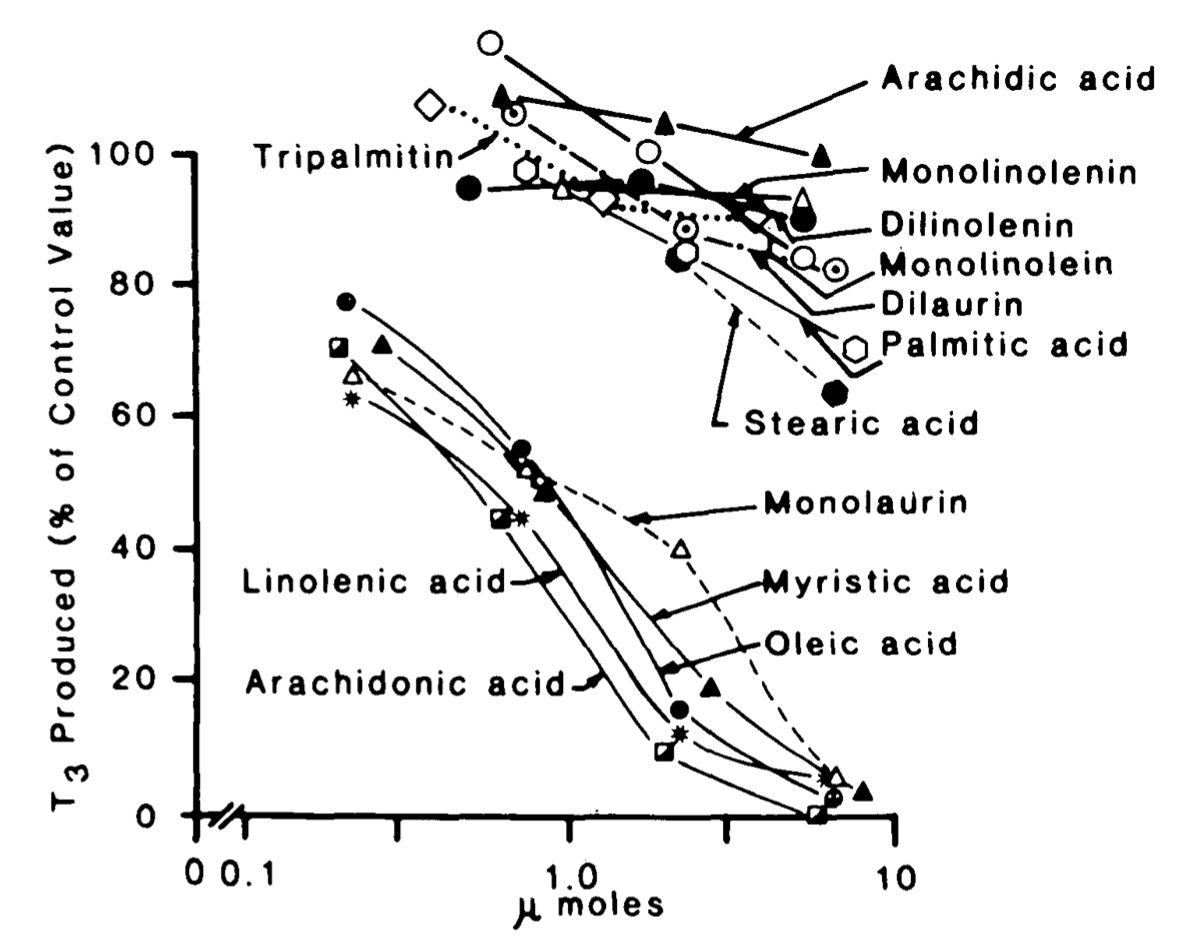
○ It's a critical process, as most of your T3 is not released by the thyroid gland, but must be converted from T4 elsewhere in the body.
○ Researchers discovered that the same fatty acids that interfere with thyroid hormone transport also reduce the liver's ability to convert T4 to T3.
○ Linoleic and arachidonic acids decrease thyroid hormone conversion in the liver, reducing the amount of T3 available.
○ PLA2 is an enzyme that releases fatty acids like linoleic and arachidonic acids into the blood. Increasing it results in lower thyroid hormone binding.
9
○ For T3 to exert most of its benefits, it must finally bind to the nuclear receptor.
○ Cell researchers investigated the effect of different fatty acids on T3 nuclear binding.
○ Linoleic, arachidonic, linolenic, and oleic acids inhibited T3 nuclear binding.
○ Linoleic and linolenic acids are two fatty acids found in seed oils.
○ Palmitoleic acid, a monounsaturated fatty acid, caused the greatest nuclear receptor binding inhibition.
○ Linoleic acid was a very close second place.
○ Saturated fatty acids exhibited little to no inhibition of nuclear receptor binding.
○ Cell researchers investigated the effect of different fatty acids on T3 nuclear binding.
○ Linoleic, arachidonic, linolenic, and oleic acids inhibited T3 nuclear binding.
○ Linoleic and linolenic acids are two fatty acids found in seed oils.
○ Palmitoleic acid, a monounsaturated fatty acid, caused the greatest nuclear receptor binding inhibition.
○ Linoleic acid was a very close second place.
○ Saturated fatty acids exhibited little to no inhibition of nuclear receptor binding.
10
