6 ways AI can improve academic work (according to a systematic review)

Prof Lennart Nacke, PhD@acagamic
11 views
Aug 26, 2024
~1 min read
Advertisement
1
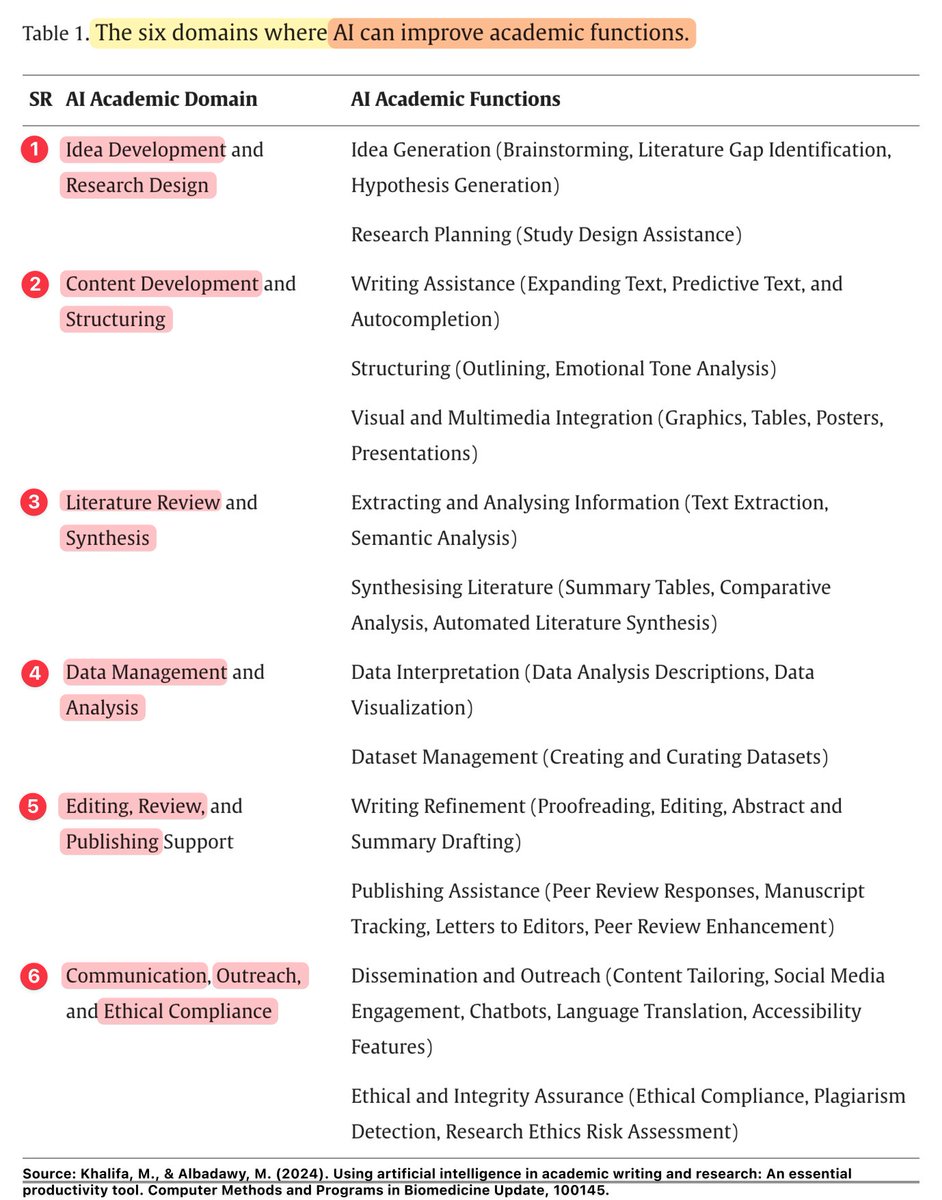
6 ways AI can improve academic work (according to a systematic review)
2
1. Idea Development & Research Design
AI helps with brainstorming, identifying literature gaps, generating hypotheses, and planning study designs.
(Think: automated idea generation and research planning tools.)
3
2. Content Development & Structuring
AI assists with text expansion, predictive writing, and even help structure your content.
Need visuals? AI can integrate graphics, tables, and presentations too.
(You have to use the right tools though, no strange rat penises, please)
4
3. Literature Review & Synthesis
AI extracts and analyzes key information from texts and helps synthesize literature with summary tables and automated synthesis.
(Your lit review just got a whole lot easier.)
5
4. Data Management & Analysis
AI simplifies data interpretation and visualization, and assists with creating and managing datasets.
(Focus on insights, let AI handle the heavy lifting with data.)
6
5. Editing, Review, & Publishing
AI supports proofreading, editing, and even manuscript tracking.
It can also enhance peer review responses and streamline the publication process.
(Less time editing, more time creating research.)
7
6. Communication, Outreach, & Ethical Compliance
From content tailoring to social media engagement, AI helps with outreach.
Plus, it ensures ethical compliance through plagiarism detection and research ethics risk assessment.
(AI keeps your research clear and compliant.)
8
Thanks for reading my tips.
If you enjoyed this guide:
1. Follow @acagamic to get more resourceful in writing and research.
2. Share this guide with your network to support fellow researchers.
Have a great day.
If you enjoyed this guide:
1. Follow @acagamic to get more resourceful in writing and research.
2. Share this guide with your network to support fellow researchers.
Have a great day.
Prof Lennart Nacke, PhD@acagamic
6 ways AI can improve academic work (according to a systematic review)
9
Want more insights?
🗞️ 4,363+ people read my newsletter every week.
Join us for free: go.lennartnacke.com/newsletter
I talk about:
• Academic success strategies
• Writing frameworks
• AI research tools