this paper is doing some good things but it's also a great example...

Ryan Schmidt@rms80
31 views
Jun 20, 2024
~3 min read
Advertisement
1
this paper is doing some good things but it's also a great example of how various issues at different steps stack up to produce a 3D result that production artists are going to reject... (1/n) (note: it's still good research!
this is about limits of ML-3D for production use)


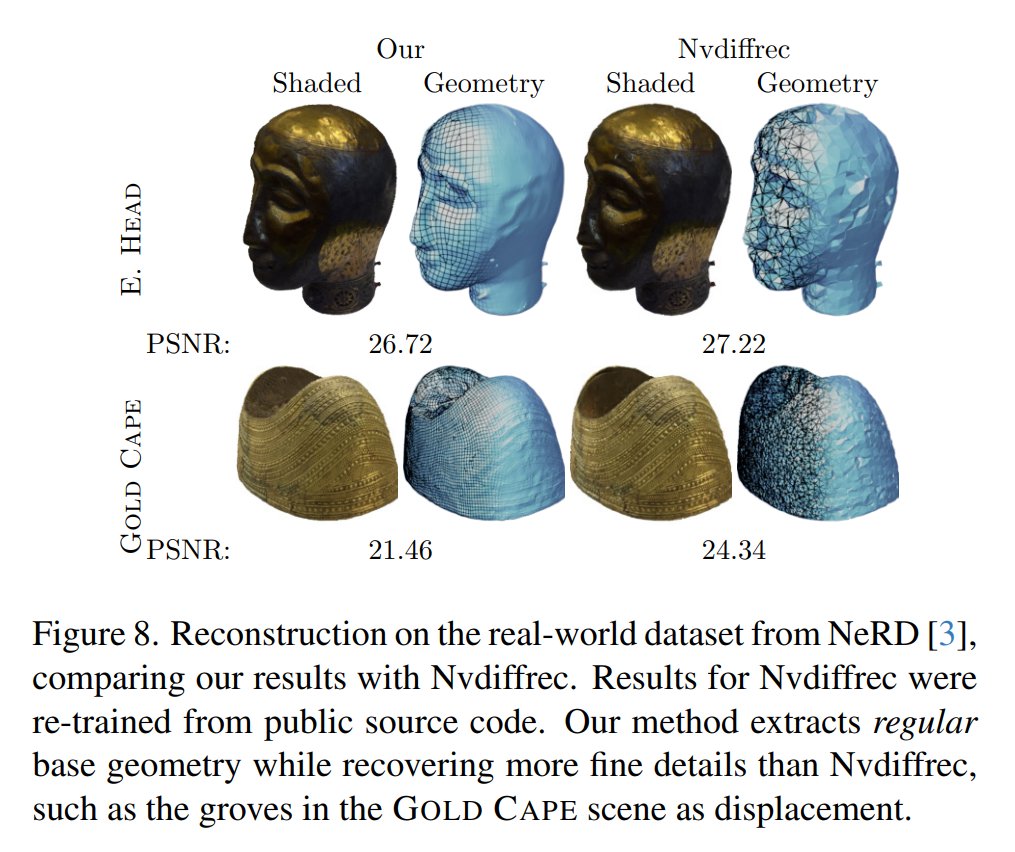
this is about limits of ML-3D for production use)
Vlad Erium 🇯🇵@ssh4net
"QUADify: Extracting Meshes with Pixel-level Details and Materials from Images" Frühauf et al.
openaccess.thecvf.com//content/CVPR2…
#CVPR2024
2
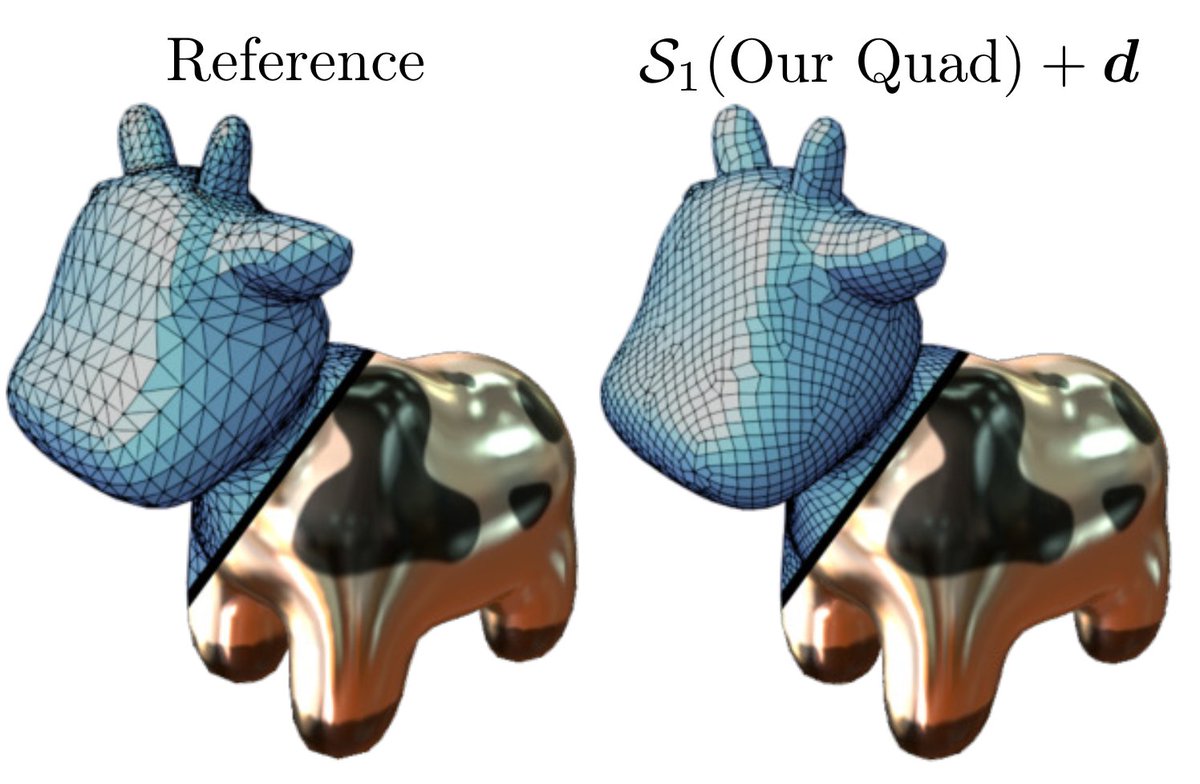
There is this nice comparison showing a hand-authored quad mesh (left) vs the quad mesh generated automatically. Yes it's nice that's it's a quad mesh. But there is no representation of the 'semantics' of the mesh embedded in the quads... (2/n)
3
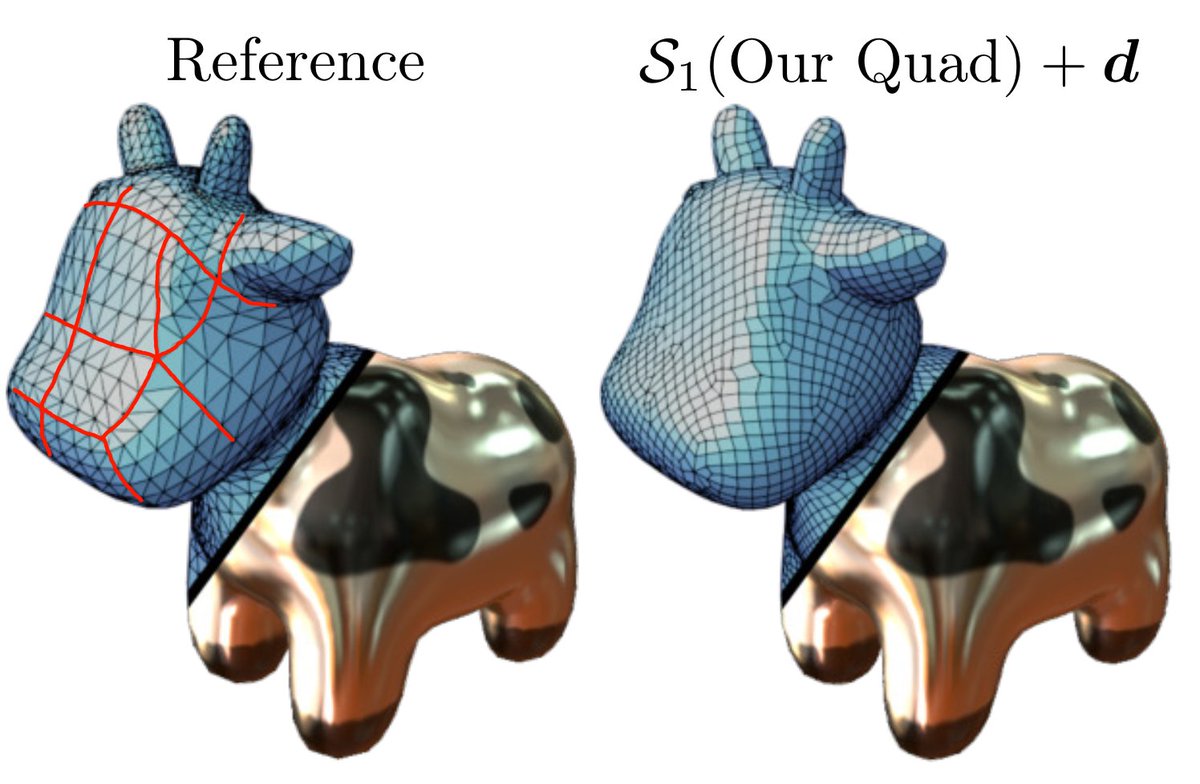
these semantics matter because if you want to edit or animate this mesh, you are going to use the "feature lines" embedded in the mesh edges. They are not explicit curves, but artists need this implicit structure, it's basically the "control handles" of the mesh. The generated quad mesh doesn't have this at all - the quads are basically randomly oriented! It's extremely hard to get an automatic method to generate all those edges in the right spots. (3/n)
4
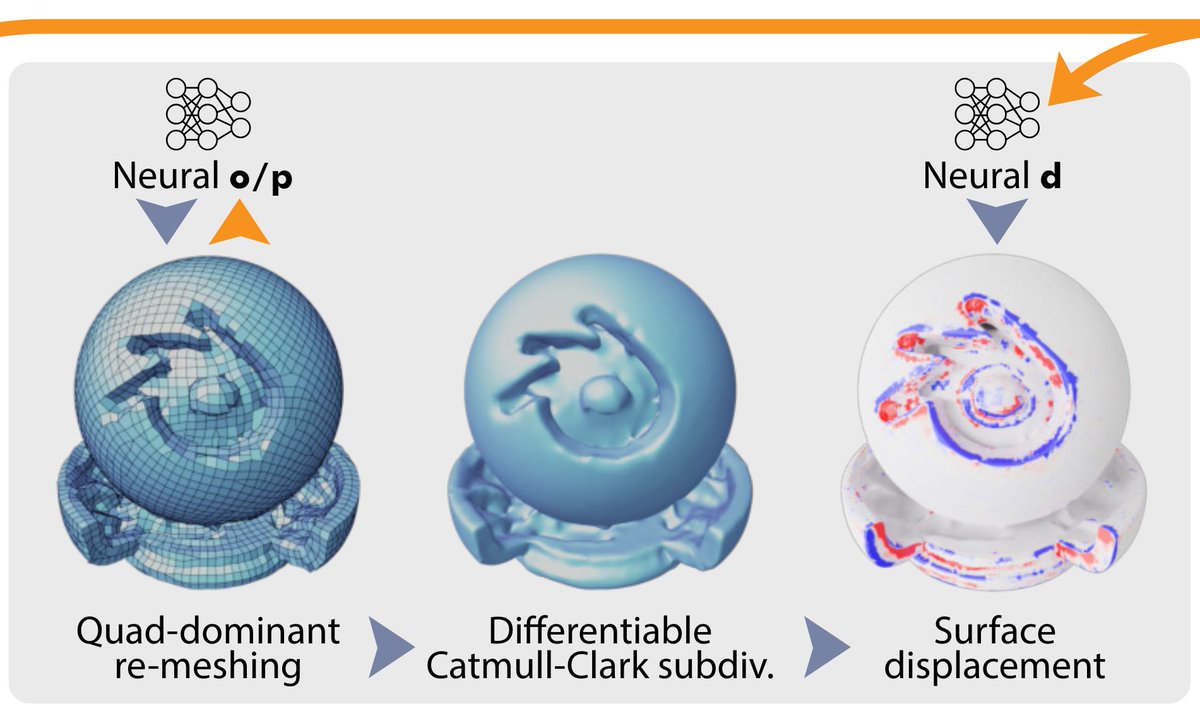
Now if you stack other things on top of this janky quad mesh, those higher layers inherit the problems. In this paper they are subdividing and fitting high-res displacements to better-represent the 3D shape - very nice! However because the initial mesh is not a good representation of the geometric features, the displacements end up having to be very noisy and non-smooth to get the subdivided mesh to fit the target shape (4/n)
5
This means the displacements are not representing "just details" like if they were sculpted onto a smooth subdivided base mesh. They are also correcting errors in the subdivided shape. So if you try to edit or animate the base mesh, the subdivided shape changes and the "correction" part of the displacements stop being meaningful and become essentially garbage, as they are corrections based on some other shape you don't have anymore.
This also causes problems for things like LODs, because the lower LODs will be generated from the janky base mesh, not the "corrected" displaced shape. The simplification algorithms will be trying to preserve the wrong shape, and the displacements will push what is left it in the wrong directions - so it's stacking even more problems (5/n)
6
this issue gets worse as the quads get coarser, because larger and larger displacement-corrections are necessary. So producing a "low-poly" quad mesh becomes implausible - many thousands of tiny quads are necessary so that the shape-corrections do not entirely overwhelm any sense of actual detail-displacements.
The deep problem here is it is not something you can fix in the displacements. If you were to somehow filter out the 'corrections' part of the displacements, the final shape approximation would be worse.
It can only be fixed in the base mesh. And if the quad mesh topology is not aligned with geometric features, you can't fix it by optimizing the vertex positions. The *only* solution is to either generate or optimize towards a better initial quad mesh topology. This is extremely hard!! geometry researchers have been working on it for decades now, and still, nothing gets closed to an artist-authored mesh. (6/n)
7
This is, IMO, *the* dealbreaker for "AI"-generated 3D assets currently. If the base geometry is not good, anything generated downstream from that mesh will not be editable or animatable at high quality. Even if you can generate amazing-looking 4k PBR texture sets, the problems in the base geometry will show through (n/n)