I received a mysterious aerospace computer from the early 1970s,...

Ken Shirriff@kenshirriff
51 views
May 29, 2024
~3 min read
Advertisement
1
I received a mysterious aerospace computer from the early 1970s, probably for navigation. It is crammed full of flat-pack integrated circuits surrounding a core memory module. Let's take a look inside... 1/17

2
The mechanical construction of the computer is clever, allowing the densely packed boards to unfold like a book. Each "page" consists of two boards mounted back-to-back. The metal frame provides conductive cooling as well as support. 2/17

3
The logic boards are crammed full of flat-pack chips. The surface-mounted components and multi-layer circuit boards were advanced for the time; commercial electronics wouldn't catch up for over a decade. 3/17

4
The computer is built around a compact core memory cube that provides storage. Core memory is made of tiny ferrite rings organized into a grid (called a plane). Planes are stacked to form a three-dimensional block of memory. The wires in the photo connect planes. 4/17

5
This side of the core memory shows the colorful wires that connect the memory to the rest of the computer. The memory appears to have 20 planes, implying that the computer has a 20-bit word. 5/17

6
The computer has some boards with analog components, probably to drive the core memory, display, and keyboard. This board has 20 metal-can transistors matching the 20 core planes. They probably control the bits that get written to the core memory, through "inhibit lines". 6/17

7
This board has 48 tiny round transistors colored red and blue. These are surface-mount transistors, soldered onto the top of the circuit board. Tiny surface-mount transistors are common now, but were unusual back then. 7/17

8
The logic boards use just three types of integrated circuits: dual 4-input NAND gates, quad 2-input NAND gates, and dual AND-OR-INVERT gates. These TTL (transistor-transistor logic) chips are in the Signetics 400-series. Texas Instrument's 7400 series was much more popular. 8/17

9
Each IC contains just a few transistors: 12 in the dual AND-OR-INVERT chip. Thus, it takes a lot of chips to build a computer. But aerospace computers could fit a complete processor in one cubic foot. 9/17

10
This unit doesn't seem to have enough chips to support a full computer. I suspect that the three connectors on the bottom plugged into another box with more chips. The box I have might just be the memory, keyboard, and display unit. 10/17

11
The display technology is interesting, using electromechanical rotating wheels with digits on them. (The first indicators are different: compass directions N/S/E/W, along with directions with a slash through them.) 11/17

12
In the display, each indicator module has 10 electromagnets, one for each digit. The rotating digit wheel has a permanent magnet. Energizing an electromagnet causes the digit wheel to spin to the electromagnet to show the corresponding digit. 12/17

13
This board uses some different ICs from the rest, including some Texas Instruments op-amps. These amplifiers might be sense amplifiers for the signals from the core memory stack. 13/17

14
I couldn't determine who built this device. NASA used the same Signetics ICs in multiple computers, so perhaps NASA built this computer too. The ICs say "CDC" so perhaps Control Data Corp. built it; they built aerospace computers like this AN/AYK-14 from the F-18. 14/17
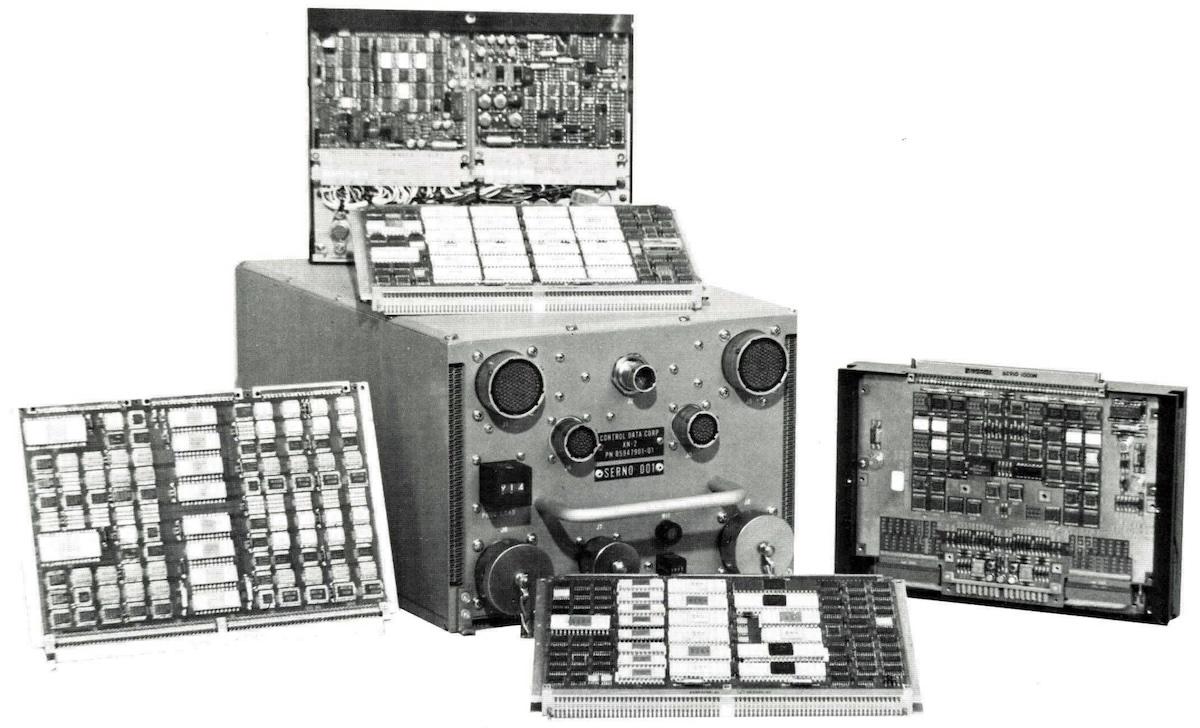
15
If you recognize my mysterious aerospace computer, let me know.
For more, see my latest blog post:
righto.com/2024/05/aerosp… 15/17
16
Credits: Thanks to @UsagiElectric for providing the computer. Patent diagram from patents.google.com/patent/US32017…. AN/AYK-14 photo from a 1983 CDC brochure via @bitsavers: bitsavers.org/pdf/cdc/milita… Schematic from the datasheet: archive.org/details/TNM_Va… 16/17
17
@UsagiElectric @bitsavers My previous thread on this mysterious aerospace computer.:
17/17

17/17
Ken Shirriff@kenshirriff
Can anyone identify this system from @UsagiElectric? Early 1970s, maybe a navigator computer, maybe CDC? Any ideas on T/A and T/G?
18
Corrected link to my blog post: righto.com/2024/05/blog-p…