The Momentum Stock Archetype If you are a swing trader, the...

Dolan V. Kent@DolanVKent
13 views
Apr 25, 2024
~2 min read
Advertisement
1
The Momentum Stock Archetype
If you are a swing trader, the archetype for a stock that we trade:
1. Starts with an episodic pivot (by definition). If it holds and follows through, that’s First confirmation
2. Then the stock goes sideways for a flag. If the stock holds and flags, that Second confirmation
3. The breakout is the third confirmation (with more confirmation from followthrough etc etc)
At step 1, the EP, that’s where the positioning is most off balance and people rush to get in.
Every leg up from there, the stock supply/demand reaches more of an equilibrium and requires more skill/confirmation to trade.
If you have had a “don’t trade” market for a while, the positioning might be even more off balance. The reaction can sometimes be more powerful. This is because the best stocks need weeks and months to digest their big moves before continuing (maybe its a growth stock with real growth but price got ahead of fundamentals and we need a few quaters for fundamentals to catch up and confirm momentum was valid).
Pull up the best movers with earnings on the chart. You will see that most leaders make big moves, consolidate for a season or two, then make a new leg (NVDA SMCI). Only a select few make big moves season after season after season TSLA during covid and ANF recently come to mind. And majority go nowhere.
I think most experienced traders have been through a season where they wait to see the best EPs move with a few days follow through, then take the ones that come after but they miss the best ones only to vow to take all EPs they come across without confirmation next season!
x.com/JWTrader013/st…
2
The image from the above post is from a study of George Soros, Stan Druckenmillers Mentor. This Sums up the archetype pretty well

Jerry Parker@rjpjr12
Soros on Soros:
“I recognize that I may be wrong. This makes me insecure. My sense of insecurity keeps me alert, always ready to correct my errors.”
“If I had to sum up my practical skills I would use one word, survival.” Thank you, @gfc4
img1.wsimg.com/blobby/go/64fc…
“I recognize that I may be wrong. This makes me insecure. My sense of insecurity keeps me alert, always ready to correct my errors.”
“If I had to sum up my practical skills I would use one word, survival.” Thank you, @gfc4
img1.wsimg.com/blobby/go/64fc…
3
"modern" swing traders like @OliverKell_ also uses these concepts in his archetype he calls "The Price Cycle".
@AsymTrading sums it up beautifully in this image

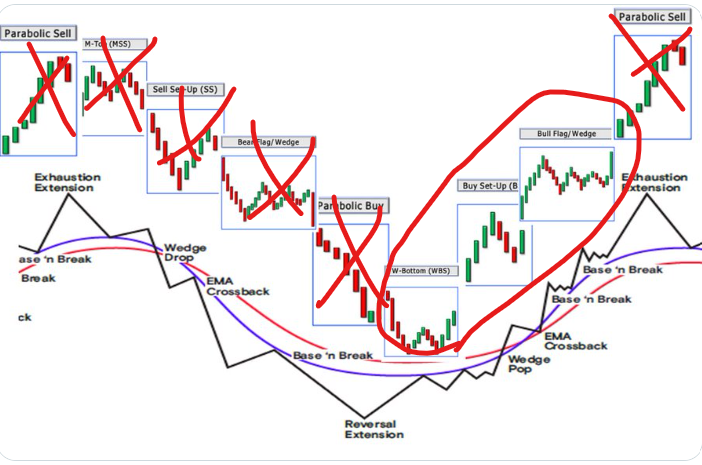
@AsymTrading sums it up beautifully in this image
AsymTrading@AsymTrading
For my swing trading strategy, where I mostly trade mid-cap and smaller stocks on the long side, a vast majority of the "easy dollar" environments occur when the $MDY $IWM proxies are in the state of rolling up and moving higher. This can be characterized nicely by the right side of Kell's price cycle model, where price breaks through declining 10/20 and then the 10/20 slopes upward.
When I speak of "good market" vs "bad market", this is what I'm generally speaking about - the conditions that support a strong, positive expectancy over not just one trade, but series and runs of trades. This is the path of least resistance where one will have higher win rates, good follow through on stocks, healthy profit factors and all of the things that help to generate strong positive expectancy. Trading outcomes, after all, aren't the result of one setup or one trade, but 10s or 100s of trades.
When I speak of "good market" vs "bad market", this is what I'm generally speaking about - the conditions that support a strong, positive expectancy over not just one trade, but series and runs of trades. This is the path of least resistance where one will have higher win rates, good follow through on stocks, healthy profit factors and all of the things that help to generate strong positive expectancy. Trading outcomes, after all, aren't the result of one setup or one trade, but 10s or 100s of trades.
4
In fact, my initial categorisation for market types was an extension of "The Price Cycle" trying to explain the nuances of price action when youre early vs late in the price cycle.
The 3 levels for a beginner might be:
1. Qullamaggie setups
2. Oliver Kells Price Cycle
3. Price Cycle Nuances

The 3 levels for a beginner might be:
1. Qullamaggie setups
2. Oliver Kells Price Cycle
3. Price Cycle Nuances
Dolan V. Kent@DolanVKent
2. Adapting to the cycle
- Potentially the most important part of the plan
- Knowing the typical cycle archetype is critical to applying corresponding tactics to minimize drawdowns
- Potentially the most important part of the plan
- Knowing the typical cycle archetype is critical to applying corresponding tactics to minimize drawdowns