The Ancient Greeks had two words for time: 1. Chronos = sequential,...

The Cultural Tutor@culturaltutor
98 views
Jan 14, 2024
~2 min read
Advertisement
1
The Ancient Greeks had two words for time:
1. Chronos = sequential, quantitative time
2. Kairos = fluctuating, qualitative time
Here's why you need to understand kairos...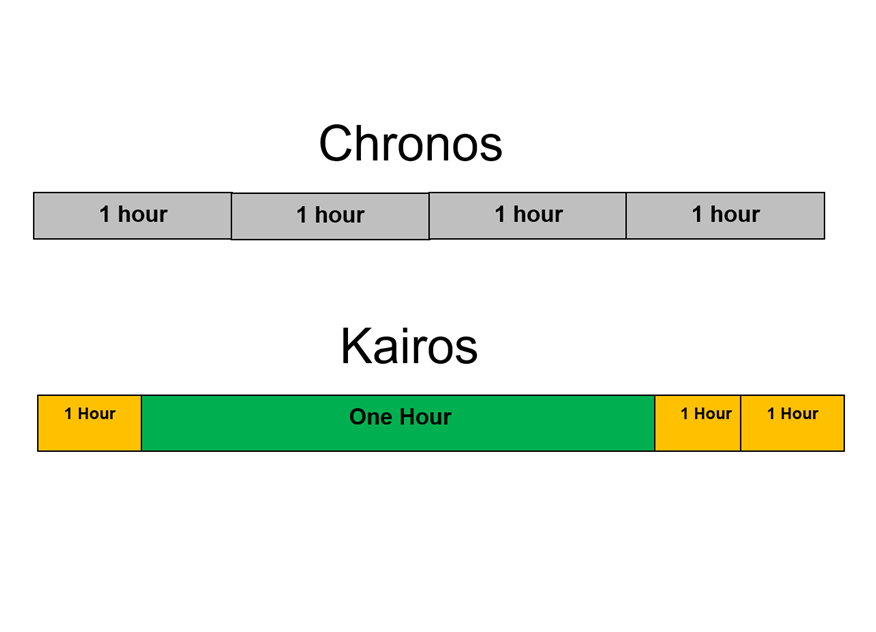
1. Chronos = sequential, quantitative time
2. Kairos = fluctuating, qualitative time
Here's why you need to understand kairos...
2
Chronos refers to time as we usually mean it: a sequence of equal parts.
There are twenty four hours in a day and each hour is the same length of time.
It's what a clock measures.
There are twenty four hours in a day and each hour is the same length of time.
It's what a clock measures.
3
Kairos refers to the way in which certain moments are more important or influential than others.
A clock can't measure that, but it's undeniable that a handful of particular moments play a much more significant role than the mass of other moments which make up our lives.
A clock can't measure that, but it's undeniable that a handful of particular moments play a much more significant role than the mass of other moments which make up our lives.
4
Think about the twenty fours in your average day.
Are they all spent equally? Do they all present equal opportunities? Of course not.
Many of them simply disappear. You look at the clock and two hours have passed while you were doomscrolling.
Are they all spent equally? Do they all present equal opportunities? Of course not.
Many of them simply disappear. You look at the clock and two hours have passed while you were doomscrolling.
5
But other moments in your day are much more noticeable.
Those ones where time seems to pass slower, or where — if you do the right thing — there can be significant consequences, for good or for bad.
You can feel kairos when it is happening.
Those ones where time seems to pass slower, or where — if you do the right thing — there can be significant consequences, for good or for bad.
You can feel kairos when it is happening.
6
This is what kairos refers to: those important moments which are — objectively! — not equal to those other, less critical moments.
An obvious example is something like the birth of one's child, an exam, getting married, or a job interview.
Moments that matter.
An obvious example is something like the birth of one's child, an exam, getting married, or a job interview.
Moments that matter.
7
But kairos doesn't just refer to life-altering and memorable occasions.
It's about the fluctuation of events and circumstances which create opportunities in any given day.
Kairos measures the importance of a particular moment in time rather than its duration.
It's about the fluctuation of events and circumstances which create opportunities in any given day.
Kairos measures the importance of a particular moment in time rather than its duration.
8
Try thinking about your day in terms of kairos, not chronos.
Which moments are the most important? Which moments are the most useful? Which moments give you an opportunity to do something consequential?
Focus on them. Use them when they arrive.
Which moments are the most important? Which moments are the most useful? Which moments give you an opportunity to do something consequential?
Focus on them. Use them when they arrive.
9
But remember: kairos is ever-changing, because events and circumstances and people are ever-changing.
You can't control it, just like you can't control chronos time.
But you can act — you can take the opportunities to which kairos draws your attention.
You can't control it, just like you can't control chronos time.
But you can act — you can take the opportunities to which kairos draws your attention.
10
A very familiar feeling to all of us is when, after an argument or debate or conversation, you suddenly realise what you should have said but didn't.
That moment when you had the chance to say just the right thing? That's kairos.
That moment when you had the chance to say just the right thing? That's kairos.
11
Everybody knows not all minutes, hours, or days are equal. Kairos puts a name to that fundamental truth.
As Lenin said: in some decades nothing happens, and in some weeks a whole decade happens.
One might say: in some weeks nothing happens, in some hours a whole week happens.
As Lenin said: in some decades nothing happens, and in some weeks a whole decade happens.
One might say: in some weeks nothing happens, in some hours a whole week happens.