NEW: we need to talk about UK graduate wages, and the idea that...

John Burn-Murdoch@jburnmurdoch
23 views
Nov 12, 2024
~4 min read
Advertisement
1
NEW: we need to talk about UK graduate wages, and the idea that Britain sends too many people to university.
American readers should stick around for the UK/US comparisons 👀
Let’s start with this: the UK graduate wage premium has fallen substantially over the last 25 years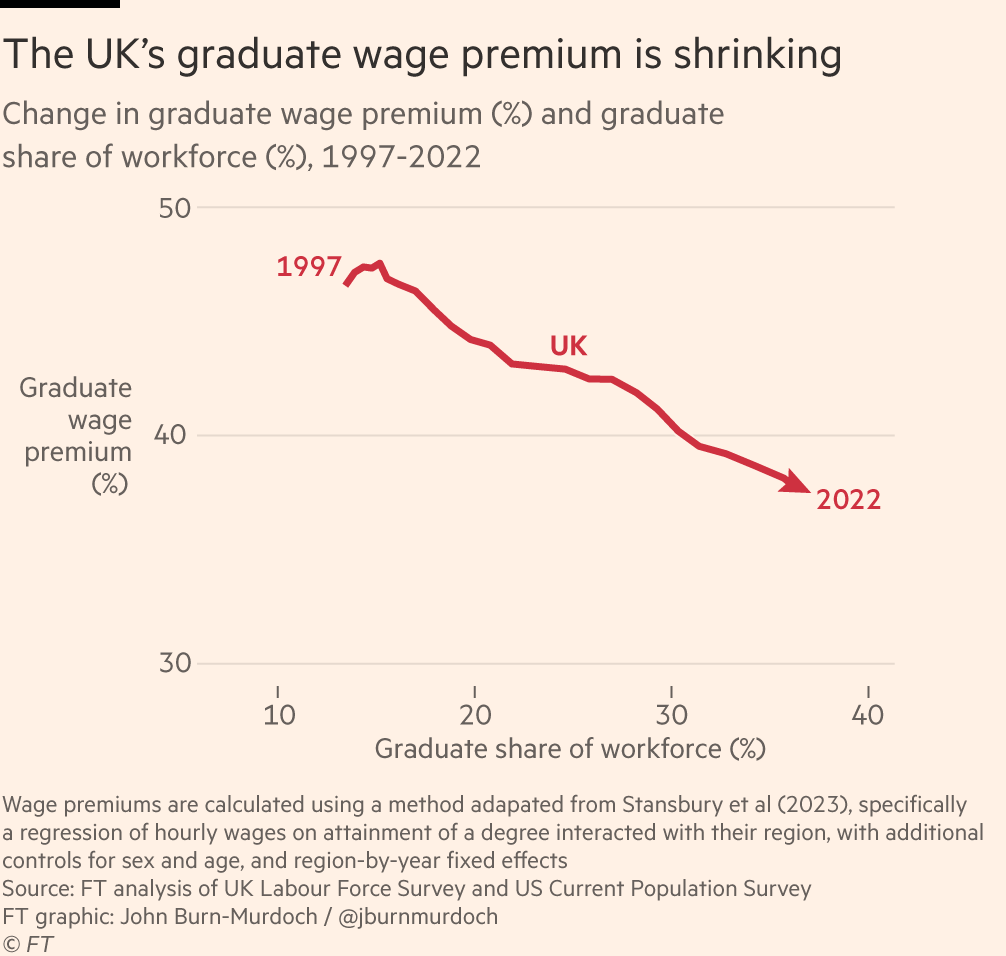
American readers should stick around for the UK/US comparisons 👀
Let’s start with this: the UK graduate wage premium has fallen substantially over the last 25 years
2
To spell out what means:
In 1997, graduates in the UK earned almost 50% more per hour than non-graduates. Today, that’s down to a bit less than 40% more.
Having a degree brings back smaller rewards in the job market than it used to.
In 1997, graduates in the UK earned almost 50% more per hour than non-graduates. Today, that’s down to a bit less than 40% more.
Having a degree brings back smaller rewards in the job market than it used to.
3
In isolation, this is not necessarily surprising.
As more people go to university, having a degree becomes less of a luxury.
In economic terms, as the supply of graduates increases, all other things being equal the price of graduates (their wages relative to non-grads) falls.
As more people go to university, having a degree becomes less of a luxury.
In economic terms, as the supply of graduates increases, all other things being equal the price of graduates (their wages relative to non-grads) falls.
4
But look what happens when we break this down by region within the UK:
The graduate wage premium has fallen everywhere *except London*.
If you work in the capital, having a degree is just as valuable today as it was in 1997.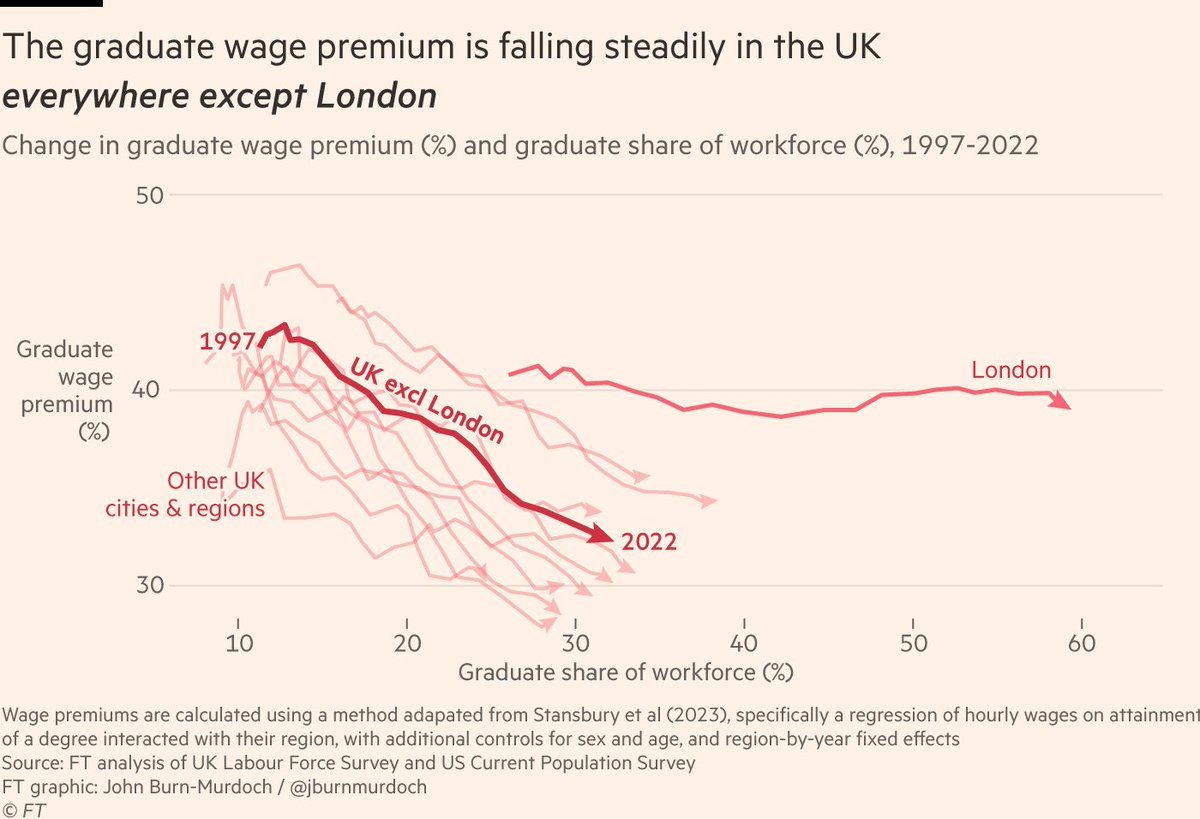
The graduate wage premium has fallen everywhere *except London*.
If you work in the capital, having a degree is just as valuable today as it was in 1997.
5
In other words, a declining graduate wage premium is not the inevitable result of expanding higher education.
If the number of graduate jobs keeps pace with the number of graduates (as it has in London), having a degree is very much still worth it.
If the number of graduate jobs keeps pace with the number of graduates (as it has in London), having a degree is very much still worth it.
6
The problem is, the number of graduate jobs outside London has *not* kept up with the supply of graduates, as we can see from those downward sloping lines.
Supply has been outstripping demand for more than two decades.
But it gets worse if we look across the Atlantic...
Supply has been outstripping demand for more than two decades.
But it gets worse if we look across the Atlantic...
7
Here’s the UK vs US:
Grads in America have a far higher earnings premium than grads in the UK, and the wage premium has been *rising*, not falling.
Grads in SF & DC earn almost 70% more than non-grads. In the UK’s second largest city, grads earn just 30% more than non-grads.
Grads in America have a far higher earnings premium than grads in the UK, and the wage premium has been *rising*, not falling.
Grads in SF & DC earn almost 70% more than non-grads. In the UK’s second largest city, grads earn just 30% more than non-grads.
8
The result in absolute terms is this:
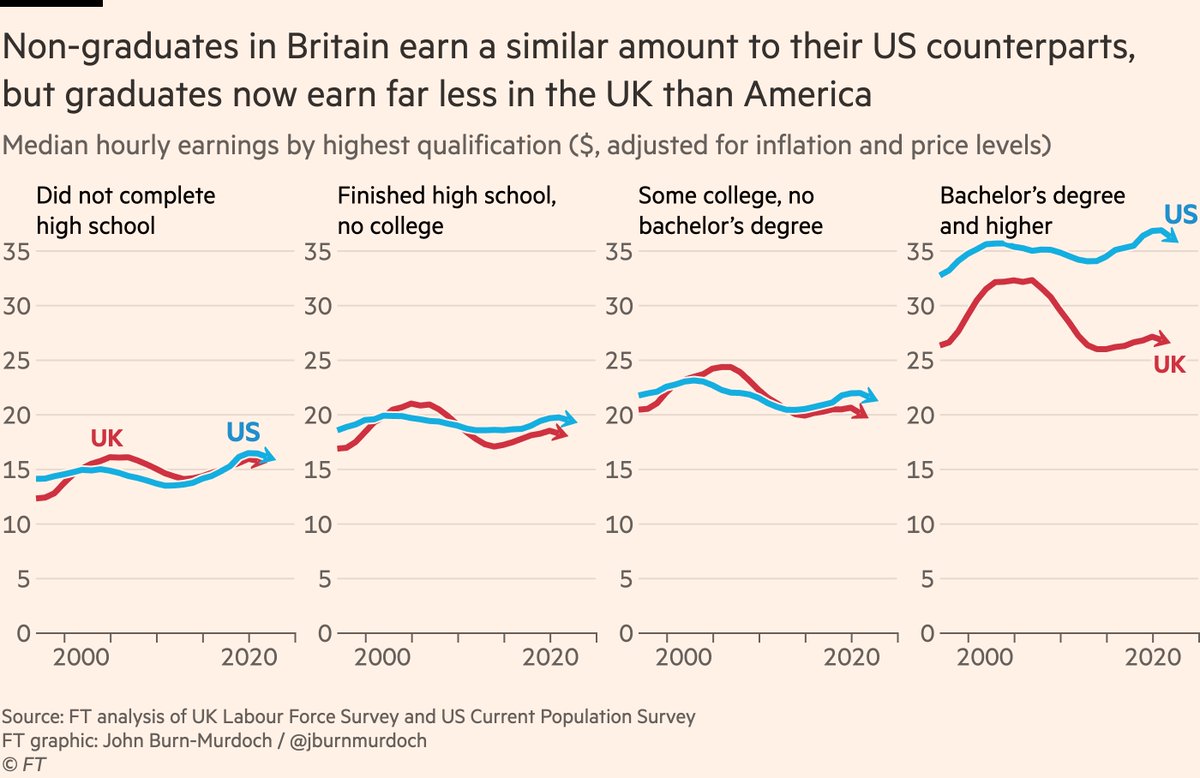
Non-graduates in the UK and US earn almost exactly the same, but graduates in the US now earn 35% more per hour than grads in the UK.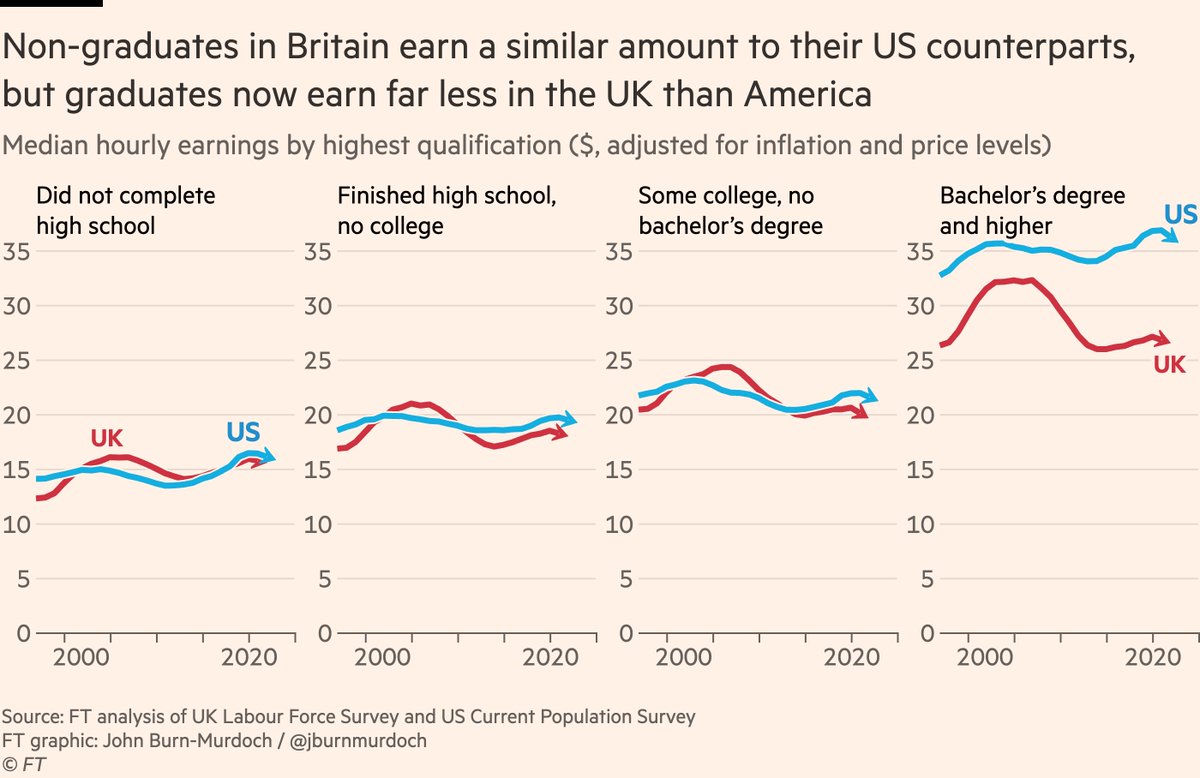
Non-graduates in the UK and US earn almost exactly the same, but graduates in the US now earn 35% more per hour than grads in the UK.
9
Why are Britain’s graduates being short-changed?
It it that, as we often hear these days, the UK sends too many people to university?
No: almost exactly the same share of US and UK workforces are graduates, including if we split by bachelor’s vs masters etc.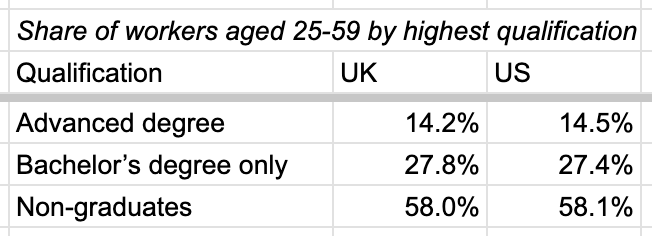
It it that, as we often hear these days, the UK sends too many people to university?
No: almost exactly the same share of US and UK workforces are graduates, including if we split by bachelor’s vs masters etc.
10
Another common moan is that too many British graduates study junk degrees. Perhaps Americans just study more lucrative subjects?
US grads are *slightly* more likely to have studied STEM subjects, but not by much.
Britain’s grads, by and large, have the skills to pay the bills.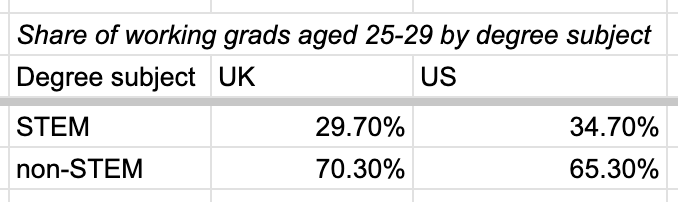
US grads are *slightly* more likely to have studied STEM subjects, but not by much.
Britain’s grads, by and large, have the skills to pay the bills.
11
In other words, the reason graduates in Britain are getting an increasingly rough deal is not over-supply, it’s insufficient demand for skilled grads in the form of skilled jobs.
12
What this chart is showing is that as each wave of graduates has entered the UK’s jobs market, on average they’re finding lower-grade jobs than the last, whereas in the US, each new wave of grads is met by a new wave of well-paid graduate jobs
13
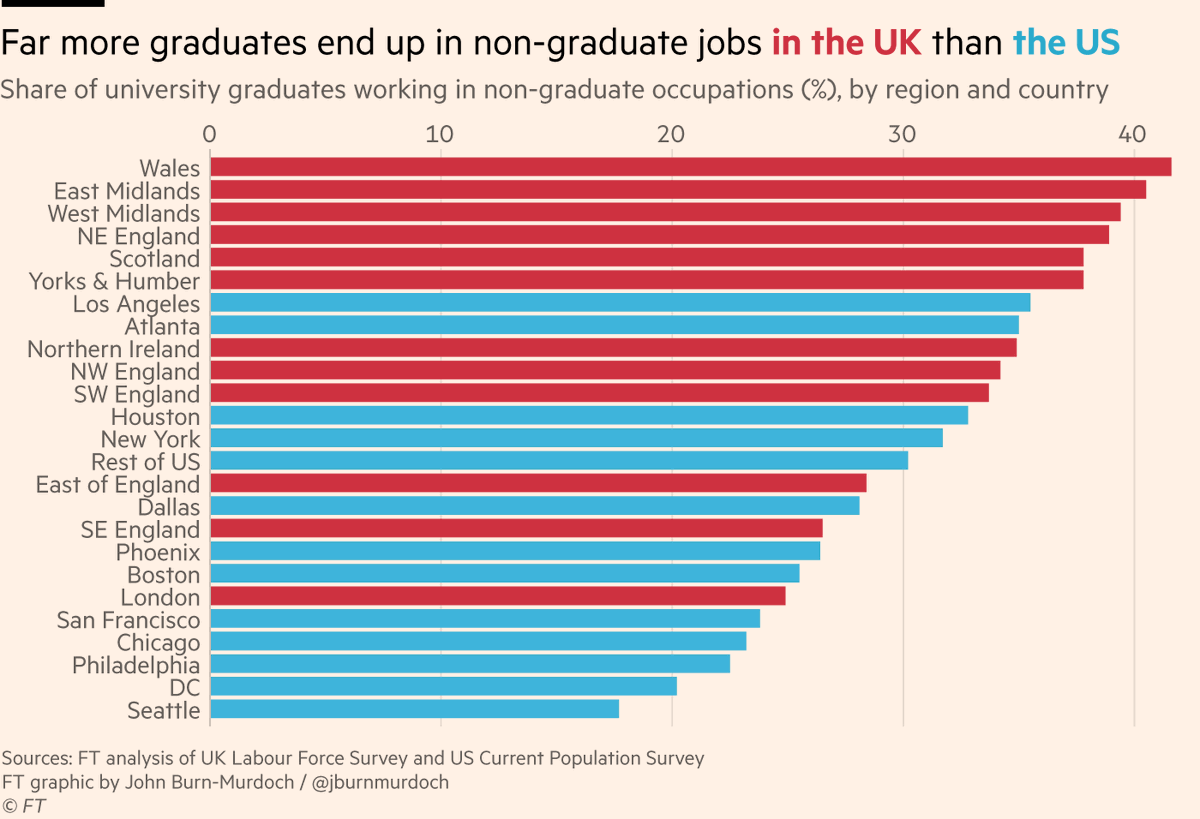
Here’s another way of looking at it: far more graduates end up in non-graduate jobs in the UK than the US . More than a third in most of the country!
14
Other countries have the same rise in graduate numbers without the same decline in graduate earnings, because they’ve created good jobs.
When people say Britain sends too many people to uni, they’re saying we’re not a country where skilled people can expect to find skilled jobs.
When people say Britain sends too many people to uni, they’re saying we’re not a country where skilled people can expect to find skilled jobs.
15
Short-changed graduates are just another symptom of the British economic disease.
If you have low investment and low or zero productivity growth, then when your grads enter the job market, they’ll have fewer and weaker opportunities than grads in a country that had higher growth
If you have low investment and low or zero productivity growth, then when your grads enter the job market, they’ll have fewer and weaker opportunities than grads in a country that had higher growth
16
In conclusion:
Stop saying we send too many people to university, and start saying we’re not creating enough graduate-quality jobs. End of rant.
Here’s my column in full (free to read for the first 300 clicks) on.ft.com/3MljMEl
Stop saying we send too many people to university, and start saying we’re not creating enough graduate-quality jobs. End of rant.
Here’s my column in full (free to read for the first 300 clicks) on.ft.com/3MljMEl
17
And I should add a belated but huge thank you to @annastansbury, whose brilliant paper earlier this year (see below) was the basis for this piece, and who was kind enough to talk me through how she did her UK analysis so that I could extend it to the US

Anna Stansbury@annastansbury
How to tackle regional economic inequality in the UK?
With @edballs and @DanTurnerSY, some ideas in a new working paper.
TLDR: (1) STEM skills, (2) better transport for non-London cities, (3) boosts to public-funded R&D outside the South.
🧵below...
hks.harvard.edu/centers/mrcbg/…
With @edballs and @DanTurnerSY, some ideas in a new working paper.
TLDR: (1) STEM skills, (2) better transport for non-London cities, (3) boosts to public-funded R&D outside the South.
🧵below...
hks.harvard.edu/centers/mrcbg/…
18
Oh, and a bonus chart that I think will fry a lot of people’s brains and break a lot of narratives:
For all the talk of six figure costs of college in the States, here’s how much debt graduates leave university with in the UK and US vs other countries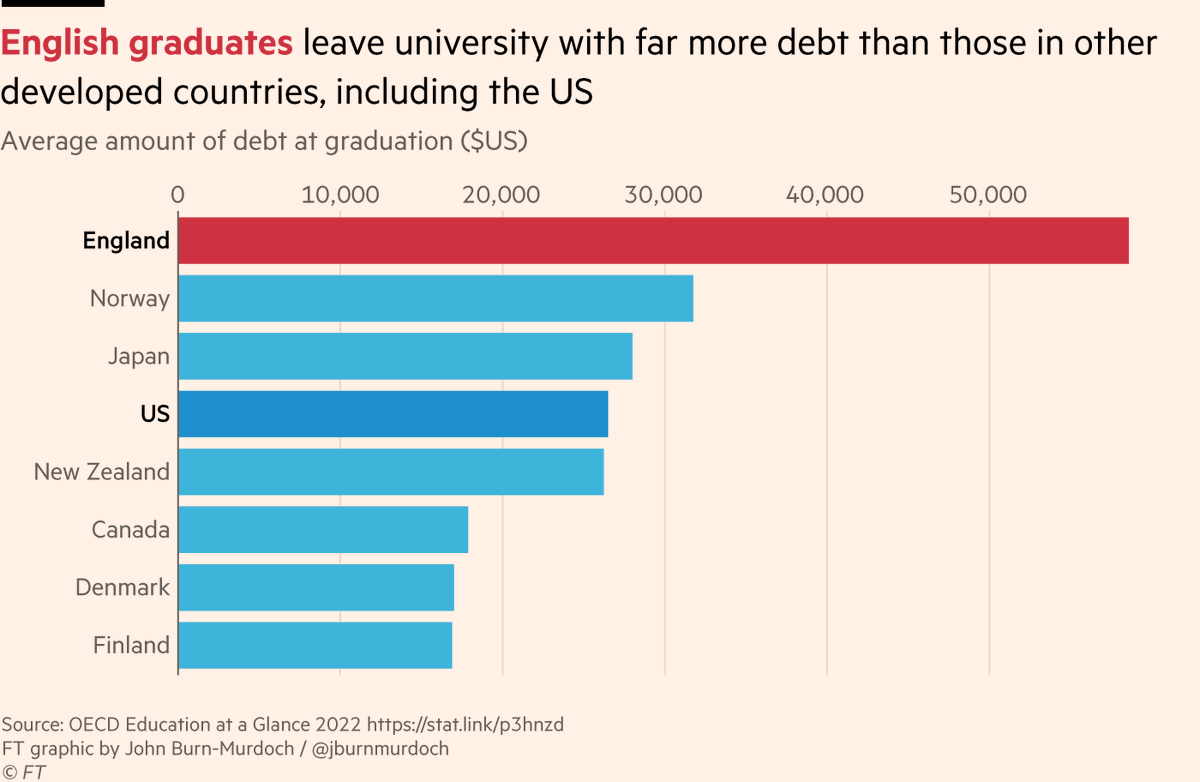
For all the talk of six figure costs of college in the States, here’s how much debt graduates leave university with in the UK and US vs other countries