An early Islamic poet sings in favor of🍷: "Who'd prohibit rain...

Elon ⚪@hadithworks
3 views
Nov 19, 2026
~2 min read
Advertisement
1
An early Islamic poet sings in favor of🍷:
"Who'd prohibit rain water when it's mixed with grape juice inside containers?!
I detest the harsh rules imposed on us by the Hadith transmitters, but I like Ibn Masʿūd’s opinion."
What was "Ibn Masʿūd's opinion" about alcohol? 🧵 [1/8]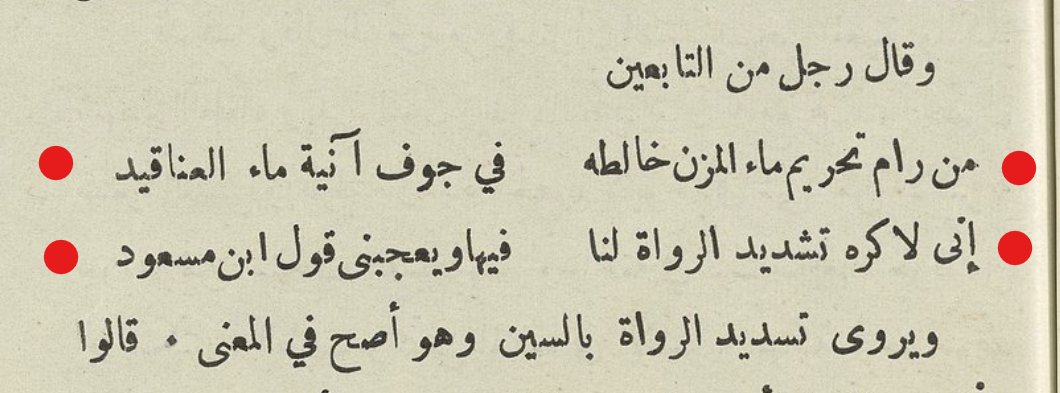
"Who'd prohibit rain water when it's mixed with grape juice inside containers?!
I detest the harsh rules imposed on us by the Hadith transmitters, but I like Ibn Masʿūd’s opinion."
What was "Ibn Masʿūd's opinion" about alcohol? 🧵 [1/8]
2
This poem implies that Ibn Masʿūd (d. 32/653), the Prophet's Companion, allowed drinking certain intoxicants (but not wine made from 🍇).
Many reports claim he & his students permitted various potentially intoxicating drinks like the date wine (nabīdh) prepared in jars. [2/8]


Many reports claim he & his students permitted various potentially intoxicating drinks like the date wine (nabīdh) prepared in jars. [2/8]
3
Thus, the poem seems to allude to Ibn Masʿūd’s permissive attitude toward intoxicants. That’s how Goldziher understood it. But, some traditional scholars could not accept that the pious Ibn Masʿūd would permit intoxicants & so they offered their own interpretations. [3/8]

4
Ibn Qutayba (d. 276/889) explained that this poem refers to Ibn Masʿūd permitting cooked grape juice (ṭilāʾ) that two thirds of its original contents were boiled away. Evaporating this amount allegedly made the cooked grape juice non-intoxicating. [4/8]

5
Ibn Qutayba’s contemporary, al-Balādhurī (Baghdad, d. ca. 279/892), had a different take. He claimed that the “Ibn Masʿūd” mentioned in the poem was not the famous Companion, but rather some Zubayrid governor with a similar name. [5/8]

6
Balādhurī’s attempt “to set the record straight” failed. While some scholars like al-Nuwayrī (Egypt, d. 733/1333) accepted his narrative, many people continued to believe that the poem was about Ibn Masʿūd the Companion permitting intoxicants other than wine 🍇. [6/8]


7
Ibn Qutayba & Balādhurī defend Ibn Masʿūd in 2 different ways:
1️⃣ Ibn Qutayba denies the poem is about alcohol.
2️⃣ Balādhurī admits it’s about alcohol but denies that it’s about the famous Ibn Masʿūd.
Verdict is the same: Ibn Masʿūd is "innocent" of permitting intoxicants [7/8]
1️⃣ Ibn Qutayba denies the poem is about alcohol.
2️⃣ Balādhurī admits it’s about alcohol but denies that it’s about the famous Ibn Masʿūd.
Verdict is the same: Ibn Masʿūd is "innocent" of permitting intoxicants [7/8]
8
When I see two conflicting solutions to the same problem I start suspecting🤨 In this case, I side with Goldziher & the common reading: The poem is probably about the Companion Ibn Masʿūd permitting controversial drinks.
What do you think? [8/8]
What do you think? [8/8]

