One of the most common questions I get: “What is that Σ symbol?“...

Tivadar Danka@TivadarDanka
15 views
Feb 12, 2025
~1 min read
Advertisement
1
One of the most common questions I get: “What is that Σ symbol?“
After 16 years of working with them, I routinely use the “Σ symbol”, a.k.a. the sum, but it wasn't always like that. As a freshman, I recall watching in terror the multitude of sums stacked on each other, feeling utterly confused about what was in front of me. Being comfortable with summation is not the default.
To help you, here’s a brief guide.
By definition, the capital Greek sigma (Σ) symbolizes repeated addition, which is called summation. We mainly use this to sum sequences, that is, numbers indexed by integers.
In most programming languages, summation can be implemented via a for loop. (There are other approaches, like in Haskell, where summation is done via a recursion.)
The sequence-to-be-summed is called the summand, while the variable that determines which terms are being added is called the running index. The lower and upper bounds of the running index are indicated above and below the Σ.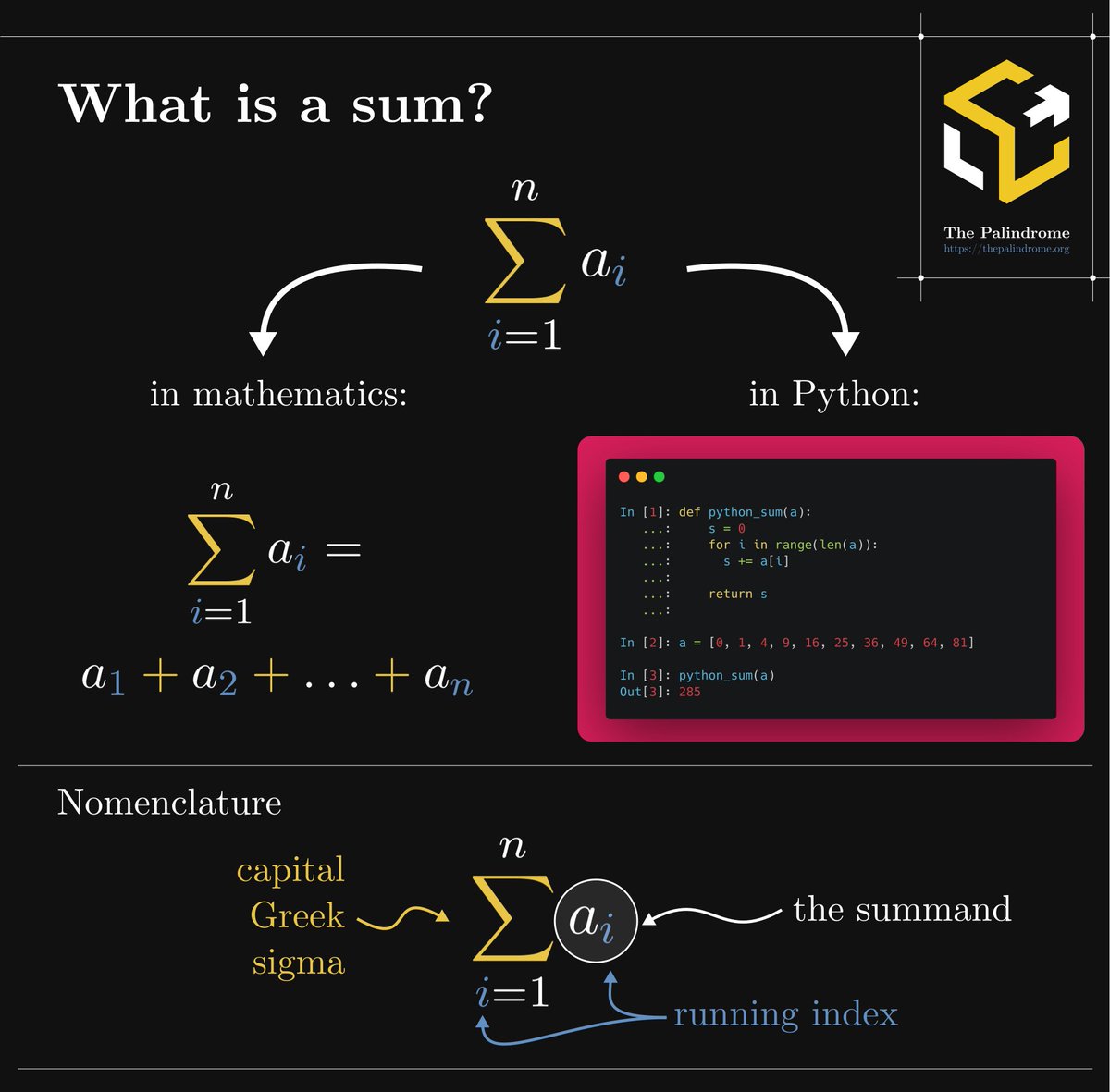
After 16 years of working with them, I routinely use the “Σ symbol”, a.k.a. the sum, but it wasn't always like that. As a freshman, I recall watching in terror the multitude of sums stacked on each other, feeling utterly confused about what was in front of me. Being comfortable with summation is not the default.
To help you, here’s a brief guide.
By definition, the capital Greek sigma (Σ) symbolizes repeated addition, which is called summation. We mainly use this to sum sequences, that is, numbers indexed by integers.
In most programming languages, summation can be implemented via a for loop. (There are other approaches, like in Haskell, where summation is done via a recursion.)
The sequence-to-be-summed is called the summand, while the variable that determines which terms are being added is called the running index. The lower and upper bounds of the running index are indicated above and below the Σ.
2
If you have enjoyed this post, follow me and subscribe to my newsletter for more!
I write about mathematics for engineers, scientists, and other curious minds. Explaining things like your teachers should have, but probably never did.
thepalindrome.org/p/what-is-the-…
I write about mathematics for engineers, scientists, and other curious minds. Explaining things like your teachers should have, but probably never did.
thepalindrome.org/p/what-is-the-…
