I've been thinking on this article and the implications of having...

|Higgs ϕ^4⟩@agarciapage
39 views
Aug 12, 2024
~5 min read
Advertisement
1
I've been thinking on this article and the implications of having (almost) everything quantized surrounding us. Have you ever stopped thinking of the deepness that ℏ > 0?
First of all, that it implies non-trivial commutation rules, such as [r, p] = iℏ ≠ 0. So, what? (🧵1/20)

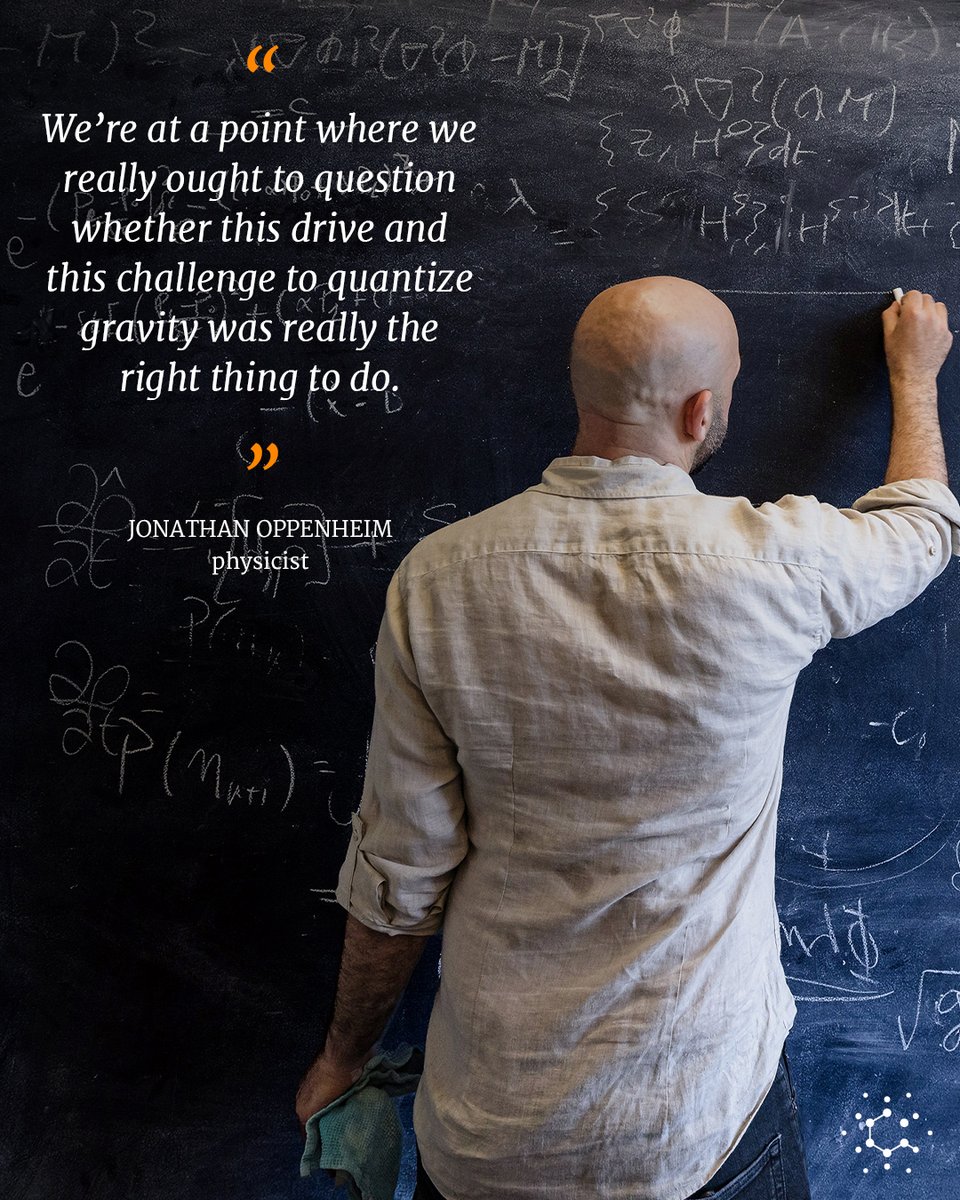
First of all, that it implies non-trivial commutation rules, such as [r, p] = iℏ ≠ 0. So, what? (🧵1/20)
Quanta Magazine@QuantaMagazine
“We’re at a point where we really ought to question whether this drive and this challenge to quantize gravity was really the right thing to do.” youtube.com/watch?v=DkRbNX…
2
This fact leads of course to the well-known uncertainity principle. And one of the coolest implications it has (for me) is allowing for virtual processes and off shell particles, in which the relativistic energy–momentum relation is not satisfied*.
en.wikipedia.org/wiki/Uncertain…
3
*(Formally, you can assume that it's still valid, but the mass does not correspond to the real one Other solution is that you could fix the real mass, but the relativistic relation is not verified, and then you cannot apply the conventional Feynman rules for the diagrams).
4
These processes appear in Feynman diagrams and in normal perturbation theory. One can discuss whether they represent (ontologically) nature, but the reality is that within our QFT formalism -which is the most successful we've ever created-, we need them.
((personally, I am still
5
so impressed by this freedom of quantum mechanics in which everything that is not forbidden (by symmetries) can actually happen)).
But what amazes me the most is that this is the essence of quantum phase transitions too. In classical mechanics, when you compute the partition f.+
6
of a system (Z), you can safely separate the position and momentum integrals, because the position and momentum commute (ℏ→0).
*Although you have Poisson's brackets, in Z they are evaluated under the integral sign, behaving as mere functions -numbers- which commute.+
7
This is actually the first step of Bohr van Leeuwen Th., which proofs why classically there can be no magnetism (it does not explain ferromagnetism, where you need to take into account the antisymmetry of fermionic wavefunctions)
en.wikipedia.org/wiki/Bohr%E2%8…
8
Or in other words: in classical mechanics, thermodynamics and the dynamics are separated. Nevertheless, in QM, the momentum and position operator do not commute, and this leads to the fact that dynamics and thermodynamics are linked (and so are their time scales).
9
This deep link it's seen in the path integral formalism: in the end, the partition function (thermodynamics) can actually be thought as a time evolution (dynamics) in imaginary time (this is not that important, one can usually safely go to real dynamics with the substitution in +
10
correlation functions like: G(τ)→G(it)). This is the result I talked about before (), and which puzzled Feynman so much. From this, one can prove that actually a quantum system in d-dimensions is equivalent to a classical one in d+1-dimensions (if you +
|Higgs ϕ^4⟩@agarciapage
Actually, the Temperature in the Many-Body (MB) physics brings a lot of surprises and beauty. How are the Green’s functions? What has all this to do with imaginary-time? And with black holes?
Here is a thread on finite-temperature MB physics! 🧵
11
treat this imaginary time as another -finite, from [0, ℏβ]- spatial dimension that diverges for T→0). And there is a direct correspondence between the phases (ordered and disordered) in the classical one to those in the quantum model. The point is that the fake temperature in +
12
the classical system is actually a measure of quantum fluctuations. Thermodynamics and time evolution holding hands.
The way I like to see this is that the phase space over which you're trying to describe your system is stretching and contracting like a bed sheet due to these +
13
quantum fluctuactions (i.e., since ℏ > 0), so that you get this emergent complexity.
(yes, the cat under the sheet is the ℏ-factor 🤣).
Actually this friendship is strong: one can define the dynamical critical exponent, z, which relates the time-scale of this dynamics (ξ_t)
14
with the spatial correlations (ξ):
ξ_t∼ξ^z∼|T-T_c |^(-ν)
where T is the 'fake' temperature of the d+1-classical one.
For ex: in the Quantum Critical Point, where, as stated by conventional Landau's theory, the correlation length diverges (ξ→∞), the time scale will do as well!
15
(it needs ∞ amount of time to transfer the information in such space scale). And here is when I come back to the initial article, or the arXiv paper I posted yesterday. This is a measure of how space and time talk to each other, +
quantamagazine.org/the-physicist-…
16
how they scale. In special relativity, as it can+ be seen with Minkowski metrics, they have equal footing (z=1). This Lorentz invariance is related to the relative velocities of the degrees of freedom in the system. +
en.wikipedia.org/wiki/Minkowski…
17
And when one finds this Lorentz invariance emerging in a Quantum Critical Point, for example between a disordered fermionic phase and and ordered bosonic field (for ex., magnons or phonons), what is telling us is that the velocity of them have a constant (and universal) ratio.
18
Or in other words: the specific heat at both sides of the transition are related to each other. This emergent Lorentz invariance is for ex. found in graphene with nearest-neighbours interactions, where the low-E physics is described by free Dirac fermions
arxiv.org/abs/0904.1019
19
(for what I know, all this Lorentz invariance is of course related to what the article goes about and quantum gravity. For example, there are many models in which you start with+ a bare (UV-microscopic) model with z≠1, but the final system respects it).
...
20
Well, in the end it seems that everything in nature is connected (the Unity of the Being!). Moreover: all this beauty and complexity exists because ℏ > 0!!
Even if it is (in our-world units), ℏ = 6.626 × 10⁻³⁴ m2kg/s, it makes a whole world of difference!
21
As I said, even being QED the most successful theory, we're still far from having an exact description of nature (and I doubt that's even possible).
We still have so many questions to address... but that's precisely where the beauty lies! 😊