ChatGPT is overhyped. That's what I told myself after 2 weeks of...

Dickie Bush@dickiebush
76 views
Mar 16, 2025
~6 min read
1
ChatGPT is overhyped.
That's what I told myself after 2 weeks of trying (and failing) to use it well.
Turns out, I was just a poor prompt writer.
But after spending hundreds of hours tinkering, I've finally cracked it.
And now, it's my personal writing assistant.
Here's how:
That's what I told myself after 2 weeks of trying (and failing) to use it well.
Turns out, I was just a poor prompt writer.
But after spending hundreds of hours tinkering, I've finally cracked it.
And now, it's my personal writing assistant.
Here's how:
2
From the beginning, I made 1 crucial mistake with ChatGPT:
I expected it to "think" rather than "do."
This means I fed it poorly written, 1-sentence prompts and expected some magical output.
But poor instructions = poor results.
So here's how I reframed it:
I expected it to "think" rather than "do."
This means I fed it poorly written, 1-sentence prompts and expected some magical output.
But poor instructions = poor results.
So here's how I reframed it:
3
ChatGPT is my personal intern.
And if I train it correctly, I can arm myself with the world's *most skilled* intern.
Unfortunately, I spent weeks training it all wrong (and blamed my intern for being incompetent).
Here's what I learned about what to avoid:
And if I train it correctly, I can arm myself with the world's *most skilled* intern.
Unfortunately, I spent weeks training it all wrong (and blamed my intern for being incompetent).
Here's what I learned about what to avoid:
4
At a high level, ChatGPT is horrible at coming up with things "from scratch."
• "Write me a Twitter thread on X"
• "Draft an email about Y"
• "Come up with ideas about Z"
When given prompts like this, ChatGPT has to make too many arbitrary decisions—which means poor output.
• "Write me a Twitter thread on X"
• "Draft an email about Y"
• "Come up with ideas about Z"
When given prompts like this, ChatGPT has to make too many arbitrary decisions—which means poor output.
5
So rather than give vague instructions, I learned to give 3 clear constraints in every prompt:
• A specific objective (with input)
• A specific format for the output
• A specific list of things to avoid
But most importantly, I realized 1 thing about prompt writing:
• A specific objective (with input)
• A specific format for the output
• A specific list of things to avoid
But most importantly, I realized 1 thing about prompt writing:
6
Prompt writing is an iterative game—you will not get it right on the first try.
But like training an employee, the upfront time investment is worth it.
Because once you have a working, reliable prompt, you can use it forever.
So with this in mind, how do I use it?
But like training an employee, the upfront time investment is worth it.
Because once you have a working, reliable prompt, you can use it forever.
So with this in mind, how do I use it?
7
I use ChatGPT for 3 types of tasks:
1. Executing templates (that I create)
2. Enhancing something already written
3. Synthesizing unstructured notes into a desired output
Notice: There is no "thinking" required in any of these—just executing.
Let's look at some examples:
1. Executing templates (that I create)
2. Enhancing something already written
3. Synthesizing unstructured notes into a desired output
Notice: There is no "thinking" required in any of these—just executing.
Let's look at some examples:
8
First, I have a ChatGPT prompt template for idea generation.
This one took me quite a bit of time to train, but now I can write (and learn) about *anything*
All I feed it is a topic I want to explore.
Then, it generates 2 lists (which I'll walk through in the next 2 tweets).
This one took me quite a bit of time to train, but now I can write (and learn) about *anything*
All I feed it is a topic I want to explore.
Then, it generates 2 lists (which I'll walk through in the next 2 tweets).
9
1. It generates a list of "actions" that someone interested in that topic might have questions about.
My constraint: Each must start with a verb so I can write things that help people accomplish that action.
Here's an example with the topic of "Building a writing habit"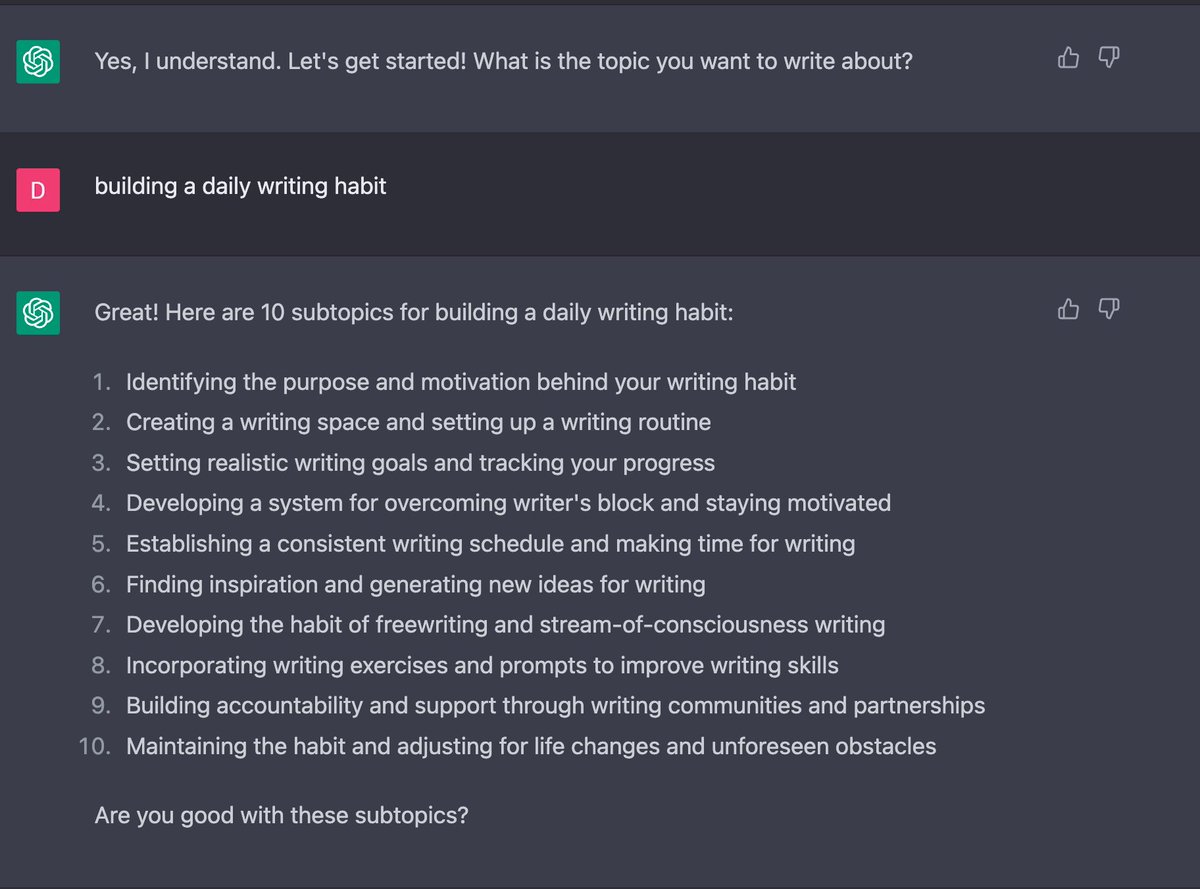
My constraint: Each must start with a verb so I can write things that help people accomplish that action.
Here's an example with the topic of "Building a writing habit"
10
And just to drive the point home, here's the list of actions for 4 other topics:
1. Learning to play House Music (my current hobby)
2. Buying your first rental property in NYC
3. Transferring bitcoin to a hardware wallet
4. Traveling through Greece in the summertime


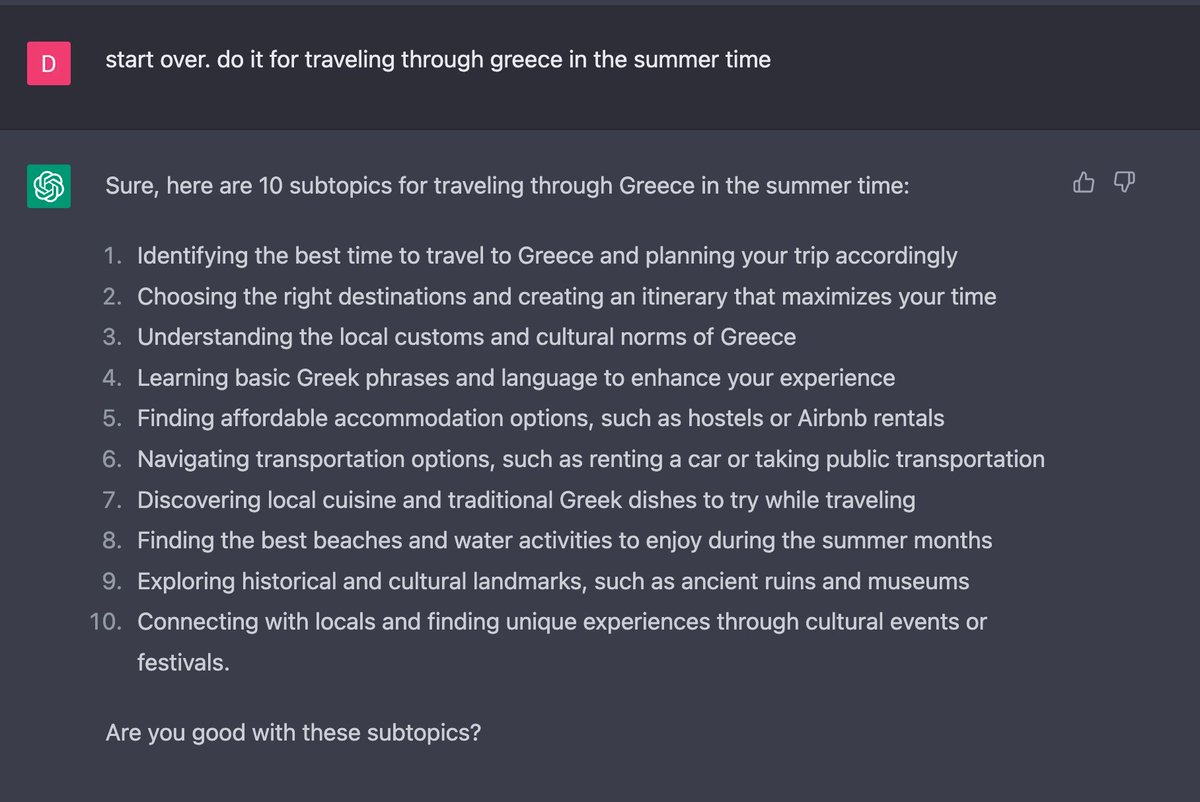
1. Learning to play House Music (my current hobby)
2. Buying your first rental property in NYC
3. Transferring bitcoin to a hardware wallet
4. Traveling through Greece in the summertime
11
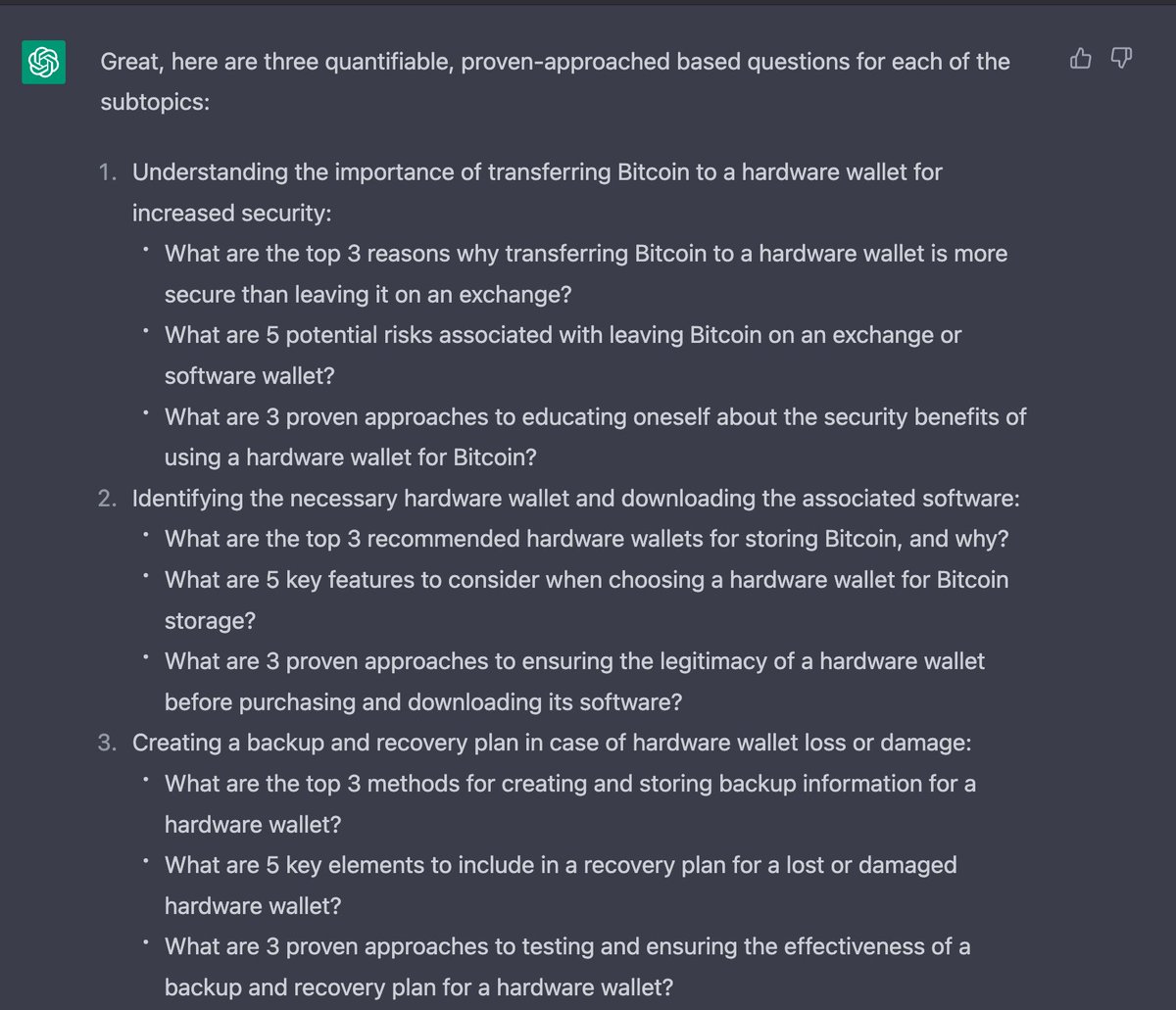
2. From this list of subtopics, I then have it ask me 3 "questions" about that subtopic.
I trained it on a list of common questions to ask, then I just say "ask."
And these become content topics—which makes writing incredibly easy because I literally just answer the question.


I trained it on a list of common questions to ask, then I just say "ask."
And these become content topics—which makes writing incredibly easy because I literally just answer the question.
12
You could see how each of these subtopics is a "pillar" piece of content helping a reader achieve the desired result.
And you build that "pillar" piece from the ground up by answering the questions.
Then, you can repurpose each part of the pillar piece into short-form content.
And you build that "pillar" piece from the ground up by answering the questions.
Then, you can repurpose each part of the pillar piece into short-form content.
13
Alrighty, that's it for idea generation.
And now I've never been more excited to explore new topics.
(If you want me to send you that prompt, hit reply on the top tweet and let me know—I'll shoot it your way.)
Now, onto the second way I use ChatGPT: rewriting and remixing.
And now I've never been more excited to explore new topics.
(If you want me to send you that prompt, hit reply on the top tweet and let me know—I'll shoot it your way.)
Now, onto the second way I use ChatGPT: rewriting and remixing.
14
I often get stuck in my own pattern of writing, failing to ever explore other ways to communicate an idea.
Luckily, this is what ChatGPT is best at.
So with the ideas generated above, I'll take a crack at my first draft.
Then, I have ChatGPT rewrite in 4 specific ways:
Luckily, this is what ChatGPT is best at.
So with the ideas generated above, I'll take a crack at my first draft.
Then, I have ChatGPT rewrite in 4 specific ways:
15
1) I ask ChatGPT to rewrite my writing with 6 different "tones":
1. More formal
2. More serious
3. More sarcastic
4. More optimistic
5. More pessimistic
6. More lighthearted
This immediately taps me into new writing voices that I can work with to enhance my own voice.
1. More formal
2. More serious
3. More sarcastic
4. More optimistic
5. More pessimistic
6. More lighthearted
This immediately taps me into new writing voices that I can work with to enhance my own voice.
16
2) I ask ChatGPT to rewrite my writing as 7 different authors:
1. Gary Vaynerchuk
2. Maya Angelou
3. George R.R. Martin
4. Winston Churchill
5. Brene Brown
6. J.K. Rowling
7. Ernest Hemingway
Again, this gives me a 360-degree perspective of ways I can talk about my idea.
1. Gary Vaynerchuk
2. Maya Angelou
3. George R.R. Martin
4. Winston Churchill
5. Brene Brown
6. J.K. Rowling
7. Ernest Hemingway
Again, this gives me a 360-degree perspective of ways I can talk about my idea.
17
3) I ask ChatGPT to rewrite my writing with 7 different "goals":
1. More concise
2. More emphatic
3. More humorous
4. More descriptive
5. More persuasive
6. More informative
7. More action-oriented
This one is my personal favorite.
Great for rewriting emails/messages.
1. More concise
2. More emphatic
3. More humorous
4. More descriptive
5. More persuasive
6. More informative
7. More action-oriented
This one is my personal favorite.
Great for rewriting emails/messages.
18
4) Lastly, I ask ChatGPT to rewrite my writing for 7 different demographics:
1. For 3rd graders
2. For 8th graders
3. For college students
4. For busy 40-year-old moms
5. For an 80-year-old who reads slowly
6. For an audience where English is a second language
(I love number 5)
1. For 3rd graders
2. For 8th graders
3. For college students
4. For busy 40-year-old moms
5. For an 80-year-old who reads slowly
6. For an audience where English is a second language
(I love number 5)
19
You get the point.
I always start with my own writing to give it something to work with.
ThenI look at it from different angles, picking and choosing bits I can use to enhance my own voice.
And all of this happens in *seconds* which would be impossible to do otherwise.
I always start with my own writing to give it something to work with.
ThenI look at it from different angles, picking and choosing bits I can use to enhance my own voice.
And all of this happens in *seconds* which would be impossible to do otherwise.
20
Alrighty—I think that's enough for one thread.
Over the coming days I'll write breakdowns with deeper dives into each of these:
• Journaling
• Idea generation
• Headline iteration
• Brain dump synthesizing
• Research and summarization
So be on the lookout for those!
Over the coming days I'll write breakdowns with deeper dives into each of these:
• Journaling
• Idea generation
• Headline iteration
• Brain dump synthesizing
• Research and summarization
So be on the lookout for those!
21
To recap, how I turned ChatGPT into my personal writing intern:
• Used it to "do," not "think"
• Fed it 3 clear constraints
• Iterated those constraints over time
• Build it into my personal idea generator
• Trained it to rewrite my drafts with a 360-degree perspective
• Used it to "do," not "think"
• Fed it 3 clear constraints
• Iterated those constraints over time
• Build it into my personal idea generator
• Trained it to rewrite my drafts with a 360-degree perspective
22
Boom—that's it.
If you found this helpful, jump back to the top tweet to like and retweet it (link below).
And hit reply if you want me to send over the idea generation prompt!
x.com/dickiebush/sta…
If you found this helpful, jump back to the top tweet to like and retweet it (link below).
And hit reply if you want me to send over the idea generation prompt!
x.com/dickiebush/sta…
23
If this is inspiring you to take writing with AI more seriously, start with this free 13,000-word Ultimate Guide + email course.
It's taught 60,000 people the fundamentals they need to know to get the most out of ChatGPT (and other AI writing platforms)
startwritingonline.com
It's taught 60,000 people the fundamentals they need to know to get the most out of ChatGPT (and other AI writing platforms)
startwritingonline.com
24
And lastly, if you're looking to up your writing game, here's a list of my 10 most popular threads.
Pair this ChatGPT thread with the fundamentals I teach in the other threads below and you have everything you need.
x.com/dickiebush/sta…
Pair this ChatGPT thread with the fundamentals I teach in the other threads below and you have everything you need.
x.com/dickiebush/sta…
25
If you're looking to start writing with AI, here's a free 5-day crash course that will put you ahead of 99% of people: startwritingwithai.com