Searching a billion tokens of agent data

Authors: @andrew_li03 @rao_abinav

How our data agent uses evals-as-indexes for better, faster, cheaper search.
Searching through agent traces is a new and hard problem
Most agent failures don’t come with a big flashing error. You usually find them by accident, while digging into how users interact with your agent, when you notice it did something unexpected. Then comes the harder question: how often has this happened? Answering it means searching through billions of tokens of production data.
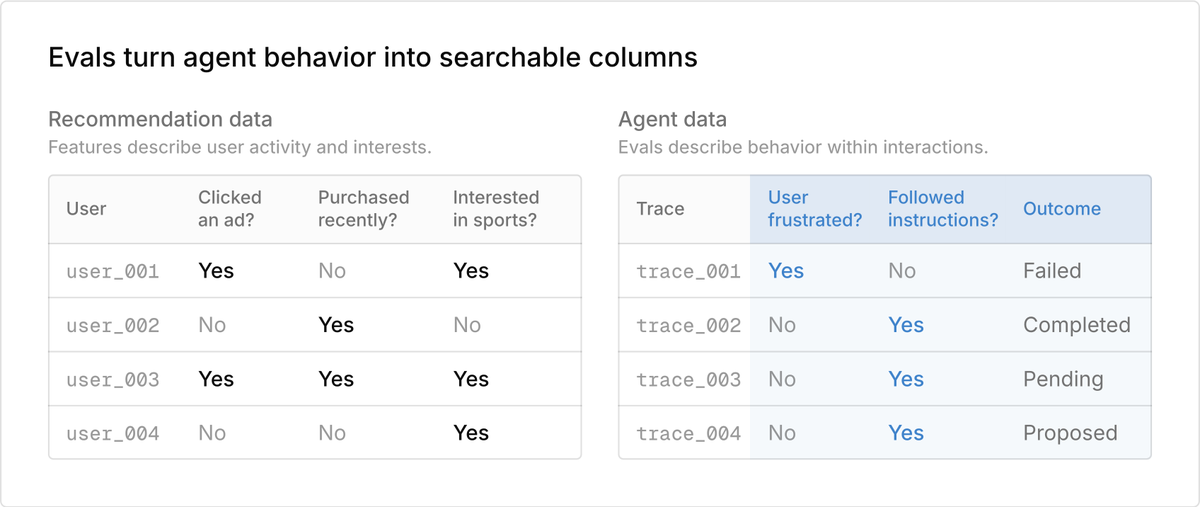
Large-scale data systems have long turned vast amounts of raw data into useful signals. Meta’s ads platform, for example, used tens of thousands of engineered features (e.g. recently clicked ads and page-visit counts) to personalize recommendations. At its core, the recommendation system turns vast amounts of user activity into better insights about people's preferences.
Long-horizon agents now produce data at a much larger scale. Their traces do contain structured events, such as searches, page visits and tool calls, but much of what we care about lives in free-form text across those events. A single run can produce thousands of model calls, tool invocations and intermediate decisions, most of them unstructured text. Whether a run actually succeeded often depends on context spread across many spans: a request the agent quietly dropped, a correction from the user, or a tool call that “succeeded” but did the wrong thing. However, the infrastructure and best practices for making sense of this data are still developing. Reading traces by hand helps you understand your agent’s behavior and discover what to look for. But finding every instance of that behavior across billions of tokens requires a more scalable approach.
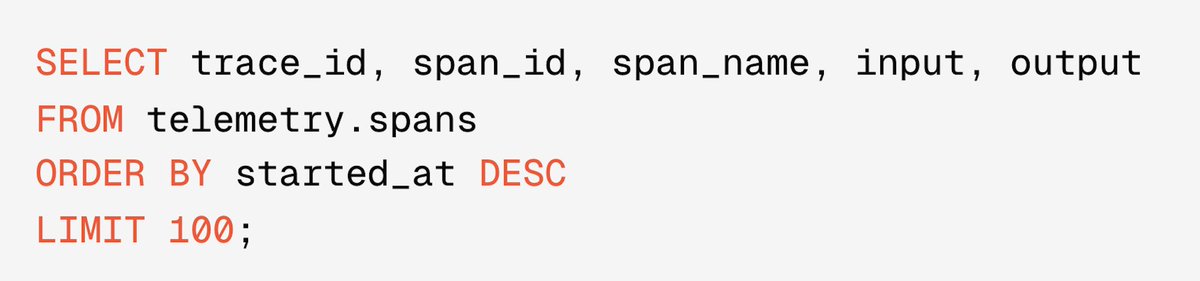
The natural next step is a data agent: an agent that answers questions about your production traffic by writing SQL over your traces, reading the relevant spans, and citing the evidence it finds. But pointed at raw traces alone, it hits the same wall we do. The behaviors we care about are often latent, so keyword search can’t reliably find them, and the data agent has to find and evaluate them from scratch on every question.
Luckily, LLMs have made it much easier to semantically parse the traces we’re storing. Compared to earlier BERT-style models, LLMs are more capable of handling arbitrary, complex rubrics without fine-tuning. That lets us break each run down along multiple semantic dimensions:
Each of these is an eval, and many teams already run evals like these as online monitoring, to track quality and catch regressions in production. But the same results can also serve as an index, a column you can filter and search on. That makes your data much easier to understand, and makes it far more likely you’ll catch what’s going wrong.
Why search needs these evals
Without evals, a data agent typically falls back on one of two approaches:
Say you run a sales agent and want to find requests it did not complete. Consider the query: “Find email requests that were not completed.”
For this example, we use three evals, some run as standard LLM-as-a-judge and some with Jev:
Evals can see an entire trace or an individual span. Their results are stored in telemetry.scores, alongside the traces and spans they describe, with the eval name (judge), its result (label) and an explanation (reason). Each result links to the relevant trace and supporting span. In this example, the evals assess whether the email request was completed at the trace level and cite supporting spans within that trace. We assume at most one result per eval per trace.
The raw query can find the right trace even when the sales agent tells the user “Done, the follow-up is ready.” A save_email_draft receipt with sent_at: null tells us the message was still a draft at that point. The search can miss the evidence that tells us whether the email was ever sent. A later delivery confirmation, for example, might appear in a span that matches neither the tool names nor the phrases in the query. With evals-as-indexes, it can filter for requests labeled not_done, exclude those labeled recovered, and inspect the supporting spans.
Using evals-as-indexes helps the data agent find relevant evidence more accurately, finish faster, and consume fewer input tokens. The search costs below exclude the upfront cost of generating the evals, which can be reused across subsequent searches.
The walkthrough below uses a simplified SQL schema to make the Sonnet 5.5 run easier to follow.
Benchmarking
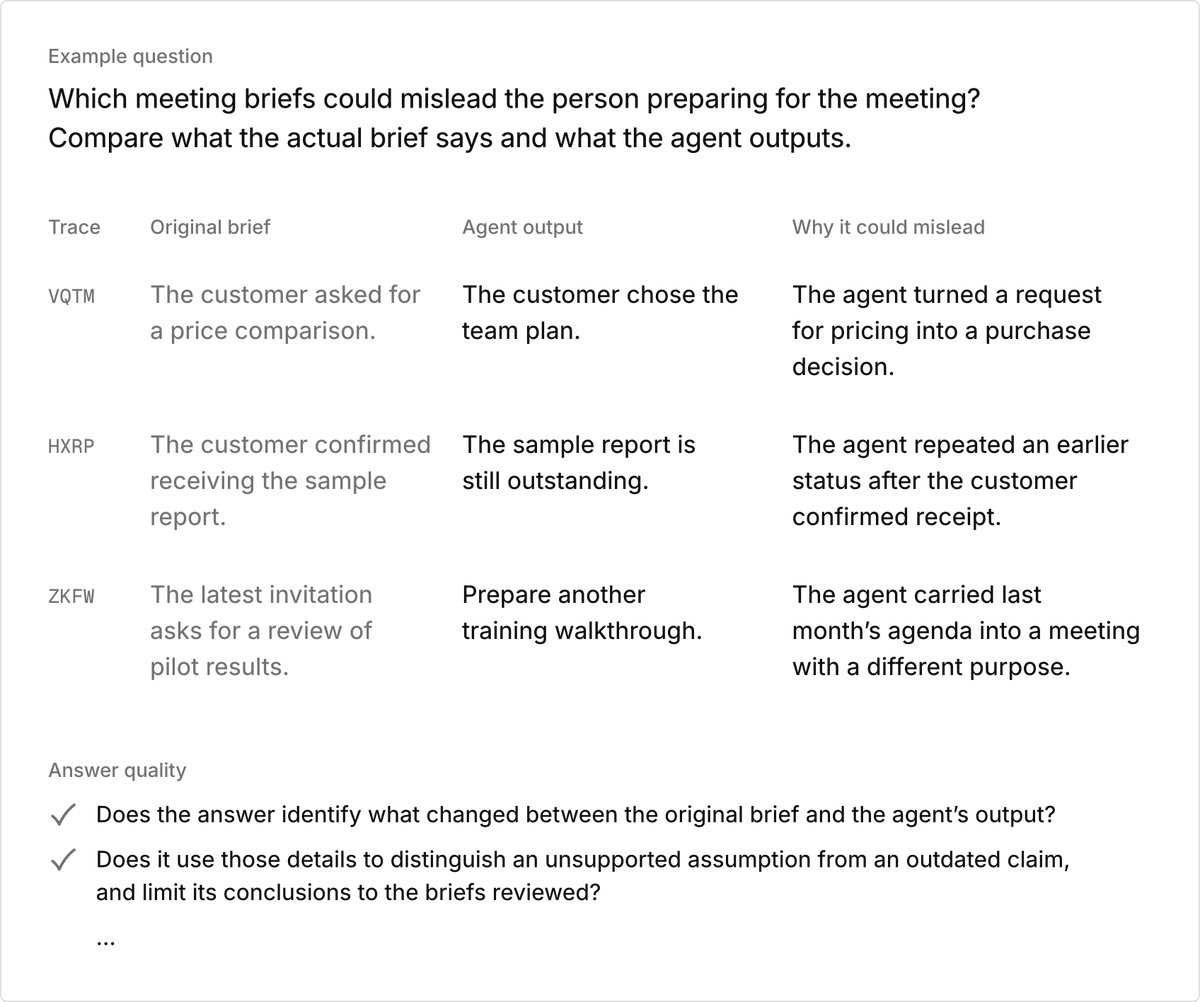
To measure whether evals-as-indexes actually help, we built a search benchmark from perturbed internal traffic: 4K+ long-horizon agent traces (1B+ tokens), with 50+ search questions. Each question includes a reference answer, human-reviewed evidence trace IDs, and a rubric that checks whether the agent correctly analyzes the evidence.
We built it with an AutoBenchmark-style loop:
We measure evidence precision and recall against the reference IDs and grade answer quality with the rubric. We ran every model with and without evals-as-indexes.
Results
Our index reuses 18 online monitoring evals, including requested_action, action_outcome and failure_recovery, for a total of 40,482 evals across the dataset. Each trace is first parsed programmatically to extract the evidence each eval needs, then scored with MiniMax M3.1 Flash and Jev, for a total cost of about $60.
Averaging each of the seven models’ relative changes, indexes reduced input tokens by 23.9%, search time by 21.4%, and estimated search costs by 20.8%. Answer quality improved by 22.7%.

In addition to these results, several open-source models saw substantial gains in recall and precision, most of the time because the evals had already surfaced cases the models were less likely to find by searching the raw text. However, stronger retrieval did not always translate into stronger analysis. Some open-source models appeared less likely to challenge the eval results, potentially making them more susceptible to incorrect or incomplete indexes. Across all seven models, recall increased by 54.8%, precision by 43.0%, and SQL calls decreased by 11.8%, averaging each model’s relative change.
When the index isn’t worth it
A data agent can always query raw traces with SQL, and evals-as-indexes are an addition on top of that. In two cases, plain SQL are probably all it needs:
Conclusion
As agents take on longer and more consequential work, they produce more data than anyone can read manually. Failures like a missed instruction, or a mistake repeated after the user corrected it, span many steps and rarely leave a keyword behind, which makes them hard to find reliably with keyword search at scale.
But most teams already run online monitoring evals to track agent quality, and those results can be reused as indexes. Every search then starts from behavior that’s already been evaluated, and the data agent spends its effort verifying evidence instead of hunting for it.
Our goal is to make agent data as easy to search as any other data: ask anything about what your agents did in production, and get an answer backed by evidence you can check.
Thanks to @22uenos and @PhilipMovery for designing the figures and interactive walkthrough. Follow @JudgmentLabs on X and check out more here.