Jupiter Quarterly Report Q3 2026

Executive Summary

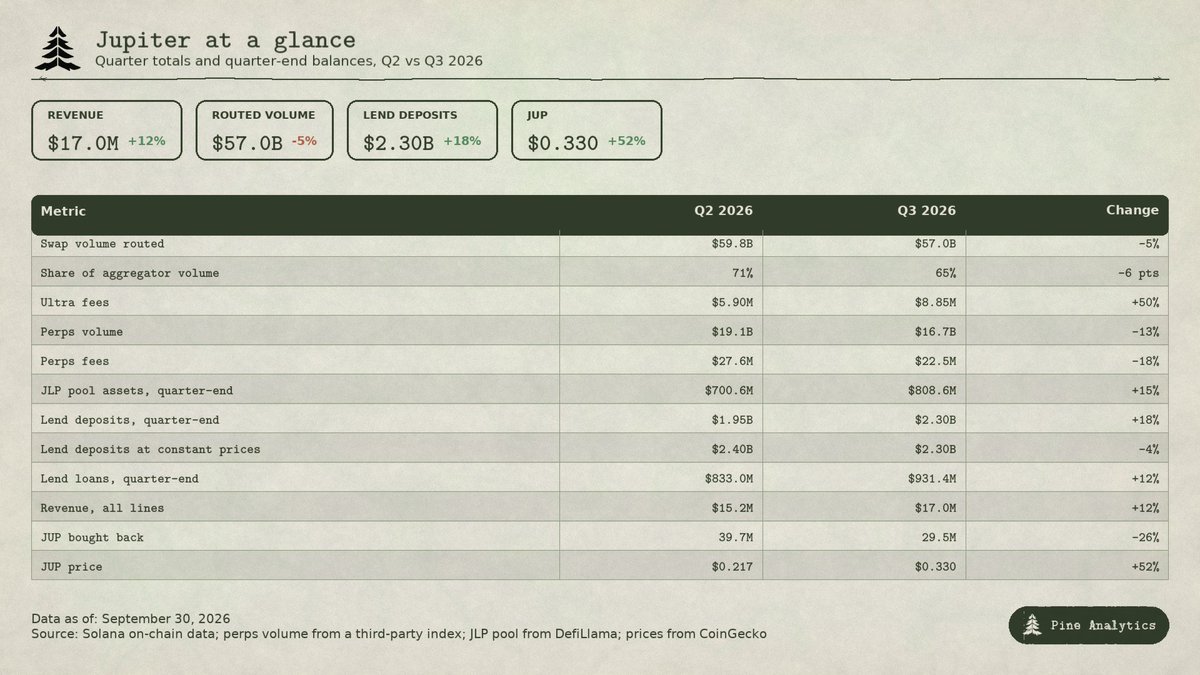
@JupiterExchange earned more in the third quarter from a smaller share of a smaller market. Revenue across its business lines was $17.0M, up 12% from Q2, and the gain came from one place: swap fees rose 50% to $8.85M while the volume Jupiter routed fell 5% to $57.0B and its share of Solana aggregator volume slipped from 71% to 65%. Two things of about equal size raised the fee per dollar. Stablecoins, which pay no fee, fell from 62% to 56% of the tokens bought through Jupiter while long-tail tokens, which pay 10 to 50 basis points, rose from 5% to 9%; and the share of flow that pays Jupiter's fee at all rose from about a quarter to about a third.
The other lines moved the other way. Perps volume fell 13% to $16.7B and perps revenue 18% to $5.6M while Hyperliquid's fees rose 12%, and the JLP pool behind Jupiter's perps grew 15% only because SOL rose 59%. Jupiter Lend ended the quarter at $2.30B of deposits, up 18% in dollars and down 4% once SOL's move is taken out, the same shape Kamino printed over the same window. The stablecoin shrank, the liquid staking token shrank, the prediction market peaked in July and fell by two thirds by September.
JUP rose 52% to $0.330, a little behind SOL, with no new tokens issued and a tenth more of the supply staked. The Litterbox Trust bought 29.5M JUP, 26% fewer than in Q2: the price was higher, and its purchases fell to 84% of half of the revenue Jupiter says it shares, from 114% the quarter before.
Where the money came from

Swap fees were 52% of revenue in Q3, up from 39% in Q2, and in September they earned $3.59M, more than the other lines combined. A year earlier the order was reversed: in Q3 2025 perps paid the protocol $34.8M against $12.2M from swaps. This quarter perps paid $5.6M on $22.5M of trader fees. Lend's 10% cut of interest was $1.08M, of which half is reported to go to Fluid, the protocol Lend is built on, leaving Jupiter $0.54M. The remaining lines together earned about $2.0M in both quarters.
Swap: fewer dollars, more fee per dollar

Jupiter routed $18.2B in July, $18.8B in August and $20.0B in September. The competition grew faster. DFlow went from $10.6B in Q2 to $15.4B in Q3 and OKX from $8.0B to $12.1B, while Titan, the second-largest aggregator in April, fell to $2.9B. Jupiter's weekly share, 82% in the first week of April, was 58% in the last full week of September, and on September 27 its daily share touched 50%. The last time that happened, on November 15, 2025, when DFlow took 48% for a day, the weekly share was back above 90% within weeks. This time the weekly share has stayed below 70% since the last week of May and each month of Q3 was lower than the one before: a lost customer, not a bad day. About a fifth of Jupiter's routed volume in both quarters is round-trip routes that start and end in the same token, arbitrage rather than users; without them the share is 66% in Q2 and 62% in Q3, and nothing below changes.

Fees did not follow volume. Jupiter's fee accounts collected $8.85M in Q3 against $5.90M in Q2, so each $10,000 routed produced $1.55 of fees, up from $0.99, and the weekly rate passed $2.00 in September. The fee depends on the pair: nothing on stablecoin-to-stablecoin or LST-to-LST swaps, 2 basis points on SOL against a stablecoin, 10 on most other pairs, 50 on tokens less than a day old, and nothing on the plain router path.

Half of the rate change is mix. Classifying every swap by the token bought, stablecoins were 62% of Jupiter's routed volume in Q2 and 56% in Q3, SOL rose from 28% to 30%, and long-tail tokens, the 1.35M mints outside our classified set, rose from 5% to 9%, with September at 12%. Over the 25 full weeks from April to September the weekly long-tail share and the weekly fee rate move together with a correlation of 0.89; the two highest-fee weeks, September 7 and September 21, are two of the three highest long-tail weeks, at 14% and 15%. Priced at Jupiter's schedule, the Q2 mix of pairs implies 2.8 basis points of fee on every dollar and the Q3 mix 3.6, a rise of 29%; the collected rate rose 57%.
The other half is how much of the flow pays at all. Against those schedule-implied fees, Jupiter collected 25% in Q2 and 34% in Q3; the rest runs through the free router API or through integrators who charge their own fee and hand Jupiter a fifth of it. That shift is worth about as much as the mix.
The swap program was upgraded ten times between July 15 and September 22; Universal Deposit, which turns tokens sent from Ethereum, Base, Arbitrum and Sui into USDC on Solana for $0.30, launched on September 2; and a September 23 study by researchers at Category Labs, ETH Zurich, Flashbots and the University of Lisbon found Ultra users sandwiched at 0.7 times the rate chance predicts, against 11 to 19 times for the Solana trading bots it compared. Jupiter's request-for-quote venue handled $3.99B, up 24%, and xStocks tokens routed through Jupiter reached $218M in September against $55M in July and $61M in August.
Perps: the pool grew while trading shrank

Perps volume was $16.7B, down from $19.1B, with July's $4.5B the weakest month of the year and September's $6.3B still below any month of Q2. Monthly traders fell from about 83,000 to about 67,000. Trader fees were $22.5M, down 18%, the protocol's quarter of them, $5.6M, is the perps revenue in the chart above, and realized trader losses, the pool's other income, were $12M against $23M in Q2.
The decline is Jupiter's, not the market's. Hyperliquid's trader fees rose 12% over the same quarter, from $194M to $216M. On Solana, the pool-model competitors did not come back: Drift's fees went to zero after April's exploit, and Flash and Adrena together earned under $0.2M. The venue that grew is Pacifica, an order-book exchange, whose trader fees were $3.4M in August and $3.6M in September, 45% of Jupiter's in a month when Jupiter's were $8.0M.
The JLP pool moved the other way. Its assets rose from $701M to $809M, a 15% gain in a quarter when SOL rose 59% and JLP itself rose 38%, from $3.51 to $4.85. The gap between the price and the pool is redemptions: JLP supply fell 13%, from 224M to 194M tokens, most of it in August, when about $109M of net redemptions left. Open interest closed the quarter near $106M.
Jupiter's answer is an order book of its own. On September 22 six perpetual markets launched in beta on GUM, its new matching engine: HYPE, ZEC, JUP, and stock perps on SpaceX, SanDisk and SK hynix that track a share price with no token behind the position. They take USDC collateral at up to 20x leverage, opened to wallets staking at least 69 JUP, and do not touch the JLP pool, whose program was not upgraded in the quarter.
Lend: up with SOL, flat without it

Deposits across Jupiter Lend's reserves rose from $1.95B on June 30 to $2.30B on September 30 and touched $2.39B on September 25. Loans rose from $833M to $931M. Valued at September 30 prices, the June 30 book was $2.40B, so depositors withdrew about 4% in units, the first unit decline since the Ethena market launched in May, and borrowers neither added nor repaid. Kamino's book did the same over the same window, up 17% in dollars and down 3% in units: a Solana lending result rather than a Jupiter one. Interest accrued rose 32%, from $8.2M to $10.8M, with the dollar book. Liquidations were $74K, against $16.1M in Q2, almost all of it in the first week of June.

Within the flat total, the composition turned over. USDC added $92.7M. PYUSD's reserve sat empty until September 29 and held $50.1M on the 30th; in the two weeks after quarter-end it grew to $252M with 96% borrowed back out, a looped position rather than new capital. dfdvSOL added $39.1M and JupSOL $35.7M, so the JupSOL reserve nearly doubled to $303M. What left was collateral and yield products: JLP deposits fell $90.5M in units even as their dollar value rose, USDe fell $55.9M and USDG $45.5M, both in September, native SOL fell $32.6M, the JUICED reserve lost $24.3M as Jupiter wound that leveraged-yield product down, and jupUSD, also a Lend reserve, shrank there from $71.6M to $55.0M.
Lend v2 launched on August 10 with Smart Collateral and Smart Debt, which place a deposit or a loan into a correlated-pair liquidity pool so it earns swap fees on top of interest; the pools traded $294M in August and $589M in September, nearly all of it USDT/USDC. The lending program was upgraded on July 3, July 16, August 29 and September 24, five reserves opened (reUSD on July 25, USX on August 5, sUSDai and japanSOL on September 1, USDGO on September 28), and borrow vaults went from 94 to 109.
The smaller lines
jupUSD, launched with Ethena in January, ended the quarter at 45.1M in circulation, down 12% from 51.5M; the launch plan to convert about $500M of the JLP pool's USDC into it has not happened, and the pool held $18.7M of jupUSD against $127M of USDC. JupSOL held 5.16M SOL against 5.33M on June 30, a 3% decline in units that SOL's price turned into a rise from $390M to $610M; the whole LST market shrank 6% in SOL, so JupSOL's share edged up from 9.4% to 9.7%. The prediction market did $20.8M against $23.0M in Q2, all of it routed to Polymarket, July the peak at $11.3M and September $4.1M; Forecast, Jupiter's own 15-minute Bitcoin market launched on June 4, is not in that series.
Jupiter shipped a product a week: a Trade, Earn and Manage reorganisation in July with Lend interest on idle recurring-order funds, trailing stop-losses and a hosted server for AI agents; Portfolio v2 on August 17; a physical card on September 30. The Collector Crypt storefront went live on July 13, took 35% of pack sales in its launch week, settled at 6% to 9%, and finished with 11% of Q3 pack sales by value; the packs reached the mobile app on September 7, when Jupiter reported 1.68M downloads, about 240,000 monthly active users and $575M of monthly volume.
JUP: the token rose, the buyback slowed

JUP closed the quarter at $0.330, up 52% from $0.217, after a low of $0.166 on August 16 and a high of $0.372 on September 28. SOL rose 59%. Market capitalization went from $722M to $1.10B on a circulating supply that stayed at 3.32B tokens: the DAO's February vote to cancel the 2026 airdrop and pause team vesting left net issuance at zero, and no governance vote was held between July and September. Staked JUP rose from 978M to 1,079M, a third of the circulating supply, and the 50M JUP reward pool for Q3 stakers opened for claims on October 13.

The Litterbox Trust held 143.8M JUP on June 30 and 173.3M on September 30. The 29.5M it bought was worth about $6.4M at monthly average prices, against 39.7M and $7.5M in Q2. Jupiter's documentation says the trust receives half of on-chain revenue from "perpetuals, spot swaps, limit orders, DCA, and onchain/offchain liquidity aggregation". Half of those lines, on the public series, was $6.6M in Q2 and $7.6M in Q3, so the trust spent 114% of its share in Q2 and 84% in Q3. Timing does not explain it: on October 16 the trust held $0.11 of USDC and one SOL, the revenue wallet that feeds it held $139 and 94 SOL, and October's daily purchases ran below September's. Either the share was cut or part of the revenue is held somewhere the chain does not label; the next quarter's ratio will say which. The trust's balance equals 5.2% of circulating supply.
What Q4 needs to show
Five numbers will say whether this quarter was a floor or a step down. Share: if Jupiter's weekly share of aggregator volume holds above 58%, September's low was the bottom; a month below 55% means DFlow and OKX are still taking flow. Fee rate: if long-tail tokens stay above a tenth of the mix and a third of flow keeps paying, fees stay near $2 per $10,000 routed and revenue grows without share; a fall back toward $1 means September was the high. Perps: the six GUM markets need to lift monthly volume above Q2's $6.4B average, and JLP needs a month without net redemptions. Lend: deposits rising in units as well as dollars would reverse Q3's decline, and the PYUSD reserve will show whether October's $252M stays once its incentives do. And the buyback: a second quarter near 84% of half of revenue would make the shortfall a policy, not a lag.
Sources and method
Swap volume counts each route through Jupiter's router program once, at its dollar value, from our own index of Solana transactions, with two one-day artefacts removed: $2.42B of round-trip trades on July 11 and $2.27B of self-dealing in a newly created token on August 24. Competitor volumes use the same method on each router; 99% of Jupiter's routes carry a price. Two public series put the quarter at $47B and $73B against our $57B. On a full hour of October 16 our rollup matched the route table exactly, 145,929 routes and $30.4M, while summing every pool leg of those routes gave $36.6M, 1.20 times as much, because a route through two pools counts twice. The higher series runs 1.2 to 1.4 times ours on ordinary days and omits the two artefact days, which were filled by market makers rather than pools: it is a sum of pool legs, ours counts each route once. The lower series counts a narrower set we could not identify. Round-trip routes, which start and end in the same token, were 22% of Jupiter's routed volume in Q2 and 23% in Q3, about $13B a quarter, against 1% for DFlow and Titan and 21% for OKX in Q3; without them Jupiter's share is 66% then 62%, its volume fell 2.5%, and the fee rate rose from $1.26 to $1.94 per $10,000. The mix is our classification of the token bought in each route. The schedule-implied fee applies Jupiter's published fee by pair type to a third-party split of Jupiter's volume by pair; the paid share is collected fees divided by that figure. The November 2025 episode is from a public Dune-based series; our aggregator index begins in March 2026.
Swap fees are the fees that land in Jupiter's 24 fee-collection accounts, measured from those accounts' balances and their transfers into Jupiter's revenue wallet. Public dashboards count only the transfers, which is why they show an $822K day on August 30: a one-time collection of six months of accrued PumpSwap cashback, not in our series. Our series runs at roughly 90% of the public figure because some fee tokens lack a price feed.
Revenue adds our fee and lending indexes, DefiLlama's perps revenue and a third-party index for the smaller lines; that index also supplies perps volume, traders, open interest, trader PnL, the JLP custody mix, the Lend pool volume and the buyback comparison's revenue for the lines Jupiter names, $13.2M in Q2 and $15.3M in Q3. Trader fees for Jupiter and its peers, the protocol's 25% share and JLP pool assets are DefiLlama's, where Pacifica's series begins July 18; JLP supply is from our token index and CoinGecko.
Lend deposits and loans are each reserve's balance in its own token at the price the reserve reports; "at constant prices" values the change in units between June 30 and September 30 at September 30 prices. Our reserve series carries a stale April, so the Lend chart starts May 1. Jupiter's half of the Lend protocol fee assumes the reported 50/50 split with Fluid, which neither party has published.
Litterbox purchases are the change in the trust's JUP token account at each month-end, valued at CoinGecko's monthly average price; the trust made no outflows. Prices are CoinGecko daily values; staked JUP, circulating supply, jupUSD supply and JupSOL's LST share are on-chain balances. Launch dates and company figures come from Jupiter's announcements, documentation and changelog, the sandwich study from its authors, and the storefront figures from our Collector Crypt report.