SEEDANCE 2.5 + KLING 3.0 = A $25 CLIP AN AGENCY SELLS FOR $375

30 seconds in one unbroken take, no camera, no actors, no set. Seven terms, every prompt inside, the whole economy worked out.

On the left, three things you can get hold of today. On the right, a fifteen-fold gap.
Right now somebody in your niche is posting a vertical clip shot without a camera. No set, no operator, no talent. One paragraph of text and twenty minutes of waiting. And that clip will outperform the one you shot on your phone all weekend.
A format lives about two weeks. Then everyone floods it and it dies. Speed is the whole edge.
The difference between a clip people pay for and a clip that looks cheap fits inside one paragraph of text. I am going to break that paragraph into its terms.
Save this now. What follows is prompts you will be copying.
Here is the whole equation.
A Good Model + an Empty Prompt = Plastic
Someone opens the prompt box. Types "beautiful girl walking through the city, cinematic, 4K". Hits generate.
Gets plastic footage with a drifting face. Concludes the model is weak, the hype is fake, come back in a year.
The model is not weak. The prompt is empty.
A video model is not an artist you commissioned for a mood. It is an extremely obedient crew that does exactly what the brief says and nothing beyond it. No light source written, you get light from nowhere. No end state written, you get a shot cut off mid-motion. No sound written, you get stock music laid over the top.
What looks beautiful is not what was described in beautiful words. What looks beautiful is what was described as physics.
"She is sad" renders as nothing.
"Shoulders drop, gaze falls, her breath is visible in the cold air" renders as a shot people watch to the end.
Here is the equation that turns that rule into a finished clip. Seven terms on the left, one number on the right.
The Whole Equation

Seven terms. Each one owns a part of the frame. Drop any of them and exactly that part falls apart.
Two tools, and the choice between them is simple.
Seedance 2.5, shipped 31 July 2026: up to 30 seconds in one unbroken take, up to 50 references at once, lip-synced sound in more than ten languages. Take it when you need a long scene with no cuts and several characters.
Kling 3.0, shipped 5 February 2026: any duration from 3 to 15 seconds, 720p, 1080p and a 4K mode, up to six shots inside one generation, a negative prompt and a prompt-adherence slider. Take it when you need a short punchy shot with real body weight and a predictable result.
Honest note before you spend money: in blind comparisons neither one is first. The text-to-video board is led by Wan 3.0 and Gemini Omni Flash at 1238, Kling 3.0 Pro sits tenth at 1108, and Seedance 2.5 is not on the board at all, its 2.0 predecessor still is, at 1222.
That is not a reason to skip them. A ranking measures the average frame from a random prompt. You are shooting one specific frame, and the model with the most levers wins. These two have the most levers.

Term 1. Idea + One Change Per Beat = a Clip People Finish
This is 80% of the result. Skip it and the other six steps produce a polished clip nobody finishes.
A beat is 5 to 8 seconds. Exactly one thing changes inside it. He walks in. He sits down. He lifts his head.
Three events in one beat and the model crams all three into the same seconds and ruins all three.
The rule: one primary change per beat. Thirty seconds is four beats, maximum.
The line for your prompt:
Total 24 seconds, three beats of 8 seconds each, one primary change per beat.If the idea will not come together, hand the boring part to a text model:
You are a shot planner for AI video.
My idea: [two sentences].
Break it into beats of 8 seconds, maximum 3 beats.
For each beat give me: the single primary change, the end state of the frame
at the last second, and one diegetic sound.
No camera directions yet. Plain lines, no prose.
It does not write the prompt for you. It forces a vague idea to become a finite list of events.
Term 2. 3 Face Angles + 1 Restriction = a Character That Does Not Drift
This is where most quality dies. People upload one random photo and wonder why the hero has a different face eight seconds in.
Build two sheets.
Character sheet: three angles of one face, front, three-quarter, profile. Separate images. A collage reads as three different people.
Location sheet: two or three angles of the same space.
Then the part that matters. Every reference gets a role and a restriction:
@Image 1 defines the courier's face, hairstyle and grey jacket. Do not use its background.
@Image 2 and @Image 3 are the same face from other angles, same person.
@Image 4 defines the courtyard: brick walls, one lamp above the door, wet ground.
@Video 1 defines only the walking rhythm, ignore its subject and colours.
Same face, same hairstyle, same outfit for the entire video.
That last line goes into every prompt you will ever write.
Do not get greedy. Seedance formally accepts fifty files but holds 1 to 8 images and 1 to 5 clips, past that it starts quietly ignoring some. Kling is more honest: up to seven images, four if you also attach a video.

Term 3. Action + End State = a Shot That Does Not Cut Off Mid-Motion
The move that separates a beginner's prompt from one people pay for.
A beginner writes the action: "she wraps the bouquet". The model wraps and stops wherever it got to. Ribbon still in hand, bouquet out of frame, beat over.
A director writes the action plus the end state of the frame:
[0-8s] A florist trims stems behind a wooden workbench.
End state: the finished bouquet is in her left hand, scissors on the right side of the bench.

[8-16s] She wraps the bouquet in kraft paper and ties a green ribbon.
End state: the wrapped bouquet lies flat in the centre of the bench, bow facing camera.

[16-24s] She places it on the pickup shelf and looks into the lens.
End state: the bouquet is centred on the shelf, her hands are empty.

Keep her face, hair, apron and the bench layout identical throughout.
No subtitles, no background music, no hard cuts, nothing appears out of thin air.
Three beats, each with a visible finish line, then a consistency line and a forbidden list.
Timestamps are time budgets, not frame-exact cuts. Give a beat too few seconds and the model rushes it.
Term 4. Light Source + Shake + One Focus Hunt = Not Obviously AI
"Cinematic", "epic", "beautiful", "4K quality". These appear in every second prompt and move zero pixels, because they describe no observable change.
A camera is three things: shot size, movement, optics.
Shot size: extreme wide, wide, medium, close-up, extreme close-up. Movement: push in, pull back, pan, track, orbit, tilt up, handheld, rack focus. Optics: 35mm, anamorphic, shallow depth of field, natural motion blur.
Light is described by its source, not its mood. Not "warm cosy light", but "one lamp above the door, light from above and left, hard shadows".
And the thing that separates expensive footage from synthetic footage: imperfection. AI clips give themselves away through sterility. Perfect light, perfect skin, perfectly smooth camera. Real footage never looks like that.
Slow push in from a medium shot to a close-up on her hands, ending at eye level.
Handheld, slight shake, 35mm, shallow depth of field.
Single practical light above the door, hard shadows, cold blue ambient, warm lamp spill.
Real skin texture with pores, dust in the light beam, slight lens haze.
Phone-camera honesty: no gimbal smoothing, autofocus hunting once.One more move that is winning right now: fake VHS and fake broadcast looks. Grain, jitter and the colour shifts of old tape hide exactly the artifacts your eye uses to spot synthetic footage.
Write yourself one style paragraph and paste it at the end of every prompt, including in your image generator. Then everything you ship looks shot by one person instead of assembled from scraps.
Term 5. Sound In Every Beat Minus Music = a Shot Worth Twice as Much
Both models generate sound with the picture. Both will happily add music you did not ask for.
Rule one: sound is written inside each beat, never as a list at the end. Each beat carries its own footsteps, its own creak, its own slam. A list at the end gets smeared into flat ambience and the shot instantly feels cheaper.
Rule two: music never goes into the generation. It goes in the edit, where you control it. A plain "no music" loses that fight often enough, so use the directive:
[SOUND] Strictly only naturally occurring sound and foley, no music allowed.Seedance has its own audio syntax, four brackets:
(music in round brackets)
<sound effects in angle brackets>
{dialogue in curly braces}
【subtitles in these】
A beat with sound written into it:
[8-16s] He stops mid-step and turns his head toward the door.
<wet footsteps stop, a heavy door latch clicks behind him, distant traffic hum>
{Who is there?}
Dialogue language: American English, neutral accent.
Name the language and accent explicitly or the model picks one for you.
What is genuinely good: effects and foley. Cars, machinery, rain, footsteps, metal. Keep them in the final cut.
What is weaker: dialogue. Lip-sync works for a talking head in an ad, in a complex scene it usually costs more than it adds.
Term 6. 10 Takes of 2 Seconds Each = 1 Finished Clip
The mental shift this whole piece was written for.
Almost everyone tries to get a finished clip out of one generation. Write, watch, feel disappointed, change one word, generate again. Twenty times, paying for each attempt.
Real sets do not work that way. They shoot coverage: several takes, different angles, shots that may never be used. The edit decides later.
Do the same. Take 3 to 5 seconds of your script, turn it into one 15 to 30 second montage prompt, and tell the model plainly that you are cutting it yourself:
I am cutting this myself in the edit. Load the sequence with extra coverage:
a large variety of aggressive angles, at least 10 short shots inside 15 seconds.
Extreme wide, low angle from the ground, macro on hands, over the shoulder,
top down, whip pan between two of them.
Give me alternative takes of the same moment, not one continuous action.
Generate about ten of those. Open everything, pull the best two or three seconds out of each, throw the rest away.
Half of it is slop. But roughly every third generation hands you a shot you would never have written yourself, and that shot becomes the best moment in the cut.
For hard action, never ask for the whole thing. Generate the calm part, confirm it is good, then extend it with the twist. You re-roll the twist only, never the setup.
Term 7. Titles + Logo On Top = a File You Can Send a Client
Titles, captions, logos, a price on screen, a buy button. Both models render letters badly and no prompt fixes it.
Everything textual goes on top in your editor. So does the music, the final assembly of your selected pieces and the vertical crop for the platform.
The left side of the equation is complete. Below it is in one piece, and after that comes the right side, in money.
All Seven Terms = One Thirty-Second Prompt
Everything above assembles into one text. Copy it and reskin it.
30 seconds, 16:9, one continuous take, no cuts.

CAST
@Image 1 defines the courier's face, hairstyle and grey jacket. Do not use its background.
@Image 2 is the same face, three-quarter angle, same person.
@Image 3 defines the courtyard: brick walls, one lamp above the door, wet ground.

BEATS
[0-10s] The courier walks into the courtyard from the far gate, holding a flat box.
End state: he stands under the lamp, box still in both hands.
<wet footsteps on stone, distant traffic, rain on metal>

[10-20s] He stops, lifts his head and looks at a lit window on the third floor.
End state: his face is fully lit by the lamp, box lowered to waist height.
<a window latch opens somewhere above, one dog barks two streets away>

[20-30s] He sets the box on the step and walks back out of frame.
End state: the box alone under the lamp, courtyard empty, camera holding still.
<cardboard on wet stone, footsteps fading, rain continues>

CAMERA
Slow track beside him at shoulder height, then a gentle push in as he stops,
ending on a medium close-up. Handheld, slight shake, 35mm, shallow depth of field.

LIGHT AND TEXTURE
Single practical lamp above the door, hard shadows, cold blue ambient, warm lamp spill.
Real skin texture with pores, rain streaks in the light, slight lens haze.
Phone-camera honesty: no gimbal smoothing, one autofocus hunt.

RULES
Same face, same hairstyle, same outfit for the entire video.
[SOUND] Strictly only naturally occurring sound and foley, no music allowed.
No subtitles, no hard cuts, nothing appears out of thin air, no extra people.
Global parameters on top, casting with restrictions, three beats with end states and their own sound, camera, light, and the list of what must not exist in frame.

120 Seconds of Generation = $20-28 of Cost
Prices as of September 2026, at official rates.
Seedance 2.5: $0.10 per second at 480p, $0.23 at 720p. A fifteen-second take is about $3.50.
Kling 3.0 Pro at 1080p: $0.168 per second with sound, $0.112 without. A fifteen-second take with sound is about $2.50.
The real budget for one finished thirty-second clip. Three ten-second pieces, four takes each, 120 seconds of generation:
Seedance 720p         about $28
Kling 1080p + sound   about $20
For contrast, the right side of the headline. A published agency rate card for short clips: $4,500 for a pack of twelve, which is $375 each. Clutch puts the video production hourly rate at $100 to $149. You produce the same runtime for $20 to $28 and one evening.
That is the cost when you work through the terms. Fire blindly, rewriting one word at a time, and the same thirty seconds turn into a hundred dollars and half a day.
If you pay in credits: Kling charges 6 credits per second at 720p without sound, 8 at 1080p without sound, 12 at 1080p with sound, 30 in 4K. The free 66 credits a day buy one short take, eleven seconds at 720p without sound. A 3,000-credit plan is roughly sixteen fifteen-second takes at 1080p with sound per month.
Time: thirty seconds at high resolution renders in nine to twelve minutes, and the free Kling queue reaches an hour. Work in batches: fire ten generations, walk away, come back and sort.
Where the Equation Does Not Balance
Text in frame. Both models render letters badly. Everything textual goes on top in the edit.
Faces on long shots. By the end of thirty seconds a face can drift, especially turned away and small. The character sheet and the consistency line help, not completely.
Crowds. Extras want to become clones. Demand variety: different clothes, different hair, movement that is not synchronised.
Resolution. Plenty of places claim Seedance 2.5 does "native 4K". It generates natively at 480p and 720p, everything above that is an upscale. Its own previous version handled more. Plan the edit around 720p.
Moderation. Recognisable people, politics, violence and anything borderline gets refused, unpredictably and without telling you why. Other people's faces, brands and characters never go into your references. If the clip is an ad, disclose the synthetic part: platforms do not punish disclosure, they do punish undisclosed fakes.
A Clip + Someone Who Needs It = Money. Five Ways
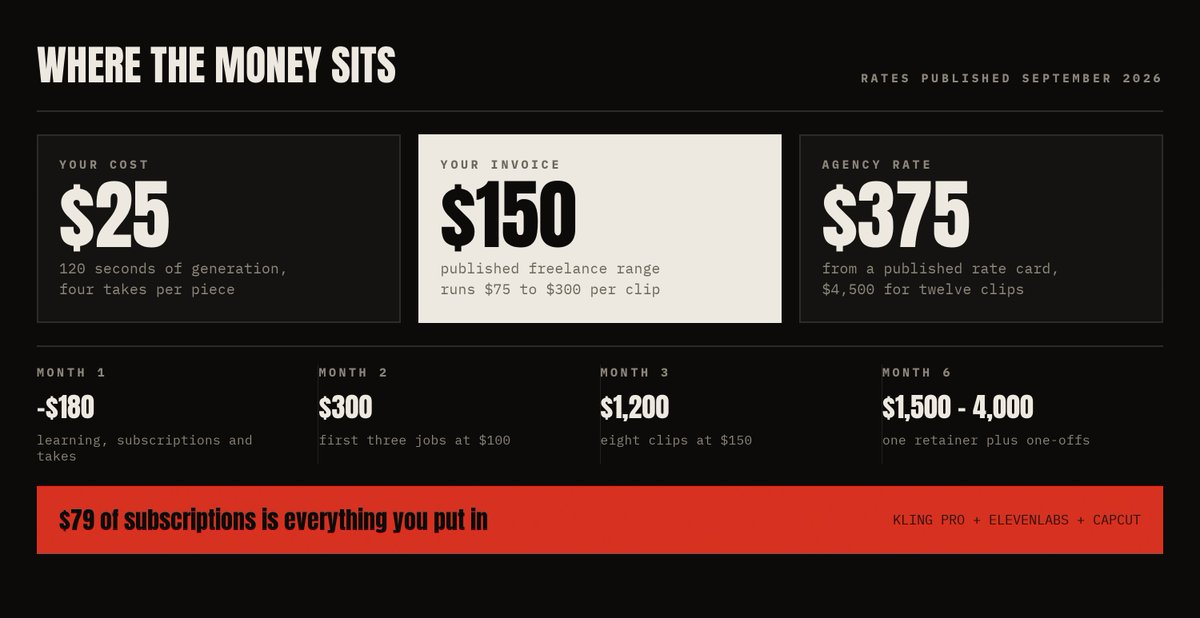
Your cost base: $20 to $28 of generation and one evening per finished clip. Five ways, fastest to slowest.
Clips on commission. Upwork's own published range for a 15 to 60 second AI UGC clip: $75 to $300. A pack of 3 to 5 hooks for one product: $300 to $800. A campaign of ten or more clips: $900 to $3,000. Enter at the bottom, $75 to $100 a clip, and raise the rate after your first five reviews. Fiverr has live gigs at $25 a clip. Do not go there: that is a price fight, not a quality one.
Retainers. Upwork's published monthly range for AI UGC work: $1,000 to $4,000. Same product, predictable income. One retainer client is worth ten one-off jobs, because you stop spending your time selling and start spending it shooting.
Product ads for sellers. The "person holds the product and talks about it" format is now generated end to end and everyone selling physical goods wants it. Same rates, easier entry: the seller already has product shots, and those become your references. Phone-camera honesty from Term 4 matters double here, a polished frame reads as an ad and sells worse.
Your own faceless account. The long game, but it is an asset. Look at the numbers soberly. TikTok only pays through Creator Rewards, which requires 10,000 followers, 100,000 views in a month and clips longer than a minute. No platform publishes a payout table. Creator reports land around $0.40 to $1.20 per thousand qualified views, $0.50 to $1.50 in the US, and roughly half of views qualify. So a million views is $200 to $500, not thousands. YouTube Shorts pays less than that per thousand, and from 1 February 2027 the bar rises: earning on Shorts will require 10 million counted views in 90 days.
Selling the channel. Real, but not the way blogs describe it. A channel is priced off profit, not followers. A verified Flippa sale: 373,000 subscribers, $271,000 of revenue over twelve months, sold for $300,000, roughly 1.2x annual profit. Marketplaces advertise multiples about twice as high as the deals actually closing on their own site.
8 Clips + 1 Retainer = $1,200-4,000 a Month
This is not an income promise, it is arithmetic from the rates above, at the bottom of Upwork's range and one clip per evening.
Month 1   learning, minus $80 of subscriptions and about $100 of takes
Month 2   first 3 jobs at $100        $300
Month 3   8 clips at $150           $1,200
Month 6   one retainer plus one-offs  $1,500-4,000
Unit economics at a mid rate: $150 in, $25 out to generation, $15 to platform fees. About $110 left for one evening of work.
The point of that table is not the totals. It is that your cost base barely moves. Your tenth job costs the same as your first, while your speed doubles, because by then you have character sheets, a style paragraph and prompts that already worked.
$79 of Subscriptions + One Evening = Everything You Put In
Kling Pro, 3,000 credits    about $37/month
ElevenLabs Creator          $22/month
CapCut Pro                  about $20/month
Subscriptions               about $79/month
Generation                  $20-28 per finished clip
The first weeks run at a loss. That is tuition, not damage. After that each clip pays for itself roughly five times over.
The Cheat Sheet: the Whole Equation on One Screen
The Right Side Is the Same for Everyone
Most people make the clip first and then look for someone who needs it.
Run it the other way. Find the person who needs a clip right now, then shoot the whole thing in one evening.
A crew costs your client a month of ad budget. You cost twenty-five dollars and one evening.
Seedance 2.5 + Kling 3.0 + an editor = a $25 clip
a $25 clip + someone who needs it = $150 an evening
The right side of the equation is the same for everyone. The only difference is what you put on the left.